Skip to product information
1 of 4

Vintage and Antique Gifts

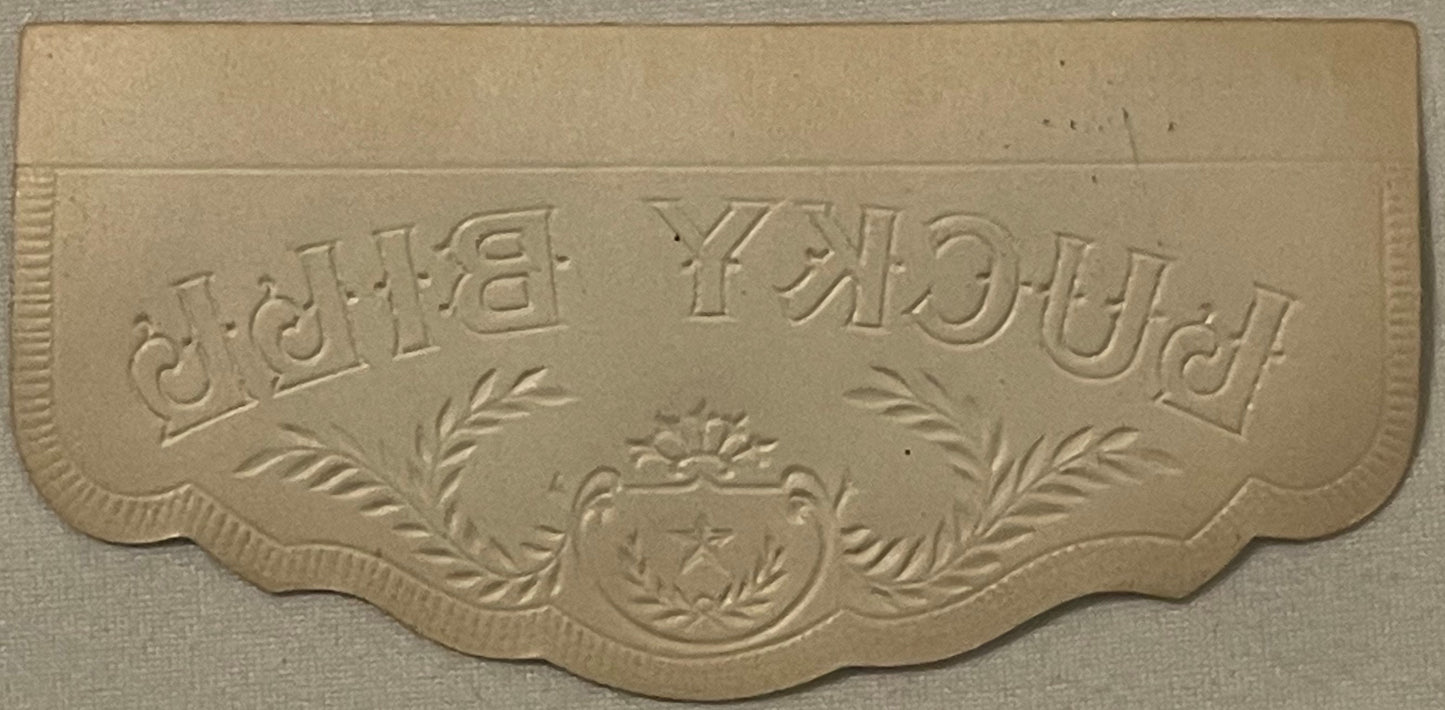
Antique Lucky Bill 🍀 Gold Embossed Cigar Box Back Flap Label NOS 1900s Green Red Victorian

Antique Lucky Bill 🍀 Gold Embossed Cigar Box Back Flap Label NOS 1900s Green Red Victorian

Regular price 6.00 USD
Regular price Sale price 6.00 USD
Sale Sold out
Shipping calculated at checkout.
Quantity

# What Does a One-Hundred-Year-Old Piece of American Commercial Art Look Like When It's Never Been Used? 🍀

There is a particular kind of quiet that settles over you when you hold something that was made with enormous skill, put away before anyone could use it, and then simply *waited* — patient as a stone, untouched through two world wars, the rise of television, the fall of the corner tobacconist, the entire churning twentieth century — and arrived here, in your hands, exactly as it left the press. No wear. No softness at the corners. No trace of glue or box or smoke. Just the object itself, at full strength, a century later. The Lucky Bill back flap label is that object. It came off a lithographic press sometime around 1908 or 1912, destined for the back flap of a cigar box that would slide across a mahogany tobacconist's counter toward a customer who thought nothing of it beyond the brand name and the price point. The label had a job to do, and it did that job — or rather, it *would have* done that job, had it ever been placed. Instead, it went into old printer stock, stayed there, and survived as New Old Stock (NOS): never mounted, never glued, never handled into softness. At over a hundred years old, that is not a small thing. That is a remarkable thing. ---

## 🍀 The Lucky Bill Label — What You Are Actually Looking At

Let's be precise about the object, because precision is what this label deserves. It measures four inches wide by two inches tall — the classic back flap proportion that printers and box manufacturers had standardized by the 1890s to fit the hinge panel of the standard five-cent and ten-cent cigar box. That dimension is not accidental; it is the result of decades of negotiation between tobacconists, box manufacturers, and the printing houses that supplied them, a whole ecosystem of commerce that produced, as its incidental byproduct, some of the finest small-format printing ever made on this continent.

The ground color is sage green, and not a flat sage green — a *chromolithographic* sage green with the characteristic gradient shift toward gold at its edges that only the best presswork of this era could coax out of the stone. Chromolithography, the dominant color printing technology of the Victorian and Edwardian periods, worked by printing each color from a separate limestone slab, one pass at a time, with each layer required to register with perfect precision against every layer that preceded it.

A label with this level of color complexity — green ground, gold embossed border, red serif lettering, red central shield, gold laurel branches, star detail — would have required a minimum of six to eight press passes, possibly more. Each pass was a point of failure. Each pass, done correctly, built the image one luminous layer deeper.

The embossed gold border runs along all four edges, rippling with the kind of dimensional texture that catches raking light and makes the label look, even now, like it was pressed yesterday. The lettering — LUCKY BILL, in bold Victorian serif capitals arching across the upper field — is red, outlined in gold, so that each letter lifts cleanly off the background rather than sitting flat against it.

At center, a red shield carries a single five-pointed star, ringed by smaller laurel branches rendered in gold that flank it like honor guards. This is New Old Stock. It left the press and went into storage and never came out until now. The condition reflects exactly that history. ---

## 🏭 The World That Made This Label — American Cigar Culture at Its Absolute Peak

To understand what the Lucky Bill label is, you need to understand the industry it served, because that industry was, at the turn of the twentieth century, one of the most economically significant and visually rich commercial ecosystems the country had ever produced. By 1905, the United States had somewhere in the neighborhood of fifteen thousand registered cigar brands. *Fifteen thousand.* Every one of them needed labels — inner labels, outer labels, back flap labels, tax stamps, band designs.

The printing houses that served this demand grew into major industrial operations, investing in the finest lithographic equipment available, employing staff artists who were genuinely accomplished, and competing ferociously for contracts on the basis of visual quality. The cigar label was, in a very real sense, the brand identity system of its era — the equivalent of what a modern company might spend on logo design, packaging, and marketing combined, compressed into a three-by-four-inch field of printed paper.

The back flap label in particular occupied an interesting position in this hierarchy. The inner label — the one visible when you opened the box — was the showpiece, the elaborate portrait or landscape or allegorical scene that made collectors of a later generation weak in the knees. The back flap was more workaday, more compact, but it still had to perform.

It still had to say *this brand, this quality, this character* in two inches of vertical space and four inches of horizontal. The best back flap labels accomplished this with a kind of compressed elegance — bold type, strong color, a central emblem that communicated authority and good fortune at a glance. Lucky Bill is a name that fits squarely into the vernacular tradition of American cigar branding: the lucky charm, the prosperous figure, the wink at fate that was baked into hundreds of brand names of this era — Lucky Strike, Lucky Deal, Gold Medal, Star Brand.

These names were not arbitrary. They were chosen to resonate with the aspirational mood of Gilded Age and Progressive Era America, with a working man's belief in fortune and quality and a good smoke at the end of a long day. The shield and star at the center of this label encode exactly that symbolism — the star as luck and excellence, the shield as American strength and protection, the laurel as the classical signal of achievement. ---

## 🖨️ The Printing Houses and the Craftsmen Behind the Stone

The chromolithographic printing houses that produced cigar labels at this level of quality were concentrated in a handful of American cities — Cincinnati, New York, Philadelphia, Baltimore, Chicago — though smaller regional operations served local manufacturers across the tobacco belt and beyond. These were not simple print shops.

They were, by the standards of the day, sophisticated manufacturing enterprises with significant capital investment in equipment, in stone inventory, and in skilled labor. The craftsmen who prepared the lithographic stones — the artists who drew the separation layers, the pressmen who managed the registration — were working at a level of technical skill that doesn't translate easily into modern terms.

There were no photographic separations, no digital guides, no automated registration systems. Each layer was drawn by hand onto limestone, etched, and printed in sequence, with the pressman using printed registration marks and his own trained eye to keep the layers aligned. A label like the Lucky Bill, with its embossed gold border and its multi-color central emblem, was a non-trivial production achievement.

The men who made it knew what they were doing. Lore passed down among cigar label collectors holds that the back flap labels were often the last sheets to be pulled from a press run — the printer completing the inner and outer labels first and finishing with the smaller format pieces — which is one reason why NOS back flap labels occasionally survived in old stock while the larger labels from the same brand had long since been used up.

Whether that accounts for the survival of this particular example is impossible to say with certainty, but the collector community has held that explanation for decades, and it has the ring of plausible production logic. Local legend among collectors in the tobacco-region auction circuit has it that entire printer's lots of back flap labels occasionally turned up in estate sales of retired print shop owners as late as the 1950s and 1960s — the original stone lithography houses had closed or converted to offset by then, and the old stock had simply sat in back rooms and flat files, forgotten, until someone's grandchildren cleared the place out.

A small number of those discoveries made it into collections rather than the trash, and that is the only reason pieces like this one exist in the condition they do today. ---

## 🌿 Why NOS Status Changes Everything for a Collector

The difference between a used cigar label and an NOS cigar label is not merely cosmetic. It is categorical. A used label has been glued. The act of removing it from the box, if anyone attempted that, adds further risk of tearing, creasing, and loss of embossed surface relief. Many of the cigar labels in general circulation are recovered labels — beautiful in their own right, valued by collectors, but carrying the physical record of their working life. An NOS label has none of that history. The paper is at its original tension. The embossed border retains its full dimensional relief because no adhesive has flattened it. The color has not been subjected to the particular darkening and shifting that glue and box wood chemistry introduce over a century. When a chromolithographic label is NOS, you are seeing the colors the printer intended, in the saturation the printer achieved, on paper that has done nothing but wait. That is a fundamentally different object, and experienced collectors treat it as such. This Lucky Bill label came out of old printer stock exactly as it left the press. Over a hundred years old. Never placed on a box. ---

## 🖼️ Display Ideas

- 🖼️ **Frame it alone with a deep mat** — a two-inch-by-four-inch label centered in a five-by-seven or four-by-six frame with a wide linen or cream mat gives the embossed gold border room to breathe and transforms it into genuine wall art for a study, library, or bar cart corner. - 🍀 **Group it in a Victorian vignette** — pair with other small-format gold and green ephemera of the era: a trade card, a stock certificate border fragment, a vintage playing card, all matted together in a shadow box for a rich, layered collector's display. - 🗃️ **Archival sleeve in a flat file or portfolio** — stored face-up in a Mylar sleeve in a flat ephemera drawer, this label is an anchor piece for a cigar label collection or a chromolithography study collection, accessible for handling without exposure. - 🍺 **Bar or smoking room accent** — mounted under glass on a serving tray, tucked into a vintage recipe card holder, or displayed beside antique tobacco tins and a carved humidor, this label adds an authentic period note to any curated spirits or tobacco-themed space. - 🎄 **Gift framing** — the green, red, and gold palette means this label is genuinely stunning framed as a gift for collectors, history enthusiasts, or anyone who appreciates the aesthetics of the Victorian commercial arts; it needs no explanation to read as beautiful. - 📚 **Reference collection anchor** — for serious students of American chromolithography or cigar label printing history, an NOS example in this condition serves as a benchmark piece — a standard against which recovered and used examples can be compared and understood. ---

## 🎁 Who Collects These

Cigar label collecting has one of the longest continuous histories of any American paper ephemera hobby. The first organized collector communities around cigar labels formed in the early twentieth century — which means people were already saving and trading these labels while the presses that made them were still running.

Today, the collector base is broad and enthusiastic, and the Lucky Bill label has something to offer several distinct collecting communities at once. **Chromolithography and printing history collectors** pursue labels like this as primary documents of American commercial printing technology. The technique is extinct as a production method, and NOS examples preserve the full range of what the process could achieve in a way that reproductions simply cannot replicate. **Cigar and tobacco ephemera collectors** build comprehensive archives of brand labels, band designs, tax stamps, and trade cards, and a strong NOS back flap label in this condition fills a meaningful gap in any serious collection. **Americana and Victoriana collectors** are drawn to the design vocabulary — the shield, the star, the laurel, the serif typography — as expressions of the visual culture of a specific American moment, the Gilded Age confidence in national identity and commercial achievement. **Vintage graphic design enthusiasts** — a growing community — collect chromolithographic labels as ancestors of the modern brand identity systems they study and practice, recognizing in pieces like this one the roots of color theory, typographic hierarchy, and visual communication that still inform contemporary design. **Framing and interior design collectors** — people who are not primarily paper collectors but who have an instinct for beautiful objects — find that a single well-chosen label, properly framed, does more for a room than a reproduction poster.

The scale is intimate. The color is genuine. The age is real. ---

## ❓ Frequently Asked Questions

### Is this label really unused — how can you tell after a hundred years? The NOS (New Old Stock) status of this label is evident from several physical characteristics that experienced collectors recognize immediately. The embossed gold border retains its full dimensional relief — if the label had been glued to a box and subsequently removed, that relief would show compression or flattening from the adhesive layer and the box surface pressing against it.

The paper retains its original tension and planar stability; used labels typically show some degree of warping or rippling from moisture in the glue. The color field shows none of the edge-darkening or tone shift that hide glue and wood chemistry introduce over decades of contact. This is printer's stock that was stored flat and dry from the day it came off the press, and the condition reflects exactly that storage history. ### What does "back flap label" mean — where did it go on the cigar box?

A cigar box has several labeled surfaces, each serving a distinct commercial and decorative function. The inner lid label — the large decorative label visible when you open the box — was the showpiece. The outer label wrapped around the box body. The back flap label was applied to the narrow panel at the back of the lid, the exterior surface of the hinge flap, which was visible when the box sat on a shelf or counter with its front face forward.

It was a secondary branding surface — compact, bold, immediately readable — and it had to communicate the brand clearly in a small format. The Lucky Bill label is exactly four inches wide by two inches tall, the standard back flap dimension that the industry had settled on by the 1890s. ### What printing process was used, and why does it matter to collectors?

This label was produced by chromolithography, the dominant color printing technology of the Victorian and Edwardian eras. Chromolithography printed each color from a separate hand-prepared limestone slab, requiring multiple press passes with precise registration between layers. A label of this complexity — with its gradient green ground, embossed gold border, red lettering, red shield, and gold laurel detail — required a minimum of six to eight separate impressions, each one adding depth and luminosity to the finished piece.

The process was labor-intensive, technically demanding, and capable of producing color saturation and surface richness that later photomechanical reproduction methods could not match. Chromolithography as a commercial printing process was largely replaced by offset lithography by the 1930s, which means every surviving example is a finite, non-reproducible artifact of a lost technology. ### How should I store or display this label to keep it in this condition?

For long-term storage, an archival-quality Mylar or polyester sleeve stored flat in a cool, dry environment away from direct light is the standard approach for paper ephemera of this age. Avoid PVC sleeves, which off-gas acids over time. For display, UV-filtering glazing — either museum glass or UV-filtering acrylic — will protect the color from fading if the label is displayed in a lit room.

The embossed gold border is three-dimensional and benefits from framing with a mat deep enough to prevent the glazing from pressing directly against the surface. Standard archival framing practices used for antique maps and prints apply directly here. ### Is the gold border actually embossed — will I be able to feel the texture?

Yes. The gold border is genuinely embossed — it has physical, three-dimensional relief that you can feel with a fingertip run along the edge. This was achieved through a combination of the chromolithographic printing process and a separate embossing die pass, a premium production step that distinguished higher-quality labels from plainer commercial work.

The embossed border catches raking light and creates the kind of dimensional shimmer that flat gold ink cannot reproduce, which is one of the reasons NOS examples of this label are visually striking even to people who are not collectors — the surface has a presence and a luminosity that a hundred years has not diminished. ### What is the approximate age, and how is that estimated?

The label dates to the 1900s and 1920s — most likely the period between approximately 1905 and 1915, based on a combination of factors that experienced ephemera collectors and printing historians use to date chromolithographic cigar labels: the typographic style of the serif lettering (consistent with late Victorian to Edwardian commercial typography), the specific color palette and embossing technique (characteristic of peak-era chromolithography before the industry's gradual transition to offset), and the back flap format and dimensions (standardized in the industry by the 1890s and in consistent use through the early 1920s). ### Can this be used as part of a collection gift or a framed art gift?

Absolutely — and it is, in fact, one of the most versatile gift formats in this collecting category. The green, red, and gold palette is genuinely beautiful and seasonally flexible. The subject matter — American commercial art, cigar culture, Victorian typography, lucky symbolism — resonates with a wide range of recipients: graphic designers, Americana collectors, cigar enthusiasts, antique dealers, anyone who appreciates objects made with serious craft.

Framed with a simple linen mat, it requires no explanation to read as a beautiful piece of decorative art. ---

*This label left a press over a hundred years ago. It waited. It survived. It is here now, exactly as it was made — every color at full strength, every embossed edge intact, the gold still catching the light like it was pressed yesterday. Some things are worth waiting for.* 🍀

Shipping

🚚 Shipping & Handling

  • Shipping costs and timing are calculated at checkout.
  • Items curated and shipped directly by me include U.S. shipping at no additional cost, professionally packed to ensure safe arrival of your artifact.

Items from Vetted Pro Collectors
Shipping for items offered by vetted Pro Collectors is determined at checkout. All Pro Collector listings are reviewed to ensure fair, reasonable shipping practices.

For full details, please refer to our Shipping Policy.

Returns & Exchange

Take your time — you've got a full six months. If a piece isn't right for you, send it back the way it reached you and we're good.

In the first 30 days your money goes straight back the way you paid. After that it's store credit, so you can put it toward something you'd rather have.

Return shipping we sort out between us, case by case. I don't make this difficult.

If something arrives damaged, or it isn't what I said it was, send me a photo within 48 hours and I'll make it right.

Email info@vintageantiquesgifts.com or call 802-356-9872 — that's me answering, not a call center.

The only things I can't take back are custom or special-order pieces and gift cards.

View full details
  • 5 stars: 2 (100%)
  • 4 stars: 0 (0%)
  • 3 stars: 0 (0%)
  • 2 stars: 0 (0%)
  • 1 star: 0 (0%)
w
w***w (338)

I received lucky bill label today and arrived safely and quickly! Thank you!!

G
Gene Ricard

Thanks for the great service with something extra. This is a great place to shop.

Thank you so much! Hope we see you again soon.