Skip to product information
1 of 1

Vintage and Antique Gifts

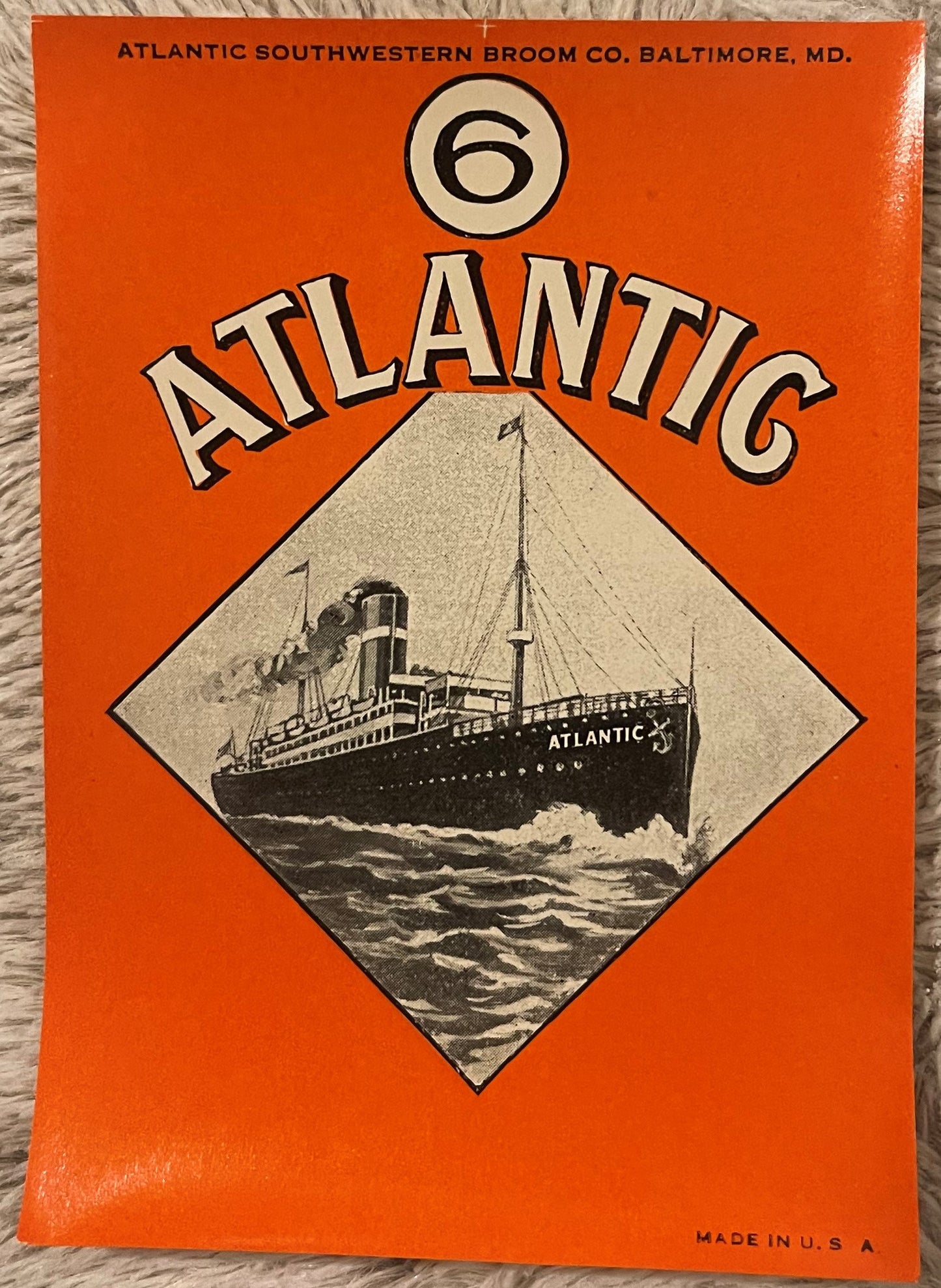
Antique Atlantic Broom Label 🚢 1900s–1940s Nautical Ship Lithograph Art Advertising Collectible American Made

Antique Atlantic Broom Label 🚢 1900s–1940s Nautical Ship Lithograph Art Advertising Collectible American Made

Regular price 4.50 USD
Regular price Sale price 4.50 USD
Sale Sold out
Shipping calculated at checkout.

Description

Could a Broom Label Really Be a Masterpiece? 🚢 When Everyday Advertising Became Timeless Art

There is a particular kind of magic that happens when you hold something small in your hands and feel the full weight of a century pressing back against your fingertips. That is exactly what this Antique Atlantic Broom Label delivers — a vivid, jewel-toned fragment of American commercial art history that somehow survived the paper drives, the attics, the damp basements, and the decades of casual disregard that claimed nearly everything else from its era. It did not survive by accident. It survived because it was made with a care and a craft that the people who commissioned it probably never fully appreciated, produced by artists who worked fast, worked hard, and went almost entirely uncelebrated. And yet here it is — colors still blazing, lines still crisp — asking to be seen again.

This is the kind of piece that stops visitors mid-sentence when it is on your wall. Not because they know immediately what it is, but because something in the composition, the saturation, the confident draftsmanship pulls the eye before the brain catches up. Then you tell them: that is a broom label. And the story begins.


🏷️ What Exactly Is This Piece?

This is an original Atlantic Broom Label — a lithographed paper label produced for commercial broom manufacturers and used to brand and market their product on retail floors, in hardware stores, and in general merchandise establishments across the country. The label measures approximately 5 inches by 3.5 inches, a compact format that belies the enormous visual ambition packed into every square inch of its design. The central imagery features a ship — a bold, romanticized nautical rendering that would have caught the eye of any shopper in a busy dry-goods store, reaching for something as utilitarian as a broom.

The Atlantic name carries a particular resonance, and we will get into that history below, because there is no small irony in the choice of that name for a household product. The label itself dates to the period between approximately 1910 and the 1930s, with production use documented across the broader window of 1900 to the 1940s — a span that covers some of the most dynamic decades in American commercial printing history. At the top of the label, a small white mark is present; this is a cross or other manufacturer's registration mark, a common feature of lithographic production from this era, used by printers to align color plates or identify their house. It is not a flaw — it is a fingerprint of the process itself.

The printing method is stone lithography, the labor-intensive, plate-by-plate color process that gave commercial labels of this era their unmatched depth, warmth, and dimensional quality. Each color was a separate pass through the press. Each pass required a skilled craftsman to align, ink, and pull. The result — that luminous, slightly three-dimensional quality you see in antique labels but almost never in anything printed after the mid-twentieth century — simply cannot be replicated with modern offset or digital printing. Museums know it. Art institutes know it. And once you have held an original lithograph from this period, you know it too. This piece is being offered in New Old Stock condition — unissued, unused, never applied to a product — which accounts for its remarkable preservation and the vibrancy of its color after more than eighty to one hundred years.


⚓ The Atlantic Name — History, Irony, and Maritime Legend

The word Atlantic carries freight far beyond geography. By the time this broom label was being designed and printed — somewhere in the window between 1910 and the early 1930s — the Atlantic Ocean had already become the backdrop for one of the most catastrophic maritime disasters in recorded memory. The name would have rung with association for anyone who followed the news in April of 1912, and it continued to echo through the subsequent decades as the story of the Titanic was told and retold in newspapers, books, theatrical performances, and early cinema. For a broom company to choose the word Atlantic as its brand banner was, at minimum, a bold piece of marketing — leaning into the grandeur and the power of ocean travel rather than shying away from its dangers.

Here is where the history becomes genuinely interesting: the ship depicted on this label looks nothing like the famous vessels of the White Star Line or Cunard fleet. Instead, the illustration presents an idealized, romanticized sailing or steamship — the kind of heroic nautical image that had been a staple of American advertising art since the mid-1800s, evoking power, commerce, and the promise of distant places. The choice was aspirational, not documentary. Broom companies wanted their product to feel substantial, trustworthy, industrious — and what better symbol of all three than a ship cutting boldly through the waves?

Lore passed down among collectors of American advertising ephemera holds that many broom manufacturers of the late nineteenth and early twentieth centuries chose nautical and transportation imagery specifically because hardware stores and dry-goods retailers would display competing broom brands side by side on the same floor rack, and the label had to do all the selling. A ship communicated strength. An anchor communicated reliability. The ocean communicated reach and ambition — all in a label the size of a playing card. Whether or not a given shopper in 1915 consciously processed all of that symbolism, the printers and the label designers understood it deeply, and they deployed it with remarkable sophistication.

Local legend among collectors of broom label ephemera holds that the most sought-after labels were those produced for regional broom companies in the Midwest corn-belt states — Illinois, Indiana, and Kansas — where broom corn (a specific variety of sorghum cultivated specifically for broom-making) was the dominant agricultural cash crop alongside grain. The Atlantic label, with its maritime identity, may well represent a coastal or mid-Atlantic regional company reaching westward, or alternatively a Midwestern manufacturer choosing the Atlantic name to conjure associations with the great shipping lanes that carried American goods to European markets. The paper trail on most broom labels is thin; the companies were small, the records were not kept, and when the businesses closed — as nearly all of them did after the war — very little documentation went with them. The label is often all that remains.


🖨️ The Lost Art of Lithography — Why These Labels Are Irreplaceable

It is worth dwelling on the printing process itself, because it is central to understanding why collectors, institutions, and serious decorators seek these labels out with such intensity. Stone lithography — and its later evolution into zinc-plate commercial lithography — was the dominant method of producing high-quality color imagery in America from roughly the 1840s through the 1930s. At its height, it employed thousands of skilled craftsmen: layout artists, color separators, stone grinders, press operators, and the anonymous commercial illustrators who produced the original artwork.

The process began with a drawing made directly onto a polished limestone slab (or later a metal plate) using a greasy medium. Water and ink were then applied in sequence — the greasy areas accepted ink, the wet stone repelled it — and the image was transferred to paper under pressure. Each color required its own stone, its own careful alignment, its own press run. A label with six colors required six separate passes, six separate stones, and six opportunities for something to go wrong. The color depth you see in original antique lithographs — that rich, almost painterly quality — is a direct product of this layering process, each color slightly translucent over the last, building warmth and dimension that flat modern printing simply approaches from a different direction.

By the late 1930s, offset lithography and photographic reproduction were rapidly replacing the old stone and zinc-plate methods in commercial printing. The knowledge base — the hand skills, the intuitive understanding of how colors would stack and blend, the ability to render a ship or a face or a piece of fruit with the kind of expressive economy that reads perfectly at three inches — began to disappear from active practice. Most of the artists who created these labels were journeymen commercial illustrators, paid by the job, often not credited anywhere on the finished piece. They were talented, prolific, and almost entirely forgotten. This label is, in the most literal sense, a surviving example of their work — and it deserves the same wall space as anything produced with a brush and canvas.

Museums and art institutes across the country have quietly recognized this for decades. Permanent collections at institutions dedicated to graphic arts, commercial history, and American material culture include broom labels, trade cards, and lithographed packaging specifically because the objects represent a convergence of fine art skill and industrial production that has no true modern equivalent. More and more private collectors are arriving at the same conclusion — and as the available supply of NOS (New Old Stock) labels thins out and moves into collections and galleries, the window to acquire examples in this kind of condition narrows considerably.


🌾 The Broom Industry — An American Story in Miniature

The American broom industry was, at its peak in the late nineteenth and early twentieth centuries, a genuinely significant sector of domestic manufacturing. Broom corn — the tall, fibrous sorghum variety whose brush-like seed heads are ideal for sweeping — was cultivated across a broad swath of the American heartland, and small-to-medium broom manufacturing operations were distributed across the country, each producing their own branded product for local and regional retail markets.

Competition among broom makers was fierce precisely because the product itself was nearly identical from one maker to the next. The broom was the broom. What differentiated brands was almost entirely the label — its design, its color, its visual impact on the retail floor. This is why broom label art became so sophisticated so quickly. Manufacturers invested real money in their labels because the label was doing the work of a salesperson. A great label meant a broom moved off the rack. A forgettable label meant it didn't.

The industry remained robust through the 1930s, sustained by the reality that the vacuum cleaner — while available — remained a luxury purchase well beyond the budget of most working-class and middle-class households. It was only after World War II, when manufacturing capacity shifted back to consumer goods, materials costs fell, and household incomes rose, that the electric vacuum cleaner became genuinely affordable to the middle class at scale. Within a single decade — roughly 1945 to 1955 — the economics of the broom industry were fundamentally altered. Dozens of small manufacturers closed. The market consolidated. And the extraordinary investment in label design that had characterized the industry for fifty years simply stopped. The artists moved on. The lithographers shifted to other work. The labels that had already been printed went into storage, into warehouses, into old stock rooms — and stayed there, waiting for the people who would eventually understand what they were.


🖼️ Display Ideas

  • 🗺️ Nautical gallery wall anchor piece — Frame it with vintage maritime maps, compass roses, and ship photography for a cohesive seafaring theme in a study, library, or hallway.
  • 🍳 Kitchen or farmhouse display — Antique advertising ephemera has a long tradition in American kitchen decor; this label's warm colors and bold graphic read beautifully against shiplap, brick, or painted tongue-and-groove paneling.
  • 🏠 Collector's shadow box — Pair it with other broom labels, trade cards, or small advertising ephemera in a deep-frame shadow box with archival matting for a curated collection display.
  • 🎨 Commercial art and lithography study — Mount it alongside examples of other stone lithograph labels or prints to illustrate the range and sophistication of the form; an educational display as at home in an office as in a gallery.
  • Coastal or lakehouse accent — The ship motif makes this a natural fit for a seasonal home, a boat house, or any space with a water-adjacent aesthetic where authentic vintage graphics carry more weight than reproduction art.
  • 🪟 Archival float frame — Display it in a float frame with UV-protective glazing to let the edges and the character of the original paper remain fully visible while protecting the piece for the next generation of collectors.

🎁 Who Collects These — and Why They Hunt Hard for Them

The collector universe for antique broom labels is broader and more diverse than you might expect for such a specific category of ephemera. At the dedicated end of the spectrum are advertising and ephemera specialists — collectors who have spent years building focused collections of American commercial lithography and understand precisely what they are acquiring when they find a NOS label in this condition. For these collectors, the Atlantic label represents a specific intersection of maritime imagery, pre-war American commercial art, and lithographic technique that fits neatly into a serious collection.

A second major collector group is nautical and maritime memorabilia enthusiasts — people who collect ship models, navigation instruments, port photographs, maritime maps, and anything else connected to seafaring culture. The ship lithograph on this label makes it a natural crossover piece for this community, and many maritime collectors actively seek advertising ephemera precisely because it shows how the ocean and its imagery permeated everyday American commercial life in the early twentieth century.

Then there are the interior design and home decor collectors — a fast-growing audience of homeowners, designers, and decorators who have discovered that original antique advertising art delivers something no reproduction can: the knowledge that it is genuinely old, genuinely rare, and genuinely made by hand with a craft that has no living equivalent. For this group, framed antique labels serve as conversation pieces, focal points, and authentic expressions of historical taste in a way that mass-produced vintage-style decor simply cannot match.

Finally, and perhaps most meaningfully, there are the art historians and graphic design enthusiasts who have come to recognize commercial lithography as one of the great unsung American art forms — a tradition of applied visual craft that deserves the same serious attention as fine art printmaking. For these collectors, each label rescued from obscurity and preserved in a frame is an act of recovery for artists whose names we will likely never know but whose work we can still see, still admire, and still pass on.


❓ Frequently Asked Questions

Is this an original antique label or a reproduction print?

This is a 100% original antique label — not a reproduction, not a reprint, not a modern facsimile. It was produced using the stone or zinc-plate commercial lithography process that was standard in American printing from the late 1800s through the 1930s, and its age, paper stock, printing characteristics, and condition are all consistent with that production window. The vibrancy of the colors reflects the fact that this is New Old Stock — it was never applied to a product and was stored rather than used, which is the primary reason it has survived in this condition. Reproduction labels exist in the market and are identifiable by their paper stock, printing dot patterns, and color quality; an original from this era has a warmth and depth that is immediately distinguishable to anyone who has handled both.

What does "New Old Stock" mean for a paper label like this?

New Old Stock (NOS) refers to items that were manufactured and stored but never actually used or sold in their intended commercial application. For a broom label, NOS means this label was printed, held in inventory, and never applied to a broom handle or retail product. This is significant for condition because labels that were actually used were glued to broom handles, exposed to handling, moisture, and general wear, and rarely survive intact. NOS labels like this one were kept in flat storage — often in printer's drawers, warehouse stock rooms, or old commercial storerooms — where they could remain relatively protected from the factors that destroy paper over time. The result is a label whose colors, edges, and surface detail are preserved far beyond what you would expect for an object of this age.

Why does the ship on the label look nothing like a real Atlantic ocean liner?

This is one of the most charming aspects of commercial label art from this era, and the seller notes it directly. The ship depicted is not a documentary rendering of any specific vessel — it is a romanticized, idealized nautical illustration drawn from the conventions of American commercial art in the late nineteenth and early twentieth centuries. Label artists were not maritime illustrators; they were commercial craftsmen working quickly to create a compelling visual that communicated a brand identity. A bold, heroic ship — sails full or smoke stacks proud — communicated strength, reliability, and ambition regardless of whether it matched any real vessel. The Atlantic name was chosen for what it evoked, not as a documentary reference, and the ship was designed to match that emotional register. This interpretive freedom is part of what makes these labels artistically interesting — they are aspirational images, not technical drawings.

What is the small white mark at the top of the label?

The white mark visible at the top of this label is a manufacturer's registration mark — most likely a cross or similar alignment symbol used by the printing house to register (align) the multiple color plates during the lithographic printing process. In multi-color lithography, each color pass had to be precisely positioned relative to the others, and registration marks outside the main image area allowed press operators to verify alignment before committing a full run of paper. These marks were typically trimmed away on finished labels intended for retail use, but on NOS stock that was stored before final trimming or application, they sometimes remain visible. Far from being a defect, this mark is a direct fingerprint of the printing process — physical evidence of the craftsmanship involved in producing the label.

How should I frame or store this label to preserve it?

For long-term preservation, the goal is to protect the paper from light, humidity fluctuation, and acidic contact. If displaying, a frame with UV-protective glazing (museum glass or UV-filtering acrylic) will dramatically slow any fading from ambient light — this is particularly important for the vibrant lithographic inks, which are stable but not impervious to prolonged light exposure. Mount with archival (acid-free) matting and backing board — regular cardboard and standard mat board are acidic and will yellow and damage paper over time. If storing rather than displaying, keep the label flat in an archival sleeve or folder, away from temperature extremes and humidity. Many collectors use standard archival polyester sleeves (the kind used for documents and philatelic material) as a simple, effective storage solution. A framed and properly mounted version of this label will remain in excellent condition for generations.

Is this label a good investment as well as a display piece?

The market for antique American advertising lithography has been on a consistent upward trajectory for decades, and broom labels specifically have benefited from growing institutional recognition — museum collections and art institute galleries have actively acquired them, which establishes a credentialed market value separate from the collector-to-collector trade. The core supply dynamic is simple and irreversible: the number of surviving NOS labels in fine condition is fixed and declining. As examples move into permanent collections, gallery displays, and framed installations in private homes, the pool of available material shrinks. Labels that are properly preserved and displayed today will be the pieces that serious collectors and institutions seek out in the decades ahead. Beyond pure investment calculation, this is also simply a beautiful object with a genuine story — and those tend to hold their value in ways that purely utilitarian antiques do not.

What period of American history does this label represent, and why does that matter?

This label represents the golden age of American commercial lithography — roughly 1880 through the mid-1930s — a period when the combination of rapidly expanding retail markets, fierce brand competition, and the maturation of the lithographic printing trade produced an extraordinary flowering of commercial visual art. It was an era before radio advertising dominated, before television existed, and before the photograph had fully displaced illustration in commercial contexts. The label, the trade card, the tin sign, and the poster were the primary visual media through which brands communicated with consumers. The artists who created them were skilled, prolific, underpaid, and almost entirely anonymous. This label is a survivor from that world — evidence of a visual culture that was vibrant, competitive, and artistically ambitious in ways that the word "broom label" does not begin to suggest. Collecting these pieces is, in the most genuine sense, an act of preservation for a chapter of American art history that did not leave behind much else.

Shipping

🚚 Shipping & Handling

  • Shipping costs and timing are calculated at checkout.
  • Items curated and shipped directly by me include U.S. shipping at no additional cost, professionally packed to ensure safe arrival of your artifact.

Items from Vetted Pro Collectors
Shipping for items offered by vetted Pro Collectors is determined at checkout. All Pro Collector listings are reviewed to ensure fair, reasonable shipping practices.

For full details, please refer to our Shipping Policy.

Returns & Exchange

Product Page Return Policy

  • 60-Day Returns – Items must be in original condition.
  • Refunds – Issued after inspection (excluding shipping costs).
  • Return Shipping – Customer is responsible unless item is damaged or incorrect.
  • Damaged/Incorrect Items – Contact us within 48 hours for a replacement or refund.
  • Easy Returns – Email info@vintageantiquesgifts.com or call 802-356-9872 to initiate a return.

For full details, visit our Refund Policy.

View full details