Skip to product information
1 of 3

Vintage and Antique Gifts

Antique Little Playfair Cigar Band 1910s 🥃 Gold Foil Embossed Tobacco Ephemera Collectible 🎖️

Antique Little Playfair Cigar Band 1910s 🥃 Gold Foil Embossed Tobacco Ephemera Collectible 🎖️

Regular price 5.50 USD
Regular price Sale price 5.50 USD
Sale Sold out
Shipping calculated at checkout.
Quantity

Size: 2.75 x 0.75 inches

🎩 What Happens to the Art Nobody Was Supposed to Keep?

A cigar band was never built to last. Its entire working life ran the length of a walk from the tobacconist's counter to the moment a smoker's thumbnail slipped under the edge and peeled it free before the match was struck. The lithography houses that produced these little bands by the millions weren't thinking about anyone keeping them — they were thinking about the next order, the next brand name, the next box going out the door. Nobody archived them on purpose. And yet here one sits: the gold foil still catching light exactly the way it was engineered to, the embossed lettering still standing proud in raised relief, the small ornamental arrows still crisp at either end of the brand name. This one never got the chance to do its job — which is precisely why it's still here to tell its story.

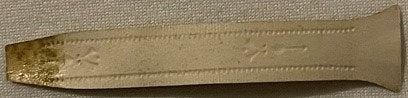
This is a vintage Little Playfair cigar band — a small, tapered strip of gold foil paper, embossed with dark printed lettering and flanked by ornamental arrow-and-dart devices, cut into the classic forked, notched profile at one end and flaring into a wider central panel where the brand name sits. A fine embossed dotted border trims the edge, a small but telling touch of period printer's craft. Flip it over and the reverse shows plain cream paper with that same design pushed through from behind — proof this was struck with a die under real pressure, not merely inked flat. No manufacture mark survives legibly on the piece, so I won't pin it to a single year. What the foil-and-emboss technique, the lettering style, and the brand's documented presence in serious antique cigar label archives DO tell us is that this belongs comfortably to the era running from the turn of the century through the 1930s — the decades when the American cigar trade turned brand identity into a competitive art form. This example is New Old Stock: printed and set aside, never wrapped around a cigar, never carried out a shop door in anyone's pocket.


🚬 The Golden Age of the American Cigar Band

To understand why so much craft went into a scrap of paper barely an inch wide, picture the cigar counter of the era this band belongs to. Cigars weren't a niche indulgence in early twentieth-century America — they were the everyday habit of millions of men, and the shops that sold them stocked dozens, sometimes hundreds, of competing brands sitting side by side in open boxes. There was no sealed cellophane wrapper to hide behind, no barcode, no shelf tag doing the selling for you. The band itself — its color, its gilt shine, its lettering — WAS the advertisement, and it had only a couple of seconds to catch a buyer's eye before he moved down the counter to the next box.

That pressure produced staggering numbers. Historians of the tobacco trade estimate that more than 1.5 million distinct cigar brand names came and went in the United States between 1870 and 1920 alone, churned out by something like 150,000 factories nationwide, together turning out well over 250 billion cigars. Every one of those brands needed a name, a look, and a band to set it apart from its neighbor in the box next door. It was, in its way, one of the largest and most disposable graphic-design industries America has ever produced — and almost none of it was meant to survive past the striking of a match.


🖨️ Gold Foil, Dies, and the Printer's Trade

The gold-foil embossing on a band like this one is itself a small history lesson. Embossed gilding of this style became fashionable in American label and advertising printing starting in the 1890s, used both for lettering and for decorative touches — coin-like medallions, ribboned borders, ornamental flourishes — anything that would catch counter light and signal quality before a single word was read. Producing it wasn't simple ink-on-paper work: it required a metal die, real pressure, and gold leaf or foil bonded under that pressure, which is exactly why the reverse of this band still shows the design pushed through in the cream paper beneath — a fingerprint of the process itself, left behind a century's worth of handling later.

The specialty houses capable of this kind of work clustered heavily on New York's Lower East Side in this period, many of them founded and run by German immigrant lithographers who had brought old-world engraving skill into the booming new American tobacco trade. It was intricate, competitive work — printers vying against one another to out-dazzle rival shops with ever more elaborate foil, embossing, and ornament, all lavished on a strip of paper meant to be discarded within minutes. Which shop actually cut the dies for Little Playfair, no legible mark on this particular piece can tell us — but the technique places it squarely in that same tradition of counter-top showmanship.


🏷️ A Name Among Thousands

"Little Playfair" is a documented brand name, catalogued among original antique cigar label reference material alongside a whole family of similarly named siblings — LITTLE POET, LITTLE POTENTATE, LITTLE QUAKER, LITTLE QUEEN, LITTLE ROSE, LITTLE SAN JUAN, LITTLE TOM, LITTLE TYCOON, LITTLE WONDER. That "Little ___" naming convention wasn't a coincidence — it was standard trade shorthand of the era for small-format cigars, the slim cheroots and short smokes pitched at a quicker, more affordable puff than a full corona. A tobacconist's shelf might have carried a dozen "Little" brands at once, each one banking on a name just distinctive enough, and packaging just eye-catching enough, to win a customer's hand over its neighbor.

No maker, factory town, or parent company is documented for Little Playfair in any source I've been able to verify, and I won't invent one. It's entirely possible this was what the trade called a stock brand — a design any wholesaler or jobber could order in bulk and slap onto cigars from any number of factories, or a private label that a saloon, drugstore, or cigar stand bought under its own name with no lasting factory tie at all. Federal tax law of the day required manufacturers to stamp the factory number and district onto the BOX — that was the only information a buyer could really trust — but a loose band like this one carried no such mark, which is exactly why so many "Little ___" brands drift through history as names without a company behind them.


🧤 Lore of the Band: White Gloves and a Canoe

Cigar bands carry more folklore per square inch than almost any other piece of tobacco ephemera, and it's worth passing along, plainly labeled as legend rather than fact. Old-timers in the tobacco trade have long repeated the story that the paper band itself was born as a practical courtesy — invented so that a gentleman smoking in polished society wouldn't stain his white gloves with tobacco leaf as he held the cigar. Some versions of the tale even tie the custom to European royalty demanding a cleaner smoke. Whether that origin story is literally true or itself a piece of trade mythology repeated so often it hardened into "fact," it's been told and retold by tobacconists and collectors for generations, and it's part of why the band came to be seen as something worth dressing up with gold foil and fine ornament in the first place — a small badge of refinement wrapped around an everyday habit.

The other legend every longtime band collector has heard — usually from an uncle, a grandfather, or "a guy at the shop" — is the rumor that saving enough cigar bands could be redeemed for a prize, canoes and rowboats being the most commonly cited jackpot. It's a rumor that refuses to die in tobacciana circles, repeated across generations of collectors even though no documented redemption program has ever been traced. Collectors say it anyway, half in earnest, half in on the joke, because it captures something true about the era: these little scraps of gold and color meant enough to people that saving them by the hundreds felt like it OUGHT to be worth something.


📉 Why the Bands Went Quiet

The golden age this band belongs to didn't last. By the mid-1930s the American cigar industry that had supported all those competing "Little" brands was contracting hard — machine rolling was replacing hand labor across the trade, the Great Depression tightened every household's tobacco budget, and cigarettes were rapidly overtaking cigars as the everyday American smoke. The lithography houses that had once battled each other with ever more elaborate foil and embossing had far fewer orders to compete for, and countless small brands like Little Playfair simply stopped being reordered, their bands never restocked, their names quietly retired.


✨ Why It Still Matters Today

What's left behind is a tiny, self-contained piece of American commercial art from a period when advertising still had to work through craftsmanship rather than technology — no photography, no color printing shortcuts, just a skilled engraver's die, real gold foil, and a printer's eye for what would catch a buyer's attention across a crowded counter. Collectors and design historians alike prize surviving examples of this "Little" brand family precisely because so few records of the individual companies survive; the band itself often IS the history, the only artifact left of a name that once meant something to somebody, somewhere, for however brief a run. Held up to the light, it's a genuine, hands-on piece of the golden age of American tobacco advertising — small enough to forget, and exactly durable enough, by pure accident, to remember.


🖼️ Display Ideas

  • 🖼️ Framed under glass alongside its "Little" family siblings for a mini gallery of turn-of-the-century cigar branding
  • 📚 Tucked into a scrapbook or ephemera album the way collectors historically preserved cigar bands by the hundreds
  • 💍 Set in a small shadow box to show off both the gold-foil face and the die-struck reverse together
  • 🪞 Propped on a bar cart or smoking-room shelf as a conversation-starting piece of Americana
  • 🕯️ Displayed near vintage cigar boxes, matchbooks, or tobacconist tins for a themed tobacciana vignette
  • 🎨 Studied loose as a graphic-design specimen — a hands-on example of embossed gold-foil lithography

🎁 Who Collects These

Tobacciana collectors chasing complete runs of "Little ___" brand names, Americana and advertising-ephemera collectors drawn to early lithography and embossing technique, scrapbook and paper-arts enthusiasts who appreciate the physical craft of a die-struck design, and anyone drawn to the small, disposable objects that quietly outlasted the industries that made them all find something to love here. It's an easy, affordable entry point into early American commercial art for a new collector, and a welcome addition to an established cigar-label or tobacco-ephemera archive.


❓ FAQ

Is this a genuine antique cigar band, or a reproduction?

It's a genuine period piece — real embossed gold foil over paper, die-struck so the design shows in reverse on the back, consistent with authentic early American cigar label printing.

How old is it, exactly?

No manufacture mark survives legibly on the piece, so an exact year can't be confirmed. Based on the embossed gold-foil technique and lettering style, it dates comfortably to the turn of the century through the 1930s, the height of American cigar-brand competition.

What does "New Old Stock" mean here?

It means this band was printed and never used — never wrapped around a cigar or carried out of a shop. It represents unused period inventory rather than a band peeled from an actual smoked cigar.

Who made Little Playfair cigars?

No manufacturer, factory, or town is documented for this brand in surviving reference sources. It's consistent with the many stock and private-label cigar brands of the era that left no lasting corporate record behind — the band itself is the primary surviving evidence of the brand's existence.

What's a "Little" cigar brand?

"Little ___" was standard trade naming for small-format cigars — slim cheroots or short smokes — and dozens of similarly named brands (Little Poet, Little Quaker, Little Wonder, and others) were sold alongside one another during this period.

How was the gold foil applied?

Through embossed die-stamping — a metal die pressed the design and lettering into the paper under real pressure while gold foil was bonded to the raised surface, which is why the impression shows through clearly on the plain paper reverse.

Are cigar bands like this considered valuable collectibles?

They're a well-established category within tobacciana and paper-Americana collecting, valued for their craftsmanship, their brand-history interest, and their surprising rarity given that they were designed to be thrown away within minutes of purchase.

Shipping

🚚 Shipping & Handling

  • Shipping costs and timing are calculated at checkout.
  • Items curated and shipped directly by me include U.S. shipping at no additional cost, professionally packed to ensure safe arrival of your artifact.

Items from Vetted Pro Collectors
Shipping for items offered by vetted Pro Collectors is determined at checkout. All Pro Collector listings are reviewed to ensure fair, reasonable shipping practices.

For full details, please refer to our Shipping Policy.

Returns & Exchange

Take your time — you've got a full six months. If a piece isn't right for you, send it back the way it reached you and we're good.

In the first 30 days your money goes straight back the way you paid. After that it's store credit, so you can put it toward something you'd rather have.

Return shipping we sort out between us, case by case. I don't make this difficult.

If something arrives damaged, or it isn't what I said it was, send me a photo within 48 hours and I'll make it right.

Email info@vintageantiquesgifts.com or call 802-356-9872 — that's me answering, not a call center.

The only things I can't take back are custom or special-order pieces and gift cards.

View full details