Skip to product information
1 of 4

Vintage and Antique Gifts

Antique Mayflower Broom Label 🧹 NOS 1920s A.F. Weymer Co. Syracuse NY Nautical Sailing Ship

Antique Mayflower Broom Label 🧹 NOS 1920s A.F. Weymer Co. Syracuse NY Nautical Sailing Ship

Regular price 5.50 USD
Regular price Sale price 5.50 USD
Sale Sold out
Shipping calculated at checkout.
Quantity

What If the Brooms Never Came — and the Label Outlived Them All? 🧹

There is a particular kind of survivor that antique collectors learn to recognize over time. It is not the piece that was treasured and preserved, framed and handed down with ceremony. It is the piece that simply waited — packed into a cardboard box, stacked on a shelf in a back room or a warehouse corner, forgotten by the very business that made it, untouched by the decades that dismantled everything around it. This Mayflower Brand broom label is exactly that kind of survivor. It did not endure because anyone thought it important. It endured because no one got around to using it. And a hundred years later, here it is — as clean, as vivid, as entirely intact as the day it came off the press. That is the quiet miracle of New Old Stock, and it is one of the great pleasures of this trade.

Nostalgia is an imprecise word. What collectors actually feel when they hold a piece like this is something more specific — a sudden, vertiginous sense that time has folded, that the gap between 1920s Syracuse and your own kitchen table has collapsed into nothing. The ink is still rich. The yellow border still catches the light. The tall-masted Mayflower still drives through dark water under a wide sky. Whoever drew her — and someone drew her carefully, with evident knowledge of rigging and sail — has been gone for most of a century. But the image they made is right here, undimmed, holding its ground. That is what paper ephemera does when it is treated right. And this piece was treated right simply by being forgotten in time.


⚓ What This Label Is — Brand, Maker, Town, Era, and Condition

This is an original, unused New Old Stock (NOS) broom label produced for the Mayflower Brand by A.F. Weymer Co. Inc. of Syracuse, New York, dating to the 1920s. "New Old Stock" in the ephemera and label trade means exactly what it sounds like: stock that was manufactured and packaged for commercial use, never actually applied to a product, and never circulated into retail. These labels were printed, stacked, and boxed at the plant. The brooms they were intended to dress — for whatever reason, a canceled order, a change in supplier, a business decision lost to history — never arrived. The box sat. The decades passed. And this label survived them in the condition it left the print shop: clean, flat, vivid, and entirely intact.

The physical label measures 4 inches by 3 inches and is cut in an elongated octagon — a clipped-corner diamond form rather than the plain rectangle that most broom labels of the era used. That shape was a deliberate commercial choice. On a hardware store pegboard in 1925, surrounded by standard rectangular packaging, an octagonal label with a warm yellow border and a tall ship at full sail would stop a customer's eye in a way that a plain card simply could not.

The central image depicts a tall-masted sailing vessel — her sails full and billowing in cream and warm ochre, rigging rendered with the kind of precision that suggests the illustrator had studied real ships — driving through a blue-grey sea beneath a low-hanging yellow orb, sun or moon left intentionally ambiguous. At the very top of the mainmast, a small flag bearing a red cross flies in the rigging: the English ensign, the flag carried by the original Mayflower when she departed Plymouth, England, in September of 1620.

Below the ship, set against deep navy, the brand name MAYFLOWER appears in bold period lettering. The printing process — likely lithography, the dominant commercial printing method for labels and packaging through the early twentieth century — has held its color with remarkable fidelity across a full century.


🏭 A.F. Weymer Co. Inc. — The Company, the Industry, and a Town That Made Things

Syracuse, New York in the 1920s was a manufacturing city in every real sense of the word. Salt had made it prosperous in the nineteenth century — the Onondaga Lake basin produced enough salt to supply the entire young nation, earning the city its early nickname, the Salt City — and that industrial foundation had diversified steadily into chemicals, steel, ceramics, and a broad universe of consumer goods manufacturing by the time A.F. Weymer Co. Inc. was operating. Central New York in this era was thick with the kind of mid-scale commercial enterprises that existed to supply other businesses: printing houses, label makers, packaging firms, specialty manufacturers who filled every link in the supply chain between raw material and finished retail product. A.F. Weymer Co. Inc. was part of that ecosystem — a supplier to the broom and brush trade, producing the branded labels and packaging that gave commercial brooms their retail identity in hardware stores, general merchandise shops, and dry goods establishments across the region and beyond.

The broom manufacturing industry in early twentieth-century America was far larger and more organized than its domestic familiarity might suggest. Broomcorn — a variety of sorghum grown extensively in Illinois, Oklahoma, and the Great Plains states — was harvested, graded, baled, and shipped by rail to manufacturing centers throughout the Northeast and Midwest, where it was sorted, tied, stitched, and fitted to handles by skilled workers in substantial factory operations. Brand identity mattered in this market. A hardware store might carry three or four different broom brands on a given day, and the label was the primary visual differentiator at the point of sale. Choosing a name like Mayflower for a broom brand was a considered marketing decision — it invoked the founding narrative of the country, suggested durability and trustworthiness, and attached a humble household tool to the most famous sea voyage in American popular memory. The sailing ship illustration reinforced all of that in a single glance.

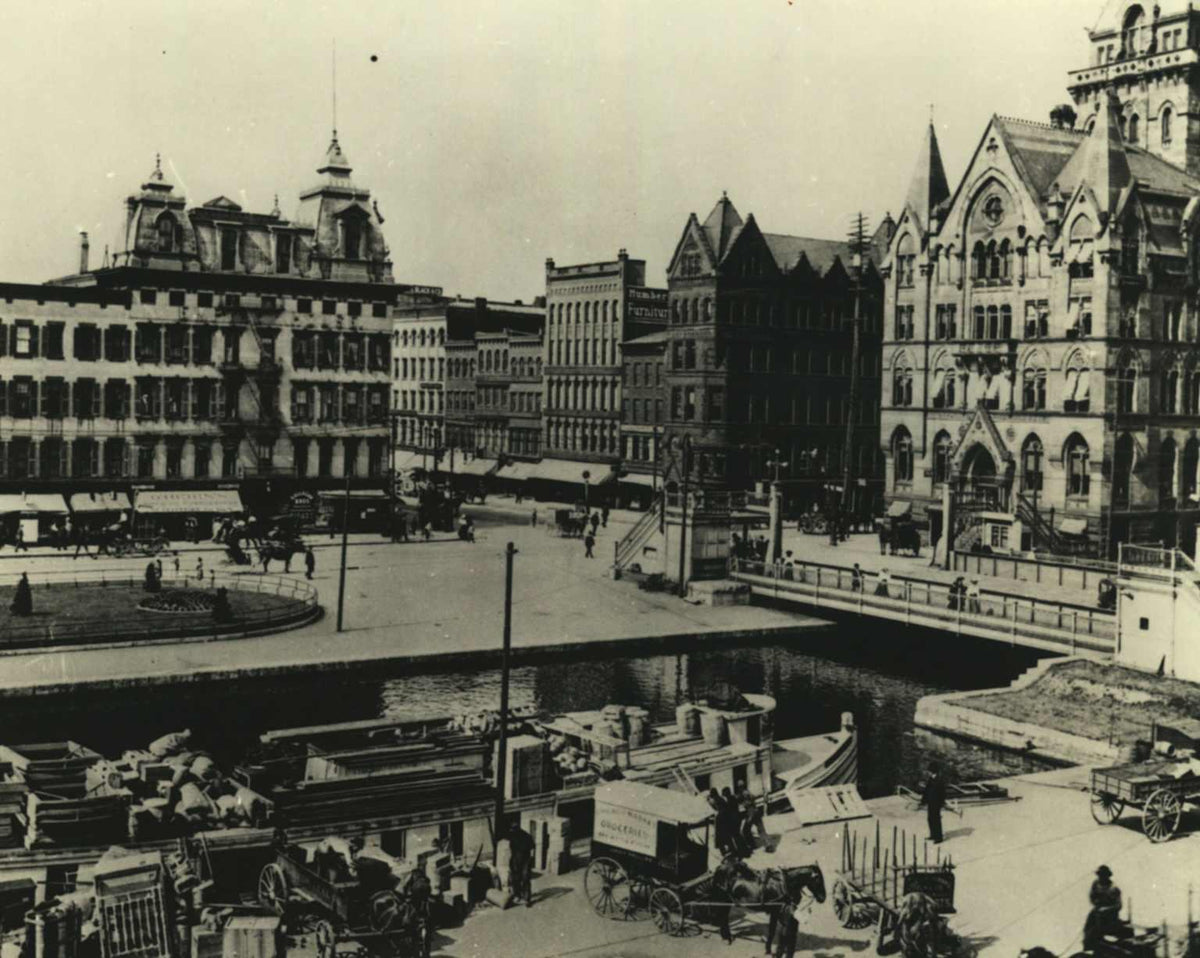
Local legend has it that A.F. Weymer operated out of warehouse and production space near the Erie Canal corridor that ran through the heart of Syracuse — the old commercial artery that had first made the city a distribution hub in the early 1800s. Whether the Mayflower label was destined for a regional broom maker or a larger national distributor is a detail that the surviving records have not yet yielded. What the label itself suggests is a client with enough commercial ambition to commission a genuinely handsome piece of printed design — not a quick, generic job, but something with a real illustrative image, a distinctive shape, and color printing that would have cost more than the plain-text alternatives available at the time.


⛵ The Mayflower — Why That Ship, and Why It Still Resonates

The original Mayflower was a merchant vessel — a workaday cargo ship of roughly 180 tons, built for commerce and pressed into history. She crossed the Atlantic in 1620 carrying 102 passengers and a crew of approximately 30, made landfall near present-day Provincetown on Cape Cod in November of that year, and anchored in Plymouth Harbor in December. The ship herself returned to England in the spring of 1621 and spent her remaining years in ordinary trade. But her name became something else entirely: a symbol of departure, of founding, of the particular blend of hardship and determination that American civic mythology returned to again and again throughout the nineteenth and early twentieth centuries.

By the 1920s, when this label was designed, the Mayflower was everywhere in American commercial iconography — on moving companies, on flour brands, on hotels, on insurance firms, on anything that wanted to suggest permanence, reliability, and deep roots. A broom brand using the Mayflower image was drawing on a century of that accumulated cultural weight. The red-cross flag at the top of the mainmast — the English ensign of the period — is a small detail that reveals the illustrator's care. Most commercial illustrators of the era working on a quick job would have drawn a generic pennant or no flag at all. The specific choice of the English ensign places this image in genuine historical context. Whoever made this drawing knew their subject.

That attentiveness to detail is part of what makes this label interesting as an artifact beyond its commercial function. It is a piece of graphic design made by someone who cared — about the accuracy of the rigging, about the drama of the composition, about the particular quality of light that comes off dark water under a heavy sky. Commercial printing of the 1920s produced a great deal of competent, uninspired work. It also produced pieces like this one, where the anonymous craftsperson behind the image was clearly engaged with what they were making. The label has survived in part because of that quality. Objects made with care tend to be worth keeping.


📜 Paper Ephemera, NOS Labels, and Why Condition Is Everything

In the world of antique paper ephemera — trade cards, labels, broadsides, advertising pieces, packaging — condition is the variable that separates a collectible piece from a transcendent one. The ordinary life of a commercial label involved being stuck to a product, handled by customers, and eventually discarded. Survival in good condition was the exception, not the rule.

New Old Stock changes that calculus entirely. Because these labels were never applied — never touched by glue, never handled in retail, never exposed to the conditions that degrade paper over decades of use — they arrive in a state of preservation that used labels almost never achieve. The colors are true. The paper is stable. The printing is crisp at the edges. For a collector, this represents something genuinely rare: the object as it was intended to be seen, in the condition its maker would have recognized. A century of forgetting, in this case, was exactly the right preservation strategy.


🖼️ Display Ideas

  • 🪟 Frame it under glass — a simple black or gilt frame, mat in navy or deep cream, lets the yellow border and ship illustration do their full work as wall art in a study, library, or nautical-themed room.
  • 🗂️ Incorporate it into a vintage ephemera collection display — grouped with other 1920s commercial labels, trade cards, or broom-and-brush industry advertising in a shadow box or archival sleeve display.
  • Anchor a nautical or maritime vignette — paired with antique navigation tools, old charts, or vintage ship models on a shelf or mantle, the Mayflower label reads as a genuine period piece rather than reproduction decor.
  • 🏠 Feature it in a Colonial or Early American themed interior — the Pilgrim iconography and period typography make it a natural companion to folk art, stoneware, and early Americana decorative pieces.
  • 📚 Archive it properly in an ephemera collection — sleeved in archival mylar with acid-free backing, catalogued by maker and date, it belongs in any serious collection of Central New York commercial printing or American broom-trade graphics.
  • 🎁 Present it as a gift piece — framed and accompanied by a brief note on the history of A.F. Weymer and the Mayflower brand, it becomes a genuinely meaningful gift for a history enthusiast, a genealogist with Central New York roots, or a collector of Americana.

🎁 Who Collects These

Antique broom labels and household-trade ephemera occupy a specific and enthusiastic corner of the broader Americana collecting world. The people drawn to pieces like this Mayflower label tend to arrive from several different directions, and the overlap between those communities is what gives this category its sustained market depth.

Nautical and maritime collectors are often the first to recognize the label's appeal — the tall-masted ship illustration, the historically accurate flag detail, and the Mayflower name place this squarely in the iconographic tradition of American maritime imagery that serious collectors pursue across categories. Americana and folk art collectors respond to the period typography, the warm color palette, and the brand's explicit invocation of the founding narrative. Paper ephemera specialists — those who focus specifically on trade labels, advertising cards, and commercial printing of the early twentieth century — value the NOS condition above almost everything else; finding a label in this state of preservation is genuinely uncommon, and experienced collectors know it immediately. Central New York regional historians and collectors have a specific interest in documented artifacts of the Syracuse manufacturing economy, a world that has largely disappeared and left relatively little physical evidence behind.

And graphic design and printing history enthusiasts — a growing collecting community — are drawn to the quality of the lithographic work, the design choices behind the octagonal format, and the evidence of a skilled illustrator working within the constraints of commercial production a century ago.

Beyond dedicated collectors, this label has genuine appeal for the decorator and the gift-giver — anyone furnishing a space with authentic period pieces rather than reproductions, or looking for a gift that carries real historical weight without requiring a significant collection budget.


❓ Frequently Asked Questions

Is this label actually from the 1920s–1930s, or is that an approximation?

The 1920s dating reflects the convergence of several verifiable indicators. The printing style, typography, and color palette are consistent with commercial lithographic label production of the early-to-mid 1920s. The business name — A.F. Weymer Co. Inc. — and the Syracuse, NY address are period-consistent with the Central New York commercial printing and packaging industry of that era. NOS status, confirmed by the label's unapplied condition and the narrative of an unconsumed press run, is consistent with a production run that was printed, boxed, and then superseded by changing business circumstances before the brooms could be manufactured or the labels distributed. Ephemera scholars and experienced collectors date commercial labels of this type using exactly these markers — printing method, typography conventions, paper stock characteristics, and provenance context — and the 1920s attribution here is sound.

What exactly does "NOS" mean, and how can you tell this label was never used?

NOS stands for New Old Stock — a term used across antique and vintage collecting to describe items that were manufactured for commercial use, never sold or applied to their intended product, and survived in original, unused condition. The label also comes from what is clearly a surviving press run — a stack of identical labels rather than a single surviving example — which is the classic signature of a NOS find. Someone packed these off the press and the box was simply never opened for its intended purpose.

What was A.F. Weymer Co. Inc., and is there more documentation on the company?

A.F. Weymer Co. Inc. was a Syracuse, New York commercial firm operating in the label and packaging supply trade for the broom and brush manufacturing industry, active in the 1920s. Detailed corporate records for mid-scale commercial suppliers of this era are often sparse — many of these firms operated for decades without leaving substantial archival traces beyond their own printed materials, city directory listings, and trade publication mentions. The label itself is, in many cases, the most vivid surviving document of the firm's work. For researchers and collectors interested in the history of the Central New York commercial printing and packaging industry, NOS label finds like this one are primary source material: they document design conventions, brand strategies, client relationships, and printing capabilities in a way that written records alone cannot. If you have Central New York regional history connections or access to the Onondaga County archives, city directories from the 1920s and early 1930s are the most reliable starting point for additional documentation on the firm.

The flag on the mainmast — what is it, and why does it matter?

The small flag flying at the top of the Mayflower's mainmast bears a red cross on a white field — the St. George's Cross, which formed the central element of the English ensign flown by English merchant and naval vessels in the early seventeenth century. This is the historically accurate flag for the original Mayflower on her 1620 voyage, which departed from Plymouth, England, under English registry. Most commercial illustrators working on a quick label job would have drawn a generic pennant, an indistinct banner, or no flag at all. The fact that this illustrator drew the correct historical flag — a detail most buyers of brooms in 1925 would never have consciously noticed — is strong evidence of genuine research and care in the image's production. For collectors interested in nautical iconography and maritime history, it is the kind of detail that elevates a piece of commercial art into something more considered.

How should I store or display this label to preserve it long-term?

For archival storage, the standard best practice for paper ephemera of this age is housing in acid-free archival sleeves or envelopes, stored flat, away from light and humidity fluctuations. Mylar (polyester) sleeves sized for trading cards or small ephemera work well for a 4x3 inch label. Avoid PVC sleeves, which off-gas over time and can damage paper. For display, UV-filtering glass in a frame will protect the colors from light degradation over years of wall display. If you are incorporating it into a shadow box display with other objects, ensure that any adhesives or backing materials used are also acid-free.

Is this label rare, or did many of these survive?

NOS commercial broom labels from the 1920s in this condition are genuinely uncommon in the market. Broom labels as a category survive in reasonable numbers because some were always saved by collectors, dealers, and label enthusiasts — but the vast majority of surviving examples show significant condition issues from having been applied to products, stored loosely, or handled repeatedly over decades. The Mayflower brand specifically, with its strong nautical illustration and the additional interest of the A.F. Weymer / Syracuse provenance, occupies a crossroads of several active collecting categories, which gives it appeal beyond the specialized broom-label collector. Pieces at that intersection, in this condition, do not turn up frequently.

Is the octagonal shape a common format for broom labels of this era?

It is not. The dominant format for commercial broom labels in the early twentieth century was the simple rectangle — practical to print, easy to apply, and inexpensive in die-cutting. The elongated octagon used for this Mayflower label — a clipped-corner diamond form with a warm yellow border — was a deliberate departure from that standard, requiring additional die-cutting expense and representing a choice by either A.F. Weymer or their client to invest in a more visually distinctive product. On a hardware store peg or display in 1925, surrounded by rectangular labels, this shape would have stood out immediately. That kind of considered visual differentiation at the point of sale reflects a level of marketing sophistication that was not universal in the broom trade of the period. For collectors of commercial printing and packaging design history, the format choice is itself an interesting data point about how the Mayflower brand was positioned in its market.

Shipping

🚚 Shipping & Handling

  • Shipping costs and timing are calculated at checkout.
  • Items curated and shipped directly by me include U.S. shipping at no additional cost, professionally packed to ensure safe arrival of your artifact.

Items from Vetted Pro Collectors
Shipping for items offered by vetted Pro Collectors is determined at checkout. All Pro Collector listings are reviewed to ensure fair, reasonable shipping practices.

For full details, please refer to our Shipping Policy.

Returns & Exchange

Take your time — you've got a full six months. If a piece isn't right for you, send it back the way it reached you and we're good.

In the first 30 days your money goes straight back the way you paid. After that it's store credit, so you can put it toward something you'd rather have.

Return shipping we sort out between us, case by case. I don't make this difficult.

If something arrives damaged, or it isn't what I said it was, send me a photo within 48 hours and I'll make it right.

Email info@vintageantiquesgifts.com or call 802-356-9872 — that's me answering, not a call center.

The only things I can't take back are custom or special-order pieces and gift cards.

View full details