Skip to product information
1 of 6

Vintage and Antique Gifts

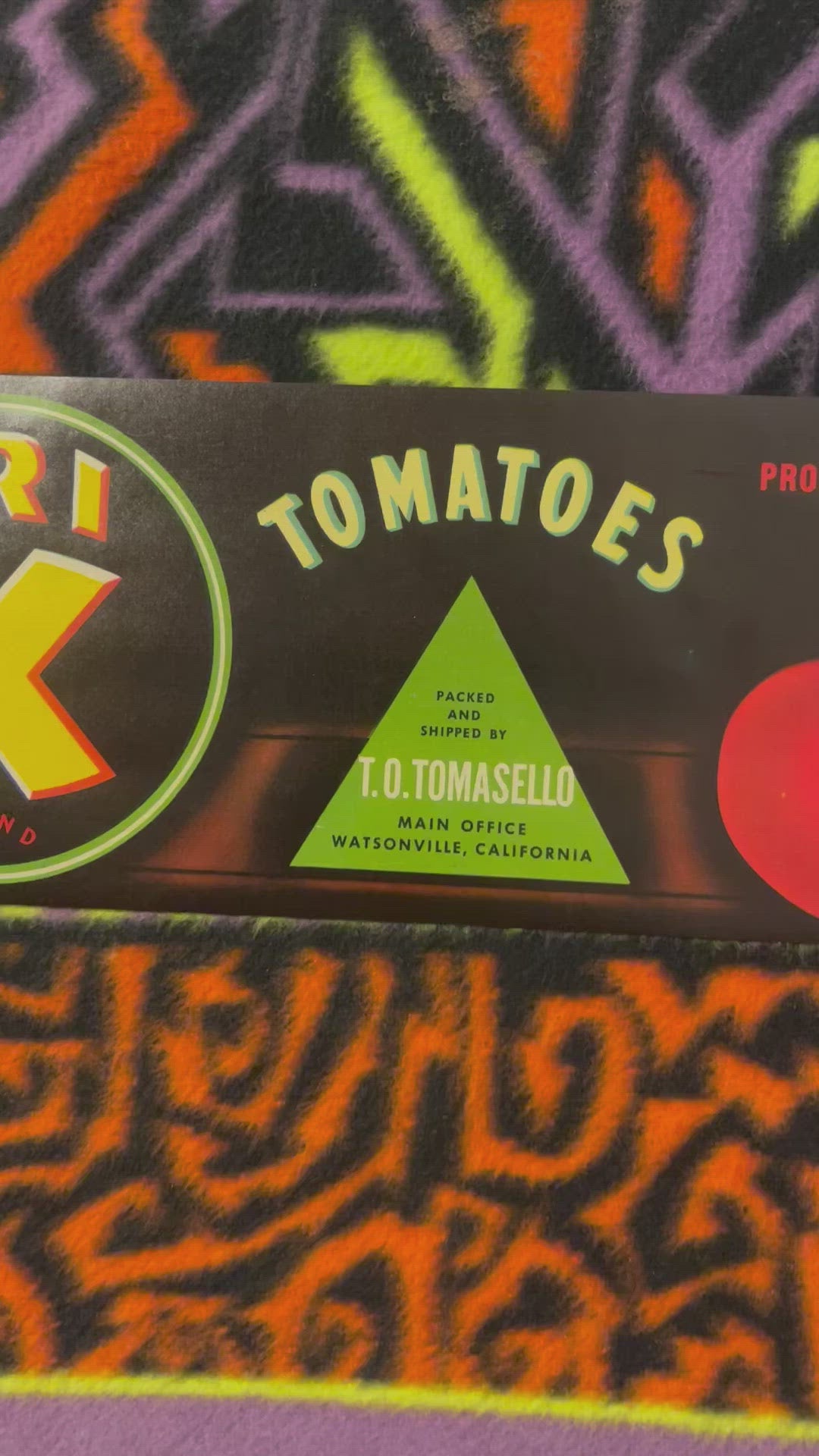
Antique Tri X Brand Tomatoes Crate Label 🍅 — 1920s-40s Watsonville California, Ripe Tomato Graphic

Antique Tri X Brand Tomatoes Crate Label 🍅 — 1920s-40s Watsonville California, Ripe Tomato Graphic

Regular price 13.00 USD
Regular price Sale price 13.00 USD
Sale Sold out
Shipping calculated at checkout.
Quantity

Size: 13" x 5 1/4" ~ Never pasted on a box, little to no wear. They vary a little one to the next.

One enormous yellow X, one ripe red tomato, and the name of a Watsonville farm family, from the valley that once called itself Apple City.

This is the Tri X Brand tomatoes label of the T.O. Tomasello Co. of Watsonville, California, made to be pasted on the end of a wooden produce box. It was never pasted on anything, and the look of it is what gets me every time: offset color, an airbrushed ground and big block lettering, the kind of bold, modern-looking mark that still stops people on a wall.

🍅 The Label

On the left, a green double ring encloses the brand: TRI in yellow block letters with red and white shading, stacked over a giant yellow X edged in red, and BRAND in small red capitals beneath. TOMATOES arches across the middle in yellow with a green shadow. Under it, a green triangle carries the shipper's credit: "Packed and Shipped by T.O. Tomasello, Main Office, Watsonville, California." At the right, under a red PRODUCE OF U.S.A., a single ripe tomato with a green calyx glows against a deep brown-black ground shaded with rust.

The back is blank, with the front showing through the paper in mirror image: TOMATOES, T.O. TOMASELLO and the big X all read backwards in the sheet.

🍅 The Tomasello Family Business

"Packed and shipped by" is the mark of a grower-shipper, a firm that grew, packed and sent produce to market under its own brands. The Tomasellos ran several of them. Alongside Tri X, the name turns up on Dominator, with its fighter plane, on Jerry, with a boy and his dog, on TOT, and on Hi-Toney plums. The T.O. Tomasello Co. is still listed at 275 West Beach Street in Watsonville.

The exact same brand art — the same ring, the same X, the same green triangle — also turns up printed for a different shipper: "Packed and Shipped by Tri-County Vegetable Exchange, Main Office, Watsonville, California." So at some point the Tri X design was shared or passed between the two Watsonville firms.

The Tomasellos were a Watsonville farm family of Italian heritage. Joseph J. Tomasello ran the T.O. Tomasello Co. for forty years, sat on the board of the Western Growers Association, and served as president of the Salinas Valley Grower-Shipper Association in 1972 and 1973.

🍎 Apple City: How the Pajaro Valley Became Farm Country

Watsonville was laid out in 1852 by John H. Watson and D. S. Gregory, in the Pajaro Valley just inland from Monterey Bay. Strawberries were first grown here in 1865, and the first commercial shipment left town in 1880. The railroad came through in 1871, and the valley built forty packing houses to move its fruit out through Moss Landing and Pajaro.

Apples made the valley famous, and Croatian immigrants made the apple trade. Most came from the Dalmatian coast, from the old Dubrovnik Republic, and families named Scurich, Marinovich, Franich, Gizdich and Miljanich built the business. Their innovation was buying a grower's crop "in blossom," months before harvest, which protected the grower from the autumn slump in prices. From that they moved into contracting and then into owning the orchards themselves, and the system they built became a model for shipping fresh produce across California. By 1908 Watsonville was known as Apple City, with a million trees bearing on 14,000 acres, and its Apple Annual, billed as "The Apple Show Where Apples Grow," drew crowds in the tens of thousands. The juice of the valley's Newtown Pippins has been the base of Martinelli's cider since the 1880s.

Refrigerated rail cars transformed the rest of the valley between 1910 and 1920, when lettuce, a notoriously hard crop to ship, could suddenly reach distant markets. As orchards in the Pacific Northwest undercut Watsonville's apples, growers turned to row crops, tomatoes and, above all, berries. Today the valley's economy still turns on strawberries, lettuce and raspberries, and Driscoll's and Martinelli's are among its biggest employers.

🌾 The People Who Brought In the Harvest

The valley's crops were planted and picked by wave after wave of newcomers. Chinese crews came for the fields in 1866 and were the main farm workers until the 1890s, when exclusion laws cut them off. Japanese laborers followed, and some became farmers, until the Japanese families of the Pajaro Valley were sent to internment camps in 1942. Mexican families began arriving in 1910, fleeing their revolution, and from 1942 to 1964 the Bracero Program brought Mexican farm workers north by contract. Dust Bowl families, many from Arkansas, settled Corralitos, Aromas, Pajaro and south Watsonville in the 1930s and early 1940s.

Filipino workers paid the heaviest price. In January 1930 a white mob spent five nights attacking Filipino farm workers in and around Watsonville, and on January 23 a 22-year-old named Fermin Tobera was shot while hiding in a bunkhouse closet. His body was sent home to the Philippines, where he is remembered as a symbol of the fight for independence and equality. California apologized in 2011. And in 1985 Watsonville's cannery workers, led mostly by Latina women, walked out for eighteen months and won a new contract, a strike still counted as a turning point for farm-town labor.

🍅 Tomatoes: a Legend and a Supreme Court Case

The best-loved tomato story in America is a legend. It says that in 1820 Colonel Robert Gibbon Johnson stood on the steps of the Salem County courthouse in New Jersey and ate a basket of tomatoes, then called love apples or wolf peaches, in front of a crowd that expected him to drop dead. Historians trace the tale no further back than the twentieth century: Salem's postmaster Joseph Sickler told it to Harry Emerson Wildes, who printed it in 1940, Stewart Holbrook dressed it up with dialogue in 1946, and CBS radio's "You Are There" acted it out in 1949.

The law had already settled the tomato's other argument. Under the Tariff Act of 1883, imported vegetables were taxed and fruit was not, so the Nix family, New York produce importers, sued the collector of the Port of New York, Edward L. Hedden, arguing that a tomato is botanically a fruit. On May 10, 1893, in Nix v. Hedden, a unanimous Supreme Court, in an opinion by Justice Horace Gray, ruled that the tomato is a vegetable, because that is how people use it and talk about it. The case set a lasting rule that the law reads words the way ordinary people use them, and New Jersey cited it in 2005 when it made the tomato its state vegetable.

📜 The Rise and End of the Paper Crate Label

Paper labels on produce boxes began on the West Coast in the 1880s, when California and Washington growers started shipping east on the new transcontinental railroads and needed their brand to stand out in distant markets. Printers worked in stone lithography before 1920 and offset afterward. World War II squeezed both the crate-makers' workforce and the printers' supply, and cheap cardboard cartons with the brand printed straight on the box took over. By the 1950s the paper crate label was finished, and the ones that survive are the leftovers that never got used.

Shipping

🚚 Shipping & Handling

  • Shipping costs and timing are calculated at checkout.
  • Items curated and shipped directly by me include U.S. shipping at no additional cost, professionally packed to ensure safe arrival of your artifact.

Items from Vetted Pro Collectors
Shipping for items offered by vetted Pro Collectors is determined at checkout. All Pro Collector listings are reviewed to ensure fair, reasonable shipping practices.

For full details, please refer to our Shipping Policy.

Returns & Exchange

Take your time — you've got a full six months. If a piece isn't right for you, send it back the way it reached you and we're good.

In the first 30 days your money goes straight back the way you paid. After that it's store credit, so you can put it toward something you'd rather have.

Return shipping we sort out between us, case by case. I don't make this difficult.

If something arrives damaged, or it isn't what I said it was, send me a photo within 48 hours and I'll make it right.

Email info@vintageantiquesgifts.com or call 802-356-9872 — that's me answering, not a call center.

The only things I can't take back are custom or special-order pieces and gift cards.

View full details