Skip to product information
1 of 2

Vintage and Antique Gifts

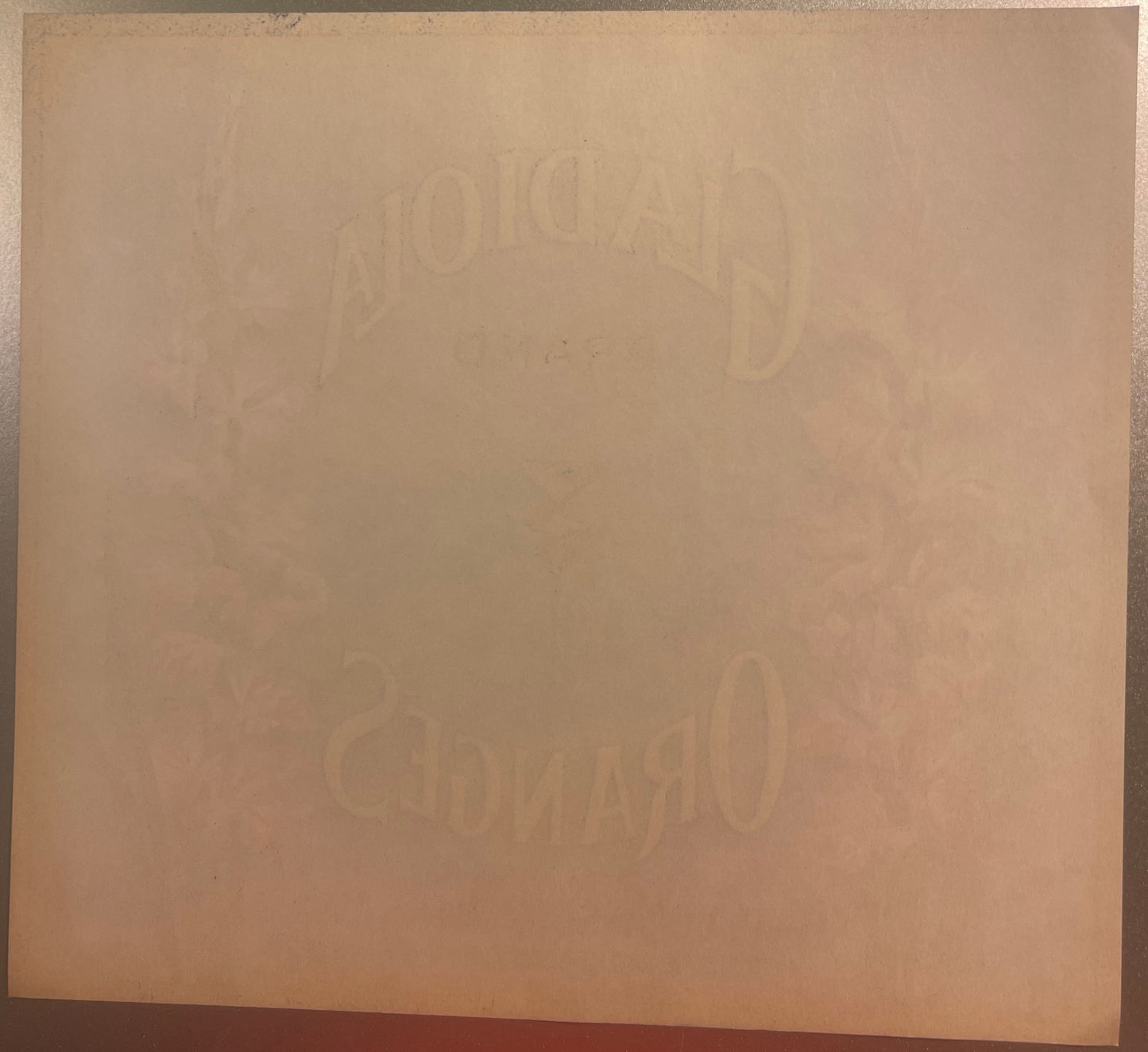
Antique Gladiola Brand Oranges 🌸 Crate Label — Covina Orange Growers Ass'n, Los Angeles Co., California — Schmidt Litho

Antique Gladiola Brand Oranges 🌸 Crate Label — Covina Orange Growers Ass'n, Los Angeles Co., California — Schmidt Litho

Regular price 5.50 USD
Regular price Sale price 5.50 USD
Sale Sold out
Shipping calculated at checkout.
Quantity

🌸 When Did a Simple Shipping Label Become a Work of Art Worth Preserving Forever?

There is a moment every serious collector knows — the first time you hold one of these old citrus crate labels in your hands and realize you are not holding packaging. You are holding a tiny museum print, a hand-separated, stone-pressed chromolithograph that was designed by a professional artist, run through a press a dozen or more times in perfect register, and glued to a pine crate destined for a rail car headed somewhere cold and far away, where a grocer would nail it to a wall just to brighten the place up. That is exactly what this Gladiola Brand Oranges label is — and it has been waiting, flat and unused, for you to find it.

I have handled a great many of these over the years, and I will tell you honestly: the lithography on a label like this stops me every time. Museums have entire gallery wings devoted to this art form. Serious collectors are racing to acquire the best surviving examples before they disappear into private hands permanently. Once the original new old stock is gone, it is simply gone. You will not find this printed again. What you see here is the real thing — original, American-made, from one of the great citrus counties of the early twentieth century, printed by one of the most storied lithographic houses the West Coast ever produced.


🍊 What This Piece Is — Exactly

This is an original, new old stock (NOS) lithographed citrus crate label for "Gladiola Brand" oranges, grown and packed by the Covina Orange Growers Association of Covina, Los Angeles County, California. It measures approximately 10 x 11 inches — the standard end-panel size used on wooden orange shipping crates throughout the California citrus era. The piece carries the printer's imprint Schmidt Litho Co., L.A. on its face, one of the most respected names in American commercial lithography.

The design is a masterwork of the commercial printer's craft. Two towering spikes of gladiolus blossoms — rendered in deep coral, vivid pink, orange-red, and soft white — rise on either side of the composition like living columns, their dark green sword-shaped leaves anchoring the base. Between them, arching in bold yellow lettering outlined in black, the word GLADIOLA crowns the piece.

Below it, in a smaller letterspaced dark brown sans face, sits the word BRAND. At the center sits a small, purely decorative Art Nouveau ornament — a stylised inverted-torch fleuron outlined in dark brown and filled with navy, coral-red and olive-yellow, tapering to a long thin stem with a single round dot beneath it.

It carries no lettering, no anchor, no fruit and no trademark of any kind. There is no Sunkist mark and no growers' Exchange device anywhere on this sheet — both lower corners and both upper corners were examined at magnification for a tissue-wrapped Sunkist orange, and there is none. Below that, in the same sweeping yellow, the word ORANGES anchors the lower half of the arch.

The whole composition rests on a warm golden-tan background that makes every color pop as if lit from behind. At the base, in neat dark lettering: GROWN & PACKED BY COVINA ORANGE GROWERS ASS'N., COVINA, LOS ANGELES CO., CALIFORNIA.

Dealer and institutional records consistently place surviving Gladiola Brand labels in a range spanning the 1920s through the 1940s — the full, golden, final run of Covina's citrus era before postwar disease and suburbanization ended it. That is the honest, defensible range for this piece. No single confirmed printing date appears on this label, and I will not invent one; what matters is that this label comes from the heart of California's citrus golden age, produced at the peak of the commercial lithographer's art.


🖨️ Schmidt Litho Co. — The West's Greatest Label Printer

The imprint Schmidt Litho Co., L.A. on the lower margin is not a footnote — it is a provenance marker that serious collectors and institutions pay attention to. This refers to the Los Angeles office of the Schmidt Lithograph Company, a firm with one of the most remarkable histories in American printing.

The company traces its origins to Max Schmidt, a German immigrant who founded his first printing business in 1873 — making Schmidt one of the oldest continuously operating lithographic firms in the United States at its peak. Schmidt was among the earliest printers to master chromolithography on the West Coast, and he refined the process into something approaching fine art. His main plant was in San Francisco, with branch operations extending to Portland, Seattle, and Los Angeles.

The firm's story has the kind of drama that belongs in a novel. The San Francisco plant burned twice — in 1884 and again in 1886 — and Schmidt rebuilt both times. Then came the 1906 earthquake and fire, which destroyed the plant a third time. By the accounts that have come down to us, Schmidt's response was almost legendary in the industry: he immediately acquired a nearby paper factory, kept production running with barely an interruption, and within two years had rebuilt an entirely new facility on the original corner of Second and Bryant Streets in San Francisco. Old-timers in the printing trade used to say that if you wanted to know what grit looked like, you looked at Max Schmidt's rebuild after 1906.

At the height of its influence, Schmidt Lithograph was the largest printing company on the West Coast. The San Francisco plant alone occupied two full city blocks and — this detail always catches people off guard — included on its premises a handball court, a volleyball court, a rooftop garden, and a company hospital for its workers. It was not merely a factory; it was a small industrial city devoted entirely to the art of the printed image.

Institutional cataloguers bracket Schmidt's documented operating span from roughly 1906 through the mid-1950s for dating purposes, though the firm's roots go back to 1873. For the fruit-shipping industry specifically, Schmidt was a dominant supplier from the turn of the twentieth century right through the decline of the wooden crate era. Collectors sometimes say that "fruit was the butter for Schmidt's bread," and the archival record bears that out. The label in your hands is a product of that tradition — designed in the Los Angeles office, run through the presses with the exacting color registration that made Schmidt's work stand apart, and sent to Covina to be affixed to a crate of California oranges headed east.


🌳 The Covina Orange Growers Association — A Cooperative That Left a Paper Trail

The Covina Orange Growers Association was not a fly-by-night outfit or a brand name invented by a marketing man. It was a genuine, documented farmers' cooperative with a paper trail long enough to fill an archival box at the Claremont Colleges Library, which holds the association's records as part of its California Citrus Industry Collection. Those records run from 1909 through 1952 — a span that maps precisely onto the era when labels like this one were in production and use. The archive contains annual meeting minutes, application letters, financial records, and administrative correspondence that document the full working life of the cooperative through its peak and its eventual end.

The Association was one of three prominent citrus cooperatives in the immediate area documented in that collection — alongside the College Heights Orange and Lemon Association and the Etiwanda Citrus Fruit Association — and it operated a physical packing house where member growers brought their fruit to be sorted, graded, packed into those characteristic wooden crates, labeled, and loaded onto rail cars. That packing house was the place where this label met the crate it was designed for. Workers there would have handled thousands of these, smoothing them onto fresh pine wood with practiced hands, never imagining that one day collectors would frame them as art.

The Association also had neighbors in the cooperative movement. Local history records that Azusa, Covina, and Glendora formed the first citrus association in the area to jointly pack and market their fruit, and that the town's business leaders were savvy enough to persuade first the Southern Pacific and then the Pacific Electric to bring rail lines through Covina — because without the rail, all the beautiful oranges in the world just rotted in the grove. The Covina Citrus Association was incorporated on October 14, 1895, and the Houser Brothers packing house — Covina's first large-scale processing operation — was erected alongside the new Southern Pacific line in December of that same year. By the time the Covina Orange Growers Association was in full operation in the early twentieth century, the infrastructure for moving California citrus to the nation was already mature and humming.


🏡 Covina — "One Mile Square and All There"

You cannot fully appreciate a label like this without knowing the town it came from. Covina, California was, for more than half a century, one of the emblematic communities of the Southern California Citrus Belt — that golden band of groves stretching across the San Gabriel Valley where the combination of winter warmth, dry summer air, mountain water, and rich soil produced oranges that commanded premium prices and loyal customers from coast to coast.

The town's origins trace to the mid-1880s. Joseph Swift Phillips purchased two thousand acres of the old Badillo land grant and laid out the Covina town site, opening his tract in January 1885 — ahead of the famous Southern California land boom that would follow in 1887 and 1888. The land was bare when the first settlers arrived. Pioneer nurserymen would haul barrels of water from the canyon by hand to water their seedling trees, working land that looked like it had no future. Gradually, those tiny trees covered the valley floor. Within a generation, citrus had become the economic heart of Covina's identity.

There is a town motto that has been passed down, and it captures the spirit of the place perfectly. The city once sponsored a contest for an official motto, offering a $20 prize. The winner — Mrs. F.E. Wolforth — submitted four words that became a local legend: "Covina — One Mile Square and All There." The people of Covina knew exactly who they were and where they stood in the world, and for decades they had the groves and the cooperative associations and the Schmidt-printed labels to prove it.

Collectors of California citrus labels often note that Covina produced some of the most beautifully designed brand identities in the entire San Gabriel Valley. The Gladiola label, with its botanical precision and warm gold field, is considered by many to be among the finer Covina designs that survive in any quantity. The gladiolus itself — bold, vertical, almost architectural in its spike form — was a natural choice for a brand that wanted to signal both beauty and strength. And Schmidt's colorists rendered those blooms with a delicacy that is genuinely remarkable: individual petals differentiated by subtle tonal shifts, the white highlights on the pink-red blooms giving them a dimensional quality that flat commercial printing rarely achieved.


🌅 The End of the Groves — Why These Labels Are All That's Left

The story of Covina's citrus era ends with a kind of quiet heartbreak that old-timers in the San Gabriel Valley still talk about. After World War II, a virus swept through the orange groves — a fast-moving pathogen that could kill a mature tree within two weeks of infection. Some growers lost half their orchards before they understood what they were fighting. The trees that had taken decades to reach full production, the groves that had been handed down from parents to children, were dying faster than they could be replanted.

And even for those willing to replant and start over, the economics had turned against them. Suburban developers were moving through the San Gabriel Valley with checkbooks open. Farmland was being assessed at residential rates, driving property taxes beyond what any orange grove could support. There was no green-belt zoning to protect the groves from the sprawl. One by one, the growers left. The packing houses closed. The cooperatives wound down their records. The wooden crates went to landfills or were burned. The labels that were not already affixed to crates — the new old stock, the printer's surplus, the association's unused inventory — were rolled up or laid flat and forgotten in warehouses, attics, and storage rooms.

That is where labels like this one spent the intervening decades. Flat, dry, preserved by accident and inattention. And now they resurface, one at a time, into the hands of people who recognize them for what they are: the last physical artifacts of an entire agricultural civilization that reshaped Southern California, fed the nation, and left almost nothing behind but a few lithographed labels and some archival boxes in a college library.

Lore passed down among serious citrus label collectors holds that the great majority of NOS Covina labels came out of a single cache — a packing house storage room that was finally cleared when the last associated grower gave up his land. Whether that is literally true or has grown in the telling, the practical reality is the same: the supply of original, unused Gladiola Brand labels is genuinely finite. When they are gone from the collector market, they will be in frames and display cases, and the remaining demand will have nowhere to go.


🎨 The Lithographer's Art — Why These Look the Way They Do

It is worth pausing for a moment on the how of what you are looking at, because the process is as remarkable as the result. Commercial chromolithography — the technique Schmidt's artists and pressmen used — required a separate limestone or zinc plate for each color in the design. The Gladiola label, with its rich palette of gold, yellow, orange, coral, deep red, pink, white, green, black, and purple, would have required a dozen or more individual passes through the press, each one carefully registered to the last. A single misalignment — a sheet that shifted a fraction of a millimeter between passes — ruined the print.

The artists who designed these labels were not illustrators working on canvas. They were specialists who understood the behavior of lithographic inks on paper, who knew how to achieve the appearance of blended color through the layering of transparent inks, and who could plan the entire sequence of press runs in their heads before the first stone was ground. The gladiolus blossoms on this label — with their convincing three-dimensional quality, their soft highlights and deep shadow areas — are the product of that kind of expertise. It was never cheap work. It was never fast work. And it was never done carelessly, because a bad label reflected on the grower's brand and the printer's reputation in equal measure.

Schmidt's standing in the industry rested precisely on the quality of this work. Growers and cooperatives could have chosen cheaper printers. Many did. But the associations that packed premium fruit for premium markets chose Schmidt, and the labels they produced — including this one — carried that premium quality all the way through the design, the presswork, and the paper.


🖼️ Display Ideas

  • 🌿 Botanical gallery wall — pair this with other floral-themed crate labels or vintage seed catalog prints for a rich, layered botanical display that reads as curated and intentional
  • 🍊 California room or sunroom — the warm gold background and vibrant coral and pink blooms are made for a light-filled space; this label radiates warmth even in a simple clip frame
  • 🏡 Kitchen or dining room accent — original citrus label art has anchored farmhouse and Craftsman-style kitchens for decades; this one brings genuine provenance rather than reproduction charm
  • 📚 Home office or library shelf display — propped on a small easel alongside vintage California maps or San Gabriel Valley ephemera, it becomes an instant conversation piece with real historical depth
  • 🖼️ Shadow box with period context — frame it with a small reproduction of a vintage rail timetable, a period postcard of Covina, or a pressed orange blossom to build a micro-exhibit around the piece
  • 🎁 Statement gift, framed — for someone with California roots, a love of botanical art, or a serious interest in American advertising history, a professionally framed original label is a gift that no mass-market print can replicate

🎁 Who Collects These

The world of citrus crate label collecting has expanded dramatically over the past few decades, and the range of people who pursue these pieces reflects just how many different things a single label can mean to different eyes. California history and Americana collectors seek them as primary documents of the state's agricultural era — tangible evidence of an economy and a landscape that no longer exists. Botanical art enthusiasts are drawn to the quality of the floral rendering, which rivals anything produced by dedicated botanical illustrators of the same period. Typography and graphic design collectors prize the lettering styles — that arching yellow "GLADIOLA" is a masterclass in early twentieth-century commercial type design. Printing history specialists value the Schmidt Litho imprint as a documented artifact of one of America's most important chromolithographic firms. And California regional collectors — people with roots in the San Gabriel Valley, in Los Angeles County, in Covina itself — collect these as a form of recovered local memory, a connection to a world their grandparents or great-grandparents actually lived in.

Museums and art institutes have long recognized the form. Gallery dedications to citrus label art are no longer unusual. But the museum pieces are mostly already in museums. What remains available to private collectors is a shrinking pool of original NOS examples — and an original, unaffixed, Schmidt-printed Covina label is exactly the kind of piece that serious collections are built around.


❓ Frequently Asked Questions

Q: Is this an original label or a modern reproduction?
A: This is an original lithographed label — new old stock (NOS), meaning it was never applied to a crate. It carries the genuine Schmidt Litho Co., L.A. printer's imprint on the face of the label itself, which is one of the reliable markers collectors and institutions use to authenticate period pieces. Reproductions of popular crate labels do exist in the market, but they do not carry original printer's imprints and are typically printed on modern paper stock.

Q: What does "new old stock" mean for a label like this?
A: It means the label was produced for commercial use — to be affixed to a shipping crate of oranges — but was never actually used for that purpose. It survived in its original unused state, likely as surplus inventory from the Covina Orange Growers Association's packing operation. NOS labels are significantly more desirable to collectors than labels that were removed from crates, which typically show adhesive residue, wood fiber, or other evidence of previous attachment.

Q: Can you confirm the exact year this was printed?
A: Not with precision, and I will not guess. No legible date stamp specific to this Schmidt-printed Gladiola label has surfaced in dealer records or institutional catalogs. What I can tell you honestly is that institutional collections and experienced dealers consistently date surviving Gladiola Brand examples to the 1920s through 1940s, which aligns with the documented operating span of the Covina Orange Growers Association (1909–1952, per the Claremont Colleges Library archive) and with Schmidt Litho's peak production period. That is the honest range, and it places this label squarely in the heart of California's citrus golden age.

Q: What are the actual dimensions, and how should I frame it?
A: The label measures approximately 10 x 11 inches, the standard end-panel size for California orange crates. This fits comfortably in a standard 11x14 frame with a mat, or can be floated in a same-size frame for a clean, borderless presentation. Many collectors prefer UV-protective glazing to preserve the vibrancy of the original inks over time.

Q: Who was Schmidt Litho Co., and why does the printer matter?
A: The printer matters because it is part of the provenance and the quality story. Schmidt Lithograph Company, founded by German immigrant Max Schmidt in 1873, was at its peak the largest printing company on the West Coast. Its Los Angeles office — the branch indicated by "Schmidt Litho Co., L.A." on this label — produced work for California's most prominent agricultural cooperatives. A Schmidt imprint signals professional-grade chromolithography executed by one of America's most experienced and technically accomplished print houses. Collectors and institutions treat it as a meaningful quality and provenance marker, much as a signed print carries more weight than an unsigned one.

Q: Is the gladiolus choice significant, or was it purely decorative?
A: Almost certainly both — but the botanical choice was deliberate. Gladiolus (the name derives from the Latin gladius, meaning sword, for the shape of the leaves) was a popular cultivated flower in California's early twentieth-century garden culture, and its bold vertical form was ideally suited to the tall, narrow flanking composition that crate label designers favored. It also gave the brand a name with genuine elegance and botanical association, signaling quality and care to the buyer. The fact that Schmidt's colorists rendered the blooms with such technical precision — individual petal highlights, realistic color gradation, convincing depth — suggests this was considered a prestige label within the Covina Association's portfolio of brands.

🏷️ What Is Printed on This Label

Read off the sheet itself, verbatim — this is the label's own printed text, not a description of it:

  • GLADIOLA
  • BRAND
  • ORANGES
  • GROWN & PACKED BY
  • COVINA ORANGE GROWERS ASS'N.,
  • COVINA, LOS ANGELES CO., CALIFORNIA.
  • SCHMIDT LITHO. CO. L.A.

The printer is on the object. SCHMIDT LITHO. CO. L.A. is set in dark brown microtype on the ochre ground at the extreme lower left, immediately above the navy border rule and left of the gladiolus foliage. Nothing follows it — no plate number, no form number, no year — and that absence is itself worth recording, because it forecloses anyone later reading a code beside the imprint as a date.

No orange is depicted anywhere on this orange label. The only botanical subject is the gladiolus: two tall spikes of coral, salmon and pink blooms with dark sword-shaped leaves, rising up each side and framing the type like columns, inside a plain navy-violet border rule.

There is no printed date and no copyright line on the sheet. The 1920s–1940s range given here rests on dealer and institutional record, and nothing on the object bears on it either way.

Shipping

🚚 Shipping & Handling

  • Shipping costs and timing are calculated at checkout.
  • Items curated and shipped directly by me include U.S. shipping at no additional cost, professionally packed to ensure safe arrival of your artifact.

Items from Vetted Pro Collectors
Shipping for items offered by vetted Pro Collectors is determined at checkout. All Pro Collector listings are reviewed to ensure fair, reasonable shipping practices.

For full details, please refer to our Shipping Policy.

Returns & Exchange

Take your time — you've got a full six months. If a piece isn't right for you, send it back the way it reached you and we're good.

In the first 30 days your money goes straight back the way you paid. After that it's store credit, so you can put it toward something you'd rather have.

Return shipping we sort out between us, case by case. I don't make this difficult.

If something arrives damaged, or it isn't what I said it was, send me a photo within 48 hours and I'll make it right.

Email info@vintageantiquesgifts.com or call 802-356-9872 — that's me answering, not a call center.

The only things I can't take back are custom or special-order pieces and gift cards.

View full details