Skip to product information
1 of 2

Vintage and Antique Gifts

🍯 Antique Little Brown Jug Syrup Label 1920s NOS St. Louis Missouri Prohibition Era Advertising Americana Kitchen Decor

🍯 Antique Little Brown Jug Syrup Label 1920s NOS St. Louis Missouri Prohibition Era Advertising Americana Kitchen Decor

Regular price 4.50 USD
Regular price Sale price 4.50 USD
Sale Sold out
Shipping calculated at checkout.

Description

🍯 Ha Ha Ha, You and Me — The Little Brown Jug That Winked at Prohibition

In January of 1920, the United States went dry. The Eighteenth Amendment took effect, the saloons shuttered, the bottles went underground, and the little brown jug — the most iconic vessel of American drinking culture — was officially supposed to disappear from the national conversation. Instead, one year later, a company in St. Louis, Missouri put the words "Little Brown Jug" on a jar of syrup, registered the name with the United States Patent Office, and spent the next decade selling it across America with a straight face.

This is that label. An authentic antique New Old Stock advertising label from Little Brown Jug Products Company of St. Louis, Missouri, copyrighted 1921 and preserved exactly as it left the print shop — bright, bold, and carrying one of the most quietly delightful stories in American food and advertising history.

🎵 The Song That Started It All — 1869

Before there was a syrup, there was a song. "Little Brown Jug" was written in 1869 by Joseph Eastburn Winner, a Philadelphia music publisher who was too embarrassed by a drinking song to put his real name on it, so he published it under his middle name "Eastburn." The song tells the cheerful story of a man and his wife and their devoted relationship with the little brown ceramic jug that held their spirits — bright and jolly in tone, darkly ironic in meaning. Winner copyrighted it, sold it out of his Philadelphia publishing house, and watched it spread across the country until it became one of the most widely known folk songs in American life.

For fifty years, the little brown jug was the symbol of good company, harvest gatherings, and the kitchen table where spirits were welcome. The song was performed on stages and at barn dances, recorded on early cylinders, and hummed by generations of Americans who may not have known the composer's name but knew every word of the chorus. By the time Prohibition arrived in 1920, "Little Brown Jug" had been woven into American culture for half a century — and the dry era only made it more popular. A song about spirits was exactly what a nation of frustrated drinkers wanted to sing.

🚫 The Sweetest Wink in Prohibition History

To understand why this label is so remarkable, you have to sit with the timing for a moment. Prohibition began January 17, 1920. The Little Brown Jug company copyrighted this label in 1921 — one year into the dry era — and named their syrup product after the most famous drinking song in the country. They put a ceramic jug on the label. They registered it with the U.S. Patent Office. They sold it in every grocery store they could reach.

Was it innocent? Almost certainly. Was it a wink? Absolutely. At the height of national prohibition, when any reference to spirits carried cultural electricity, the Little Brown Jug name was either the most oblivious branding decision in food history or the most knowing one. Either way, it worked. The name was warm, familiar, instantly recognizable — every American who had ever hummed the song knew exactly what a little brown jug was, and what it was supposed to hold. Putting syrup in it was either a substitution or a joke, and both readings sold product.

When Little Brown Jug blended syrup was introduced in 1921, it originally came in a ceramic container shaped like a thick round disc on its side with a large loop handle on the shoulder — the physical embodiment of the little brown jug of the song, sitting on pantry shelves across America during the very decade when the original article was banned. That container design was patented by Joseph Klein in 1922. The physical jug was the thing: round, brown, ceramic, unmistakably the little brown jug, filled with syrup instead of spirits and sold with complete legal innocence.

🍁 Cane and Maple — The Blended Syrup Era

The product itself tells a story about the American pantry of the 1920s. The formula printed right on this label — 70% cane sugar, 30% maple sugar — is the signature of the blended syrup era, a period when American food manufacturers were navigating the gap between what consumers wanted and what they could afford.

Pure maple syrup was expensive in the 1920s, as it remains today. The maple trees were in New England and Canada; getting the syrup to a St. Louis pantry shelf added cost at every step of the journey. Cane sugar, refined in volume from Southern plantations and Caribbean imports, was the affordable alternative. The blended syrup was the solution: the warmth and flavor of maple, stretched with cane sugar to a price point that working families could actually afford, in a quantity — 1 pound 6 ounces — sized for the everyday American breakfast table.

Little Brown Jug's 30% maple content put it at the premium end of the blended category — more maple than many competitors, less than the pure article, priced right in the middle of the market where it could sell in volume. The name helped move it too. A product called Little Brown Jug, in a ceramic jug container, named after the most famous jug song in American music, was a product that told a story before anyone read the label.

🎺 Glenn Miller and the Second Life of the Little Brown Jug

The story of the song did not stop at Prohibition. In 1939, bandleader Glenn Miller recorded "Little Brown Jug" as a swing instrumental that became one of the defining recordings of the entire Big Band era. Miller's arrangement — joyful, irresistible, built on the old folk melody that had been circling American culture for seventy years — became one of the most recognized pieces of American popular music ever recorded. It was broadcast across the country on radio, played in ballrooms from coast to coast, and pressed onto records that sold in the millions. For an entire generation of Americans, Glenn Miller and "Little Brown Jug" were inseparable.

The song was later featured centrally in the 1953 Universal Pictures film biography "The Glenn Miller Story," starring James Stewart and June Allyson — a Hollywood treatment that cemented Miller's recording as a piece of American cultural memory for yet another generation. A Little Brown Jug syrup label sitting in a kitchen in 1953 carried, by name alone, the weight of the song, the swing era, the war years, and the nostalgia of a nation looking back at its recent past.

🖼️ The Label Itself — A Masterclass in 1920s Graphic Design

Look at the design and you will see why it has survived a century in collectors' hands. The ground is a bold, sunlit yellow — not a cautious background color but a declaration, the color of summer and honey and warmth at the breakfast table. Around the top, the name "LITTLE BROWN JUG" arches in massive red letters, with "REG. U.S. PAT. OFF." printed in the arc — the company's signal that they had invested in this brand and intended to defend it.

At the center, the ceramic jug sits in illustration — dark brown, round, with its looped handle at the shoulder, exactly the shape of the Klein patent design. And on that illustrated jug, a smaller version of the label itself, showing the name and the syrup in miniature — a label within a label, a self-referential design trick that speaks to the confidence of a company that knew its own brand was the product.

Below the jug, "SYRUP" in bold red letters almost as large as the brand name itself, flanked by "1 LB. 6 OZ." and "NET WEIGHT." Then the formula: "70% CANE SUGAR / 30% MAPLE SUGAR." Then the company name and city: "LITTLE BROWN JUG PRODUCTS CO. St. Louis." And at the very bottom, the copyright line: "COPYRIGHTED, 1921 BY LITTLE BROWN JUG PRODUCTS CO." — a date that places this label squarely in one of the most fascinating decades in American cultural history.

🔍 What You Are Receiving

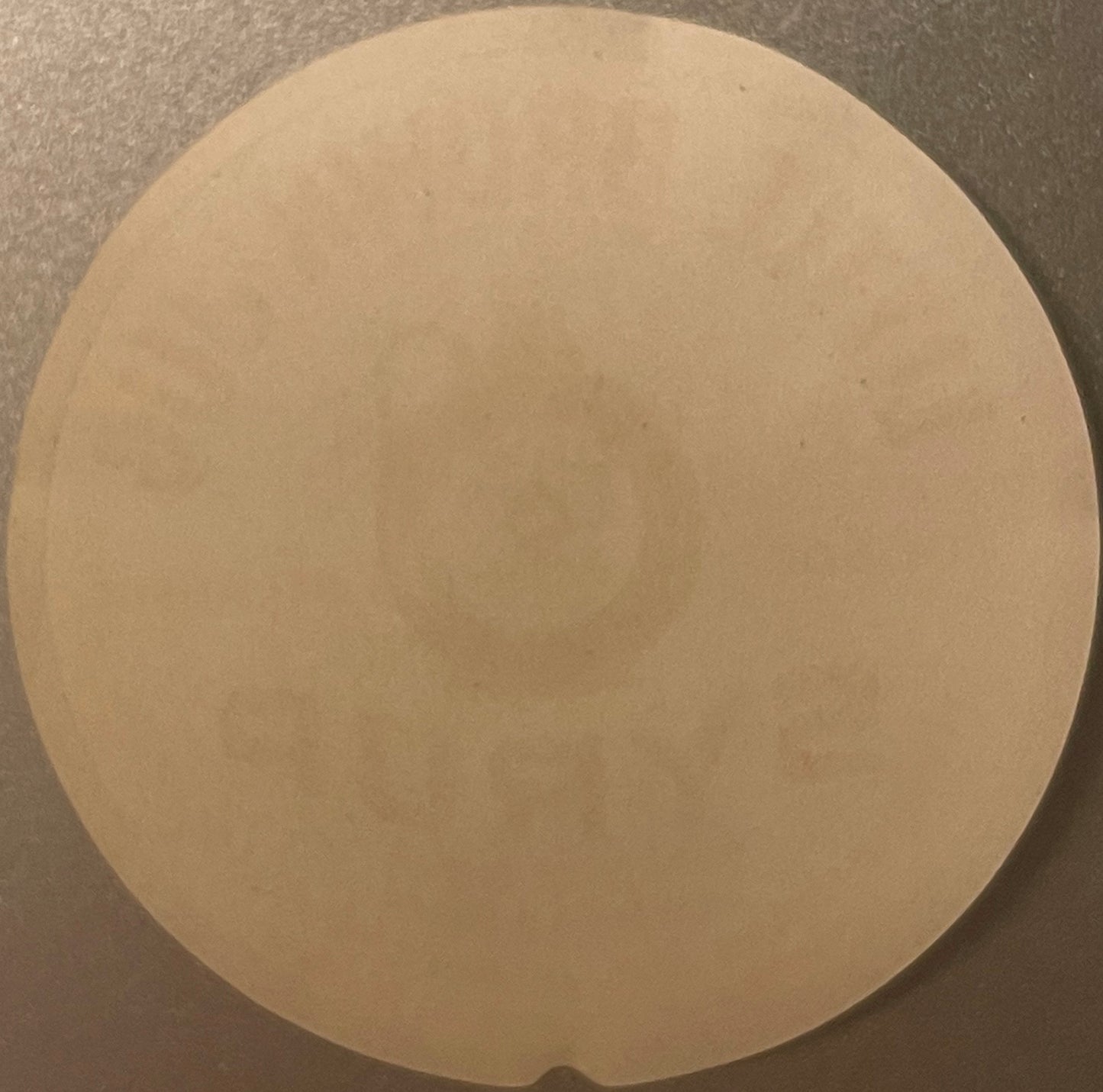
Each label is an original NOS antique advertising label from Little Brown Jug Products Company of St. Louis, Missouri, copyrighted 1921. Round format, approximately 3¼" in diameter. Bright yellow ground with red typography and brown central jug illustration. Clean, unused condition — New Old Stock, preserved since original production. These labels were never applied and have never been used.

Condition: New Old Stock

These labels are New Old Stock — unused, never applied, never put to their working life on a jar. They have been preserved since production and survive in the bright, clean condition of labels that never saw the inside of a grocery store. For collectors of antique advertising and vintage food labels, unused examples are the reference-grade pieces — the standard against which worn and applied survivors are measured.

🏛️ Why Antique Food Labels Are Collected

The antique advertising label sits at one of the richest crossroads in American collecting. It is simultaneously a piece of graphic art, a primary document of commercial history, a window into the daily life of the era that produced it, and a glimpse of the brands and tastes that shaped the American pantry for generations. The labels that survive in unused condition are the rarest of all — designed to be applied and discarded, saved only by the accident of an unfinished run or a careful hand. For collectors of kitchen Americana, Prohibition-era ephemera, antique advertising art, and vintage food history, the Little Brown Jug label is a crossover piece that carries its story on its face.

🛍️ Add this antique Little Brown Jug Syrup label to your collection and own a perfectly preserved piece of Prohibition-era American food and advertising history — the sweetest wink at the driest decade in American history, bright and bold a century later exactly as it left the press.

Shipping

🚚 Shipping & Handling

  • Shipping costs and timing are calculated at checkout.
  • Items curated and shipped directly by me include U.S. shipping at no additional cost, professionally packed to ensure safe arrival of your artifact.

Items from Vetted Pro Collectors
Shipping for items offered by vetted Pro Collectors is determined at checkout. All Pro Collector listings are reviewed to ensure fair, reasonable shipping practices.

For full details, please refer to our Shipping Policy.

Returns & Exchange

Product Page Return Policy

  • 60-Day Returns – Items must be in original condition.
  • Refunds – Issued after inspection (excluding shipping costs).
  • Return Shipping – Customer is responsible unless item is damaged or incorrect.
  • Damaged/Incorrect Items – Contact us within 48 hours for a replacement or refund.
  • Easy Returns – Email info@vintageantiquesgifts.com or call 802-356-9872 to initiate a return.

For full details, visit our Refund Policy.

View full details