Skip to product information
1 of 5

Vintage and Antique Gifts

Vintage Roberts Jersey Dairy Creamery Butter Box 🐄 NOS 1930s–40s Utica, NY Pastoral Print

Vintage Roberts Jersey Dairy Creamery Butter Box 🐄 NOS 1930s–40s Utica, NY Pastoral Print

Regular price 10.00 USD
Regular price Sale price 10.00 USD
Sale Sold out
Shipping calculated at checkout.
Quantity

What Does a Four-Digit Phone Number Tell You About a Butter Box? 🐄

It tells you everything. It tells you the decade, the city, the scale of a business, and the texture of daily life in a place that still believed the name on the package meant something — because the family behind that name lived close enough to hear if it didn't. When I first unfolded this box and read 2-6994 printed right there alongside the address — 716 Pleasant Street, Utica, New York — I stopped and just held it for a moment. Four digits. That is not a telephone number designed for a regional directory or a national listing. That is a number a housewife on Bleecker Street memorized, or a corner grocer kept on a slip of paper tucked under the counter. Four-digit telephone exchange numbers in American small cities give way to the standardized seven-digit system through the mid-1940s, which means this box dates itself almost to the season without a single additional clue. It belongs to the 1930s and the early 1940s, a window confirmed independently by the embossed glass milk bottles Roberts Jersey Dairy left behind — bottles documented from at least 1941 and 1947, the physical cousins of this very box.

That is the thing about printed commercial packaging from this era: it is not inert. It is a primary source document dressed up as everyday utility. Every typographic choice, every color register, every pastoral illustration was made by a real press operator at a real printing house, probably somewhere in upstate New York, running a job that Roberts Jersey Dairy considered important enough to do beautifully. Nobody cut corners on a butter box for a dairy that took pride in its Jerseys. And nobody expected the box to outlast the century.

This one did.


🧈 What This Is — The Object Itself

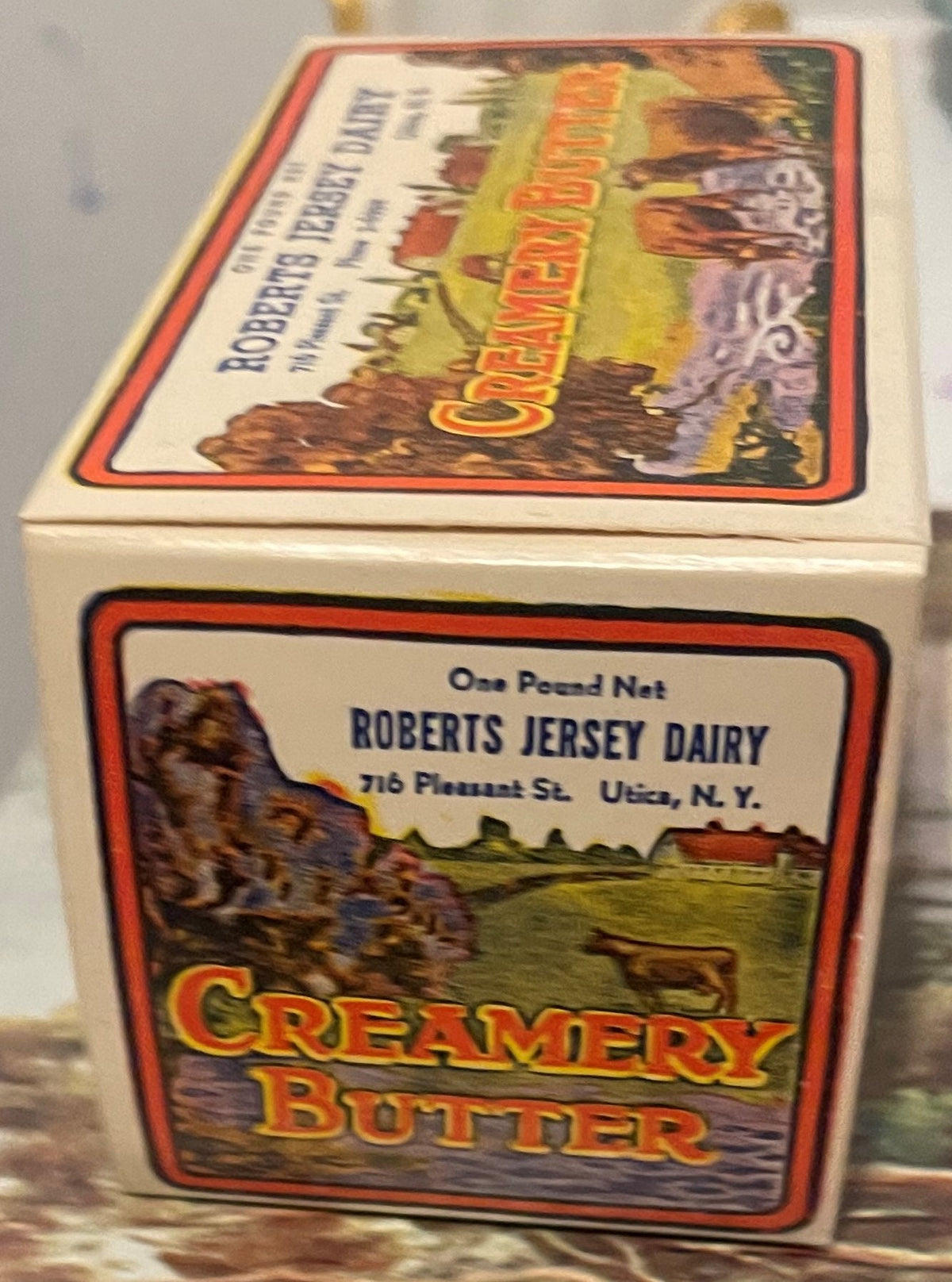
This is a one-pound creamery butter box produced for Roberts Jersey Dairy of Utica, New York, almost certainly between the mid-1930s and the early 1940s, and it is New Old Stock (NOS) — meaning it was manufactured, printed, and folded flat but never filled, never sealed around a block of butter, never touched a refrigerator shelf or a grocery display case. It survived the entire intervening century in the condition it left the pressroom: crisp, unsoiled, the colors intact, the printed pastoral scene reading exactly as the artist intended it to read.

When assembled into its box form, the piece measures approximately 4⅞ × 2⅝ × 2⅝ inches — the classic proportions of a pound-of-butter package, sized to nestle into the butter compartment of an icebox or an early electric refrigerator. Unfolded flat, the sheet opens to 11¾ × 5¼ inches, revealing the full printed surface as a single continuous piece of commercial graphic art you can spread on a table and read like the small masterwork of applied printing it genuinely is. Every panel, every fold, every tab is there — the whole geometry of the box laid out at once.

The printing process is consistent with commercial lithographic or letterpress color work of the period — tight registration, layered ink, warm and earthy tones applied with the kind of craft attention that mid-century regional print shops brought to institutional clients like local dairies, creameries, and bottling operations. The illustrated scene wraps all four primary faces of the assembled box: Jersey cows standing at a streambank, rolling green fields receding behind them, a cluster of farm buildings sitting comfortably in the middle distance under an open sky. The palette is warm golds, deep rusts, earthy browns, and soft blues with cream ground — colors chosen not just for beauty but because they read wholesomeness and pastoral abundance at a glance from across a refrigerator case. This was intentional commercial art, and it holds up.


🏭 Roberts Jersey Dairy — The Company, the Milk, and the Meaning of a Local Creamery

Roberts Jersey Dairy was not a national brand. It was not a cooperative assembled from dozens of farms across multiple counties. It was a Utica institution with an address and a phone number, and that specificity is precisely what made it matter to the people it served. Jersey dairies occupied a particular and respected niche in the American creamery landscape: the Jersey breed, with its famously high butterfat content, produced milk and cream of a richness that industrial Holstein-dominant operations couldn't easily match. A dairy that specifically identified its herd as Jersey cows was making a quality claim to its customers — we chose the breed for the cream, not the volume.

Butter from a Jersey dairy, in the 1930s, was a household luxury at an everyday price. The Great Depression had reshaped how American families thought about food expenditure, and local dairies that offered a quality product at a neighborly price — and that delivered to your door, or appeared reliably on the shelf at your grocer — became fixtures of community trust in a way that is difficult to fully reconstruct today. The Roberts family, operating out of 716 Pleasant Street, was in the business of being known. The glass bottles with their embossed names, the printed butter boxes with their pastoral scenes, the four-digit telephone number — all of it was identity-building for a business whose reputation was renewed with every delivery.

The dairy's glass bottles document its active presence through at least 1947, and the telephone numbering convention on this box places it at the earlier end of that window — the mid-1930s through the early 1940s, a period that spans economic hardship, the approach of war, and the gradual modernization of American household refrigeration. Roberts Jersey Dairy lived through all of it, and left these objects behind as evidence.

Local legend has it that Pleasant Street in this period was a corridor of small working enterprises — a neighborhood of industry at a human scale, where a dairy could occupy a building, keep its operations visible to the street, and be known by the people who passed it every morning. Collectors of Utica dairy memorabilia have passed down the observation that Roberts pieces surface less frequently than those of the larger Utica-area dairies precisely because the operation was smaller and more tightly local — fewer bottles pressed, fewer boxes printed, fewer items ever in circulation to begin with. Scarcity, in this case, is a direct function of intimacy.


🌆 Utica, New York — The City Behind the Dairy

Utica sits in the Mohawk Valley of central New York, a city shaped by the Erie Canal, by waves of immigration, by textile manufacturing, and by the kind of civic density that produces exactly this sort of rich local commercial culture. In the 1930s and 1940s, Utica was a fully functioning small American city with its own newspapers, its own institutions, its own retail district, and its own food economy that moved product from farm to table through local intermediaries — dairies, creameries, bakeries, bottlers — rather than through the long supply chains that would come to dominate after the war.

The Mohawk Valley's agricultural hinterland fed that economy. Dairy farming was a serious enterprise in the hills and flatlands surrounding Utica, and a city dairy like Roberts Jersey was the urban node in a network that began with a herd of Jersey cattle somewhere in Oneida County and ended on a kitchen table on Genesee Street. That geography is compressed into this butter box. The pastoral scene on its panels — the streambank, the rolling fields, the distant farm buildings — is not generic decoration. It is a visual argument that the butter inside this package came from exactly that kind of place, tended by exactly that kind of care.

Utica in the Depression era was also a city of practical thrift and strong neighborhood identity. The fact that Roberts Jersey Dairy printed a box this handsome — with a full illustrated scene in multiple colors, on a quality stock, for a one-pound commodity item — reflects the competitive reality of local creamery business in that moment. You distinguished yourself through presentation as much as through product, because your customer could walk two blocks and buy someone else's butter. The box was a sales tool, a quality signal, and a small piece of beauty delivered into an ordinary household on an ordinary Tuesday.

Stock stored in commercial buildings that later changed hands or were cleared out sometimes reappears decades later through estate sales and old shop discoveries, traveling a quiet underground route from pressroom to collector's hands across seventy or eighty years.


🎨 The Art of the Butter Box — Commercial Printing and Pastoral Imagery in the 1930s

It would be easy to call this packaging. But what it actually represents is the intersection of commercial necessity and genuine craft tradition in American printing. By the 1930s, regional print houses serving food and dairy clients had developed a well-understood visual vocabulary for creamery packaging: pastoral scenes, healthy animals, open skies, colors that communicated warmth and natural abundance. The Roberts Jersey Dairy box participates fully in this tradition, but it does so with the kind of quality that comes from a client who cared about the result and a printer who rose to the brief.

The palette — warm golds, deep rusts, earthy browns, soft blues, cream ground — is not accidental. These are the colors of late summer and early autumn in upstate New York, the colors of a working dairy farm at its productive best. The Jersey cows at the streambank are rendered with enough specificity to be recognizable as the breed — that warm fawn-and-cream coloring, that slightly refined build — rather than generic cartoon cattle. The farm buildings in the middle distance give the scene an anchor of human habitation, a suggestion that this pastoral world is tended and purposeful. The open sky completes it: abundance, space, clean air.

Held open flat at its full 11¾ × 5¼ inches, this sheet is a complete piece of graphic ephemera that stands entirely on its own as a display object. The printing registration is tight, the colors are vivid, and the overall condition — NOS, never used — means you are seeing it exactly as the pressman pulled it from the press and the cutter trimmed it for folding. There is no refrigerator condensation, no butter staining, no grocery shelf wear. Just the box, at the beginning of a life it never quite got around to living.


🖼️ Display Ideas

  • 🖼️ Frame the flat sheet. Unfolded to its full 11¾ × 5¼ inches, this piece fits beautifully in a standard document frame — matted in cream or warm white, it reads as a complete piece of vintage commercial art and holds its own on any wall.
  • 🧺 Style it in a farmhouse kitchen vignette. Prop the assembled box alongside a vintage butter mold, a stoneware crock, or an early electric refrigerator advertisement for an instant period still-life that tells a coherent story about 1930s and 1940s American domestic life.
  • 🐄 Pair it with Roberts Jersey Dairy glass. The embossed glass milk bottles from the same dairy and the same era are their natural companions — display them together on a shelf or in a cabinet as a matched set of dairy ephemera from a single Utica operation.
  • 🗺️ Create a Utica or Mohawk Valley local history display. Collectors and local historians assembling a sense of place around Utica's mid-century commercial life will find this box speaks clearly and specifically to that moment — pair it with local newspaper ephemera, trade cards, or other Utica business paper from the period.
  • 🧈 Use it in a broader creamery and dairy packaging collection. Butter boxes, cream-top bottle caps, dairy crate stencils, and milk bottle carriers from the 1930s and 1940s form a rich collecting category; this Roberts Jersey box holds an honored place in any such grouping.
  • 🎨 Display it as printed commercial art in a graphic design or printing history context. For collectors interested in the history of American commercial printing, food packaging design, or regional press work, this piece is a primary artifact — the pastoral illustration alone merits close study and display.

🎁 Who Collects These

This butter box sits at the crossroads of several serious and passionate collecting communities, and it speaks fluently to all of them.

Dairy and creamery memorabilia collectors are the natural first audience — people who pursue milk bottles, cream-top carriers, butter molds, and dairy ephemera from the era when local creameries were genuine community institutions. Roberts Jersey Dairy pieces are relatively scarce in the collector market precisely because the operation was small and local; a NOS printed box from this dairy, in this condition, is a meaningful addition to any serious dairy collection.

Utica and Oneida County local historians and collectors will immediately recognize the significance of the Pleasant Street address and the four-digit phone number as period-specific documentation. For anyone building a collection around Utica's mid-century commercial and civic life, this box is primary-source material dressed in its original colors.

Farmhouse, country kitchen, and Americana decorators are drawn to pieces like this for their visual warmth and their immediate legibility as objects of a specific time and place. The pastoral scene, the earthy palette, the clean typographic layout — everything about this box translates beautifully into a curated domestic display without requiring any explanation or label to communicate its character.

NOS packaging collectors — a dedicated community of people who specifically pursue unused, unissued examples of vintage commercial packaging — will appreciate the condition and the rarity here. New Old Stock items from food and dairy businesses are among the more ephemeral categories in this field; most packaging was used, discarded, or destroyed. An intact, unfolded, never-filled butter box from the 1930s is a genuine survivor.

Graphic design and printing history enthusiasts collect original commercial printing from this era as documents of applied craft — the color choices, the illustration style, the typography, and the physical object of the folded-flat sheet all tell a story about how regional American printing shops worked and what they could achieve. This box is a small but complete and beautiful example.


❓ Frequently Asked Questions

What does "NOS" mean, and how does it apply to this butter box specifically?

NOS stands for New Old Stock — a term that describes an item manufactured and prepared for use or sale but never actually used. In the context of this butter box, it means the box was printed, cut, and folded flat by the packaging manufacturer but was never filled with butter, never sealed, never placed in a refrigerator case, and never handled as a consumer product. It went directly from the pressroom or a storage inventory into the decades of quiet preservation that eventually brought it to this listing. What you see here is as close to the pressman's original output as it is possible to get.

How do we know this box dates to the 1930s–early 1940s?

The dating comes from two independent lines of evidence that confirm each other. First, the telephone number printed on the box — 2-6994 — is a four-digit number, which is consistent with the telephone exchange conventions of smaller American cities in the 1930s and early 1940s, before the standardized seven-digit system was broadly implemented. This convention narrows the window considerably on its own. Second, Roberts Jersey Dairy is independently documented through embossed glass milk bottles that survive from at least 1941 and 1947, placing the dairy's active operation squarely within that same window. Together, these two data points give us a confident date range of mid-1930s through the early 1940s, with the phone number evidence suggesting the box may lean toward the earlier end of that span.

Can the box be assembled into its three-dimensional form, or is it better displayed flat?

Both options are genuinely appealing, and the good news is that the flat, unfolded state is the format that best preserves the printing and the structural integrity of the piece for long-term display. Folded flat, the box is a complete piece of printed commercial ephemera at its full 11¾ × 5¼ inches — frameable, readable as a whole composition, and safe from any handling stress. The assembled form — approximately 4⅞ × 2⅝ × 2⅝ inches — shows the box as it would have appeared on a grocery shelf or in a refrigerator, and the pastoral illustration wraps the four faces beautifully in that configuration. For a collector who wants maximum versatility, the flat state is probably the wiser choice for permanent display, but assembling the box for photography or temporary exhibition is certainly possible and produces a striking object.

How rare are Roberts Jersey Dairy pieces, and why?

Roberts Jersey Dairy pieces are meaningfully scarce in the collector market for reasons rooted directly in the nature of the operation itself. This was a small, single-location city dairy serving a local customer base in Utica — not a regional operation with wide distribution, not a cooperative with output from dozens of farms. Smaller production volume means fewer bottles pressed, fewer boxes printed, and fewer items ever entering the stream of commerce where they might eventually surface in antique markets or collections. The dairy's glass milk bottles are documented but not abundant; printed paper packaging from the same operation is rarer still, because paper packaging — intended as temporary — was almost always discarded. A NOS butter box in this condition represents a survival against considerable odds, which is precisely what makes it a meaningful find for collectors focused on this category.

What is the condition of the printing and paper after all these years?

The condition is consistent with the NOS designation: this box was never used and never exposed to the moisture, cold, or handling that would accompany its intended function. The printed colors — warm golds, deep rusts, earthy browns, soft blues on a cream ground — retain their original vibrancy, and the pastoral illustration reads clearly across all panels. The paper stock is intact. As with any printed item from this period, collectors should expect the natural character of paper that has aged over seventy to ninety years — this is a vintage piece, not a reproduction, and its age is part of its authenticity and appeal. The specific condition details visible in the listing photographs are the authoritative reference for this particular example.

Is the pastoral scene on this box a generic stock illustration, or was it created specifically for Roberts Jersey Dairy?

This is one of the genuinely interesting questions about period creamery packaging, and the honest answer is: the evidence within the object itself is the best guide. Regional print houses serving dairy clients in this era maintained libraries of pastoral and agricultural illustrations that could be adapted across multiple clients, sometimes with modifications to accommodate different brand identities. However, the quality and integration of the illustration on this box — the specific rendering of the Jersey cows, the coherence of the scene across all four faces, the palette choices — suggests a job that was executed with care and attention to the client's identity. Whether the underlying pastoral scene was a house illustration adapted for Roberts or a commission specific to this dairy is a question that would require access to the printing house's records, which almost certainly no longer survive. What can be said with confidence is that the finished result presents as a coherent and purposeful piece of brand communication for Roberts Jersey Dairy specifically, with the dairy's name, address, and telephone number integrated seamlessly into the overall design.

Does this box have any connection to or significance for local Utica history research?

It does, and that significance is more substantial than a casual glance might suggest. The Roberts Jersey Dairy butter box is a primary-source document of Utica's mid-century local commercial economy — it records an address (716 Pleasant Street), a telephone exchange number (2-6994), a business name, and a product type at a datable moment in the city's history. For researchers interested in the history of Utica's food economy, its neighborhood commercial corridors, or the broader story of how small American cities sustained dense networks of local producers and retailers through the Depression and wartime years, this box is genuine documentary evidence in printed form. It belongs to the same historical conversation as the dairy's embossed glass bottles, and together those objects give local historians a small but specific window into Roberts Jersey Dairy's active years. For Utica collectors and local history enthusiasts especially, that specific provenance — Pleasant Street, four-digit phone number, Jersey breed — gives this piece a meaning beyond its considerable charm as a decorative object.

Shipping

🚚 Shipping & Handling

  • Shipping costs and timing are calculated at checkout.
  • Items curated and shipped directly by me include U.S. shipping at no additional cost, professionally packed to ensure safe arrival of your artifact.

Items from Vetted Pro Collectors
Shipping for items offered by vetted Pro Collectors is determined at checkout. All Pro Collector listings are reviewed to ensure fair, reasonable shipping practices.

For full details, please refer to our Shipping Policy.

Returns & Exchange

Take your time — you've got a full six months. If a piece isn't right for you, send it back the way it reached you and we're good.

In the first 30 days your money goes straight back the way you paid. After that it's store credit, so you can put it toward something you'd rather have.

Return shipping we sort out between us, case by case. I don't make this difficult.

If something arrives damaged, or it isn't what I said it was, send me a photo within 48 hours and I'll make it right.

Email info@vintageantiquesgifts.com or call 802-356-9872 — that's me answering, not a call center.

The only things I can't take back are custom or special-order pieces and gift cards.

View full details
  • 5 stars: 6 (100%)
  • 4 stars: 0 (0%)
  • 3 stars: 0 (0%)
  • 2 stars: 0 (0%)
  • 1 star: 0 (0%)
8
8***o (567)

Exactly as advertised. Beautiful job! Fast shipping. Great Ebayer family!

e
e***e (782)

great item, quick and safe shipping, would buy from again !

c
c***b (1306)

Beautiful! Thank You! Great note!

s
stevemarino55

An excellent seller. Highly recommended.

D
Dawn

Awesome seller. Highly recommend. Thank you so much for the fun extras!

Thank you for your support and review! We really appreciate it. Happy Holidays!

S
Steven

Great seller. Thank you very much!

Thank you, we appreciate it!