
Skip to product information
1 of 5

Vintage and Antique Gifts

Vintage La Green's Brilliantine Bottle | Art Deco Pressed Glass Hair Grooming | 1930s–1950s 🧴

Vintage La Green's Brilliantine Bottle | Art Deco Pressed Glass Hair Grooming | 1930s–1950s 🧴

Regular price 27.00 USD
Regular price Sale price 27.00 USD
Sale Sold out
Shipping calculated at checkout.

Description

🧴 The Bottle That Belonged on Every Barber's Shelf

Before the aerosol can standardized every hairstyle. Before the plastic tube replaced the glass bottle on the bathroom shelf. Before mousse and gel and pomade in a plastic jar took over the drugstore aisle — there was brilliantine, and in the first half of the twentieth century, it was the product every man with any sense of his own appearance reached for when he wanted his hair to behave.

This is a vintage La Green's Brilliantine bottle, dating from the 1930s through the 1950s. It has been sitting quietly long enough that finding a labeled example in a glass form this honest is a genuine satisfaction for anyone who collects vintage personal care glass, studies the material culture of the American barbershop, or builds displays rooted in the Art Deco era. 🧴

🏛️ The History Behind Brilliantine

Brilliantine came to America from France. Édouard Pinaud, the Parisian perfumier celebrated for his work in men's grooming, introduced it to the world at the 1900 Exposition Universelle in Paris — a perfumed, colored oil formulated to soften hair and impart the high shine that the era associated with elegance, composure, and masculine authority. The name derived from the French word for brilliant, and it earned that name at every counter and every barbershop chair where it was used.

By the 1910s and 1920s, brilliantine had made the Atlantic crossing and planted itself firmly in the American grooming tradition, right alongside the straight razor, the strop, the hot towel, and the bay rum. The Rudolph Valentino look — that slicked-back mirror-polished hair that became the shorthand for masculine glamour throughout the silent film era and into the talking pictures — ran on brilliantine. It was the product that separated a man who cared about his appearance from one who didn't, and the glass bottle that contained it was as much a statement as the product itself. 💈

💈 The American Barbershop and Its Shelf

The American barbershop of the 1920s through 1940s was its own institution, its own civic space. Men didn't simply go to get their hair cut. They went to be part of something — the conversation, the ritual, the neighborhood rhythm of Saturday mornings, the familiar smell of talc and witch hazel and bay rum that meant you were somewhere specific in the world. The barber's shelf was a carefully curated arrangement: glass bottles and tin containers in rows, labels in green and gold and red and yellow, names like Vitalis and Fitch's and Jeris and dozens of regional brands that never made it past their state's border but had loyal customers who wouldn't use anything else.

The Depression era didn't kill brilliantine — if anything, it was the brilliantine bottle's design peak. Money was tight everywhere, but the barbershop remained the one luxury working men allowed themselves, and the product lines that filled those shelves during the 1930s show American industrial glass at its Art Deco finest. Ribbed panels, stepped shoulders, faceted bases — the pressing molds of the period produced glass that was functional, beautiful, and economical enough to justify the investment. The glass bottle was the product's face to the world, and the manufacturers of the era understood that.

🔍 La Green's: The Regional Brand Worth Finding

La Green's Brilliantine was one of those regional American brands — not a national advertiser, not a household name in every city, but the kind of label that showed up on the local barbershop counter because the barber knew it worked and the supplier could get it in. That regional obscurity is exactly what makes La Green's harder to find today than the nationally recognized names. Fitch's, Vitalis, Wildroot, Jeris — those were advertised in Life magazine and on the radio, and empty bottles still surface in reasonable quantities through the collector market. La Green's doesn't turn up as often. A labeled example in this condition fills a genuine gap in a serious collection. 🏛️

Because La Green's never ran national campaigns, it was never documented in the advertising histories that followed the major brands into the archives. You won't find La Green's catalogued in most barbershop bottle price guides. The collectors who know it are working from experience and direct familiarity with the material. The label is the tell — it identifies the brand, the product, and the era all at once — and on this bottle, the label reads.

🧪 Art Deco Pressed Glass at Its Best

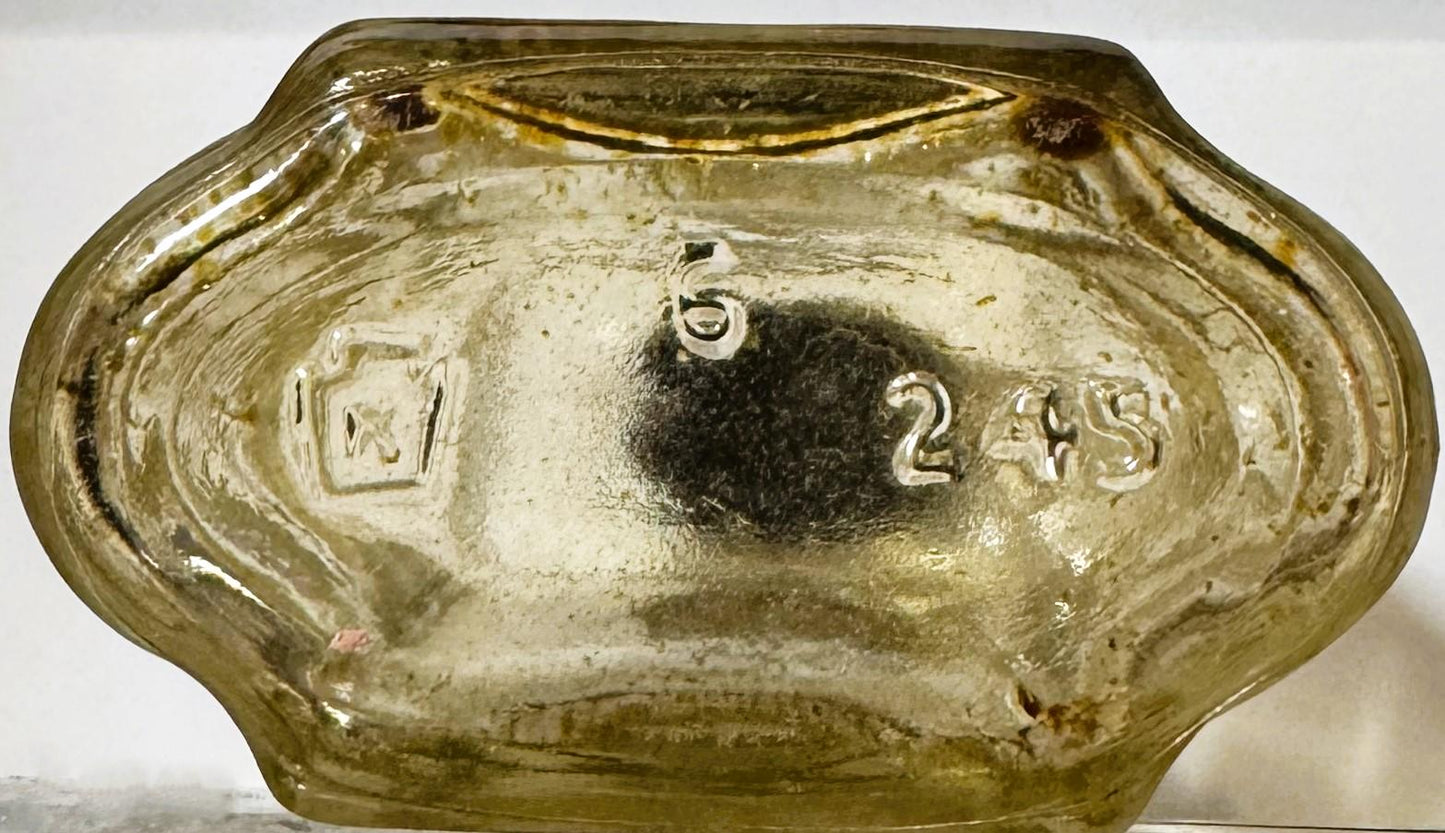
This bottle is heavy pressed glass in the rectangular form with bold vertical ribbed paneling running the full height of each face — a design that catches light from every angle and gives the piece a faceted quality that sits right at the edge of the decorative. Pick it up and it has real weight — the substantial heft of 1930s pressed glass designed to look authoritative on a shelf and feel purposeful in the hand even when empty. This is not thin wartime glass or a lightweight modern reproduction. It is the real article, pressed in an era when the bottle was understood to be part of the product.

The proportions are classic Art Deco: the body widens gently toward the base, the shoulder carries a stepped profile before narrowing to the threaded neck, and the whole piece sits with the balanced self-possession of period industrial design. It is the same geometric vocabulary — stepped forms, vertical emphasis, the celebration of materiality — that appeared in the Chrysler Building's stainless steel crown and in the streamlined architecture of the 1933 Chicago World's Fair, translated into a glass bottle form that could be pressed by the thousands and still carry the conviction of the era's design philosophy. ✨

The glass has developed the warm, slightly amber quality that old pressed glass takes on over decades — a gentle shift from pure clarity that comes from the silica composition and the long exposure to light. It gives the bottle a warmth that no modern reproduction can replicate because it is not a formula or a finish but the physical record of time. The cap is dark metal, low-profile, smooth, threading down onto the glass with the satisfying weight of period hardware. Decades of sitting have given it an honest patina — not damage, but the quiet accumulating record of years spent at rest.

🏷️ The Label

The label is what distinguishes this bottle for the collector. Green and yellow on white stock, it carries the La Green's Brilliantine branding in flowing script at the top of an arched frame with a stylized plant motif at the crown — a design visually coherent with the broader Art Deco print culture of the period. The upper portion reads clearly and completely: the brand name, the product name, the decorative framing — all present and legible from across a shelf. The lower half shows the natural lifting and wear that happens to paper labels bonded to old glass through decades of temperature change and time. This is the honest record of the years, and it is part of what makes the label authentic. A paper label in perfect condition on a bottle this age invites questions. This one doesn't need to. 🏷️

📏 Dimensions and Display

The bottle stands approximately 5 inches tall and 2¼ inches wide — a compact form that presents beautifully on a shelf, a mantel, or a display cabinet. At that size it works as a standalone object or as part of a curated arrangement of period bottles, grooming items, and barbershop ephemera.

For the display builder, this bottle has exceptional versatility. Pair it with straight razors and leather strops for a barber theme. Set it alongside period drug store glass — amber prescription bottles, cobalt blue druggist flasks, clear apothecary jars — for a vintage pharmacy aesthetic. Include it in a vintage bathroom arrangement with period mirrors, safety razor sets, and shaving mugs. Put it on a study shelf alongside leather-bound books and antique desk accessories where the 1930s and 1940s grooming aesthetic adds texture to a broader Americana arrangement. The ribbed pressed glass form is versatile enough to work across collecting contexts without being limited to any single theme, and the green and yellow label photographs well for anyone building a curated display presence. 🏛️

⏳ The Sitting Is the Credential

Here is the thing about bottles like this: most of them did not survive. Not because they were fragile, but because they were ordinary. When brilliantine went out of fashion in the late 1950s and early 1960s — pushed aside by aerosol hairsprays, tube pomades, and the completely different grooming culture that followed — the glass bottles that had held it went to the trash, or got pushed to the back of the medicine cabinet, or disappeared in the kind of household clearing-out that happens between generations. The ones that survived were the ones forgotten somewhere dark and dry: a back shelf of an old store, a box in a basement, the back of a cabinet in a house that hadn't been cleared since Eisenhower was in office.

They emerged decades later still holding the shape and the label of the era that made them, waiting for someone who understood what they were looking at. This La Green's Brilliantine bottle has been sitting for a while. That is its credential. The patina on the metal cap, the way the glass has settled into its decades, the natural lift at the lower edge of a paper label bonded to glass long before most of us were born — all of it is the physical record of the years, and all of it is exactly what makes this bottle worth having. 🧴

📋 Condition

Empty glass bottle, clean dry interior. Original dark metal screw cap present and functional, with period patina. Original paper label on front — upper portion fully intact and legible, lower portion shows natural age wear and partial lifting consistent with decades of storage. Glass has minor surface haze from storage, no chips, no cracks, no structural damage. Vertical ribbed paneling crisp and intact throughout. Stands upright and stable, displays beautifully. Approximately 5 inches tall × 2¼ inches wide.

Shipping

🚚 Shipping & Handling

  • Shipping costs and timing are calculated at checkout.
  • Items curated and shipped directly by me include U.S. shipping at no additional cost, professionally packed to ensure safe arrival of your artifact.

Items from Vetted Pro Collectors
Shipping for items offered by vetted Pro Collectors is determined at checkout. All Pro Collector listings are reviewed to ensure fair, reasonable shipping practices.

For full details, please refer to our Shipping Policy.

Returns & Exchange

Product Page Return Policy

  • 60-Day Returns – Items must be in original condition.
  • Refunds – Issued after inspection (excluding shipping costs).
  • Return Shipping – Customer is responsible unless item is damaged or incorrect.
  • Damaged/Incorrect Items – Contact us within 48 hours for a replacement or refund.
  • Easy Returns – Email info@vintageantiquesgifts.com or call 802-356-9872 to initiate a return.

For full details, visit our Refund Policy.

View full details