Skip to product information
1 of 6

Vintage and Antique Gifts

Antique American Brilliant Cut Glass Two-Handled Sugar Bowl ✨ Gilded Age 1876-1915

Antique American Brilliant Cut Glass Two-Handled Sugar Bowl ✨ Gilded Age 1876-1915

Regular price 35.00 USD
Regular price Sale price 35.00 USD
Sale Sold out
Shipping calculated at checkout.
Quantity

Size: 6.25 inches

✨ An Antique American Brilliant Period Cut Glass Sugar Bowl

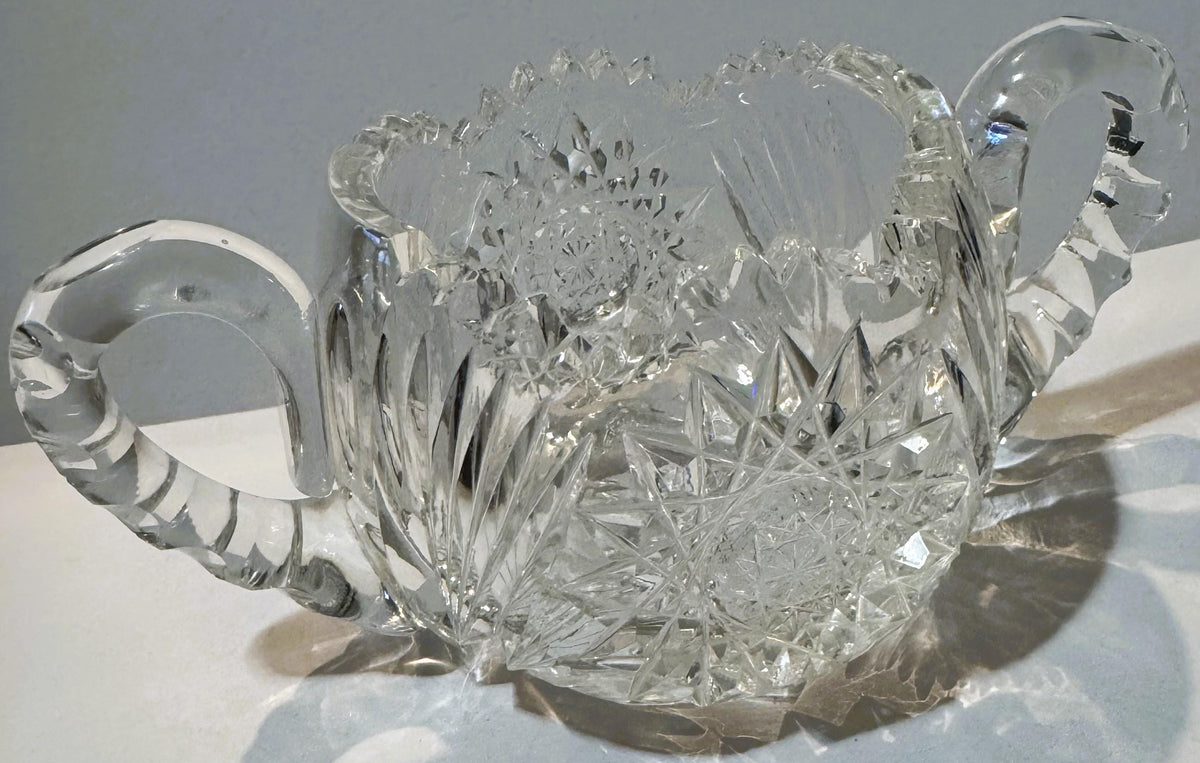
This is a genuine two-handled open sugar bowl in American Brilliant cut glass, made during the height of the American Brilliant Period — the roughly 1876-to-1915 window of the Gilded Age when American glasshouses cut the most dazzling, most deeply faceted lead crystal the world had ever seen. It is a heavy, luminous, richly cut piece, alive with light from every angle, and everything on this page is described from the object itself in the photographs. It carries no maker's signature and no identified pattern name, and — importantly — we will not guess at either; what follows is an honest description of the cutting, the form, and the era, which is exactly how a piece like this should be presented. What you are looking at is a survivor of a lost craft: a small, brilliant, hand-cut object from a moment in American life when a sugar bowl on the table was meant to stop the eye.


🔪 The Cutting, Read Off the Glass

The real pleasure of this piece is in the cutting, and it is worth slowing down over. Both faces of the bowl are dominated by large, deeply cut hobstars — the signature motif of American Brilliant glass — each one radiating to a many-pointed star with a finely cross-cut cane or strawberry-diamond button at its very center. Around and between the hobstars run crisp fan sprays and panels of crosshatched (cross-cut) diamond and triangle cutting, so that almost no surface is left plain. The rim is a sawtooth scalloped edge, cut into sharp points all the way around, and the two handles are solid applied notched-prism C-handles, ribbed with cut steps that catch the light just as the body does. Every one of these cuts was made by hand, judged by eye and feel against a spinning stone wheel, and the density and precision of them here is exactly what marks this out as serious American Brilliant work rather than a lighter, later, or pressed imitation.


⭐ The Showpiece Underneath

Do not miss the base, because it is a small tour de force. Turned over, the underside reveals a flat sixteen-ray star cut into the center, framed within a hexagram — a six-pointed star — built from panels of crosshatched triangles. Cutting a fully finished, radiant star into the bottom of a piece, where most people never look, was a point of pride for the best cutting shops: it says the maker cared about the object as a complete work, not just the parts that show on a shelf. It is also a genuine delight to handle — lift the bowl and the base flashes as brightly as the top — and it is one of the details that most clearly separates a truly good American Brilliant piece from an ordinary one. We have made a point of photographing that underside prominently so you can judge the quality of the work for yourself.


🏛️ The American Brilliant Period and the Gilded Age

American Brilliant cut glass was the glittering table luxury of the Gilded Age. From about 1876 — the year of the Philadelphia Centennial Exhibition, where American cut glass announced itself to the world — through to roughly 1915, American glasshouses produced blanks of exceptionally clear, high-lead crystal and then handed them to skilled cutters who covered them, wheel-cut facet by facet, in the deep geometric patterns that give the style its name. These pieces were the centerpieces of formal dining in an age of candlelight and ceremony, chosen precisely because they threw light around a room like nothing else on the table. A two-handled open sugar like this one would have sat with its matching creamer at the heart of a tea or coffee service, a small daily performance of refinement. To own a piece of it now is to hold a fragment of that vanished world of American domestic grandeur.


🧠 Why the Knowledge Chain Broke

Here is the part most people never hear, and it explains why this bowl is unsigned. American Brilliant cut glass did not fade away gradually; it collapsed. The cutting was extraordinarily labor-intensive — every facet judged and made by a highly trained artisan — and as wages rose and industrial efficiency took over, glasshouses could no longer justify the cost. Cheaper pressed glass and later machine-cut crystal replaced it almost overnight, and when production stopped, the whole chain of knowledge went with it: master cutters retired or died, the skills stopped being taught, pattern names were forgotten, and factory records were scattered or discarded. The objects survived, but the language to describe them often did not. That is precisely why so many genuine American Brilliant pieces, this one among them, come down to us with no maker's mark and no recoverable pattern name — not because they are lesser, but because the world that could have named them is gone.


🔎 Unsigned — and Honestly So

This sugar bowl carries no signature. Many, though not all, American Brilliant cutting shops acid-etched a tiny mark into a polished spot on their pieces, but a great deal of superb cut glass — including work from shops that never signed, or on blanks that simply were not marked — went out into the world anonymous. The absence of a signature is not a flaw and it is not a mystery to be solved with a guess. Rather than invent an attribution or borrow a famous pattern name to dress the piece up, we describe exactly what is here: an unsigned, very skillfully cut American Brilliant sugar bowl, judged on the quality of its own cutting. For a collector, that honesty is the point — you are buying the glass in front of you, described truthfully, and you are free to enjoy it for its brilliance rather than for a label it never had.


🕯️ Beauty as a Demonstration of Skill

The brilliance of this piece is not accidental. In American Brilliant cutting, depth, angle, and spacing were all decided in real time at the wheel, by an artisan reading the blank and the light as the work progressed. That is why the hobstars here are so crisp, why the fans are so evenly stepped, and why the whole surface fractures light the way it does — effects that modern molded or lightly-cut glass simply does not reproduce. This was never decoration for its own sake; it was beauty offered as proof of mastery, a maker showing exactly how well the human hand and eye could work glass. Heavy in the hand, deeply and confidently cut, and balanced between strict symmetry and dense complexity, this bowl is a compact lesson in why collectors prize genuine American Brilliant crystal so highly.


🌟 A Survivor Worth Owning

Pieces like this are often priced far more modestly than their craftsmanship deserves — not because the quality has changed, but because the world that once demanded such objects has. The style did not disappear because people stopped wanting beautiful things; it disappeared because time became more valuable than hand-labor, simplicity replaced spectacle, and the formal rituals that justified a dazzling sugar bowl faded from daily life. What remains are survivors like this one: still heavy, still flashing, still capable of stopping someone in their tracks across a room. That is not nostalgia talking — it is simply what the object does. For anyone who loves antique glass, the Gilded Age, or the vanished crafts of the nineteenth century, it is a genuine and rewarding thing to own.


🔨 How These Pieces Were Made

An American Brilliant piece began as a blank of exceptionally clear, high-lead crystal, blown or shaped into a heavy, plain form with plenty of glass to carve into. A skilled cutter then held that blank against rotating stone wheels of different profiles, cutting the design freehand: roughing in the deep miter lines that lay out the pattern, then adding the hobstars, fans, and crosshatched fields in stage after stage. Finally the cut surfaces were smoothed and brought to full brilliance, traditionally by hand-polishing or an acid bath. There were no stencils and no machines guiding the wheel; the geometry was carried in the cutter's trained eye and hands. The density and accuracy of the cutting on this bowl — how evenly the hobstar points space out, how cleanly the miter lines meet — is a direct record of that skill.


🧼 Caring for Antique Cut Glass

Cut glass of this age is best washed gently by hand in lukewarm water with a mild detergent, never in a dishwasher, whose heat and harsh detergents can dull the polished facets over time. A soft brush reaches into the deep miter lines, and drying with a lint-free cloth keeps water spots from settling into the cutting. Sudden temperature changes should be avoided, as should knocking the delicate sawtooth rim points against a hard surface. Treated sensibly, a piece like this will keep its brilliance indefinitely — it has already survived the better part of a century, and it asks only for reasonable care to dazzle for another.


🍴 Living With It

  • ✨ Set it where it can catch daylight or lamplight — a windowsill, a lit cabinet, a mantel — and let the hobstars and the base star do their work.
  • 🍵 Pair it with a cut-glass creamer or a tea service for a true Gilded-Age table vignette.
  • 🍬 Use it as intended for sugar cubes, or as a small open dish for candies, nuts, or trinkets.
  • 💍 Keep it on a dressing table as a brilliant little catch-all for rings and small keepsakes.
  • 🎁 Give it to a collector of American Brilliant glass, a lover of antiques, or anyone drawn to the craftsmanship of the Gilded Age.

An unsigned but very skillfully cut American Brilliant Period sugar bowl — hobstars, fans, a sawtooth rim, notched-prism handles, and a radiant sixteen-ray star hidden in its base — a heavy, brilliant survivor of a Gilded-Age craft the world no longer knows how to make, described exactly as it is.

Shipping

🚚 Shipping & Handling

  • Shipping costs and timing are calculated at checkout.
  • Items curated and shipped directly by me include U.S. shipping at no additional cost, professionally packed to ensure safe arrival of your artifact.

Items from Vetted Pro Collectors
Shipping for items offered by vetted Pro Collectors is determined at checkout. All Pro Collector listings are reviewed to ensure fair, reasonable shipping practices.

For full details, please refer to our Shipping Policy.

Returns & Exchange

Take your time — you've got a full six months. If a piece isn't right for you, send it back the way it reached you and we're good.

In the first 30 days your money goes straight back the way you paid. After that it's store credit, so you can put it toward something you'd rather have.

Return shipping we sort out between us, case by case. I don't make this difficult.

If something arrives damaged, or it isn't what I said it was, send me a photo within 48 hours and I'll make it right.

Email info@vintageantiquesgifts.com or call 802-356-9872 — that's me answering, not a call center.

The only things I can't take back are custom or special-order pieces and gift cards.

View full details