Skip to product information
1 of 4

Vintage and Antique Gifts

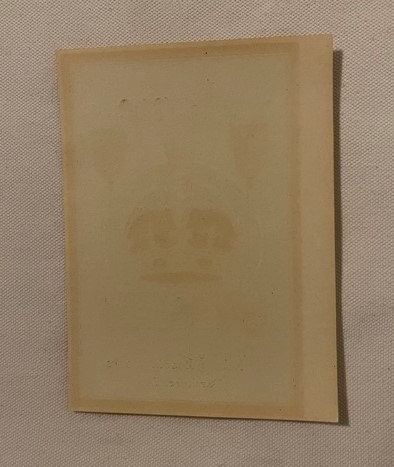
Antique Acme No 6 Broom Label 1910s 1920s Hamburg Broom Works Hamburg PA Crown New Old Stock Advertising Art Ephemera 🧹

Antique Acme No 6 Broom Label 1910s 1920s Hamburg Broom Works Hamburg PA Crown New Old Stock Advertising Art Ephemera 🧹

Regular price 10.00 USD
Regular price Sale price 10.00 USD
Sale Sold out
Shipping calculated at checkout.
Quantity
# 🧹 When Did a Broom Label Become a Work of Art? The Answer Is Hamburg, Pennsylvania — and This Is the Proof. There is a particular kind of pleasure that comes from holding something a century old that has never been used. Not worn, not faded, not folded into a drawer and forgotten — simply *waiting*. Waiting in whatever dark, dry corner of a warehouse or estate it occupied for the better part of a hundred years, colors sealed inside it like light in a bottle. That is exactly what this Acme No. 6 label from Hamburg Broom Works is. It arrived in the world sometime in the 1910s or 1920s. It was designed to be pasted onto a broom and sold across a counter. Instead, it survived intact, and now it sits in your hands — or it can — as vivid as the day the lithographer pulled it off the press. That is not luck. That is destiny wearing the disguise of good storage. --- ## What You Are Actually Looking At 🧹 This is an original, **New Old Stock (NOS) lithographed paper broom label** produced for the **Acme No. 6** line by **Hamburg Broom Works** of **Hamburg, Pennsylvania**, dating to the **1910s–1920s**. It measures **5.25 x 4 inches** — a compact, dense little rectangle of commercial art that punches far above its size. It has never been applied to a broom, never soaked in paste, never exposed to the humidity and grime of a shop floor. The condition is described plainly and honestly as showing **little to no wear**, which in the world of NOS paper ephemera is as close to miraculous as the category allows. The label was produced using **chromolithography** — the dominant commercial printing process of the era — in which multiple stones or plates, each carrying a separate color, were aligned with extraordinary precision and printed in sequence to build up a finished image with the kind of saturated, layered color that digital reproduction still struggles to fully capture. You are not looking at a scan. You are not looking at a reproduction. You are looking at the artifact itself: ink on paper, pressed by a machine operated by a skilled craftsman, designed by a commercial artist whose name we will never know, and approved by a businessman who understood that the label *was* the brand. The crown motif — present in the Acme branding — was not chosen carelessly. It was chosen because it telegraphed quality in a single glance across a hardware store or general merchandise counter. This is that object, complete and uncompromised. --- ## 🏭 Hamburg Broom Works: The Factory That Built a Industry **Wilson Schmick** founded Hamburg Broom Works in **1894**, entering an industry that was, by that point, already deeply woven into the economic identity of Berks County and the Schuylkill Valley. What he built over the following decades was not a cottage operation. By **1911**, the business had outgrown its original West Hamburg location — sited just south of the **Philadelphia and Reading Railroad** station, a detail that tells you everything about how the product moved — and Schmick committed **$25,000** to a purpose-built manufacturing facility. In 1911 dollars, that figure commanded genuine respect. It was the investment of a man who had studied his market, believed in his product, and intended to dominate. Hamburg Broom Works transitioned to a **public company** in **1923**, eventually operating under the **Hamburg Industries, Inc.** umbrella at **218 Pine Street**, Hamburg. At its full stride, the operation produced **corn brooms, staple-set brushes, wet mops, dry mops, and handles** for a national market — the kind of product diversity that keeps a manufacturing floor running twelve months a year regardless of season. The factory operated on Pine Street until **1999**, more than a century after Schmick first opened his doors. The building itself stood until **2017**, when it was demolished. The Pine Street site now carries an **EPA Superfund designation**, a reminder of what a century of industrial chemistry leaves behind even when the people and the products are long gone. The physical plant is gone. The records of its daily labor are scattered. What remain are the objects it produced — and the labels that identified them. The **Philadelphia and Reading Railroad** connection deserves a moment of attention. That rail line was the artery through which Hamburg's brooms reached the rest of the country. Wholesale distributors in Philadelphia, retailers as far as the Midwest, and catalog operations that served rural households all depended on rail freight to move household goods efficiently and at scale. The broom sitting in a kitchen in Ohio or Virginia might well have traveled from Hamburg on a Reading Railroad car, its Acme label pressed flat against the handle, the crown emblem facing outward. The label was the last thing a merchant saw when he pulled the broom off the freight pallet. It had to do its job instantly. --- ## 🌽 The Broom Capital of the World: Hamburg, Pennsylvania The title sounds like the kind of thing a local chamber of commerce invents on a slow Tuesday. It is not. In the late nineteenth and early twentieth centuries, **Hamburg, Pennsylvania** was genuinely, measurably, verifiably the **Broom Capital of the World** — not a regional boast, not a county superlative, but a claim that held up against international production figures. The borough of Hamburg, tucked into the **Schuylkill Valley of Berks County**, approximately **65 miles northwest of Philadelphia**, produced more brooms than any other location on earth during its peak years. The reasons were practical and geographic. The region had access to **broomcorn** — *Sorghum bicolor* var. *technicum*, the tall-stalked grain whose fibrous seed heads form the working end of a traditional broom — through established agricultural and commodity channels. It had the railroad. It had a labor pool shaped by generations of German-immigrant craftsmen who brought with them a cultural seriousness about useful goods made well. And it had entrepreneurs like Wilson Schmick who were willing to scale a skilled trade into an industrial enterprise without sacrificing the identity of the product. At the height of the broom industry's presence in Hamburg, multiple factories operated within the borough limits. The competition between them drove quality standards upward and forced each manufacturer to distinguish their product through **branding** — which is precisely why labels like this Acme No. 6 example were designed with such care. In a hardware store where three brands of corn broom hung side by side, the label was the salesman. The crown said *premium*. The word *Acme* — from the Greek for *peak* or *highest point* — said *best in class*. These were not accidents of vocabulary. They were strategy rendered in ink. **Local legend holds** that during the busiest years of Hamburg's broom trade, you could smell the broomcorn dust on the wind walking through the borough on a weekday morning — a dry, faintly sweet agricultural scent that the old-timers apparently found as natural and unremarkable as the smell of bread from a bakery. Whether that account is precise history or the kind of sensory memory that softens with decades, it has been passed down among those who grew up in Hamburg in the mid-twentieth century as a genuine piece of lived experience. **Lore passed down among collectors of Pennsylvania paper ephemera holds** that Hamburg Broom Works labels — particularly the earlier chromolithographed examples from the 1910s and 1920s — are among the most difficult NOS broom labels to source in fine condition, precisely because the factory's production runs were efficient enough that relatively few over-run or unissued labels survived in storage. Most were used. The ones that didn't reach a broom handle typically ended up damaged in warehouse transitions or lost entirely when the company changed ownership structures. Finding one in the condition this label presents is, by that measure, genuinely uncommon. --- ## 🎨 The Art of the Broom Label: Commercial Lithography at Its Peak It is easy, in retrospect, to underestimate what went into a label like this. The chromolithography process that produced it required **skilled stone or plate preparation**, color separation done entirely by hand and eye, precise registration across multiple passes through the press, and inks formulated to hold their vibrancy on paper stock that had to be lightweight enough to apply to a broom handle without cracking or lifting at the edges. The commercial lithographers who produced advertising labels for manufacturers like Hamburg Broom Works were specialists. Their clients included food canners, tobacco companies, seed merchants, hardware manufacturers, and pharmaceutical houses — anyone who needed a label that could survive handling, display, and the scrutiny of a purchasing decision made in seconds. The best of these lithographers operated in Philadelphia, New York, Baltimore, and Pittsburgh, and they competed fiercely for manufacturing contracts by demonstrating superior color work and consistent registration. The **crown motif** on the Acme No. 6 label is part of a visual vocabulary that was immediately legible to the early twentieth century consumer. Crowns on product labels signaled royalty by association — *the king of brooms*, *the queen of clean floors* — without ever having to make the claim in words. It was the kind of shorthand that worked across language barriers in an era when immigrant households were a significant portion of the consumer market. You did not need to read the brand name to understand what the crown was telling you. That the colors on this label remain **vivid** after a century is not incidental. It is the direct result of the label never having been exposed to the UV degradation, moisture cycling, and handling that would have stripped a used label of its brilliance over time. NOS condition for a chromolithographed paper label means the ink is still in its original oxidative state — essentially unchanged from the moment it left the press. That is the correct way to understand what "NOS" means for paper ephemera: not merely *unused*, but *chemically intact*. --- ## 🖼️ Display Ideas - 🖼️ **Frame it for the kitchen or mudroom** — a 5x7 or 6x8 mat-and-frame brings the crown motif to full visual presence on a wall and starts conversations every time a guest notices it. - 🎨 **Incorporate it into a Pennsylvania heritage gallery wall** — pair it with other Berks County or Schuylkill Valley ephemera, vintage maps, or tintype portraits for a cohesive regional display. - 🛋️ **Display it on a sideboard or bookshelf easel** — propped in a small tabletop frame, it holds its own as a standalone decorative object, exactly as buyers have found when framing it for sideboards and entryway tables. - 🧺 **Group it with other antique household trade labels** — seed labels, soap labels, and hardware labels from the same era create a rich, thematic collection that documents domestic American commerce across a single wall or shelf. - 🏪 **Use it as a focal point in a shop or studio** — vintage retail spaces, antique booths, and artisan studios frequently use period advertising art to establish visual identity and provenance. - 📚 **Mount it archivally in a collection binder or display portfolio** — for the serious ephemera collector, an archival sleeve in a displayed portfolio preserves the label while keeping it accessible and visible. --- ## 🎁 Who Collects These The audience for a piece like this is broader and more specific than it first appears. **Antique advertising collectors** are the obvious first category — people who have spent years building collections of lithographed paper labels, trade cards, and point-of-sale materials from American manufacturing's golden era. For this collector, the Acme No. 6 label represents a specific intersection of industrial history, printing craft, and brand design that is genuinely difficult to assemble in NOS condition. **Pennsylvania history enthusiasts** — and Berks County collectors in particular — find pieces like this meaningful in a way that goes beyond aesthetics. Hamburg's claim as the Broom Capital of the World is a real chapter in the state's industrial biography, and a surviving NOS label from Hamburg Broom Works is documentary evidence of that era. It belongs in a collection that tells the story of southeastern Pennsylvania's manufacturing heritage. **Kitchen and home décor collectors** with a taste for authenticity are a growing segment of the audience for antique advertising art. The domestic subject matter — a broom, a household tool, a product designed to keep a home clean — connects this label to the material culture of the American household in a way that resonates with people who decorate with intention and with history. **Lithography and printing history enthusiasts** value the technical achievement embedded in a well-preserved chromolithographed label. The process is essentially extinct as a commercial medium, and original examples in this condition are primary sources for understanding what the craft could produce at its peak. Finally, there are the **local collectors** — people from Hamburg, Berks County, Reading, and the wider Schuylkill Valley who recognize the name on the label and feel the specific pull of recovered local history. For them, this is not just advertising art. It is a piece of their borough's story. --- ## ❓ Frequently Asked Questions ### Is this label genuinely from the 1910s–1920s, or is there a reproduction concern? This is an original period label, not a reproduction. The dating to the 1910s–1920s is based on the label's design vocabulary, printing technique, and its relationship to the known operational timeline of Hamburg Broom Works, which was founded in 1894 and transitioned to public company status in 1923. The chromolithography process used to produce it was the dominant commercial printing method of that era and was largely replaced by offset lithography through the 1920s and 1930s. The paper stock, ink oxidation, and registration characteristics of this label are consistent with original period production. NOS condition means it was never applied to a product, which is precisely why it presents so well — it has not been subject to the handling, moisture, and adhesive damage that destroys most surviving broom labels. ### What does "NOS" mean for a paper label, and why does it matter for condition? NOS stands for New Old Stock — meaning the item was produced for commercial use but was never actually used. For a paper chromolithography label, this is an exceptionally important distinction. Labels that were applied to brooms were typically destroyed along with the product through normal household use, or damaged by paste adhesive, moisture, and handling when stripped or recovered. A NOS label has been in essentially its original manufactured state since it left the press. The colors have not been degraded by UV exposure or humidity cycling. The paper has not been stretched, torn, or stained by adhesive. What you see on a NOS label is what the lithographer intended — the full saturation of the original ink, the crispness of the registration, the integrity of the paper. That is why NOS condition is the benchmark for paper ephemera collectors. ### How should I frame or preserve this label after purchase? For display purposes, a standard **5x7 or 6x8 mat-and-frame** accommodates the label's 5.25 x 4 inch dimensions comfortably, with the mat providing appropriate visual breathing room around the image. For long-term preservation, **UV-filtering glazing** (either glass or acrylic) is strongly recommended, as UV exposure is the primary cause of color degradation in lithographed paper. If you are adding this to an archival collection rather than displaying it, an **acid-free polyester sleeve** or **archival mat board** mounting will protect it indefinitely without introducing chemical deterioration. Avoid rubber bands, acidic paper envelopes, and any adhesive contact with the printed surface. ### What is the significance of the "Acme No. 6" designation on the label? The "Acme" brand name was Hamburg Broom Works' premium product line — the word itself derives from the Greek for *highest point* or *peak*, and was widely used in late nineteenth and early twentieth century American commerce to signal top-tier quality. The "No. 6" designation refers to a specific **grade or size classification** within the Acme product line, reflecting the standardized grading system that the broom industry used to differentiate products by bristle quality, handle length, and construction method. Broom manufacturers typically produced multiple numbered grades, with lower numbers sometimes representing smaller or lighter-duty products and higher numbers representing more substantial commercial-grade brooms — though this varied by manufacturer. The crown motif on the label visually reinforces the premium positioning of the Acme name. ### Is Hamburg, Pennsylvania really known as the Broom Capital of the World? Yes — and it is one of those historical claims that is more verifiable than it sounds. Hamburg, located in Berks County in the Schuylkill Valley approximately 65 miles northwest of Philadelphia, was home to multiple broom factories during the late nineteenth and early twentieth centuries and was, by production volume, recognized as the world's leading broom-manufacturing center during its peak years. The combination of railroad access through the Philadelphia and Reading Railroad, an established German-immigrant craftsman community, and entrepreneurs like Wilson Schmick — who invested $25,000 in a purpose-built facility as early as 1911 — made Hamburg an industrial concentration of broom-making that was genuinely without parallel. Hamburg Broom Works itself operated continuously from 1894 to 1999, more than a century of production from a single borough. ### How large is the label, and will it fit in a standard frame available at craft or home stores? The label measures **5.25 inches wide by 4 inches tall**. A standard **5x7 frame** with a cut mat will accommodate it beautifully — the mat opening can be sized to show the full label with a clean border. Alternatively, a **4x6 frame** used without a mat, or with a very narrow mat, works well if you prefer a tighter presentation. Both sizes are widely available at craft stores, home goods retailers, and online framing suppliers. The label's compact dimensions are actually an asset for display — it fits easily on a shelf, sideboard, or in a gallery arrangement without requiring significant wall space. ### What makes this a good investment piece for a collector, beyond its decorative appeal? Several factors converge to make this label genuinely collectible rather than merely decorative. First, **NOS condition in chromolithographed paper ephemera is inherently scarce** — most period labels were used and destroyed with the products they identified, and the ones that survived were typically damaged by storage conditions over the intervening century. Second, the **Hamburg Broom Works history is documented and specific** — this label can be placed in a precise industrial and geographic context, which gives it provenance that generic advertising art lacks. Third, the **physical plant is gone** — the Hamburg Broom Works factory was demolished in 2017, which means no further archival material will emerge from that source, and the supply of surviving Hamburg-made advertising material is now fixed. Fourth, **Pennsylvania industrial history ephemera** has a deep and active collector base that continues to recognize the documentary and aesthetic value of pieces like this one. All of these factors point toward stable and appreciating collectibility for a piece already in fine condition.

Shipping

🚚 Shipping & Handling

  • Shipping costs and timing are calculated at checkout.
  • Items curated and shipped directly by me include U.S. shipping at no additional cost, professionally packed to ensure safe arrival of your artifact.

Items from Vetted Pro Collectors
Shipping for items offered by vetted Pro Collectors is determined at checkout. All Pro Collector listings are reviewed to ensure fair, reasonable shipping practices.

For full details, please refer to our Shipping Policy.

Returns & Exchange

Take your time — you've got a full six months. If a piece isn't right for you, send it back the way it reached you and we're good.

In the first 30 days your money goes straight back the way you paid. After that it's store credit, so you can put it toward something you'd rather have.

Return shipping we sort out between us, case by case. I don't make this difficult.

If something arrives damaged, or it isn't what I said it was, send me a photo within 48 hours and I'll make it right.

Email info@vintageantiquesgifts.com or call 802-356-9872 — that's me answering, not a call center.

The only things I can't take back are custom or special-order pieces and gift cards.

View full details
  • 5 stars: 1 (100%)
  • 4 stars: 0 (0%)
  • 3 stars: 0 (0%)
  • 2 stars: 0 (0%)
  • 1 star: 0 (0%)
w
waxwing19672

Smooth transaction; recommended seller!

Thank you, Happy Holidays!