Skip to product information
1 of 3

Vintage and Antique Gifts

Vintage Hurdy Gurdy Brand Crate Label 🐒 — 1940s Egan, Fickett & Co. Orlando Florida, Organ Grinder & Monkey Art

Vintage Hurdy Gurdy Brand Crate Label 🐒 — 1940s Egan, Fickett & Co. Orlando Florida, Organ Grinder & Monkey Art

Regular price 10.00 USD
Regular price Sale price 10.00 USD
Sale Sold out
Shipping calculated at checkout.
Quantity

Size: 8.5 x 3 inches

🐒 An Organ Grinder for an Orlando Citrus House

This little label is all fun. Against a deep forest-green ground, a big yellow banner sweeps across carrying "Hurdy Gurdy" in bouncy red script; at the left stands a cartoon organ grinder — a mustachioed fellow in a green jacket, yellow cap and red-and-white striped trousers, cranking his barrel organ — with a cheeky little monkey in a red cap perched on his hand. "Produce of U.S.A." sits in the banner, and a dark bar across the base names the firm: "Egan, Fickett & Co. • Orlando, Florida." It is a strip label — the long, narrow shape made for the end panel of a Florida citrus crate — with its corners neatly canted. Everything described here comes straight from the label in the photographs; the history is what can honestly be established about the company behind it.


🏢 Egan, Fickett & Co, of Orlando

The firm named at the bottom is a genuinely storied one in Florida citrus. Egan, Fickett & Company was founded in 1914 as a fruit-and-vegetable distributing house, and it grew into one of the long-lived names of the Florida citrus trade. Its founder, Joseph B. Egan — by the accounts that survive, an immigrant who had worked the New York docks before turning to produce — built the business before his death in 1936, and his son, Bernard A. Egan, carried it much further still: a figure important enough to Florida citrus to be honored in the state's Citrus Hall of Fame, he expanded the family into large-scale grove ownership, moving operations toward the Indian River country and eventually controlling many thousands of acres of citrus. From that 1914 beginning grew a citrus enterprise that outlasted most of its contemporaries.

"Hurdy Gurdy" was one of the firm's citrus brands, and by all accounts a popular and colorful one — the kind of cheerful, memorable mark that stuck in a grocer's mind, carried on crates and, in the firm's later years, painted on the trucks that delivered fruit to the chain stores. The brand was formally registered as a trademark for citrus fruit in 1962, though the label's cartoon styling and the firm's long history sit comfortably with a mid-century printing. Whatever the exact year, this sheet is the trade dress of a real, substantial Orlando citrus house — not a generic "vintage" graphic, but the working signature of Egan, Fickett & Co.

Orlando anchors the story. Long before its theme parks, central Florida was orange country — the citrus belt of ridge and lake that shipped fruit north by the trainload every winter — and Orlando sat at its heart, ringed by packing houses and groves. A citrus brand out of Orlando is a genuine thread in that history. The label itself reads simply "Produce of U.S.A," as many house brands did, but Egan, Fickett & Co. was a citrus house and Hurdy Gurdy a registered citrus brand; this is a Florida orange crate's cheerful face.


🎵 Why an Organ Grinder?

Because the label's one job was to be unforgettable, and few images are as instantly charming as an organ grinder and his monkey. In an era when a buyer's eye slid across dozens of stacked crates in seconds, a brand lived or died on whether its label could stop that eye and lodge in the memory — and a "hurdy gurdy" man, a staple of old street entertainment, did exactly that. The cartoon is genuinely delightful: the grinder's curled mustache and striped trousers, the little monkey in its red cap reaching out for coins, the whole thing bouncing along the yellow banner. It is warm, funny, and completely memorable, which is precisely what a good brand needed to be — and it makes wonderful, whimsical wall art today.


📦 Genuinely Old, Never Used

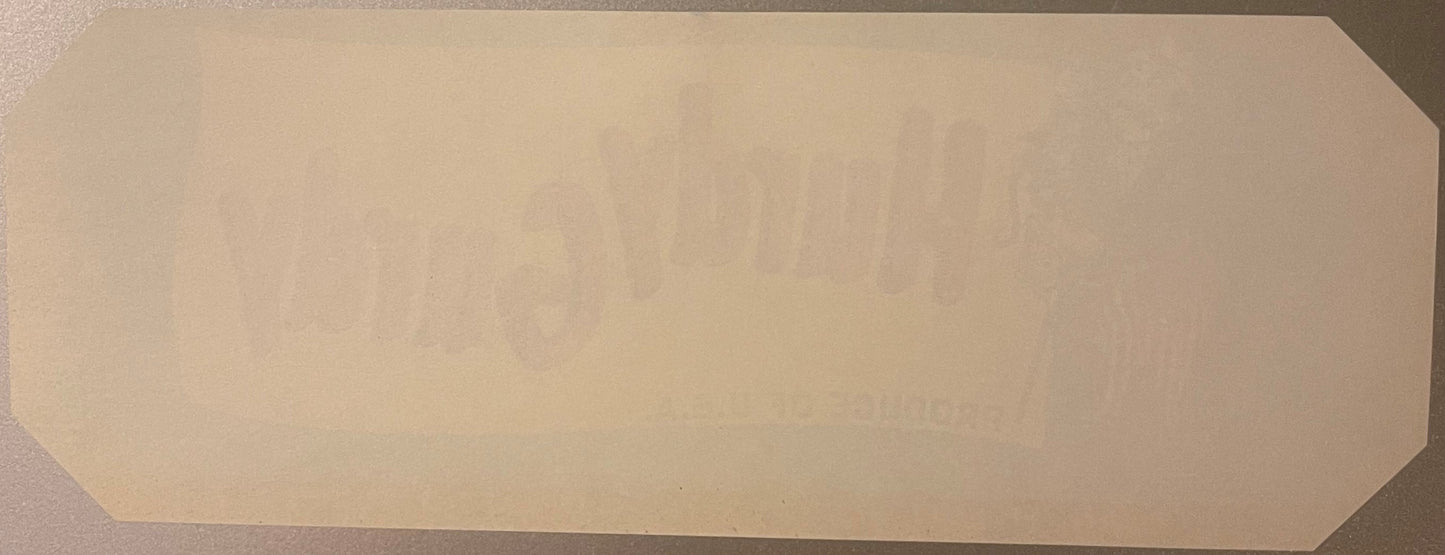
A word on why a label this old still looks so bright: it was never used. Florida citrus shipped in nailed wooden crates that each wanted a pasted paper end label, so packers ordered them in bulk. When pre-printed cardboard cartons took over — printing the brand straight onto the box — the paper labels became obsolete, and leftover stacks were pushed to the back of warehouse shelves and forgotten. This Hurdy Gurdy label is one of those survivors: never pasted, its reverse clean but for a soft mirror-image ghost of the front bleeding through, its colours as bold as the day it was printed. It is described as a mid-century, circa-1940s label, in keeping with its styling and the absence of any ZIP code (Florida citrus labels with a five-digit ZIP postdate 1963; this one has none); no single exact year is claimed.


🔍 An Honest Look at Condition

Read from the same photographs: this is a single sheet of original vintage lithographed paper, unused, with a blank reverse showing only a faint mirror-image bleed-through of the front — exactly what an unused, never-pasted label should show. The printed face is richly coloured, the green deep, the yellow banner bright, the red script strong and the cartoon crisp. It shows the light, honest character of stored vintage paper and is offered exactly as pictured, with nothing added, retouched or concealed. As a flat paper item it frames cleanly and without bulk.


🖼️ How to Live With It

A label this cheerful, from a real Orlando citrus house, is made to be seen:

  • 🐒 Frame it as whimsical art — the long strip shape and funny cartoon look great in a slim frame, a natural for a kitchen, a playroom or a music room.
  • 🍊 Build a Florida citrus wall, grouping it with other orange and grapefruit labels for a bright, sun-soaked corner.
  • 🎵 Give it to a musician or a lover of old street entertainment — the hurdy-gurdy man is a rare and charming subject.
  • 🌴 Give an Orlando or central-Florida connection a keepsake — a genuine local citrus label is a specific piece of home from the orange-grove days.
  • 🎁 Use it as an affordable, genuinely-antique gift — real Florida citrus history, light to send and easy to frame.

🎁 Who This Is For

This label speaks to several kinds of people. The crate-label collector values a bright, packer-attributed Florida citrus label with a rare and charming figural subject. The lover of oddball vintage graphics simply wants that organ grinder and his monkey on the wall. The musician or student of old street culture reads the hurdy-gurdy theme with delight. And the person with roots in Orlando or central Florida finds real local history in the Egan, Fickett name from the citrus-belt years. For each of them, this is a single original label, offered exactly as shown.


❓ Questions Worth Answering

Who made it?

Egan, Fickett & Co. of Orlando, Florida — a Florida citrus house founded in 1914 by Joseph B. Egan and later led by Bernard A. Egan of the Florida Citrus Hall of Fame. "Hurdy Gurdy" was one of its citrus brands, registered as a trademark for citrus fruit in 1962.

What's a hurdy gurdy?

Here it's the street organ-grinder tradition — the "hurdy gurdy" man with his barrel organ and his little performing monkey, a once-common sight in American cities, used as the brand's charming mascot.

Is it original or a reproduction?

An original vintage lithographed label. The bleed-through-only reverse and the paper character indicate genuine unused new-old-stock.

How old is it?

A mid-century, circa-1940s Florida citrus label, in keeping with its cartoon styling and the absence of any ZIP code. The Hurdy Gurdy brand was trademarked in 1962, while the firm itself dates to 1914. No single exact year is claimed.

What condition is it in?

Unused, with a clean blank back (bearing only a faint bleed-through) and a bright, crisp face. Offered exactly as pictured.


🍊 Central Florida's Orange Country

It is worth pausing on the place this cheerful strip came from. Long before its theme parks, central Florida was orange country — the ridge-and-lake citrus belt that shipped fruit north by the trainload every winter, its towns strung with packing houses and its horizons filled with groves. Orlando sat at the heart of it, and a firm like Egan, Fickett & Co. was part of that world: a house that began in 1914 and grew, over the following century, into one of the enduring names of the Florida citrus trade, eventually holding groves by the thousands of acres. When you frame this Hurdy Gurdy label you are keeping a small emblem of that citrus world — the moment when a crate of central-Florida oranges became a brand, and rode north under a picture jolly enough to make a grocer grin.

That is the quiet substance beneath the fun: not just a funny cartoon, but the working signature of a real Orlando citrus enterprise with a founding date, a family and a long history — a nearly-forgotten packing-house world kept bright on one small strip of paper.


✨ Why It Matters

Every one of these labels is a small window into how a real company once sold its food — not with a photograph and a barcode, but with a picture good enough to stop a busy buyer and make him grin. Egan, Fickett & Co. of Orlando — a citrus house that began in 1914 and grew into one of the enduring names of the Florida trade — did it with an organ grinder and his monkey, bouncing along a yellow banner to sell crates of central-Florida oranges. Preserved unused for the better part of a century, it is still every bit as funny and bright. Frame it, and you are keeping a real, cheerful piece of the Florida citrus story from its orange-grove days — and giving a storied Orlando packing house one more turn in the sun.

📋 What Is Printed On This Label

Every line of type on the sheet, transcribed from the label itself rather than paraphrased:

  • Hurdy Gurdy
  • PRODUCE OF U.S.A.
  • EGAN, FICKETT & CO. . ORLANDO, FLORIDA

Printer: a lithographer's imprint is physically present on this sheet, but it is set in microtype below what the photographs resolve. It is left unread rather than guessed at — a flat re-scan of that corner would settle it.

What the sheet does not say. No fruit or vegetable is named anywhere in type on this label. Brands of this kind were printed for a packing house rather than for one commodity, and the contents were understood by the trade rather than stated on the paper.

The strip has canted corners — the four corners are clipped, which is how this long lug format was cut. A red microtype imprint runs along the bottom right of the maroon base bar immediately after ORLANDO, FLORIDA; it is present but too fine to read at photographic resolution, so no printer is named here.

Shipping

🚚 Shipping & Handling

  • Shipping costs and timing are calculated at checkout.
  • Items curated and shipped directly by me include U.S. shipping at no additional cost, professionally packed to ensure safe arrival of your artifact.

Items from Vetted Pro Collectors
Shipping for items offered by vetted Pro Collectors is determined at checkout. All Pro Collector listings are reviewed to ensure fair, reasonable shipping practices.

For full details, please refer to our Shipping Policy.

Returns & Exchange

Take your time — you've got a full six months. If a piece isn't right for you, send it back the way it reached you and we're good.

In the first 30 days your money goes straight back the way you paid. After that it's store credit, so you can put it toward something you'd rather have.

Return shipping we sort out between us, case by case. I don't make this difficult.

If something arrives damaged, or it isn't what I said it was, send me a photo within 48 hours and I'll make it right.

Email info@vintageantiquesgifts.com or call 802-356-9872 — that's me answering, not a call center.

The only things I can't take back are custom or special-order pieces and gift cards.

View full details