Good product arrive quickly
I am very happy with my purchase
Never received the item.
Quick shipping and delivery. Item was in great condition!
Just as described and was packaged very well to prevent bending.

Everything authentic. Nothing reproduced. 🏛️ Vintage and Antique Gifts is a multi-channel...

Preserving History: Authentic Objects Across Eras
Vintage and Antique Gifts
Couldn't load pickup availability
Size: 9.75 x 9.5 inches
Most asparagus growers put a bunch of spears on their label. The Kings of Clarksburg, California put a crown on theirs, then marched a column of cadets past it. The brand name KING'S CADETS runs over CALIFORNIA GREEN ASPARAGUS, and the ribbon under the coat of arms names the family firm that grew and packed the crop, F.S. and F.E. King. They turned their surname into a royal house, with a jeweled crown, a heraldic shield and a parade ground of young soldiers in green and white, all to sell a crate of Delta asparagus. It is a pun you can frame, and the King's Cadets label is kept today by the Center for Sacramento History and by the UC Davis Library's Lug and Can Label Collection.
A column of cadets crosses a yellow sky in perfect step. Each wears a bottle-green tunic with gold buttons and braid, white trousers with a red stripe, white gloves and a tall black shako with a red plume, his rifle shouldered at the same angle as every other rifle in the line. One cadet near the front wears chevrons on his sleeve, and the black cartridge box on another's belt is lettered KI. They march over green lawn between dark hedges.
At lower right is the brand's coat of arms: a jeweled crown over a shield, and on the shield, where a lion or an eagle would stand, a bundle of green asparagus tied with blue bands, framed by leafy branches. Below it the ribbons carry the packers' names and their town. The brand name runs across the top in maroon blackletter shaded in gold and green, BRAND and CALIFORNIA GREEN ASPARAGUS sit at upper right in green, red and brown, and a dark border with a thin gold rule frames the whole sheet.
Both halves of the joke are printed on the sheet: KING'S in the brand, KING in the packers' banner. From there the picture writes itself. A king needs a crown and a coat of arms. A king's cadets are the young soldiers of a royal academy. And a regiment on parade is the image of straight, even, upright ranks, which is just what a grower wanted a buyer to think about the spears packed inside. In a produce market a buyer's eye ran along a wall of stacked crate ends in seconds; a marching column in gold, green and red was built to stop it.
The two Kings grew their own asparagus and packed it themselves, and the label says so in those words. The UC Davis Library catalogues the King's Cadets label under its creator, "F. S. & F. E. King," filed under asparagus and Clarksburg, Yolo County. The Center for Sacramento History keeps a King's Cadets label in its photo collection, described as an asparagus crate label with rows of marching cadets. The King name ran on other Clarksburg asparagus as well: a King's Diet brand label names F.E. King of Clarksburg alone.
Clarksburg sits on the Sacramento River in Yolo County, south of the state capital at the northwestern edge of the Sacramento-San Joaquin Delta. It takes its name from Robert C. Clark, who settled there in 1849 and is credited with the first peach orchard in Yolo County. Its post office opened in 1876 as "Clarksburgh" and dropped the final h in 1893, the spelling this label uses. Delta people called the townsfolk "rimlanders," because Clarksburg was built on a natural levee between Sutter Slough and Elk Slough.
Much of the farmland around it had to be made. In 1911 Isaac B. Parsons of the Bank of Hayward began buying land near Clarksburg for the men who formed the Netherlands Farms Company, and in 1916 the Holland Land Company was incorporated to carry the project on. When it began reclamation that year the ground was wet and soft, covered in tules seven to twelve feet high. The company built thirty-five miles of levees, 150 miles of canals and a main pumping plant that moved 175,000 gallons a minute, then tried crop after crop on the new ground: alfalfa, asparagus, barley, beans, celery, lettuce, potatoes, sugar beets and wheat. In the 1920s it divided 15,000 acres into smaller farms, sold to buyers screened for "agricultural ability" and "civic responsibility" in the hope of a model town.
A sugar refinery went up in 1933 and processed beets for sixty years. As vineyards spread it was restored in 2000 as The Old Sugar Mill, now a winery center in the Clarksburg wine district, recognized as an American Viticultural Area in 1984. The asparagus ground of this label is wine country today.
The Delta's first commercial asparagus crop was grown on Bouldin Island in 1892 by Chinese farmers, and that year Robert Hickmott built the Delta's first successful cannery there. In August 1900 the Hickmott Company sent the first trainload of canned asparagus east, at least twenty carloads to New York. By the mid-1920s canneries stood in Isleton, Walnut Grove, Rio Vista, Ryde, Antioch and Pittsburg, and Delta asparagus acreage grew three and a half times between 1918 and 1930. Asparagus was the Delta's signature crop for most of the twentieth century, and Isleton, downriver from Clarksburg, was once called the Asparagus Capital of the World. Refrigerated rail cars, the "ice cars," then shifted the trade toward fresh spears shipped across the country. CALIFORNIA GREEN ASPARAGUS on a wooden crate end belongs to that fresh trade.
In the packing sheds the spears were washed, trimmed, graded and boxed in the distinctive "pyramid" wooden crate. Asparagus is thicker at the butt than at the tip, so the crate was built wider at the bottom than the top to keep the spears from shifting, and asparagus labels were made to fit its end.
The asparagus harvest took a great deal of hand labor. It was done first by Chinese immigrant workers, then by Japanese, then by Filipinos. In 1930 the Delta had more than 350 asparagus camps and about 7,000 harvest workers, some 5,500 of them Filipino. Stockton asparagus workers founded the Filipino Agricultural Laborers Association in March 1938, and on April 22, 1939 it won wage increases and union recognition from asparagus growers after a strike that paralyzed the asparagus industry. That is the harvest a Delta asparagus label went to market on.
In tiny capitals along the bottom edge, below the cadets' boots, runs the lithographer's line: CROCKER-UNION, S.F., followed by a small numeral. The name joins two California printing houses. Henry Smith Crocker, brother of the Central Pacific Railroad's Charles Crocker, founded his printing concern in Sacramento in 1856, and the story goes that his first office was little more than a tent with a small sign. He moved the business to San Francisco in 1871, and in 1885 built a five-story printing plant, then the largest on the West Coast. The Crocker company bought the Union Lithograph Company in 1922; Union kept its own name until 1936, and from then the work carried the joint imprint Crocker-Union. A printing house born in a Sacramento tent put its name on asparagus grown just down the river.
The printer's name is the clock. The sheet carries no printed year and no ZIP code, but the Crocker-Union name went on the firm's work in 1936 and stayed about a decade, so this label was printed in 1936 or after, no earlier than the late 1930s. The small numeral after S.F. is not a year.
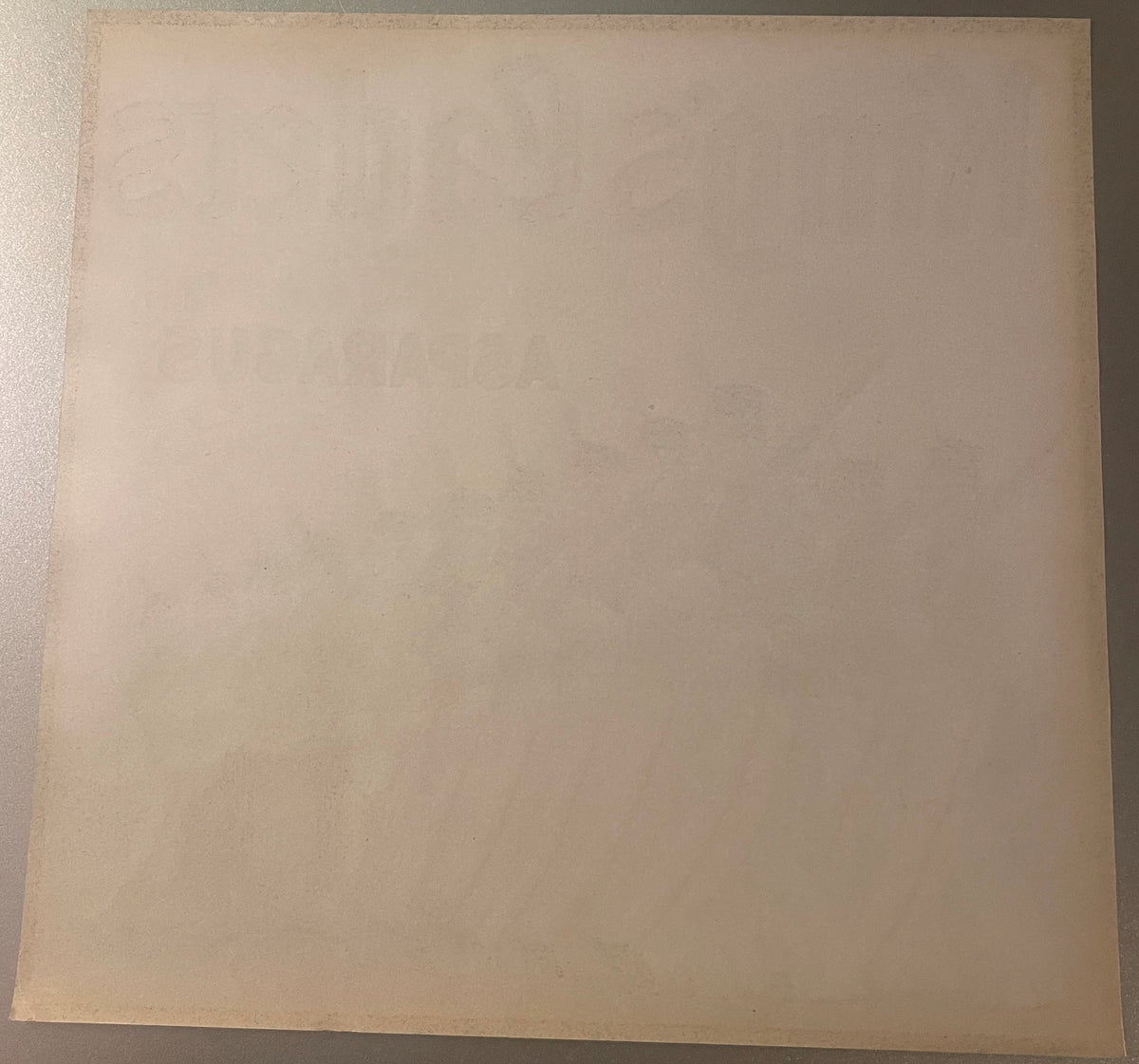
Every wooden crate end needed its own pasted label, so packers kept stacks of them ahead of the season. This one never reached a crate. Its back is plain paper with only a faint mirror image of the front showing through, and its yellow, green, red and gold are still strong.
New old stock: a single original lithographed paper label, never applied. Blank reverse with light show-through of the front, bright face, strong color. Offered exactly as pictured.
A Clarksburg, California asparagus firm whose names run along the ribbon beneath the crest. The UC Davis Library lists the pair as creators of this brand's label.
Because the packers were named King. The brand gave the family a crown and a shield and set the crop where a heraldic lion would sit.
They were cut for the end panel of the tall pyramid asparagus crate, whose sides slope inward toward the top to follow the taper of the spears.
It carries the Crocker-Union printer's imprint, a name first used in 1936, so it was printed in 1936 or later.
Yes. It is an original lithographed paper label, unused, with a blank back.
In Yolo County, downriver from Sacramento where the Delta begins. Once asparagus and sugar beet country, it is known today for wine grapes and The Old Sugar Mill.
Items from Vetted Pro Collectors
Shipping for items offered by vetted Pro Collectors is determined at checkout. All Pro Collector listings are reviewed to ensure fair, reasonable shipping practices.
For full details, please refer to our Shipping Policy.
Take your time — you've got a full six months. If a piece isn't right for you, send it back the way it reached you and we're good.
In the first 30 days your money goes straight back the way you paid. After that it's store credit, so you can put it toward something you'd rather have.
Return shipping we sort out between us, case by case. I don't make this difficult.
If something arrives damaged, or it isn't what I said it was, send me a photo within 48 hours and I'll make it right.
Email info@vintageantiquesgifts.com or call 802-356-9872 — that's me answering, not a call center.
The only things I can't take back are custom or special-order pieces and gift cards.