Skip to product information
1 of 3

Vintage and Antique Gifts

Antique Little Jewel Blindmade Broom Label Pennsylvania Working Home for Blind Men Philadelphia Patriotic Eagle WWI Era NOS 🧹

Antique Little Jewel Blindmade Broom Label Pennsylvania Working Home for Blind Men Philadelphia Patriotic Eagle WWI Era NOS 🧹

Regular price 17.00 USD
Regular price Sale price 17.00 USD
Sale Sold out
Shipping calculated at checkout.
Quantity

Size: 6 x 3.5 inches

What Does a Broom Label Tell You About the Men Who Made It? 🦅

There is a particular kind of object that historians overlook precisely because it was never meant to last. A broom label. Gummed paper, printed in a small run, destined to be glued to a wooden handle and carried into a kitchen or a parlor or a factory floor — and eventually thrown away when the broom wore down to nothing. That most of them didn't survive is exactly what makes the ones that did so extraordinary. This one survived because it was never applied. It sat, perfectly flat, in storage across more than a hundred years of American history — through two World Wars, through the Depression, through the long slow transformation of West Philadelphia from streetcar suburbs to urban institution corridor — and it came out the other side with its color intact, its paper crisp, and its eagle still fierce.

Hold that in mind for a moment. A piece of printed ephemera from the WWI era, New Old Stock, never used. That almost never happens.


🏷️ What This Is — The Object Itself

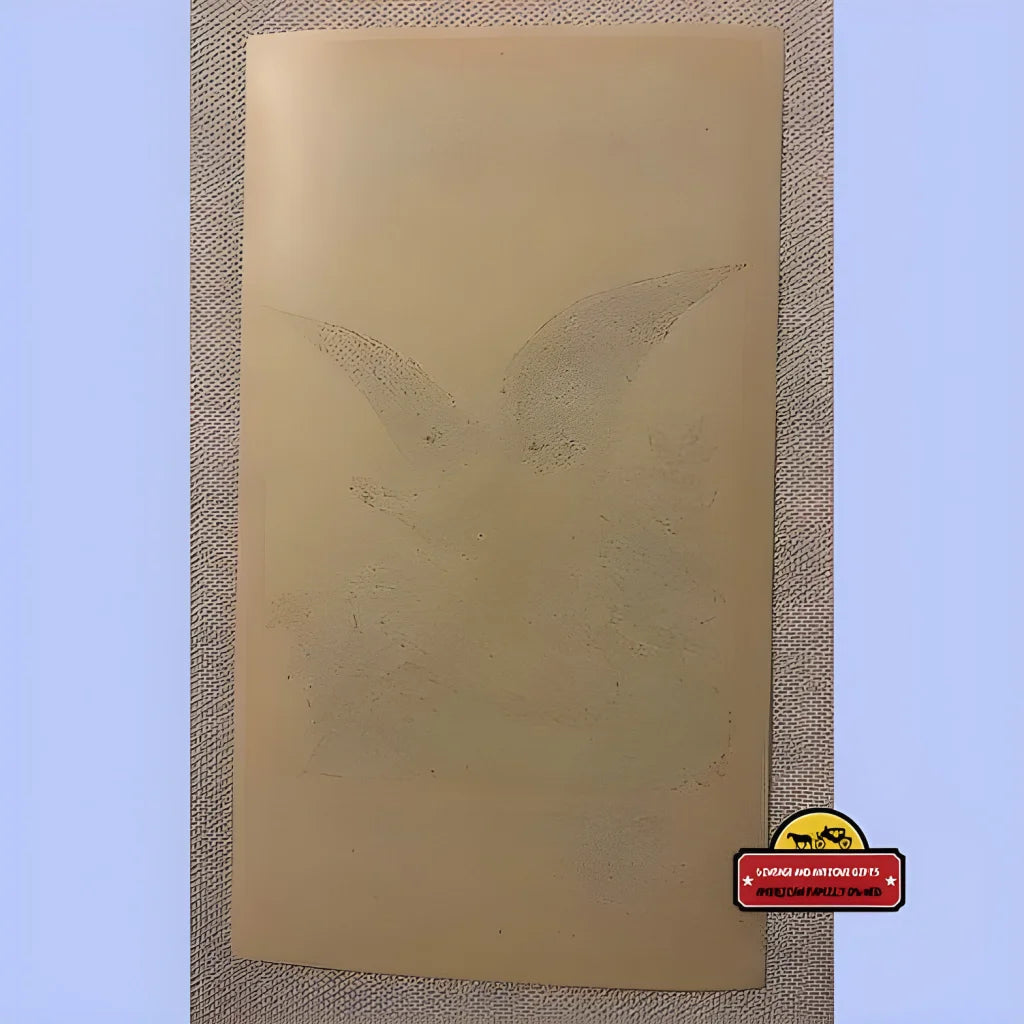
This is an antique broom label — NOS, meaning New Old Stock, printed and never applied — produced for the Pennsylvania Working Home for Blind Men, located at 3518 Lancaster Avenue in West Philadelphia, Pennsylvania. The brand name printed across the top of the label is "Little Jewel," rendered in a heavy Gothic blackletter typeface that was the commercial printing standard of the late nineteenth and early twentieth centuries. Below the brand name, a bold American bald eagle spreads its wings in a fierce downward sweep, talons gripping a shield bearing stars — a patriotic design firmly rooted in the iconography of the WWI era, when American manufacturing was proud to display its eagle and mean it.

The label is a period chromolithograph or letterpress commercial print — the kind of trade label work produced by specialty job printers who served regional manufacturers across Pennsylvania and the mid-Atlantic states. It was designed to identify a finished product coming out of a sheltered workshop that had, by the time this label was printed, already been operating for several decades and earning a reputation as one of the most respected industrial rehabilitation institutions in the Delaware Valley. The color holds. The structure holds. The paper has not foxed, has not crumbled, has not yellowed into illegibility. It is, in the very literal sense of the term, a jewel — small, precise, and against all odds, intact.


🏛️ The Pennsylvania Working Home for Blind Men — A Philadelphia Institution

The Pennsylvania Working Home for Blind Men was not a charity in the modern passive sense of the word. It was a working institution — and the emphasis on working was intentional, structural, and philosophically central to everything the organization stood for. Founded in 1874, the organization acquired the former Mission House of the Protestant Episcopal Church on Lancaster Avenue in West Philadelphia, and by 1876 the original Workshop was operational. The Factory building followed in 1890–1891. The Administration Building went up in 1891–1892. Annual reports were filed beginning in 1875, creating a paper trail of production records, financial accountability, and institutional mission that runs deeper than most private manufacturers of the same era could claim.

The campus occupied the hexagonal city block formed by Lancaster Avenue, 34th Street, 35th Street, and Warren Street — a tightly organized industrial footprint embedded in a residential and commercial streetcar neighborhood. Most of the city walked past without a second glance. Inside, men who had lost their sight — or who had never had it — were building brooms, brushes, and mops with a precision and consistency that sighted factory observers routinely noted with admiration. The work was not symbolic. It was real production, sold under real brand names, into real markets. "Little Jewel" was one of those brands.

By the WWI era, when patriotic eagle imagery was at its commercial and cultural peak, the Pennsylvania Working Home had been running for over forty years. It was not a new organization capitalizing on wartime sentiment — it was an established institution that had earned the right to put an eagle on its label. The men who made these brooms had been doing skilled handwork for decades. The label reflected that confidence.


🌿 Lancaster Avenue, West Philadelphia, and the World That Surrounded This Label

Lancaster Avenue in West Philadelphia is one of those old diagonal streets that cuts across the grid at an angle, following the track of what was once a turnpike running out from Center City toward Lancaster, Pennsylvania — hence the name. By the late nineteenth century it was a dense commercial and residential corridor, served by streetcar lines, lined with row houses and small businesses, and increasingly surrounded by the institutional infrastructure that would eventually define West Philadelphia: universities, hospitals, churches, and organizations like the Pennsylvania Working Home.

The neighborhood around 34th and Lancaster was a working neighborhood. Not wealthy, not fashionable — functional. The kind of place where a man could walk to work, where local families knew the names of the institutions on their block, and where the products made inside those buildings were used in the homes of people who lived within walking distance. A broom made at 3518 Lancaster Avenue might have been purchased by someone who lived three blocks away on Warren Street, who swept her kitchen floor with it every morning without ever once thinking about how precisely the blind men who made it had tied the broomcorn to the handle.

The building that stood on that footprint no longer stands the way it once did. West Philadelphia has changed — dramatically, repeatedly, and in ways that have erased a great deal of what was there before. The Lancaster Avenue corridor has been reshaped by the growth of Drexel University and the University of Pennsylvania, by urban renewal projects, by the slow attrition of older industrial structures. The brick walls of the Pennsylvania Working Home's campus have not survived in their original form. Which is precisely why objects like this label carry a weight they might not otherwise bear. They are what remains.


🦅 The Eagle, the Era, and What WWI-Era Patriotic Commercial Art Actually Looked Like

Collectors sometimes casually throw the term "WWI era" onto anything printed before 1920, but in the case of this label, the eagle design earns that designation honestly. The downward-sweeping bald eagle gripping a starred shield is a very specific visual vocabulary — it belongs to the period between roughly 1898 and 1920, when American commercial graphic design leaned hard into patriotic imagery as a mark of quality, domestic origin, and civic pride. This was not decorative nationalism for its own sake. It was a message to the buyer: this product was made here, by people you can trust, under conditions that deserve your respect.

For the Pennsylvania Working Home for Blind Men, that message had additional resonance. The men making these brooms were demonstrating capability, dignity, and productive citizenship — values that the patriotic eagle on the label was meant to reinforce visually before a single word was read. The Gothic blackletter typeface of "Little Jewel" added another layer: old-world craftsmanship, solidity, permanence. These were deliberate design choices made by a printer who understood what the label needed to communicate, and they were made for a client — the Pennsylvania Working Home — that had thirty or forty years of institutional reputation behind it and wanted a label that matched that standing.

NOS commercial trade labels from this period are among the most collectible of American printed ephemera precisely because the ones that survived intact did so entirely by accident. They were not archived. They were not preserved. They were simply stored — in a back room, in a flat file, in a cardboard box in a basement — and forgotten, while the world changed around them. Finding one with color this strong and structure this intact, from an institution as historically specific as the Pennsylvania Working Home for Blind Men, is genuinely uncommon.


🖼️ Display Ideas

  • 🪟 Frame it flat under UV-protective glass alongside other Pennsylvania trade labels or Philadelphia institutional ephemera — it holds its own as a standalone graphic object, and the eagle reads beautifully from across a room.
  • 📚 Mount it in a shadow box with a period household broom or broom fragment, a Philadelphia streetcar transfer from the Lancaster Avenue line, and a reproduction map of the West Philadelphia neighborhood — a complete micro-exhibit of a single block's history.
  • 🏛️ Display it in a study or library dedicated to American labor history, disability history, or Philadelphia civic history — it functions as a primary source object that speaks to all three simultaneously.
  • 🎨 Group it with other WWI-era patriotic commercial ephemera — eagle-themed trade cards, cigar labels, seed packets — where the graphic language of the period creates a coherent visual conversation.
  • 🛋️ Use it as a focal point in a vintage Philadelphia-themed room, paired with period photographs of Lancaster Avenue, Drexel Institute, or West Philadelphia streetscapes from the 1900s–1920s.
  • 🗂️ Integrate it into a research collection on sheltered workshops, American labor reform, or the history of disability employment — it is as much a document as it is an artifact, and it deserves to be treated as both.

🎁 Who Collects These

The collector field for antique broom and household trade labels is smaller than it is for tobacco labels or seed packet art, which means the people who pursue them tend to know exactly what they're looking for and why. Philadelphia ephemera collectors are one natural audience — anyone building a serious collection of printed material from the city's industrial and institutional history will recognize the Pennsylvania Working Home for Blind Men immediately and understand exactly what this label represents. It's not a supporting piece. It's a centerpiece.

Collectors of American disability history and labor reform history represent another passionate and growing community. The Pennsylvania Working Home for Blind Men is a documented, historically significant institution with a paper trail going back to 1875, and material culture from that institution — especially NOS printed ephemera in this condition — is rare enough that it belongs in serious collections. Scholars and curators working in this space know how few objects survive.

Graphic design historians and collectors of commercial printing art are drawn to WWI-era patriotic trade labels as a specific subcategory — the blackletter type, the eagle design, the chromatic choices of the period all represent a distinct chapter in American commercial art that is increasingly well-documented and increasingly collected. And then there are the pure Philadelphia enthusiasts: people who grew up in West Philadelphia, who know Lancaster Avenue, who have a personal or family connection to the neighborhood and its institutions. For them, this label is not just a collectible. It is a piece of a place that has changed beyond recognition, held still in paper and ink.


❓ Frequently Asked Questions

What exactly is "New Old Stock" and why does it matter for this label?

New Old Stock — NOS — means that this label was produced during its original era of manufacture and was never used. It was printed, stored, and never applied to a broom handle. This matters enormously for paper ephemera because the physical and chemical degradation that happens to a label once it has been glued to a wooden surface, exposed to moisture, handling, cleaning products, and eventually disposal is severe and irreversible. A NOS label bypassed all of that. It has been aging only in the way that flat, protected paper ages — slowly, in the dark, without mechanical stress. The color retention and structural integrity you see in this label are the direct result of that NOS status. Applied vintage broom labels in this condition essentially do not exist. NOS ones survive only when someone happened to set a stack of extras aside and forget about them for a century.

How can I tell this is genuinely from the WWI era and not a later reproduction?

The combination of printing technique, typeface selection, paper stock, and iconographic vocabulary places this label firmly in the late nineteenth to early WWI era of American commercial printing. The Gothic blackletter display type was a standard choice for trade names in this period and fell sharply out of commercial fashion after the 1920s. The specific rendering of the patriotic eagle — downward sweep, starred shield, the particular weight of the engraving — is consistent with American commercial art from the 1900–1920 window. The paper itself shows the aging characteristics of period stock: not the uniform brightness of modern paper, but the warm, slightly ivory tone that comes from a century of slow, natural oxidation in protected storage. There is no reproduction printing of this specific label, and the institutional history of the Pennsylvania Working Home for Blind Men is documented and verifiable going back to 1875.

Is the Pennsylvania Working Home for Blind Men still operating?

The institution as it existed on Lancaster Avenue — the brick campus at 3518, with its Workshop, Factory, and Administration Building — no longer stands in its original form. West Philadelphia underwent significant physical transformation through the twentieth century, and the specific hexagonal campus bounded by Lancaster, 34th, 35th, and Warren streets has changed dramatically. The organizational history of the Pennsylvania Working Home for Blind Men is documented in annual reports dating from 1875 onward, and those records are a resource for historians researching the institution's full arc. What this label represents is a specific, bounded era — the operating peak of a functioning industrial sheltered workshop that was making household goods under brand names like "Little Jewel" and selling them into regional markets. That era is over. This label is one of its surviving documents.

Why is the "Little Jewel" brand name so specific — did the Pennsylvania Working Home make other broom brands?

Sheltered workshops of this period commonly produced goods under multiple brand names differentiated by size, quality tier, or intended market — much as a regional brewery might have several named beers or a textile mill several named fabric grades. "Little Jewel" almost certainly referred to a smaller household broom rather than an industrial floor broom, and the name was chosen to position it as a domestic premium product: small, precise, something a householder could take pride in owning. Whether the Pennsylvania Working Home used additional brand names for other product lines is a question for institutional historians with access to their annual reports and production records. What this label tells us is that "Little Jewel" was a finished, market-ready brand — complete with its own typeface treatment, its own eagle, and its own visual identity — which means it was produced with enough regularity to justify the cost of label design and printing.

How should I store or frame this label to protect it?

Paper ephemera of this age benefits from archival handling: acid-free materials wherever it makes contact, UV-filtering glazing if framed, stable temperature and humidity away from exterior walls, heating vents, and direct light. If you choose to mat and frame it, a conservation-quality mat with a backing of archival foam board or ragboard will protect the paper without introducing acids that accelerate degradation. The label's current condition — crisp, colorfast, structurally sound — reflects a century of fortunate storage; the goal of any framing or housing solution is simply to continue that good fortune deliberately rather than by accident.

Is this the kind of piece that belongs in a museum or institutional collection?

Honestly, yes — and if a museum or archival collection focused on Philadelphia history, American labor history, or disability history wants to pursue it, that would be a genuinely fitting home. The Pennsylvania Working Home for Blind Men is a documented Philadelphia institution with a history running from 1874 through the twentieth century, and NOS printed material from its production operations is exactly the kind of primary-source object that institutional collections seek. That said, private collectors of Philadelphia ephemera, American trade label art, and WWI-era commercial printing have built serious and well-documented collections of material at this level, and a piece like this is well-served by any owner who understands what it is and cares for it accordingly.

What makes this label different from other antique broom or household product labels?

Three things, working together. First, the institutional identity: this is not a generic brand label from an anonymous regional manufacturer. It is a label produced by and for a specific, named, historically documented Philadelphia institution with a forty-plus-year operational history at the time of printing. That provenance is not common in surviving trade ephemera. Second, the condition: NOS paper labels from the WWI era with this degree of color retention and structural integrity are genuinely uncommon. Most labels from this period that have survived did so attached to objects, where they were exposed to the full range of physical abuse that working tools absorb. Third, the graphic quality: the combination of Gothic blackletter, patriotic eagle, and the specific name "Little Jewel" creates a label design that is memorable, readable, and visually striking even a century after it was printed. It was made well. It survived well. Those two things together are what collectors spend years looking for.

Shipping

🚚 Shipping & Handling

  • Shipping costs and timing are calculated at checkout.
  • Items curated and shipped directly by me include U.S. shipping at no additional cost, professionally packed to ensure safe arrival of your artifact.

Items from Vetted Pro Collectors
Shipping for items offered by vetted Pro Collectors is determined at checkout. All Pro Collector listings are reviewed to ensure fair, reasonable shipping practices.

For full details, please refer to our Shipping Policy.

Returns & Exchange

Take your time — you've got a full six months. If a piece isn't right for you, send it back the way it reached you and we're good.

In the first 30 days your money goes straight back the way you paid. After that it's store credit, so you can put it toward something you'd rather have.

Return shipping we sort out between us, case by case. I don't make this difficult.

If something arrives damaged, or it isn't what I said it was, send me a photo within 48 hours and I'll make it right.

Email info@vintageantiquesgifts.com or call 802-356-9872 — that's me answering, not a call center.

The only things I can't take back are custom or special-order pieces and gift cards.

View full details