Skip to product information
1 of 2

Vintage and Antique Gifts

Vintage 1950s Oregon Loganberries Crate Label 🍓 Oregon Fruit Products Co. Salem

Vintage 1950s Oregon Loganberries Crate Label 🍓 Oregon Fruit Products Co. Salem

Regular price 10.00 USD
Regular price Sale price 10.00 USD
Sale Sold out
Shipping calculated at checkout.
Quantity

🍓 The Berry Salem Bet On

In loganberry country the boast went like this: "Eighty percent of the world's loganberries grow within thirty miles of Salem, Oregon." For a few heady years the loganberry was Salem's fruit, pressed into juice, put up in cans and jars, and advertised from coast to coast. Today most Americans have never tasted one. This label, with LOGANBERRIES set in the middle of a painted harvest and OREGON arched across the top, is a small piece of that Salem story.

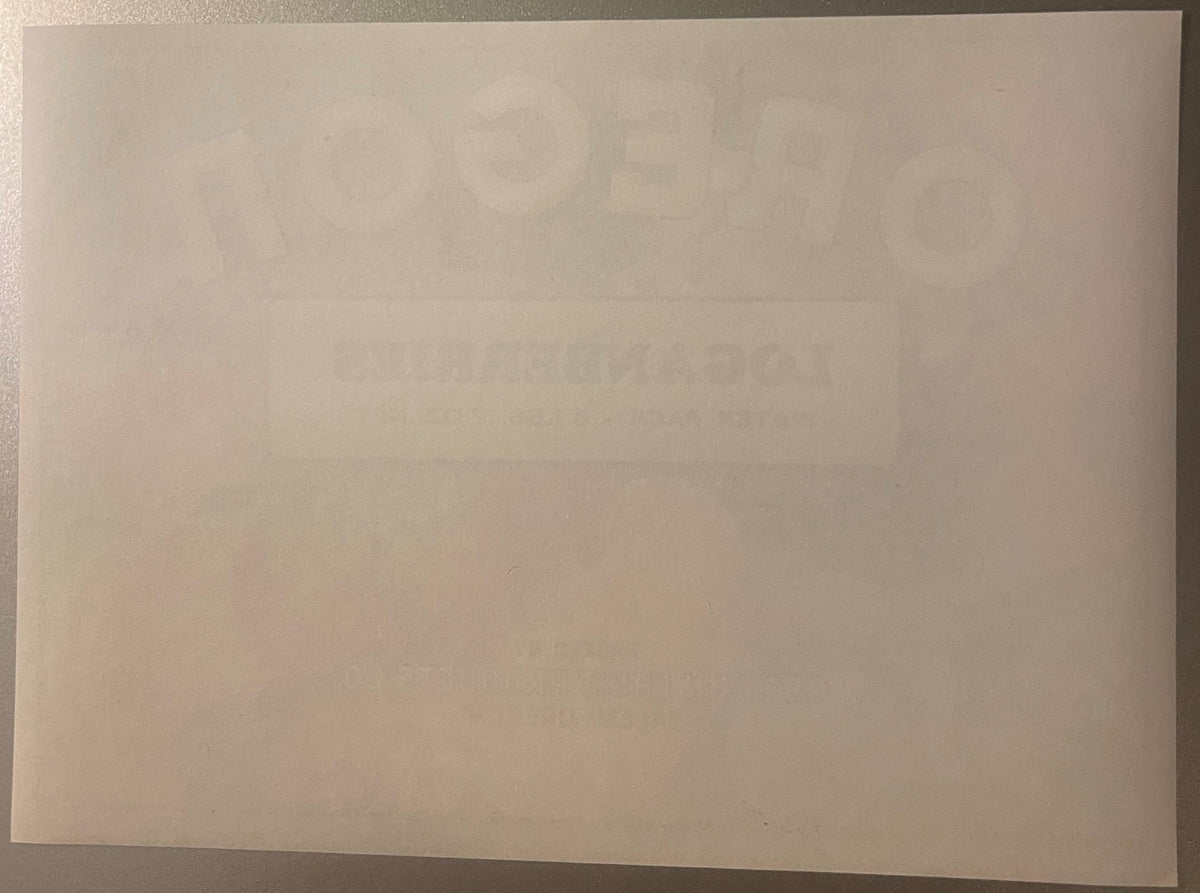
It is a 1950s Oregon Loganberries crate label for berries packed by the Oregon Fruit Products Co. of Salem, Oregon, and it measures 9 x 6 inches. The sheet is unused, its back clean and blank.


What the Label Says and Shows

Every word on the sheet, top to bottom:

  • OREGON, arched across the top in big yellow letters, each with a white stripe inside and a dark outline
  • LOGANBERRIES in dark serif capitals on a pale yellow panel, and under it WATER PACK - 6 LBS. 7 OZ. NET
  • PACKED BY OREGON FRUIT PRODUCTS CO. SALEM - OREGON at lower center, in yellow and white outlined letters
  • NATURE'S TWO FRUIT FAMILIES - CITRUS - NON CITRUS - EAT BOTH FOR HEALTH in pale blue capitals along the maroon border

Behind the lettering, a painted harvest fills every inch of a near-black ground: a big red apple and bright red cherries at the upper left; dark, nearly black cherries and pale green striped gooseberries at the lower left; clusters of blackberries and red bramble berries throughout; a dark purple plum at the upper right with yellow cherries blushed red below it; two strawberries with green caps and yellow seeds at the center; a golden pear; and a peach glowing at the lower right. Green leaves tuck in behind all of it, and the maroon border frames the whole sheet.

Read the slogan twice and there is a small irony in it. The label tells you to eat from both of nature's fruit families, citrus and non-citrus, and then pictures only one of them: there is not an orange or a lemon anywhere on the sheet.

Water pack means the fruit was packed in water rather than sugar syrup, and the net weight printed under the name promises more than six pounds of berries.


🫐 Judge Logan's Accident

The loganberry began as an accident in a California garden. In 1881 Judge James Harvey Logan (1841-1928) of Santa Cruz, a judge and amateur plant breeder, was growing blackberries of the Aughinbaugh variety and happened to plant them beside an old red raspberry, the Red Antwerp. The plants bloomed and ripened their fruit together, crossed on their own, and the seedlings gave him a new berry, half blackberry and half raspberry by parentage, that took his name. Plants descended from Logan's original were introduced to Europe in 1897.


🌆 Salem, Loganberry Town

According to the berry's own publicity, farmer Gus Freniard brought the first loganberry plants to Salem in 1899, and his stock went to seed sellers who promoted it as "the largest and most beautiful" berry. The Willamette Valley suited it, and Salem took to it.

Then came prohibition. Local prohibition laws took hold in Salem in 1913, and the Salem Brewery Association was left with a plant and nothing to make in it. In 1915 two Salem companies incorporated, within days and a few blocks of each other, to press loganberry juice on an industrial scale. The brewery reorganized as the Northwest Fruit Products Company and sold a loganberry drink called Loju. The other company's juice was Phez, marketed as a substitute for alcohol. The Willamette Heritage Center records that this second firm started out under the name Oregon Fruit Products before rechristening itself the Pheasant Company. The Salem Fruit Union had already pressed 2,500 gallons of loganberry juice in 1914, and by the end of 1915, once an enameled can was developed, loganberry jams and jellies had caught on as well.

Salem went all in. In July 1915 Oregon's commissioners to the Panama-Pacific International Exposition in San Francisco announced they would celebrate a "Loganberry Day" at the fair. Juice makers spent as much as $700,000 on advertising aimed at hotels, clubs and railway lines across the country. In 1918 the Pheasant Fruit Company merged with the Northwest Fruit Growers Association.

The boom did not last. By the 1920s the market was showing strain and shrinking, and in the late 1930s the boysenberry cut further into the loganberry's trade. By 2002 Oregon's loganberry crop had fallen to about 45 tonnes, grown on 28 hectares.


🏭 Oregon Fruit Products Co.

Max Gehlar founded Oregon Fruit Products in Salem in 1935 to can the Willamette Valley's cane berries and cherries, and the first cans of Oregon Fruit were packed that year. Three generations of Gehlars ran the company from its original West Salem location before Ed and Cyndy Maletis bought it in 2011. In 2018, after 83 years in West Salem, it moved into a former NORPAC cannery, and it still sells Oregon fruit today as Oregon Fruit.


🍹 Where the Loganberry Lives On

Oregon's juice boom faded, but the loganberry found a second life far to the east. It became a popular drink flavor in Western New York and parts of Southern Ontario, a tradition that began at Crystal Beach Park in Ontario, and companies there still bottle loganberry drinks. The berry itself remains a hard sell to commercial growers: the canes are thorny, the fruit hides under the leaves, and berries on the same plant ripen at different times, which makes picking slow.


🖼️ Display Ideas

  • 🖼️ Frame it on its own; the sheet suits a small kitchen or dining room frame
  • 🍒 Hang it with other Pacific Northwest fruit labels for a regional wall
  • 🧺 Pair it with canning jars or berry baskets on an open shelf
  • 🎁 Give it to someone from Salem, the Willamette Valley, or Western New York loganberry-drink country
  • 📚 Keep it in an archival sleeve with other food and grocery advertising

❓ Questions People Ask

Who packed the loganberries this label was made for?

Its printed packer line names Oregon Fruit Products Co., in Salem, Oregon.

How old is it?

It is a 1950s label. No year is printed on it.

What is a loganberry?

A hybrid berry, the offspring of an Aughinbaugh blackberry and a Red Antwerp raspberry, that appeared in Judge Logan's Santa Cruz garden in 1881.

What does "water pack" mean?

The berries were packed in water, not sugar syrup.

What does the slogan mean?

It divides fruit into citrus and non-citrus kinds and tells the reader to eat both for good health. Every fruit pictured on this label comes from the non-citrus side.

Is the label unused?

Yes. It is a loose sheet that was never applied, with a clean, blank back.

What size is it?

9 inches by 6 inches.

Why was Salem called loganberry country?

Salem was the heart of the loganberry trade in the 1910s: its juice companies, the Salem Fruit Union and Oregon's "Loganberry Day" at the 1915 exposition all grew out of it, and the boast held that most of the world's loganberries grew within thirty miles of town.

Shipping

🚚 Shipping & Handling

  • Shipping costs and timing are calculated at checkout.
  • Items curated and shipped directly by me include U.S. shipping at no additional cost, professionally packed to ensure safe arrival of your artifact.

Items from Vetted Pro Collectors
Shipping for items offered by vetted Pro Collectors is determined at checkout. All Pro Collector listings are reviewed to ensure fair, reasonable shipping practices.

For full details, please refer to our Shipping Policy.

Returns & Exchange

Take your time — you've got a full six months. If a piece isn't right for you, send it back the way it reached you and we're good.

In the first 30 days your money goes straight back the way you paid. After that it's store credit, so you can put it toward something you'd rather have.

Return shipping we sort out between us, case by case. I don't make this difficult.

If something arrives damaged, or it isn't what I said it was, send me a photo within 48 hours and I'll make it right.

Email info@vintageantiquesgifts.com or call 802-356-9872 — that's me answering, not a call center.

The only things I can't take back are custom or special-order pieces and gift cards.

View full details
  • 5 stars: 1 (100%)
  • 4 stars: 0 (0%)
  • 3 stars: 0 (0%)
  • 2 stars: 0 (0%)
  • 1 star: 0 (0%)
d
d***_ (17)

I love this label. So graphic and beautiful. It arrived quickly and was well packed. It was in perfect condition. the quality is great. I have it framed and hangig in my kitchen