Skip to product information
1 of 4

Vintage and Antique Gifts

Vintage 1950s William Tell Brand Apples Crate Label 🍎 R.N. Barber & Co. Waynesville NC Chromolithograph Fruit Crate Advertising Art

Vintage 1950s William Tell Brand Apples Crate Label 🍎 R.N. Barber & Co. Waynesville NC Chromolithograph Fruit Crate Advertising Art

Regular price 6.00 USD
Regular price Sale price 6.00 USD
Sale Sold out
Shipping calculated at checkout.
Quantity

🏹 Ever wonder why a Swiss legend was aiming a crossbow at a boy's head on a crate of North Carolina apples? 😍

Long before supermarket produce came shrink-wrapped and barcoded, a wooden crate of apples rolling off a mountain rail line had exactly one shot at catching a grocer's eye — and that shot was the label pasted to its end. This one did its job beautifully. A steady-handed archer in a feathered cap, bow drawn, arrow already loosed toward a bright red apple balanced on a boy's head beneath a mountain oak — it's one of the most instantly readable pieces of storytelling ever slapped on a shipping crate, and it sold apples for decades out of the Great Smoky Mountains. I've handled a lot of crate labels over the years, and I still stop every time I come across a William Tell.

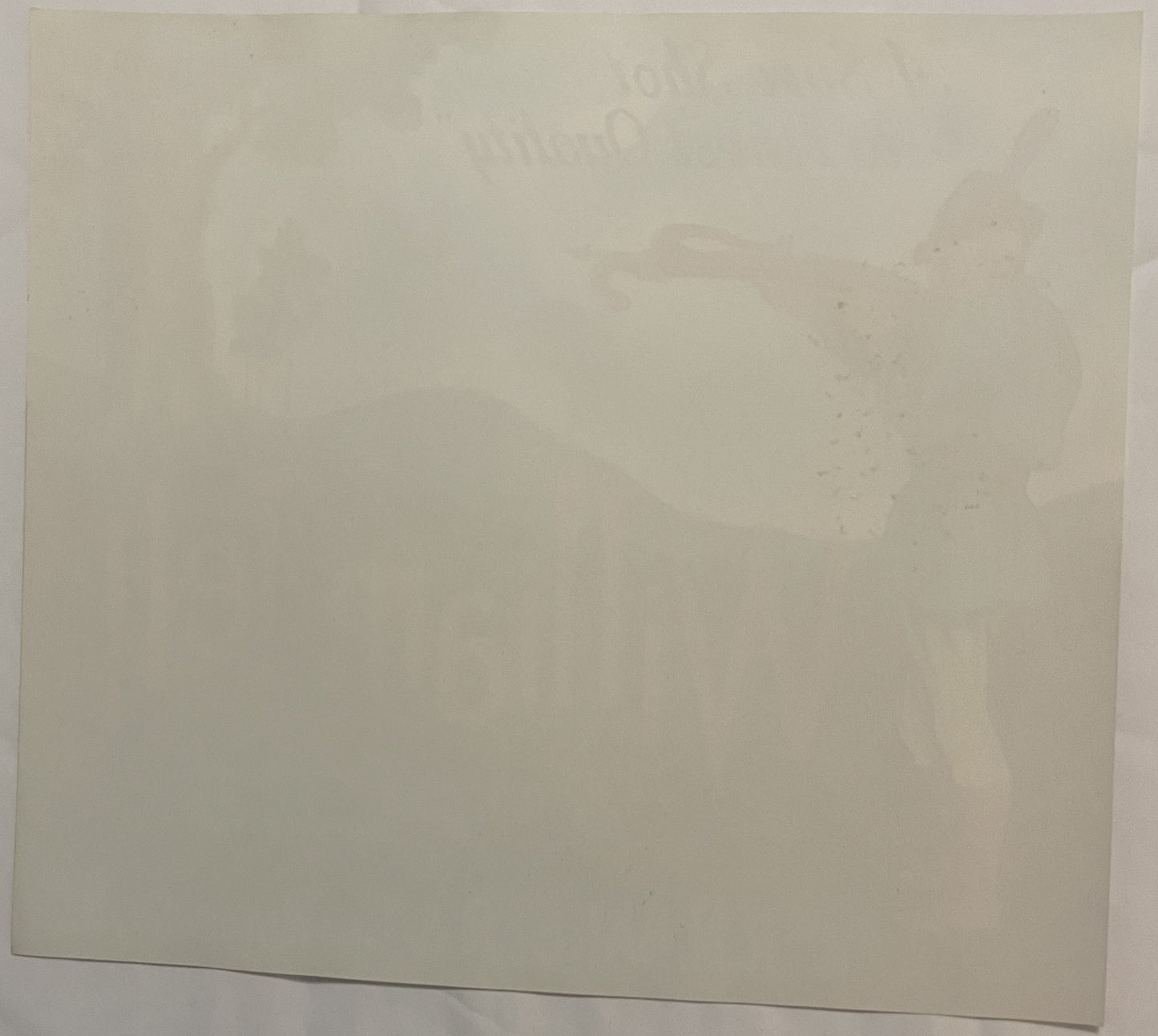
What you're holding is an original William Tell Brand Apples crate label, grown and packed by R.N. Barber & Co. of Waynesville, North Carolina, a genuine early-to-mid-20th-century chromolithograph produced in the 1940s and into the 1950s, measuring 9 x 8 inches.

This is New Old Stock (NOS) — never used on a crate, never shipped, simply held back from a packing house's supply decades ago. The artwork carries the full punch of period commercial lithography: a bold script "A Sure Shot to Finest Quality" arcs across a pale blue mountain sky, the archer stands in green tunic and orange-yellow striped hose with a purple-feathered cap and full blond beard, his crossbow angled toward a distant oak where a green-shorted, red-shirted boy waits calmly with the apple balanced on his head.

Behind them both rolls a soft blue-grey silhouette of mountain ridgeline, with a stand of dark evergreens breaking up the middle distance. Below, the name "William Tell" explodes across the lower third in tall, flame-orange lettering, "Brand Apples" in smaller brown and pale-blue type, and the grower's line — "Grown by R.N.

Barber & Co. – Waynesville, N.C." — anchors the whole composition in cool blue against near-black shadow. It's a striking, confident piece of mid-century produce advertising art, built to be seen from across a produce dock.


🏹 The Legend Behind the Label

The man on this label isn't a packing-house invention — he's borrowed straight from one of Europe's oldest folk heroes. William Tell is remembered in Swiss legend as a master marksman and a fierce defender of his people's liberty, a kind of Alpine cousin to Robin Hood, celebrated for his uncanny accuracy with a crossbow and his skill in the high wilderness.

As the story goes, a tyrannical Austrian bailiff named Gessler forced Tell to shoot an apple off the head of his own young son as punishment for refusing to bow to Gessler's hat on a pole — and Tell, without flinching, split the apple clean. That single, impossible shot became the founding myth of Swiss defiance and, eventually, of the Swiss Confederacy itself.

Collectors and old-timers who've traded in this lore for years also pass down the ending of the tale less often printed in the schoolbooks: that William Tell, the father of that Confederacy, met his own end in 1354 attempting to save a child's life from drowning in a mountain river — a hero to the last, on land as in legend.

It's a striking thing to think that a Swiss folk hero from the 1300s ended up as the marketing face of North Carolina apple crates six centuries later, but that's exactly the kind of borrowed grandeur that makes crate label art so much fun to collect — a grower reaching for the world's most famous "sure shot" to promise the finest quality apples in the crate.


🍎 R.N. Barber & Co. — A Mountain Apple Empire

The company behind this label was no fly-by-night packer — it was one of the defining apple operations of western North Carolina for the better part of a century. Exactly when it began is one of those delightful puzzles that comes with digging into small-town commercial history: one local retrospective places founder Richard Barber, Sr. — a sales representative traveling for the McCormick and Deering farm equipment line — purchasing orchard land in the Saunook community of Haywood County as early as 1890.

Another account, from the trade press, has him as an "enterprising traveling salesman" peddling hardware up and down the East Coast around 1902, so taken with an apple grower's operation he encountered in New York that he came home, cleared pine timber off a stretch of mountain land, and planted his first trees in 1903.

Yet a third source — the present-day operators of the historic Barber orchard property — date the founding to 1910. Three respected sources, three different years; rather than pretend one is gospel, I think it's worth knowing that the orchard's true beginning sits somewhere in that turn-of-the-century window, however the exact year shakes out, and that the Ephemera Society of America's own catalog record settles on 1903 as the year R.N.

Barber & Co. began growing and packing apples in the mountains, continuing under the William Tell name until the orchard's ultimate demise decades later.

The operation grew enormously under the founder's son. Richard "Dick" Barber, Jr. took the reins at just 23 years old — by one account in 1929, the very year the country tumbled into the Great Depression — inheriting an orchard of about 120 acres and roughly 10,000 bearing trees. By the time he sold it half a century later, it had swelled past 400 acres and 30,000 trees, and by the Depression years the orchard was already pushing 500 acres, with the William Tell brand established as one of the most popular and long-lived apple labels the region ever produced.

Dick Jr. opened the operation's retail fruit stand in the early 1930s and later modernized the whole enterprise with a cold-storage system, which freed him from relying only on old thick-skinned keeper apples and let him branch into newer varieties like Golden Delicious and Gala. Worth knowing for any fellow label collector: "William Tell" wasn't a variety of apple at all — it was the top packing grade, the company's premium brand name stamped across the best fruit in the crate, alongside other in-house grades the operation used like Water Rock Knob and Clay Hill.

The family's own history notes the William Tell name stayed in use on their bushel boxes for generations, a mark of quality rather than a description of the apple itself. Old-timers in the trade also recall that the William Tell brand found its way onto the shelves of the A&P Tea Company, one of the orchard's earliest and steadiest retail clients, carrying Barber apples out of the mountains and into grocery stores far beyond North Carolina.

The orchard's story didn't end quietly. Dick Jr. sold the operation in 1977 to the Stewart brothers, Glenn and Gerald, of West Palm Beach, Florida, who took it over with all the same enthusiasm the Barbers had built it with — only to run headlong into a run of brutal luck: high interest rates on their loans through the 1970s combined with a string of freezes, late frosts, and hailstorms that produced seven consecutive crop failures. The mortgage holders foreclosed by the late 1980s, and the Federal Land Bank ended up holding the 400-plus acres that had once been covered in William Tell apple trees. Much of that ground has since become residential — fittingly, one of the neighborhoods built on the old orchard land is named Barber Farms, a quiet echo of the label you're holding now.


🏔️ Waynesville, North Carolina — Gateway to the Balsams

Waynesville itself is a town worth knowing on its own terms, not just as a name at the bottom of a fruit label. It was founded in 1809 on land donated by Revolutionary War veteran Colonel Robert Love, established as the seat of the newly formed Haywood County and named in honor of Love's old commanding officer, General "Mad" Anthony Wayne. Haywood County, in turn, carries the name of John Haywood, the state treasurer — a man who, as North Carolina's own state history records note with a bit of local irony, never actually set foot in the county that bears his name. Waynesville holds a curious footnote in Civil War history too: local lore and documented record both point to it as the site of the last battle of the Civil War, a Confederate victory fought nearly a month after Lee had already surrendered at Appomattox — word, in those days, simply hadn't traveled fast enough into the mountains to stop it.

The town grew slowly at first — incorporated in 1871, it stayed a modest mountain community until the railroad finally reached it in 1884, a connection that changed everything for growers like the Barbers. Once a crate of apples could reach a rail line, it could reach Charlotte, Atlanta, New York — anywhere a produce buyer had money to spend, which is precisely why a mountain packing house needed a label bold enough to be remembered on a crowded produce dock hundreds of miles from the orchard that grew the fruit. Today Waynesville has grown into the largest town in North Carolina west of Asheville, but in the era this label was printed, it was still very much an orchard town, its economy tied tightly to the mountainsides of apple trees around it.


🖨️ The Art of the Crate Label

Chromolithography was the workhorse art form of American produce advertising for the better part of a century, and this label is a fine, colorful example of the craft at full strength — layered inks in blue, green, orange-red, yellow, brown, and black, built up to give the illustration real depth and shine on a printed sheet meant to be seen at a glance.

Crate labels like this one were part of a genuinely competitive visual marketplace: dozens of growers shipping the same fruit from the same regions needed their crates to stand out to wholesale buyers sorting through stacks of identical wooden boxes, and packing houses across California, the Pacific Northwest, and the Appalachian apple country commissioned increasingly elaborate, colorful artwork to win that split-second of attention.

Even seasoned dealers in this material have never been able to pin down which lithography firm printed the William Tell design — it's one of those quiet mysteries of the trade, where the artwork survived in far greater number than any record of the shop that made it. What is known is that the William Tell design had staying power: it was still being printed in a slightly smaller format years later, a testament to how well the "sure shot" imagery kept working for the Barber operation long after it was first drawn.


🌟 Impact Today

Original fruit crate labels have become one of the great overlooked corners of American folk advertising art, prized today by collectors of Americana, agricultural history, and vintage graphic design alike. The William Tell label carries a bit of extra weight in that world because it sits at the crossroads of two disappearing American stories: the golden age of hand-drawn crate art, and the once-thriving mountain apple orchards of western North Carolina that have largely given way to subdivisions and second homes. Barber Farms, the neighborhood built where the orchard's William Tell trees once stood, is proof enough of how completely that agricultural landscape has changed — which makes a surviving label like this one feel less like ephemera and more like a small, colorful record of a working mountain economy that no longer exists in the same form. It's a piece of the produce aisle's history, the railroad's history, and Waynesville's own history, all folded into one crate label.


🖼️ Display Ideas

  • 🖼️ Float it in a simple black or barnwood frame as a standalone piece of folk-art advertising for a kitchen or dining room wall
  • 🍎 Group it with other fruit-themed crate labels for a gallery wall celebrating America's orchard country
  • 🏹 Pair it with archery or Robin Hood-adjacent decor for a playful, story-driven vignette
  • 🏔️ Display it alongside other North Carolina or Appalachian collectibles as a nod to Waynesville's mountain heritage
  • 🧺 Set it beside a vintage wooden apple crate or fruit basket for an authentic farm-stand tableau
  • 📚 Slip it into a shadow box with old orchard tools or apple-themed ephemera for a layered collector's display

🎁 Who Collects These

Crate label collectors are a wonderfully varied bunch — advertising art enthusiasts chasing bold mid-century lithography, regional historians building out the story of Southern Appalachian agriculture, folks with roots in Haywood County or western North Carolina looking for a tangible piece of home, and everyday gift-givers drawn to a hero-with-a-crossbow motif for anyone who loves archery, folklore, or a good underdog story. It's also a natural pick for kitchen decor lovers who want vintage color and story without committing to a full-size sign, and for anyone building out a farmhouse or orchard-themed room who wants something with real history behind the pretty picture.


❓ FAQ

What is a fruit crate label, exactly?
It's a printed label — in this case a chromolithograph — made to be affixed to the end of a wooden shipping crate, used by growers and packing houses to identify and advertise their fruit as it traveled to market by rail.

Who made the William Tell brand apples?
R.N. Barber & Co., a family-run apple orchard and packing operation based in Waynesville, North Carolina, that grew and shipped apples under this brand across decades of operation in the western North Carolina mountains.

Is "William Tell" a type of apple?
No — it functioned as the packing house's premium grade or brand name, stamped on the best fruit shipped from the orchard, rather than describing a particular apple variety.

How old is this label?
It dates to the 1940s into the 1950s, based on its size, printing style, and the documented production window for this design among crate label specialists.

What condition is it in?
It's New Old Stock (NOS) — an unused label that was never applied to a shipping crate, held in supply and never put into service.

Why is a Swiss legend on a North Carolina apple crate?
William Tell's legendary reputation as the ultimate "sure shot" made him a natural mascot for a grower promising top-quality fruit — a bit of borrowed European folklore doing marketing work for a mountain orchard half a world and several centuries away.

Where was Waynesville, North Carolina, in relation to this orchard?
Waynesville was the home base and shipping point for the R.N. Barber & Co. orchards, a mountain town whose 1884 rail connection made it possible for crates like this one to reach markets far beyond Haywood County.

Shipping

🚚 Shipping & Handling

  • Shipping costs and timing are calculated at checkout.
  • Items curated and shipped directly by me include U.S. shipping at no additional cost, professionally packed to ensure safe arrival of your artifact.

Items from Vetted Pro Collectors
Shipping for items offered by vetted Pro Collectors is determined at checkout. All Pro Collector listings are reviewed to ensure fair, reasonable shipping practices.

For full details, please refer to our Shipping Policy.

Returns & Exchange

Take your time — you've got a full six months. If a piece isn't right for you, send it back the way it reached you and we're good.

In the first 30 days your money goes straight back the way you paid. After that it's store credit, so you can put it toward something you'd rather have.

Return shipping we sort out between us, case by case. I don't make this difficult.

If something arrives damaged, or it isn't what I said it was, send me a photo within 48 hours and I'll make it right.

Email info@vintageantiquesgifts.com or call 802-356-9872 — that's me answering, not a call center.

The only things I can't take back are custom or special-order pieces and gift cards.

View full details
  • 5 stars: 1 (100%)
  • 4 stars: 0 (0%)
  • 3 stars: 0 (0%)
  • 2 stars: 0 (0%)
  • 1 star: 0 (0%)
k
k***e (4581)

Super seller!!! Personal experience…as described….thanks again!!!! A+++++