
Skip to product information
1 of 4

Vintage and Antique Gifts

Vintage 1940s William Tell Cherries Crate Label 🍒 San Joaquin Valley CA NOS

Vintage 1940s William Tell Cherries Crate Label 🍒 San Joaquin Valley CA NOS

Regular price 8.00 USD
Regular price Sale price 8.00 USD
Sale Sold out
Shipping calculated at checkout.
Quantity

🍒 Do You Remember the Legend That Sold California Cherries?

Long before a Swiss folk hero ever had anything to do with California fruit, William Tell was already one of the most recognizable names in Western legend — the marksman forced to shoot an apple off his own son's head, a story of quiet defiance that had been told and retold across Europe for centuries. So when a California packing house went looking for a name and an image bold enough to sell a crate of cherries sight unseen to a wholesale buyer in a crowded rail yard, they reached for a legend everybody already knew. This is an original 1940s William Tell cherries crate label, produced for Anthony A. Bianco, Inc. in California's San Joaquin Valley, and it's New Old Stock — never applied to a crate, never used, preserved in the exact condition it left the print shop more than eighty years ago. 🌲

📏 THE LABEL ITSELF

🍒 Vintage 1940s California cherry crate label, original — not a reprint
🍒 Approximately 10" x 2 1/2" — the long, narrow format typical of crate-end labels
🍒 New Old Stock (NOS): unused, unmounted, never glued to a crate
🍒 Little to no wear, colors still bright and saturated
🍒 Printed via traditional stone or metal-plate lithography

🎯 THE SCENE ON THE LABEL

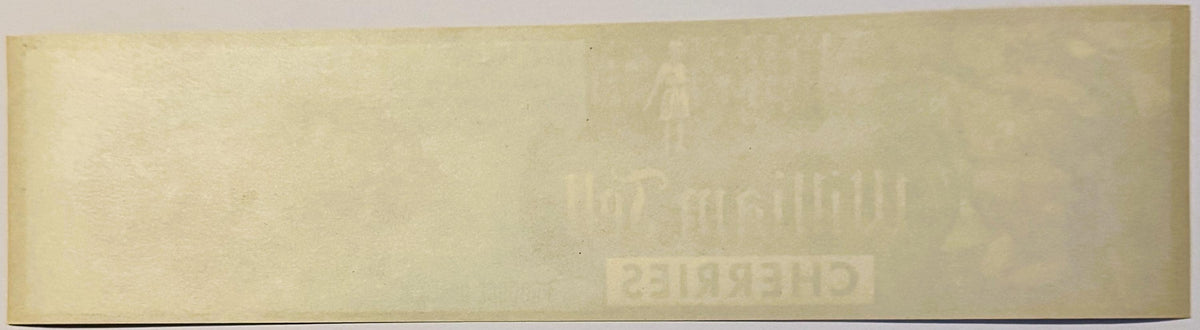
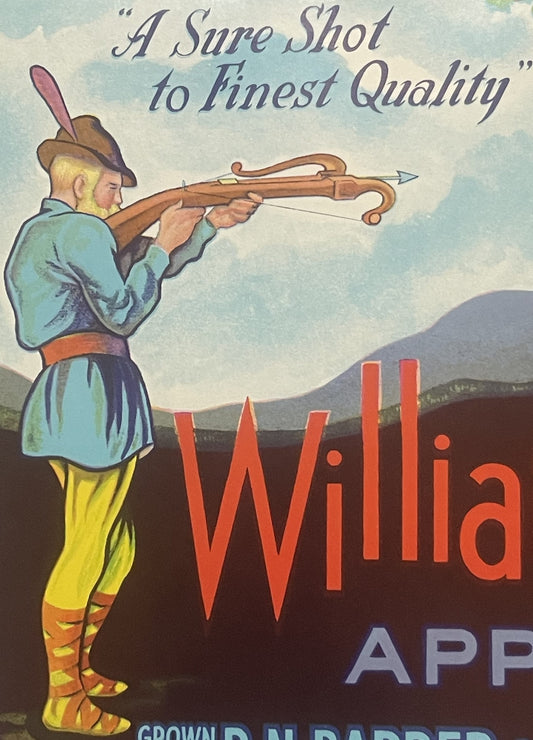
The artwork tells the story in a single frozen moment: William Tell kneels in the foreground, crossbow drawn and aimed, dressed in brown hunting garb with a feathered cap — the classic Alpine huntsman silhouette. In the distance, small against a backdrop of forest, his son stands in a white tunic, waiting. It's the exact instant before the legendary shot, rendered with real dramatic tension for a label meant to be glanced at for less than a second by a produce buyer walking a rail platform. Above the scene, "William Tell" is lettered in gold Gothic script across a navy banner. Below it, "CHERRIES" appears in bold dark blue block letters on cream, set against a background of forest green and gold. It's a genuinely striking piece of narrative commercial art — most crate labels lean on a pretty picture of the fruit itself or a scenic landscape; this one tells an actual story in one glance. 🏹

🍇 ANTHONY A. BIANCO — FROM A NEW YORK PUSHCART TO THE SAN JOAQUIN VALLEY

The name behind this label belongs to a genuinely remarkable American story. Anthony A. Bianco arrived in New York City as a young immigrant from Italy and started out selling produce from a pushcart — the classic first rung of the American fruit trade in the early 20th century. Through hard work and a sharp eye for the business, he worked his way onto the New York Produce Market itself, eventually specializing in California wine grapes shipped east for the home winemaking trade that boomed during and after Prohibition.

In 1950, Bianco made the move that defined the rest of his career: he relocated his family — his wife and eight children — from New York to Fresno, California, settling in the San Joaquin Valley to be close to the source of the fruit he'd spent decades selling secondhand. There, he founded Bi-Mor Farms and the Bianco Fruit Corporation, building an operation that packed and shipped San Joaquin Valley fruit — cherries among it — under labels like this one, out to markets across the country.

By 1958, Bianco's success had reached national recognition: The New Yorker profiled him and crowned him the "Juice Grape King of the United States," a title that reflected just how significant his operation had become in the California fruit trade within less than a decade of relocating west. This label predates that peak — a piece from the earlier chapter of the Bianco story, when the operation was still built around cherries and the San Joaquin Valley fruit trade that would eventually make his name.

🌲 THE SAN JOAQUIN VALLEY CHERRY TRADE

California's San Joaquin Valley became one of the most productive agricultural regions in the entire country during the 20th century, and cherries were a meaningful part of that story — a short, intense harvest season each spring that packing houses across the valley competed hard to move quickly while the fruit was at its best. A label like this one did real commercial work: it had to catch a buyer's eye fast, communicate quality and origin instantly, and make a crate of cherries from Bianco's operation stand out from every other crate on the platform. The William Tell name and imagery gave buyers something memorable to ask for by name.

📦 WHY SO FEW OF THESE SURVIVED

Crate labels were never built to last beyond a single shipment. Glued to the end of a wooden crate, shipped, unloaded, and then discarded along with the crate itself — that was the entire working life of a label like this one. Nobody at Bianco's packing house in the 1940s was thinking about future collectors; they were thinking about getting the next batch of cherries to market while they were still fresh.

The labels that survive today in clean, unused condition come almost exclusively from a packing house's leftover printed stock — cases of extra labels that, for one reason or another, never made it onto a crate and ended up boxed away and forgotten rather than destroyed. That's the improbable path this label took to reach the present day in NOS condition: printed, set aside, rediscovered decades later still flat and bright. The overwhelming majority of labels from this era never survived their one and only trip to the produce terminal.

🖼️ WHY COLLECTORS SEEK OUT PIECES LIKE THIS

Crate labels sit at a genuinely interesting crossroads of collecting categories: American advertising art, agricultural history, regional Americana, and mid-century commercial lithography. Design archives and museum collections hold citrus and orchard crate labels specifically because they document an entire visual language — narrative labels like this one, built around a recognizable character or legend, represent some of the more ambitious and successful examples of that art form. Multi-color stone or metal-plate lithography required real technical skill: separate print passes for each color, careful registration to keep the linework crisp, and a trained eye for color that shows clearly in the saturated forest greens and gold script on this piece.

For today's collectors, a label like this fits naturally into several kinds of collections — California agricultural ephemera, mid-century narrative advertising art, or simply a bold, colorful, genuinely interesting piece of paper history with a real story (two of them, actually — William Tell's and Anthony Bianco's) behind it.

🏠 DISPLAY IDEAS

🔸 Framed solo as a striking accent piece in a kitchen, dining room, or home bar
🔸 Grouped with other California fruit crate labels for a gallery wall of Golden State agricultural history
🔸 Paired with other Western-legend or folk-tale-themed collectibles
🔸 Displayed alongside other Bianco or San Joaquin Valley ephemera for a focused regional collection

💎 CONDITION AND WHY UNUSED EXAMPLES MATTER

This label is NOS — printed, never applied to a crate, and preserved as flat protected stock rather than working packaging material for its entire existence. A label that actually traveled on a crate typically shows staining, wood-grain creasing, adhesive residue, and sun fading from its journey. This one shows none of that: the navy banner and gold script remain crisp, and the forest green background retains its original saturation.

✨ A REAL PIECE OF SAN JOAQUIN VALLEY HISTORY

Whether you collect California agricultural ephemera, mid-century advertising art built around legend and story, or you're simply drawn to a genuinely well-composed piece of narrative commercial art with real history behind it, this William Tell label rewards a closer look. It connects two real stories at once — an old European legend about courage under pressure, and a real American immigrant success story out of the San Joaquin Valley — captured in a single crate label that very nearly never survived to be seen today. 🍒🏹

📋 What Is Printed On This Label

Every line of type on the sheet, transcribed from the label itself rather than paraphrased:

  • ANTHONY A. BIANCO, Inc.
  • Main Office: NEW YORK, N.Y.
  • From SAN JOAQUIN VALLEY
  • CALIFORNIA
  • William Tell
  • BRAND
  • CHERRIES
  • PRODUCE OF U.S.A.

Printer: no lithographer's imprint, form number or plate code appears anywhere on this sheet. None is claimed here.

The firm's main office is New York. The shipper block prints ANTHONY A. BIANCO, Inc. / Main Office: NEW YORK, N.Y. / From SAN JOAQUIN VALLEY / CALIFORNIA. California is where the cherries came from; New York is where the firm sat.

The colours, as printed. The shipper panel on the right third is pale sky-blue and the whole sheet is framed in a solid dark-brown border on all four sides. Forest green appears only inside the pictorial scene. There is no gold ground.

The picture, and what is not in it. A bearded archer in a green feathered cap, teal cloak and tan hose kneels on one knee with a crossbow drawn and sighted, quiver at his hip; downrange a fair-haired child in a white smock stands bareheaded against pine trunks. There is no apple on the child's head — the artist drew the aim, not the shot. A spray of four dark-red cherries with green leaves on a brown branch fills the right third beside the type.

Shipping

🚚 Shipping & Handling

  • Shipping costs and timing are calculated at checkout.
  • Items curated and shipped directly by me include U.S. shipping at no additional cost, professionally packed to ensure safe arrival of your artifact.

Items from Vetted Pro Collectors
Shipping for items offered by vetted Pro Collectors is determined at checkout. All Pro Collector listings are reviewed to ensure fair, reasonable shipping practices.

For full details, please refer to our Shipping Policy.

Returns & Exchange

Take your time — you've got a full six months. If a piece isn't right for you, send it back the way it reached you and we're good.

In the first 30 days your money goes straight back the way you paid. After that it's store credit, so you can put it toward something you'd rather have.

Return shipping we sort out between us, case by case. I don't make this difficult.

If something arrives damaged, or it isn't what I said it was, send me a photo within 48 hours and I'll make it right.

Email info@vintageantiquesgifts.com or call 802-356-9872 — that's me answering, not a call center.

The only things I can't take back are custom or special-order pieces and gift cards.

View full details