Skip to product information
1 of 2

Vintage and Antique Gifts

Antique Rosa Y Yo Cigar Label 🏷️ Embossed Victorian Romantic Couple NOS Gold Lithograph 1890s-1900s

Antique Rosa Y Yo Cigar Label 🏷️ Embossed Victorian Romantic Couple NOS Gold Lithograph 1890s-1900s

Regular price 5.50 USD
Regular price Sale price 5.50 USD
Sale Sold out
Shipping calculated at checkout.
Quantity

What Was Rosa Whispering to Him? 💌

There's a particular kind of magic in a label that was made to be looked at for exactly as long as it took to reach into a cigar box, and yet was drawn, engraved, and printed with the care of a fine painting. This little oval — barely larger than a playing card — was built by hand-set stone lithography to catch a shopkeeper's eye, sell a nickel cigar, and then most likely be thrown away with the empty box. Instead, it survived. It never went anywhere near a cigar box at all. It sat in a print house's flat file for well over a century, untouched, waiting for someone to finally unwrap the string and see what was inside.

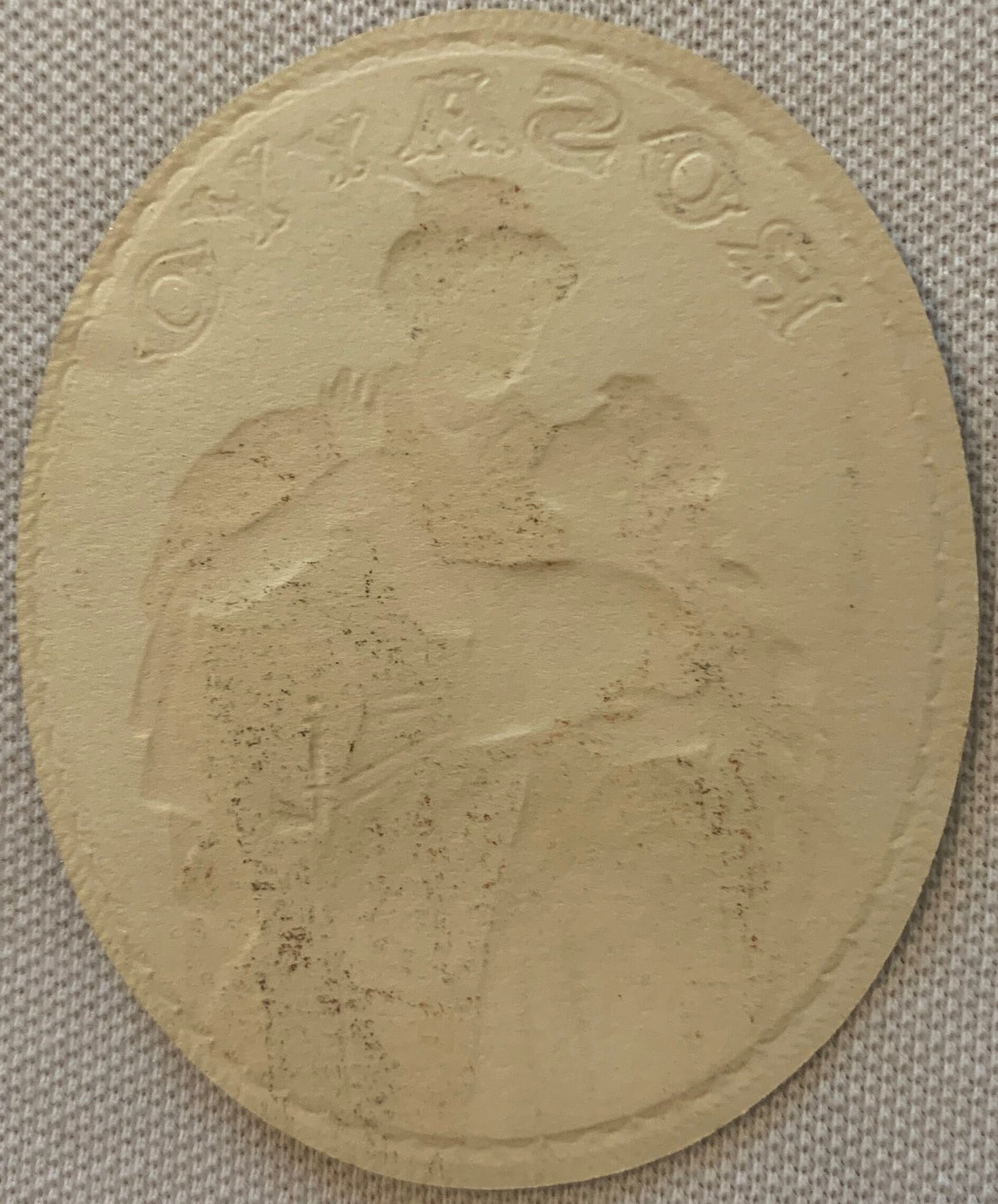
This is an original antique Rosa Y Yo cigar label, New Old Stock, produced during the 1890s to 1900s — the height of American chromolithographed cigar box art. It measures 2 ¾ x 2 ¼ inches, a small oval format, and it was never applied to a box, which is why the gold on it still looks freshly pressed rather than handled. The name ROSA Y YO arcs across the top of the label in raised, embossed lettering — bold, blocky, medieval-flavored type with small jeweled accents worked right into the negative space of the "O"s, all of it finished in gleaming gold against a soft sky-blue field. Below the lettering, a Victorian couple embraces: a woman with long, loose auburn hair, dressed in a red bodice and gold-yellow skirt, gazes up at a man in a red fez-style cap trimmed with a feather, a deep red cloak thrown over one shoulder, a dagger tucked at his belt. Behind them, a stone column and a sweep of tropical greenery set the whole scene somewhere warm and romantic — a balcony, a courtyard, a story already in progress. The whole oval is bordered in a thick band of embossed gold, the kind of metallic ink that only period lithography could produce with this much depth and shine.


🖨️ The Golden Age of the Cigar Label

To understand why a piece of packaging this small got this much artistic attention, you have to understand what the cigar industry looked like at the turn of the century. By the close of the 1800s, America had over 50,000 cigar manufacturers — most of them small, regional, and fiercely competing for the same wall of glass jars behind the same tobacconist's counter. A cigar wasn't sold by taste alone; it was sold by the box it came in, and the box was sold by the label glued inside its lid. That single fact turned commercial lithography into an art form almost overnight.

The period roughly spanning 1870 to 1920 is remembered by collectors and historians of the trade as the Golden Age of Stone Lithography. Staff artists at the great print houses hand-translated original artwork onto heavy lithographer's limestone using grease pencil, one stone per color. A label of this quality — rich, multi-tone, with gold embossing layered on top — could require a dozen or more separate press runs, each one perfectly registered to the last, before the sheet was ever cut into individual labels. After 1890, the very best houses added one more step: brass dies engraved to match the printed image, a raised "male" die and a recessed "female" die, aligned and driven together under tremendous press pressure so the artwork stood up in relief off the paper. That embossed gold border and that raised lettering on this label are the signature of that exact technical leap — a hallmark of cigar label production from 1890 onward.

There's an interesting wrinkle in why any of this artistry existed in the first place. After the Civil War, the federal government began taxing cigars, and manufacturers were required to identify their product for revenue purposes. What started as a bureaucratic requirement — put your name on the box — quickly became a marketing arms race. If you had to label it anyway, you might as well make that label beautiful enough to outsell the box sitting next to it on the shelf.


💌 "Rosa Y Yo" — A Name Built for Romance

Rosa Y Yo is Spanish for "Rosa and I" — Rose and me. It's a phrase that reads like the opening line of a love letter, and it was clearly chosen to match exactly the kind of scene printed beneath it: two figures caught in a private moment, her hand at his chest, his arm settling around her shoulders. Spanish and Italian-flavored titles were extremely common in cigar label work of this era — tobacco's roots ran straight through Cuba and Spain, and American cigar marketing leaned hard into that romantic, exotic association. Collectors who study this corner of the hobby often point out that the Spanish-titled labels tend to be some of the most heavily gilded of the whole genre — a lot of gold, a lot of drama, and a great deal of hand labor behind every sheet.

The couple themselves are drawn in full Victorian romantic style — not modest, everyday dress, but a kind of theatrical costume: the man's fez and dagger and sweeping cloak, the woman's flowing hair and rich color palette, all set against a column and greenery that suggest a warm, faraway courtyard rather than an American street. This was a deliberate choice across the whole industry. Cigar labels of the period routinely dressed their figures in imagined "exotic" settings — Spanish courtyards, Moorish gardens, faraway ports — because that kind of imagery photographed as luxury and adventure to a customer standing at a tobacco counter in an ordinary American town.


🎀 A Nail Tag's Job on the Box

A finished cigar box of this era typically carried several different labels working together: a large inner label glued to the underside of the lid (the "showpiece"), and then a set of smaller labels — often called nail tags or end labels — applied to the outside edges and corners of the box. These smaller labels had to do a lot of visual work in very little space: an eye-catching name, a strong image, a flash of gold, all compressed into a couple of inches. Rosa Y Yo, sized as it is here, falls into that nail-tag category — small, dense, and built to be seen at a glance rather than studied at length. It has surfaced over the years in the same company as other Spanish-titled labels from this period — names like Don Rey, Senora Cubana, and La Blanca — a family of romantic, Spanish-flavored titles that print houses turned out side by side for whichever factory needed one.


🌴 Tampa, Ybor City, and an Industry Built on Cigars

No town or factory name is printed on this particular label, and that's worth being honest about rather than guessing at — the vast majority of surviving labels from this era carry no manufacturer's mark at all. But the industry this label belonged to has a hometown, and it's one of the great stories in American manufacturing. In 1885, cigar maker Vicente Martinez Ybor moved his operations to a patch of land just northeast of Tampa, Florida. That settlement — Ybor City — was absorbed into Tampa proper by 1887 and grew, almost impossibly fast, into a cigar manufacturing center that eventually outproduced even Havana. At its peak in the 1920s, roughly 10,000 people worked across some 200 factories in Ybor City, turning out around 500,000,000 cigars in a single year. Rows of cigar rollers worked by hand at long tables while a "lector" read newspapers and novels aloud to keep the workroom entertained — a tradition cigar workers carried over directly from Cuba, and one that old-timers in the trade still talk about as one of the more colorful details of the whole industry.

It didn't last. Machine-rolled cigars began replacing hand work through the 1920s and '30s, the Great Depression crushed demand across the board, cigarettes became the country's new habit, and by the 1960s a trade embargo closed off the Cuban tobacco that so much of the American industry depended on. The factories that once turned out half a billion cigars a year and glued in labels exactly like this one are, today, mostly historic buildings and museum districts rather than working floors.


🎭 Selling to Everyone in the Room

One detail that's easy to miss about labels like this one: the romantic imagery wasn't only aimed at the men who actually smoked the cigars. Cigar label historians note that women were a fast-growing part of the tobacco market by the turn of the century, and manufacturers knew it. A tender, romantic scene — rather than a soldier, a hunting dog, or a boxer — was a label that could sit out in a parlor or a general store without offending anyone, while still carrying enough drama and beauty to stop a browsing customer in their tracks. Rosa Y Yo, with its embrace and its gold and its warm Mediterranean color palette, was doing double duty: selling romance to whoever happened to be standing at the counter.


📜 The Names History Chose Not to Keep

No surviving cigar trade directory or brand registry documents a company called Rosa Y Yo. That's not a gap in research so much as it is the honest shape of this whole category of collecting. Thousands of small cigar operations across the country commissioned one-off labels like this from the big lithography houses — a name, a mood, a budget — and once the boxes sold out, most of those companies left no further paper trail. The label survives; the business behind it usually doesn't. It's the same reason so many of the most beautiful labels from this era carry gorgeous, evocative names with absolutely no company history attached — the artwork was built to last on a shelf for weeks, not to be remembered for a century. And yet here it is, remembered anyway.


💛 Why It Still Matters Today

Pieces like this one now sit at the intersection of several collecting worlds at once — cigar box label collectors, ephemera and paper Americana collectors, chromolithography enthusiasts, and anyone drawn to the sheer romance of Victorian commercial art. What was once disposable packaging has become one of the more accessible ways to own a genuine, hand-produced example of 19th-century American printing craft — the kind of multi-stone, hand-registered, gold-embossed work that simply isn't done at this scale anymore. A piece that never made it onto a box has an added appeal for exactly that reason: it's a snapshot of the print house's finished output, straight off the press, with nothing between then and now.


🖼️ Display Ideas

  • 🖼️ Frame it solo in a small oval or shadow-box frame to let that embossed gold border catch the light on its own.
  • 📚 Group it with other Spanish or Latin-titled cigar labels for a themed grid of turn-of-the-century romance art.
  • 🚬 Pair it with an antique cigar box, humidor, or tobacco tin for a tabletop vignette of the era.
  • 💌 Set it near vintage valentines or romantic postcards for a Victorian sweethearts display.
  • 🏛️ Add it to a wall of early American advertising art alongside other chromolithographed ephemera.
  • 🎁 Gift it as a framed keepsake for anyone who loves cigars, romance history, or antique printmaking.

🎁 Who Collects These

Cigar label collecting draws a genuinely wide crowd — paper and ephemera collectors chasing chromolithography at its technical peak, cigar box and tobacciana collectors filling out a themed set, Victorian romantic-art enthusiasts drawn to the couple imagery, and history-minded buyers who simply want a real, tactile piece of the era when a five-cent cigar came wrapped in artwork this good. New Old Stock examples like this one are especially prized because they represent the label exactly as it left the printer, with nothing lost to handling along the way.


❓ FAQ

What does "Rosa Y Yo" mean?

It's Spanish for "Rosa and I" — Rose and me — a romantic phrase that matches the embracing couple pictured on the label.

Is this a full cigar box label or something smaller?

This is the smaller nail tag / end label style rather than the large inner lid label — a compact format meant to catch the eye from the outside edge of the box.

What does New Old Stock (NOS) mean here?

It means this label was never applied to a cigar box and never entered use — it's original printer's stock that sat unused since it was produced.

What company or town made this label?

No manufacturer or town is printed on this particular piece, which is common for cigar labels of this era — most were commissioned by small, short-lived operations that left no company records behind, even though the labels themselves survived.

How was this label actually printed?

Through stone chromolithography, with the image built up in multiple hand-registered color passes and finished with an embossing die that raised the gold lettering and border off the surface of the paper — standard practice for top-tier cigar labels from 1890 onward.

What size is the label?

It measures 2 ¾ x 2 ¼ inches (roughly 7 x 5.7 cm).

Why is the couple dressed the way they are?

Cigar labels of this period often dressed their figures in romanticized, exotic-leaning costume — Spanish and Mediterranean flavors were especially popular — to give the artwork a sense of drama and faraway luxury for customers back home.

Shipping

🚚 Shipping & Handling

  • Shipping costs and timing are calculated at checkout.
  • Items curated and shipped directly by me include U.S. shipping at no additional cost, professionally packed to ensure safe arrival of your artifact.

Items from Vetted Pro Collectors
Shipping for items offered by vetted Pro Collectors is determined at checkout. All Pro Collector listings are reviewed to ensure fair, reasonable shipping practices.

For full details, please refer to our Shipping Policy.

Returns & Exchange

Take your time — you've got a full six months. If a piece isn't right for you, send it back the way it reached you and we're good.

In the first 30 days your money goes straight back the way you paid. After that it's store credit, so you can put it toward something you'd rather have.

Return shipping we sort out between us, case by case. I don't make this difficult.

If something arrives damaged, or it isn't what I said it was, send me a photo within 48 hours and I'll make it right.

Email info@vintageantiquesgifts.com or call 802-356-9872 — that's me answering, not a call center.

The only things I can't take back are custom or special-order pieces and gift cards.

View full details
  • 5 stars: 1 (100%)
  • 4 stars: 0 (0%)
  • 3 stars: 0 (0%)
  • 2 stars: 0 (0%)
  • 1 star: 0 (0%)
G
Guisseppe Catiano

A++ service. Great item and Service! Thank you!

Absolutely amazing pictures, Joe!!! Thank you so much for sharing it really shows what can be done with these. A beautiful job really bringing them to life! I need to hire you to do my pictures. lol