Skip to product information
1 of 4

Vintage and Antique Gifts

Antique Seal of Philadelphia Cigar Label 🏛️ Seider Cigar Co PA 1920s NOS Dual Seal

Antique Seal of Philadelphia Cigar Label 🏛️ Seider Cigar Co PA 1920s NOS Dual Seal

Regular price 6.00 USD
Regular price Sale price 6.00 USD
Sale Sold out
Shipping calculated at checkout.
Quantity

Seal of Philadelphia: The Cigar That Wore the City's Coat of Arms 🏛️

In 1874 Philadelphia's City Councils voted in a new version of the city's arms. In 1874, according to the two gold medallions on this label, a cigar brand called Seal of Philadelphia was born. Half a century later the brand was still wearing those arms on its boxes — and this is one of those labels, never used: gilt, deeply embossed, printed in Brooklyn in the 1920s for the Seider Cigar Co. of Philadelphia, Pa.


🏛️ What Is on the Label

Across the top, SEAL of PHILADELPHIA arcs in red letters edged in raised gold. Below it sits a navy roundel inside a gold sawtooth border, and inside the roundel is the city's coat of arms, redrawn for the cigar trade. A bare arm rises from the crest holding the scales of justice. Peace stands on the left with an unrolled scroll marked in a grid; Plenty stands on the right with a cornucopia spilling red fruit. Between them the shield carries a plough in the upper field and a ship under full sail below — and where the city's own version has a plain gold band across the middle, the label artist ran a red ribbon lettered QUALITY CIGAR. The motto ribbon underneath reads PHILADELPHIA MANETO.

Flanking the seal are two matching gold-rimmed medallions reading ESTABLISHED 1874 · PHILADELPHIA CIGAR MANF'Y · TRADE MARK, wrapped around an interlaced gold monogram. Between them a script signature, Charles Seider, sits over the single word ORIGINATOR. The bottom panel, on a pale blue ground framed in gold scrollwork, repeats the brand name and adds SEIDER CIGAR CO., MAKERS. PHILADELPHIA, PA. Under that panel, in type small enough to miss, is the printer's line: CONSOLIDATED LITHOGRAPHING CORPORATION BROOKLYN N.Y.

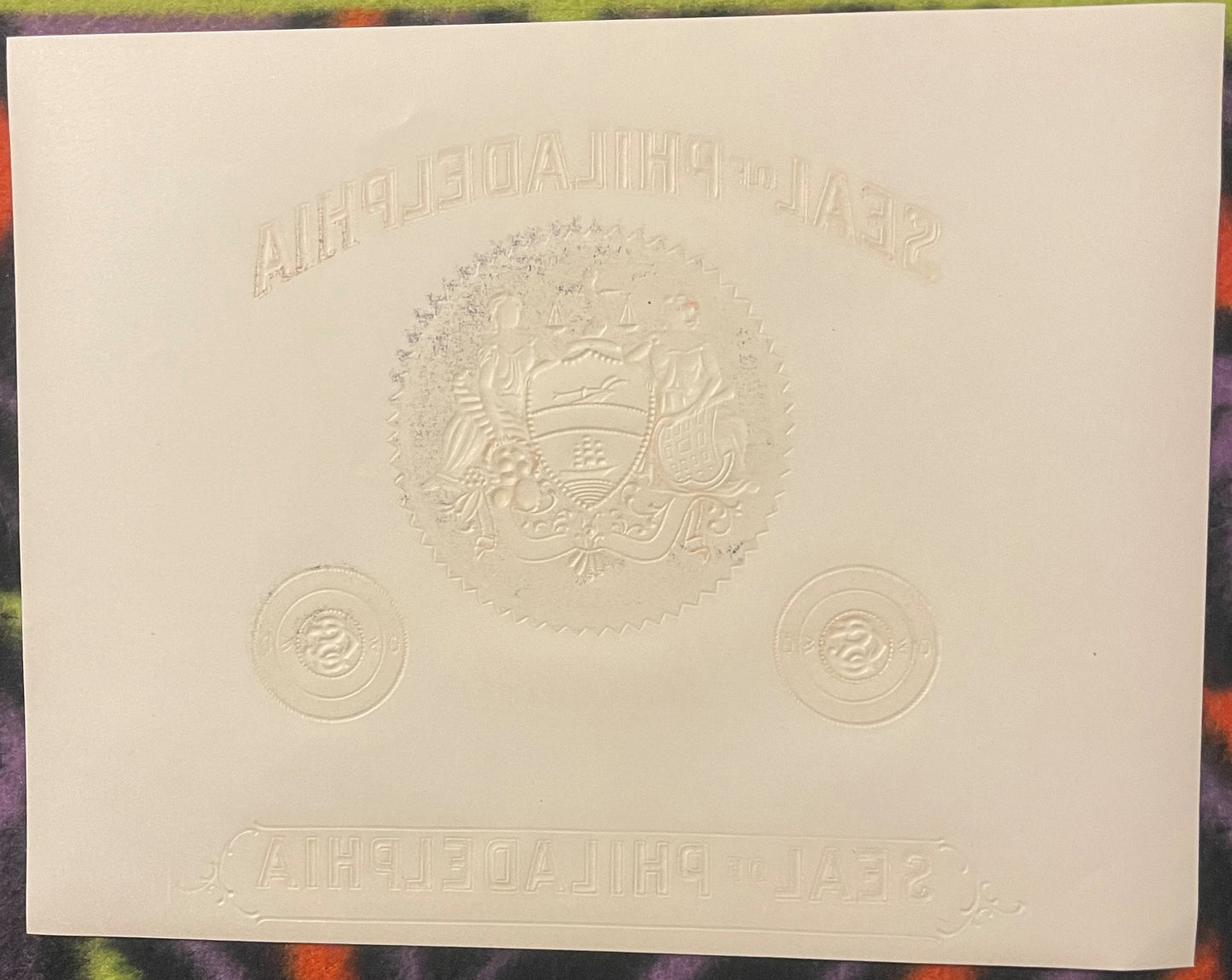
Turn the sheet over and the whole design stands up in reverse relief on the back — the lettering, the seal, both medallions and the bottom panel. That is what a heavy embossing press does to paper, and it is something a flat poster print of this brand's art cannot copy. It measures approximately 9" x 7" and is new old stock, never applied to a box.


📅 How the Printer's Line Dates It

That tiny line of type does the dating. William Steiner and Isaac Rosenthal founded a cigar-label lithography house in 1884; it became Wm. Steiner & Sons in 1896, and it was still trading under that name in 1915, when it took over the New York label printers Krueger & Braun. Jacob A. Voice, a lithographer born in Romania in 1884 who came to America at three, went to work for Steiner in 1903 and had organized his own company by 1911. The businesses merged, and in 1925 the firm took the name Consolidated Lithographing Corporation — one of the largest paper-label printers of its day. A label carrying that name came off the press in 1925 or later: this is a 1920s printing, not a turn-of-the-century one.


🗝️ Charles Seider and the 1874 Claim

The label is the maker's own testimony. The medallions claim a founding in 1874 and a registered trade mark; the signature names Charles Seider as the originator; the bottom panel credits the Seider Cigar Co. as makers in Philadelphia. Put that beside the printer's line and the sheet tells a small business story on its own: a Philadelphia brand, printing fresh labels in Brooklyn in the 1920s, still telling smokers it went back fifty years — and saying it twice, once on each side of the seal.


⚖️ The Arms on the Box: Frank Marx Etting's Seal

Philadelphia's modern seal took shape in 1789, after the Revolution dissolved the old colonial Corporation. In that version Peace held a scroll bearing William Penn's plan of the city, with Thomas Holme's survey, and Plenty held her overflowing cornucopia. The plough was borrowed from Chester County's seal and the ship from Philadelphia County's.

Frank Marx Etting was the man who changed it. Born in 1833 to a prominent colonial Jewish family, he trained for the law, joined the Army as a paymaster in 1861, and in 1872 was made chairman of the city's Committee on the Restoration of Independence Hall. He proposed a set of revisions to the seal, and Philadelphia's Select and Common Councils adopted them on February 14, 1874. Etting took Penn's map out of Peace's hands and gave her an anchor, and he added a ribbon lettered PHILADELPHIA MANETO.

Now look at the left-hand figure on this label. She still holds the scroll, drawn in a grid, while the ribbon beneath the shield carries Etting's motto. The cigar-label artist put the older scroll and the newer motto on the same seal.


📜 The Lore of "Philadelphia Maneto"

"Philadelphia" is Greek for brotherly love, and Etting built his motto as a rendering of the verse in Paul's Epistle to the Hebrews from which the city takes its name — Hebrews 13:1, "Let brotherly love continue." Half Greek and half Latin, it reads loosely as "Let Philadelphia endure." Etting also set a founding date on the seal, 1701, the year of Penn's charter to the city. In 1908 a special committee appointed by Mayor John Reyburn decided Philadelphia had in fact been founded in 1683 and recommended that Etting's 1701 be banished from the seal.

Etting's other obsession comes with a story of its own. He inherited a chair believed to have been used by the Continental Congress in 1776, and it sent him hunting: he eventually located twelve identical chairs and displayed them in the room where the Declaration of Independence was signed. He served as chief of the Historical Department of the Centennial Exhibition of 1876 and wrote a history of the old State House — and in that same year the City Councils removed him from the restoration committee. He died in Philadelphia in 1890.


🏭 Philadelphia, Cigar City

By one estimate Philadelphia had some nine hundred cigar factories by 1900. Theobold & Oppenheimer, making cigars in the Northern Liberties since 1860, moved into a new plant at 1147 N. Fourth Street that year, and seven hundred of its employees were women. By 1915 the city's cigar factories employed 4,300 women, more than twice the number of men. Cuban and Puerto Rican cigar makers followed the Caribbean tobacco trade to the city and settled in Southwark, where the Bayuk brothers founded their company in 1896 — the firm behind "Philadelphia Hand Made Perfectos," better known as Phillies, which kept a Philadelphia plant running until 1976.

Seal of Philadelphia sold into that crowd on civic pride: the city's name, the city's arms and a Philadelphia maker, all on one box lid.


🖨️ Stone, Gold and the Brooklyn Presses

Labels like this one are chromolithographs — each color laid down from its own stone — then run through an embossing press and dressed with metallic gold or bronze powder so the letters and borders catch the light. The scale of the business was staggering. When the New York label house Heppenheimer & Maurer took inventory in 1879, it counted 25,000 registered lithographic stones, 7,000,000 cigar labels, and 725 different box edgings created by 22 artists working on the premises.

Photomechanical printing and hard economics brought the stone-printed label to an end around 1930. That year American Lithographic sold its cigar-label business to Consolidated, which went on printing for the cigar trade for decades afterward.


🚬 A Really Good Five-Cent Cigar

The most famous thing ever said about cigars in Washington came out of this same world. As the story goes, Vice President Thomas R. Marshall was presiding over the Senate while Senator Joseph Bristow of Kansas laid out, at length, everything the country needed. Marshall leaned over to Henry M. Rose, the Senate's assistant secretary, and said: "What this country needs is a really good five-cent cigar." Newspapers carried it in early 1914, manufacturers of nickel cigars promptly bombarded him with sample boxes, and after working through them Marshall announced that the country's greatest need still existed. Later retellings moved the moment to 1917 or 1920, and the joke was older than Marshall anyway — the Hartford Courant printed it in September 1875.

By the Depression the nickel cigar had become a battlefield. White Owl cut its price to five cents in 1931 and became the largest-selling 5¢ cigar in the country at 520,000,000 a year; in 1933 Phillies dropped from ten cents to a nickel.


🌍 The Legacy

Etting's arms outlived the cigar trade that borrowed them. When Philadelphia adopted its city flag on March 27, 1895 — designed by Dr. Henry C. McCook, its blue and yellow honoring the city's Swedish colonial roots — the coat of arms went onto it, and that flag still flies over the city.

The labels had a second life of their own. Cigar makers, box makers and printers all ended up with unused bundles on their shelves. The story told among collectors is that those bundles sat dormant in old warehouses and stores until they were rediscovered in the 1970s, and by the 1980s unused labels were spreading across America as people began to see their worth. That is how a sheet printed for a Philadelphia cigar box can still turn up crisp and unapplied a century on.


🖼️ Display Ideas

  • 🏛️ A Philadelphia home or office — the city's arms, motto and a home-town maker in one frame.
  • 🍷 A cigar room, bar or humidor wall — the red, navy and gold read from across the room.
  • 🔔 An Independence Hall or Centennial collection — Etting's seal, on a working piece of advertising.
  • 🎁 A gift for anyone who grew up in Philly or still roots for the city from somewhere else.
  • 🖼️ Framed with a mat or spacer, so the raised gold never presses flat against the glass.

❓ Questions People Ask

How old is this Seal of Philadelphia label?

It is a 1920s printing. The imprint under the bottom panel names the Brooklyn firm Consolidated Lithographing, a name it adopted in 1925.

Is it an original or a reproduction?

Original and unused. The raised relief visible on the back is the giveaway — reproduction posters of this brand's art are printed flat.

Who was Charles Seider?

His signature appears on the label over the word "Originator," identifying him as the man behind the brand; his company is credited as maker, and the medallions give 1874 as the year the trade mark was established.

Why does the seal show a plough and a ship?

Both are borrowed from older county seals: the plough from Chester County, the ship from Philadelphia County. They were joined on the city arms after 1789.

What does "Philadelphia Maneto" mean?

Loosely, "Let Philadelphia endure" — Etting's rendering of Hebrews 13:1, added to the arms when the councils approved his changes.

How should I frame it?

Use a mat or spacer to keep the embossing off the glass, and UV-filtering glazing to keep the reds and the navy roundel bright.

Shipping

🚚 Shipping & Handling

  • Shipping costs and timing are calculated at checkout.
  • Items curated and shipped directly by me include U.S. shipping at no additional cost, professionally packed to ensure safe arrival of your artifact.

Items from Vetted Pro Collectors
Shipping for items offered by vetted Pro Collectors is determined at checkout. All Pro Collector listings are reviewed to ensure fair, reasonable shipping practices.

For full details, please refer to our Shipping Policy.

Returns & Exchange

Take your time — you've got a full six months. If a piece isn't right for you, send it back the way it reached you and we're good.

In the first 30 days your money goes straight back the way you paid. After that it's store credit, so you can put it toward something you'd rather have.

Return shipping we sort out between us, case by case. I don't make this difficult.

If something arrives damaged, or it isn't what I said it was, send me a photo within 48 hours and I'll make it right.

Email info@vintageantiquesgifts.com or call 802-356-9872 — that's me answering, not a call center.

The only things I can't take back are custom or special-order pieces and gift cards.

View full details
  • 5 stars: 1 (100%)
  • 4 stars: 0 (0%)
  • 3 stars: 0 (0%)
  • 2 stars: 0 (0%)
  • 1 star: 0 (0%)
1
1***p (507)

Pristine vintage label. Excellent price.