
Skip to product information
1 of 4

Vintage and Antique Gifts

Antique 1900s - 1920s Tebson Embossed Cigar Label Woodgrain 🚬 Brooks & Co's, Red Lion, PA

Antique 1900s - 1920s Tebson Embossed Cigar Label Woodgrain 🚬 Brooks & Co's, Red Lion, PA

Regular price 5.50 USD
Regular price Sale price 5.50 USD
Sale Sold out
Shipping calculated at checkout.
Quantity

What Hangs on Your Wall When a Whole Town's Identity Rolls Into One Label? 🏷️

There's a small borough in York County, Pennsylvania, that once rolled so many cigars it became, by some accounts, the wealthiest community per capita in the entire nation. The road where the factories stood is still called Cigar Row. Every New Year's Eve, the town raises a giant cigar at midnight instead of dropping a ball. And in the middle of all that remarkable, fragrant, leaf-wrapped history sat a firm called T. E. Brooks & Co. — makers of the Tebson. This label is a direct, physical piece of that world.

I've spent hours on some of these pieces. With the Tebson Perfecto De Luxe, every rabbit hole I followed paid off. Little neat facts kept surfacing — the kind that make you set the research aside and just sit with the object for a moment. That's the feeling I want to pass along to whoever hangs this on their wall.


🏷️ What You're Looking At

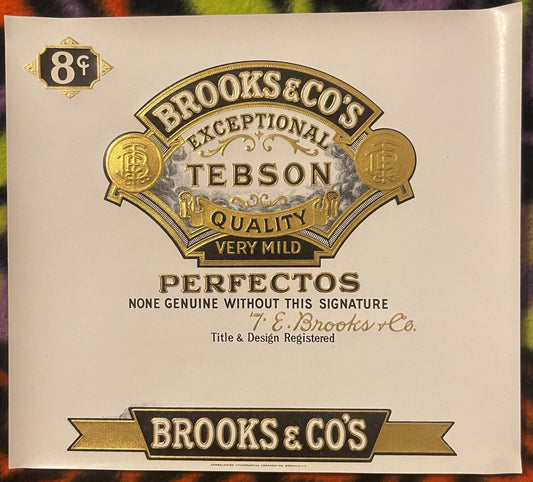
This is an original Brooks & Co's Tebson Perfecto De Luxe inner cigar box label — embossed, lithographed, and finished with genuine gold and silver foil in the manner of the great American cigar label printers of the early-to-mid twentieth century. It measures approximately 9 inches by 7 inches, printed on the heavy paper stock that the industry demanded and that has kept these labels vibrant across decades of storage. This is New Old Stock (NOS) — it never made it onto a box, never saw a cigar factory floor in the commercial sense, and survives as the lithographers and pressmen left it.

The design is everything a collector hopes for. A bold arched banner at the top reads BROOKS & CO'S in white on black. Below it, a silver and white cartouche — the kind of oval medallion shape that the finest label artists reserved for their most prestigious grades — carries EXCEPTIONAL / TEBSON / QUALITY in letterforms that command the space. A scroll banner beneath declares VERY MILD, and below that, in strong serif capitals: PERFECTO DE LUXE. The authentication line reads exactly as it would have read to a suspicious retailer in any decade this firm operated: NONE GENUINE WITHOUT THIS SIGNATURE — T. E. Brooks & Co. — Title & Design Registered. Flanking the central cartouche are two embossed gold wax-seal medallions, each bearing the company monogram. The background is a rich faux wood-grain in warm brown and gold — a lithographer's trick that gave the label the authority of a fine wooden box even before the box itself was seen. The third image in the listing shows the blank reverse: the embossing reads right through the paper in mirror image, a quiet proof of the physical pressure and craft that went into each sheet.

Most of the great lithographic houses of this era incorporated real gold in their foil stamping and embossing — not gold-toned ink, but actual metallic leaf worked into the process. Look at this label in raking light and you'll understand immediately why collectors rank cigar labels among the finest surviving examples of American commercial printing art. Modern offset printing simply cannot reproduce what a skilled stone lithographer achieved working by hand, press by press, color by color. That tradition was largely gone by the 1930s, which makes surviving examples like this one irreplaceable documents of a craft as much as a brand.


🏭 T. E. Brooks & Co. — The Firm Behind the Tebson

The man behind the label was Thomas E. Brooks, and his story is woven tightly into the industrial history of Red Lion, Pennsylvania. The documented record places him in the cigar trade by the very opening of the twentieth century: in 1900, Thomas E. Brooks joined D. A. Horn, S. S. Sechrist, and Fred Smith to form the Porto Rico Cigar Co., a venture that ran for five years. When that partnership dissolved, Brooks went on to build his own firm — T. E. Brooks & Co. — and the Tebson brand became his flagship.

The name Tebson is itself a piece of branding ingenuity entirely typical of the era: it is a contraction built from the founder's initials, T. E. B(rooks), shaped into a word that sounded like a proper noun, like a place or a person of distinction. Tebson. It rolls off the tongue with just enough mystery that a customer reaching for a nickel cigar felt he was choosing something with a pedigree.

The brand registry tells us the firm's creative span was long and productive. The brand Canadian Club carries a registration date of 1894 in the Brooks ledger; Have A Sweet appears as late as 1941. The Tebson line itself ran in multiple formats — Invincibles, Corona, and the grade you're holding now, the Perfecto De Luxe. A federal factory record lists T. E. Brooks & Co. as Factory No. 160, 1st District, Pennsylvania, active in 1936. Surviving boxes have been traced to the early 1940s. The picture that emerges is a firm that endured across the full arc of the nickel-cigar era — from the Edwardian boom years through Prohibition, the Depression, and into the Second World War. The wide range of the 1900s through the 1940s and into the 1950s is the honest bracket for when Brooks labels like this one were in production.

By the time of the First World War, Brooks was among the names that Red Lion's old-timers remembered with a kind of reverence. As one local resident recalled it directly: "Business was very good. They couldn't make enough cigars — soldiers smoked a lot. That's when Brooks and all those big fellows made all their money." The Tebson Perfecto De Luxe was one of the labels that funded that prosperity.

The Perfecto De Luxe specifically is the harder find. If you've spent any time in this collecting corner, you know that the Tebson Cubanos turn up with some regularity. The Perfecto De Luxe is genuinely scarcer — and the label's survival in unaffixed NOS condition makes it rarer still. Brooks also produced Have A Sweet and Canadian Club — both available separately in the store — but the Perfecto De Luxe carries a different visual weight, a more formal presentation, a label clearly intended for the premium end of a five-cent world.


🌿 Red Lion, Pennsylvania — The Town That Rolled America's Cigars

You cannot fully understand this label without understanding the town it came from, because Red Lion, York County, Pennsylvania, is one of the most extraordinary industrial micro-stories in American history — and it is almost entirely forgotten outside its own borough limits.

At its peak, roughly between 1880 and 1930, Red Lion was home to 150 cigar factories. One hundred and fifty. In a borough that you could walk across in twenty minutes. The street where the major operations clustered — including the Brooks plant — is still known locally as Cigar Row, a name that has outlasted every factory that once gave it meaning.

The scale of what this small town produced is staggering. Red Lion at its height was generating roughly ten percent of all cigars manufactured in the United States. By 1927, the borough's factories were responsible for fully one fifth of every nickel cigar rolled in America. York County became so saturated with cigar-industry tax activity that the federal government maintained two separate tax collection offices — one for the county at large, and a dedicated office just for Red Lion's output.

The wealth this generated was real and visible. The cigar trade was so strong by the 1920s that Red Lion was documented as the wealthiest community per capita in the nation — a claim that still stops people in their tracks when they hear it the first time. Local profits funded the opera house. The theater. The civic buildings that still stand. Thomas E. Brooks and his fellow manufacturers were the engine of all of it.

The local lore runs deep. Oral histories collected from Red Lion residents describe a town where factory work was everywhere, where the smell of curing leaf was simply the smell of the air, where women and men both worked the rolling tables and the pace never really let up. The WWI years, in particular, are remembered as a kind of golden fever — demand outstripped supply, and the factories ran as hard as they could. "They couldn't make enough," is how the old-timers put it. Brooks and the other big names built their fortunes in those years.

The decline came the same way it came for most of the American cigar industry: cigarettes. Machine-made, mass-marketed cigarettes rewired American smoking habits through the 1930s and 1940s, and the hand-rolled nickel cigar — the entire product category that Red Lion had built its identity around — simply faded. The factories left, one by one, over decades. The last cigar manufacturing operation in Red Lion closed sometime in the early 2010s, with sources placing the final closure between 2011 and 2014. A century-long industry, ended quietly.

But the town has not let go of the memory. Every New Year's Eve, Red Lion raises a large cigar up the side of the Municipal Building at midnight — their signature answer to the Times Square ball drop, complete with tracks built into the building's facade to guide the cigar's rise. It is, as traditions go, perfectly chosen: wry, proud, locally rooted, and just a little bit defiant. The cigar may be gone as an industry. As an identity, Red Lion holds it tight.


🎨 The Art and the Artists — A Lost Craft Worth Remembering

One of the things that moves me most about these labels — and I mean genuinely moves me, not just as a seller but as someone who has spent real time with this material — is thinking about who made them.

The lithographic artists who designed and executed cigar labels in the late nineteenth and early twentieth centuries were, by almost any objective measure, among the most skilled commercial artists working in America. The techniques they commanded — stone lithography, multi-pass color registration, embossing, metallic foil application — were demanding, physical, highly trained crafts. The visual sophistication they achieved, the layering of depth and texture and metallic shimmer, was genuine artistic achievement.

And almost none of them are remembered by name.

These were working artists, often desperate for steady employment in an era that offered commercial illustrators little security and no residuals. They were paid for the job and moved on. The label went on the box, the box went into the trade, and the artist's name went nowhere. The major lithographic houses of the era — firms operating out of New York, Cincinnati, Baltimore, and other printing centers — took the institutional credit, but the individual hands that drew and composed each design remain, for the most part, permanently anonymous.

What we can do — what I think we're obligated to do — is keep the work alive. A label like this Tebson Perfecto De Luxe, framed and displayed, is the only memorial most of these artists will ever get. The craft of stone lithography was largely displaced by the 1930s as photomechanical and offset processes took over. What the old-school lithographers could do with a grease crayon, a flat stone, and a hand press has never been fully replicated by any subsequent technology. This label is evidence of that. Hold it at an angle to the light and watch what the gold foil does. That effect was designed and executed by someone who knew exactly what they were doing — and who we will never be able to thank by name.

The heavy paper stock these were printed on is part of the craft too. The weight was not accidental — it was chosen because it could take the physical pressure of embossing without tearing, hold the foil without flaking, and carry color across decades without the fragility that thinner stock would have introduced. The paper is part of why labels like this one survive looking the way they do.


🖼️ Display Ideas

  • 🖼️ Frame it alone in a deep shadowbox — the embossing reads beautifully with a slight gap between label and backing glass, letting light catch the raised gold seals and the central cartouche from multiple angles.
  • 🏠 Anchor a bar or study gallery wall — pair it with vintage barware, a mid-century bar cart, or antique spirits advertising for a layered, period-authentic vignette that tells a coherent American commercial story.
  • 🗺️ Build a Pennsylvania / York County local history display — alongside a period map of Red Lion, a vintage postcard of Cigar Row, or other York County ephemera, this label becomes the centerpiece of a deeply specific sense of place.
  • 🎁 Commission a custom mat in burgundy or forest green — the gold foil reads explosively well against deep jewel tones; a wide mat in either color and a thin gold frame turns this into something that looks like it belongs in a private club or a serious collector's library.
  • 🖼️ Group it with Brooks & Co's other Tebson labels — the Cubanos and the companion label available in the store — for a brand-focused display that shows the full visual range of what one remarkable Red Lion firm produced.
  • 🏛️ Display in a home office or cigar lounge — surrounded by other pieces of early American advertising ephemera, this label grounds the room in the era when American commercial art was at its most inventive and handmade.

🎁 Who Collects These

Cigar box label collectors are a particular breed, and I mean that as the highest compliment. This is a collecting category that rewards patience, genuine curiosity, and a willingness to do the research — because the history behind the best labels is as rich as anything in American material culture, and most of it lives nowhere except in the labels themselves and in the memories of people who are no longer with us.

The Tebson Perfecto De Luxe specifically draws collectors of Pennsylvania advertising and regional Americana — people who understand that Red Lion, York County, is not a footnote but a genuinely significant chapter in American industrial history. It draws paper ephemera and lithography enthusiasts who collect for the printing craft as much as the subject matter. It draws tobacco and cigar memorabilia collectors who know that the Perfecto De Luxe is the harder-to-find Tebson grade. And it draws the broader category of antique advertising collectors — people who hang these on their walls the way others hang paintings, because they understand that a label this well-designed, this well-made, and this deeply rooted in a specific American place and time is a form of art that deserves to be seen.

It also makes a genuinely meaningful gift — for a Pennsylvania native, a cigar enthusiast, a history lover, or anyone who appreciates that some of the finest American visual art of the early twentieth century was made not for galleries but for the tops of five-cent cigar boxes.


❓ Frequently Asked Questions

Is this an original label or a reproduction?

This is an original label — New Old Stock, meaning it was never applied to a box and has been in storage since the era of manufacture. The third image in the listing shows the blank reverse with the reversed embossing reading through the paper — physical evidence that cannot be faked by a reproduction print. Reproductions are flat; this label has real dimensional depth from the embossing press.

What does "Perfecto De Luxe" mean as a cigar designation, and why is it scarcer than the Cubanos?

Perfecto refers to a specific cigar shape — tapered at both ends, with the widest point toward the middle — and De Luxe signals the premium grade within Brooks's Tebson line. The Cubanos was Brooks's more widely distributed format and turns up with regularity in the collector market. The Perfecto De Luxe was a smaller production run aimed at a slightly elevated price point within the nickel-cigar world, and surviving labels — especially in NOS unaffixed condition — reflect that smaller original print quantity.

What exactly is the "Tebson" name? Is it a place?

It is not a place — it is a founder's name construction, built from Thomas E. Brooks's initials: T. E. B, shaped into the word Tebson. This was a common and effective branding strategy of the era, giving a brand name the sound of a proper noun or geographic designation while keeping the founder's identity embedded in it. Every time a retailer or customer said "Tebson," they were, without knowing it, invoking Thomas E. Brooks.

The label text says "Title & Design Registered" — what does that mean in this context?

This was the standard legal protection language printed on premium cigar labels of the era. Cigar brand identities — names, designs, color schemes, label layouts — were registered with the U.S. Patent and Trademark Office as trade dress, and the "Title & Design Registered" line served as both legal notice and a quality signal to retailers and consumers. It said, in effect: this design belongs to us, and any box without our signature is a counterfeit. The authentication line — NONE GENUINE WITHOUT THIS SIGNATURE — reinforced exactly the same message.

Why does Red Lion still raise a cigar on New Year's Eve?

Because the cigar is Red Lion's identity in a way that no other symbol captures. At its peak, this borough produced roughly ten percent of all American-made cigars and, by some years, a fifth of all American nickel cigars. The industry built the town's wealth, its civic institutions, its social fabric. When the factories left, the community chose to honor that history rather than let it go quietly — and the annual cigar raise, with tracks built into the Municipal Building's facade for exactly this purpose, is their answer to every other town's ball drop. It is one of the most specifically rooted, genuinely local New Year's Eve traditions in the country.

Could this label be framed without matting?

It could, but I'd encourage a mat for one reason: the embossing. When a label this deeply embossed is pressed flat against glass, you lose much of the dimensional effect that makes it extraordinary. A deep mat — or a shadowbox frame — keeps the label slightly recessed from the glass, preserving the play of light across the raised gold seals and the central cartouche. That's where the real visual drama lives, and it's worth protecting.

Does the store carry other Tebson or Brooks & Co. labels?

Yes — the store carries additional Brooks & Co. labels including other Tebson grades and the companion brands Have A Sweet and Canadian Club, both of which were produced by the same Red Lion firm. Collectors building a Brooks-focused display, or a broader Red Lion cigar history grouping, will find the companion pieces worth seeking out. The Perfecto De Luxe is the scarcer grade; the others represent different chapters of the same remarkable story.

Shipping

🚚 Shipping & Handling

  • Shipping costs and timing are calculated at checkout.
  • Items curated and shipped directly by me include U.S. shipping at no additional cost, professionally packed to ensure safe arrival of your artifact.

Items from Vetted Pro Collectors
Shipping for items offered by vetted Pro Collectors is determined at checkout. All Pro Collector listings are reviewed to ensure fair, reasonable shipping practices.

For full details, please refer to our Shipping Policy.

Returns & Exchange

Take your time — you've got a full six months. If a piece isn't right for you, send it back the way it reached you and we're good.

In the first 30 days your money goes straight back the way you paid. After that it's store credit, so you can put it toward something you'd rather have.

Return shipping we sort out between us, case by case. I don't make this difficult.

If something arrives damaged, or it isn't what I said it was, send me a photo within 48 hours and I'll make it right.

Email info@vintageantiquesgifts.com or call 802-356-9872 — that's me answering, not a call center.

The only things I can't take back are custom or special-order pieces and gift cards.

View full details