
Skip to product information
1 of 4

Vintage and Antique Gifts

Antique 1920s Brooks & Co's Tebson Perfectos Cigar Label 🏷️ Red Lion PA Gold Embossed Lithograph Art

Antique 1920s Brooks & Co's Tebson Perfectos Cigar Label 🏷️ Red Lion PA Gold Embossed Lithograph Art

Regular price $5.50 USD
Regular price Sale price $5.50 USD
Sale Sold out
Shipping calculated at checkout.

Size: 8" x 7 1/4"

🚚 Free US Shipping — ships within one business day. International shipping calculated at checkout.

Quantity

Why Does Red Lion, PA Raise a Cigar on New Year's Eve? 🏷️ Antique 1920s Brooks & Co. Tebson Perfectos Cigar Label

Size: 8" x 7 1/4"

Every New Year's Eve, Red Lion, Pennsylvania raises a giant cigar at midnight, held aloft by a red lion. This label comes from the decade that town was rolling a fifth of all the nickel cigars made in America.

It is the Tebson Perfectos label of T. E. Brooks & Co., one of the big Red Lion houses on the stretch of road still called Cigar Row, printed in Brooklyn by the most celebrated cigar-label lithographer of its day. Gold, black and cream, deeply embossed, unused, and 8" x 7 1/4" ~.

The Label

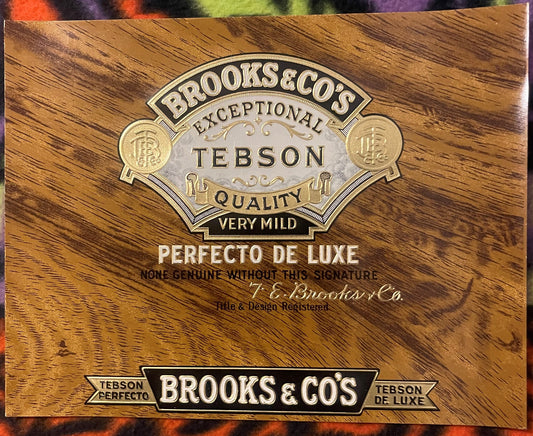
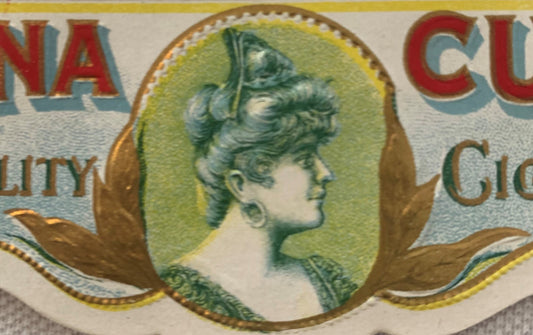
An arched black-and-gold cartouche carries the words BROOKS & CO'S, EXCEPTIONAL, TEBSON, QUALITY and VERY MILD, the center set against a cloud of soft gray. Two round gold medallions flank it, each stamped with an interlaced TEB monogram. Below sits PERFECTOS in gold capitals, then the line "None Genuine Without This Signature" over a gold facsimile signature reading T. E. Brooks & Co., and the notice "Title & Design Registered." An 8¢ price tag sits in a gold-edged lozenge in the upper left corner, and a ribbon banner repeating BROOKS & CO'S runs across the foot of the sheet. The printer's line along the bottom edge reads Consolidated Lithographing Corporation, Brooklyn, N.Y.

The embossing goes all the way through. Turn the sheet over and the whole design stands in the back of the paper in mirror image: the medallions, every letter of TEBSON, the signature and the lower banner. This is the earlier Tebson design, before the brand moved to a wood-grain version of the label.

A Perfecto is the cigar shape that swells through the middle and tapers toward the ends, and the price tag tells you where Brooks pitched it: an 8-cent smoke, a step up from the nickel cigar that made Red Lion rich.

How Old It Is

The printer's name dates it. Jacob Voice's Brooklyn firm took the name Consolidated Lithographing Corporation in 1925, so a sheet carrying that imprint was printed no earlier. This label was printed in the later 1920s, at the height of Red Lion's cigar boom.

Brooks of Red Lion and the Tebson Brand

T. E. Brooks & Co. was one of the major factories on Red Lion's Cigar Row, and Tebson was one of its house brands, alongside Have a Sweet and Canadian Club. Brooks had plenty of company on the Row, J. C. Winters & Co. and the Jacobs factory among them. The Federal Cigar Company, which the Tobacco Trust set up in 1907 to run its cheaper brands, had a factory in town as well, and that factory went to P. Lorillard when the Supreme Court broke up the Trust. And just over in Dallastown, John Peeler ran a good-sized cigar factory of his own. That signature warning and the registered title and design were the firm's guard against imitators in a town with more than a hundred cigar factories competing for the same smokers.

World War I made the big Red Lion firms. Soldiers smoked heavily, orders outran what the town could roll, and one old Red Lion cigar hand remembered plainly that during the war they could not make cigars fast enough, and that was when Brooks and the other big fellows made their money. By 1930 T. E. Brooks & Co. was running five Pennsylvania factories.

The brands outlived the boom. Canadian Club and Have a Sweet were still being rolled in Red Lion by G. W. Van Slyke & Horton when that company, York County's last cigar maker, shut down in 2011.

The man behind that last chapter was Clark Jacobs. He was born in Red Lion in 1912, got his start in Windsor selling tobacco cuttings for chewing tobacco, and bought the Van Slyke & Horton business name in the 1950s. For years he owned and ran it as the parent company of T. E. Brooks & Co., and kept a dairy farm out in Chanceford Township on the side. He died at home in Red Lion in July 2011, at 99, the same year the factory stopped making cigars. I like that the Brooks name on this label finished its run with a Red Lion family.

Red Lion: A Town Built With Cigars

Red Lion took its name from an early tavern. The story handed down in the family that kept it is that a young couple named the inn after a Red Lion tavern the husband's family owned in England. An 1886 history of York County remembered the sign: a lion painted red, and a mild, peaceful fellow with an inviting look rather than one to frighten thirsty travellers away.

There was barely a hamlet here until the York and Peach Bottom Railroad arrived in 1874. When Red Lion incorporated in 1880 it had about 200 people and a single cigar factory employing a handful of workers. Tobacco transformed it. By 1920 York County kept two tax offices, one for the county and one just for Red Lion. By 1924 the factories employed two thousand men and women, paid them almost three million dollars a year in wages and turned out over two hundred million cigars. In 1927 the town counted 109 cigar factories and produced a fifth of the nation's nickel cigars, and at one time some 150 factories operated there. Locals have long said Red Lion was built "with cigars."

Women outnumbered men on the factory floors and did the rolling; children stripped tobacco after school, and a stripper could be paid as little as eight cents a pad. The trade was done in by the machine and the cigarette. An automatic machine could make 6,000 cigars in a day against a hand roller's 600, cigarettes took the smokers, and the 1934 strike in Red Lion is remembered as the last struggle of a dying craft.

What remains is kept on purpose. The Consumers Cigar Box Company building on First Avenue, also known as Red Lion Woodcraft Inc., built in 1921 and enlarged in 1925 and 1935 to 1936, has been on the National Register of Historic Places since 1999. They made cigar boxes there until the 1950s. And the cigar still goes up every New Year's Eve: where other towns drop a ball, Red Lion raises its cigar, so the new year starts on the upswing.

Consolidated Lithographing Corporation and Jacob A. Voice

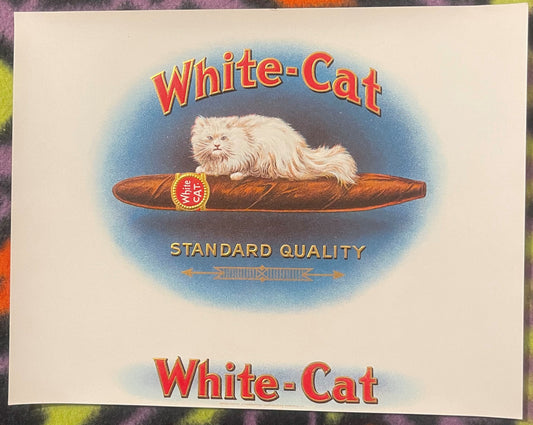
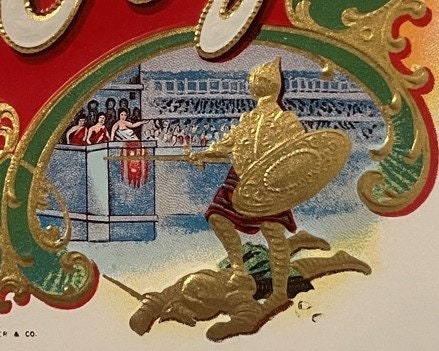
Jacob A. Voice was born in Romania in 1884 and came to America at the age of three. In 1903 he went to work for the label house Wm. Steiner & Sons, and by 1911 he had a company of his own. Around 1925 he merged his firm with Steiner's, a line that ran back to Steiner & Rosenthal of 1884, and the result was Consolidated Lithographing Corporation, one of the largest paper-label printers in the country. By 1935 Consolidated was printing 6,500 different labels for more than 4,000 million cigars. Other labels from Consolidated's presses include White Cat, Ben-Hur, Dime Bank and Brick House. Their labels traveled a long way from Brooklyn, too: the University of South Florida keeps a Consolidated label made for the Hav-a-Tampa Cigar Co. in its Osterweil Collection of cigar labels.

In 1933 Fortune magazine named Voice, by common acclaim, the foremost maker of cigar box art in America. Two years later he gave a collection of cigar box labels spanning roughly 1870 to 1930 to the Museum of the City of New York, and he died in 1942. Sidney P. Voice, the firm's vice-president, assembled the Sidney Voice Collection of Cigar Bands, cigar box labels and salesmen's sample books, now at the New-York Historical Society. Between them they turned the working stock of a label factory into a public record of American commercial art.

Gold, Brass Dies and Pressure

From the 1890s the best label houses added embossing to lithography. A raised brass die and a matching sunken one, each engraved to line up with the printed picture, were pressed together on the sheet so the image stood up in three dimensions. Gilding came in a separate run, in genuine gold leaf or in bronze powder buffed to a shine. Collectors like to say the old labels used real gold, and some did. Either way, it took several trips through the press to finish one sheet like this, and nobody prints labels that way now.

The artists who drew these designs are almost all unknown. Their names never went on the labels; the printer's did. Keeping a sheet like this is how their work stays on a wall instead of in a landfill.

Questions People Ask

Where were Tebson cigars made?

In Red Lion, York County, Pennsylvania, by T. E. Brooks & Co. Brooklyn, N.Y. on the label is the printer's address, not the cigar maker's.

How old is this Tebson label?

It dates from the later 1920s. The printer used the Consolidated Lithographing Corporation name from 1925.

What size is it?

8" x 7 1/4" ~

Has it been used?

No. It was never applied to a box. There is minor corner wear that a frame hides.

What other brands did T. E. Brooks & Co. make?

Canadian Club was one and Have a Sweet another, and both were still being made in Red Lion into the twenty-first century.

Why does the back show the design?

Because it was embossed between brass dies under heavy pressure, the relief shows through the paper in reverse.

Is the gold real gold?

Label houses of the period gilded with either genuine gold leaf or bronze powder. Both give the warm, raised shine you see here.

How should I frame it?

Behind UV-filtering glass with an acid-free mat, which keeps the paper off the glass and lets side light catch the embossing.

Shipping

🚚 Shipping & Handling

  • Shipping costs and timing are calculated at checkout.
  • Items curated and shipped directly by me include U.S. shipping at no additional cost, professionally packed to ensure safe arrival of your artifact.

Items from Vetted Pro Collectors
Shipping for items offered by vetted Pro Collectors is determined at checkout. All Pro Collector listings are reviewed to ensure fair, reasonable shipping practices.

For full details, please refer to our Shipping Policy.

Returns & Exchange

Take your time — you've got a full six months. If a piece isn't right for you, send it back the way it reached you and we're good.

In the first 30 days your money goes straight back the way you paid. After that it's store credit, so you can put it toward something you'd rather have.

Return shipping we sort out between us, case by case. I don't make this difficult.

If something arrives damaged, or it isn't what I said it was, send me a photo within 48 hours and I'll make it right.

Email info@vintageantiquesgifts.com or call 802-356-9872 — that's me answering, not a call center.

The only things I can't take back are custom or special-order pieces and gift cards.

View full details

Preserving History: Authentic Objects Across Eras

— Curated by Travis Weigel