Skip to product information
1 of 3

Vintage and Antique Gifts

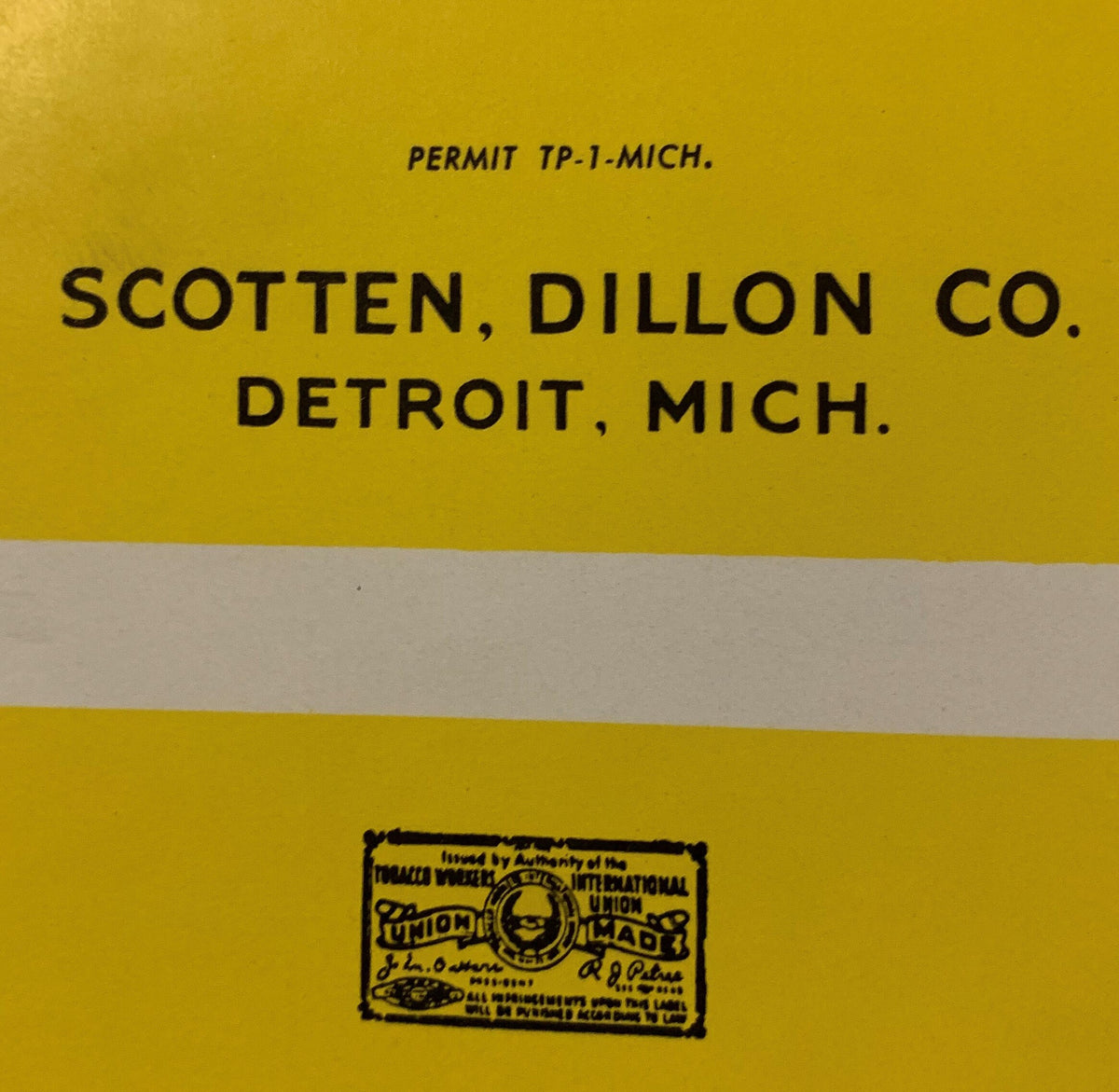
Antique Union Workman Tobacco Label 🌿 Scotten Dillon Co Detroit NOS Burley Long Cut Circa 1910

Antique Union Workman Tobacco Label 🌿 Scotten Dillon Co Detroit NOS Burley Long Cut Circa 1910

Regular price 6.00 USD
Regular price Sale price 6.00 USD
Sale Sold out
Shipping calculated at checkout.
Quantity

What Does a Detroit Factory Worker's Daily Smoke Look Like After 115 Years? 🌿

There is something quietly remarkable about holding a piece of paper that was printed before the First World War, never opened, never wrapped around anything, never touched by the tobacco it was designed to contain — and yet still carrying every ounce of its original intention. The yellow ground is still bright. The ornate black line work still crackles with the confident energy of a commercial printer at the top of his craft. The words Union Workman still arch across the top in bold letters that were meant to catch the eye of a man coming off a shift, reaching into a glass case at the corner cigar shop, or browsing the shelves of a depot store somewhere along a Michigan rail line. This label was made for a moment that never came for it — and that is exactly why it survived. It waited, and now it arrives more than a century later as vivid and purposeful as the day it came off the press.

That kind of survival is not common. It is not even close to common. Understanding why takes you deep into the world of Detroit industry, Burley tobacco culture, the labor movement, and the golden age of American commercial lithography — and every thread of that story runs straight through this single yellow rectangle of paper.


🏷️ What This Piece Actually Is

This is an original antique tobacco wrapper label produced for Scotten, Dillon Company of Detroit, Michigan, for their long-running Union Workman brand of Burley tobacco. The Detroit Historical Society catalogs this exact style of wrapper as circa 1910, placing it in the years immediately preceding the First World War — a period of extraordinary commercial and industrial energy in Detroit, when the city was simultaneously the tobacco capital of the Midwest and on the very edge of becoming the automobile capital of the world.

The label is a tall double-panel wrapper, measuring approximately 12¼ inches by 4¼ inches — large enough to wrap a two-ounce plug of sweet long cut Burley tobacco and still carry the full weight of the brand's visual identity on every face. The central panel is framed in ornate black line work, with UNION WORKMAN in bold letters across the top and Sweet Long Cut Smoke or Chew curved gracefully beneath. A green Burley Tobacco box anchors the center against the bright yellow ground, giving the whole design a strong, readable contrast that would have popped on a cluttered general store shelf. The side panels carry the phrases Sweet Chew and Pleasant Smoke — a practical design decision that kept the brand's dual-use promise legible even when packages were stacked on edge in a display case.

This example is new old stock (NOS) — unused, unfolded around product, surviving with its color intact and its paper uncreased by the tobacco it was printed to hold. It is the rarest form any ephemera can take: a manufacturing artifact that outlasted its entire purpose and came through the other side as a document of its own era.


🏭 Scotten, Dillon Company — Detroit's Tobacco Giant

To hold this label is to hold a thread connected to one of the most important manufacturing dynasties in nineteenth and early twentieth century Detroit. The story begins with Daniel Scotten, who established his Hiawatha Tobacco factory in Detroit in the 1850s — a time when Detroit was already developing the industrial infrastructure that would make it one of America's most important manufacturing cities long before the first automobile rolled out of a Cass Avenue workshop. Scotten's operation grew steadily, and by the time the company had evolved into Scotten, Dillon Company, it was producing plug, chewing, and smoking tobaccos for a genuinely national market, with Detroit as its manufacturing and distribution hub.

Scotten, Dillon was not a regional curiosity. It was a serious industrial operation with the reach and output to compete with tobacco manufacturers across the country. Their brands were built around the tastes and habits of working men — men in foundries, on factory floors, in rail yards, on Great Lakes docks — and the Union Workman brand name itself was a calculated appeal to that audience. In the early 1900s, the American labor movement was reshaping the cultural identity of working-class men, and a brand that called itself Union Workman was speaking a language that resonated powerfully in cities like Detroit, where union membership was a source of pride and solidarity. Buying Union Workman tobacco was, in a small but real way, a declaration of who you were.

The tobacco itself — Burley long cut — was the workingman's tobacco of choice for both pipe smoking and chewing. Burley, grown primarily in Kentucky and Tennessee, was prized for its mild, slightly sweet flavor and its ability to absorb casing flavors well. A "sweet" long cut Burley would have been lightly flavored to make it pleasant for both uses, and the Sweet Long Cut Smoke or Chew tagline on this wrapper was not marketing fluff — it was a genuine product description that told a buyer exactly what he was getting and how he could use it through the course of a day.


🏙️ Detroit, Michigan — The City Behind the Label

By 1910, Detroit was in a state of industrial transformation so rapid it is almost difficult to comprehend from the distance of a century. The automobile industry was beginning its ascent toward global dominance, but Detroit was already a deeply established manufacturing center long before the first Model T rolled down the line. Stove manufacturing, railroad car production, marine engines, pharmaceuticals, and — critically — tobacco processing had made Detroit one of the most economically dynamic cities in the American Midwest.

The physical neighborhood around the Scotten, Dillon works was defined by the sounds and smells of production: the sweetish, slightly dusty fragrance of processed Burley drifting through the surrounding streets, the rumble of freight wagons carrying finished product toward the rail depots, the particular rhythm of a city that made things and sent them outward across the country. Tobacco warehouses, printing establishments, and supplier operations clustered around major manufacturers the way supporting industries always have, and the commercial printing trade that produced labels like this Union Workman wrapper was a thriving sector in its own right.

The label printing craft of this era deserves its own moment of appreciation. Commercial lithography in 1910 was a sophisticated and labor-intensive process, requiring skilled craftsmen who could achieve the kind of crisp black line work, the clean color registration, and the rich yellow ground seen on this wrapper. These were not mass-produced throwaway graphics in the modern sense — they were the product of professional design and precision printing, executed with the understanding that the label was the first and often the only salesman a product had at the point of purchase. A label had to work hard, and the men who designed and printed them knew it.


👷 The Union Workman Brand — Labor, Identity, and the Corner Store

The early twentieth century was a period when brand names carried genuine social meaning in ways that go deeper than modern marketing. The word Union on a consumer product in 1910 Detroit was not a neutral descriptor — it was a signal, a positioning statement, a promise of solidarity with the men who bought it. Tobacco companies understood their customers intimately, and Scotten, Dillon's decision to name this line Union Workman reflected a sophisticated reading of the market they were serving.

Consider the daily life of the man this wrapper was designed to reach. He might have worked in one of Detroit's foundries, or in the stove works, or later in one of the new automobile assembly operations spreading across the east side of the city. He would have stopped at a general store, a cigar shop, or a depot tobacconist. He would have looked at a wall of competing products, all vying for his two-ounce purchase, and the one that called him by his identity — workman, union — had already won half the argument before he reached into his pocket. The yellow ground made the package visible from across a room. The bold typography left no ambiguity about the brand. The side panels told him it worked in a pipe or as a chew, covering the full range of how a working man might want to use his tobacco through a long shift.

The brand's cultural resonance, or simply the powerful habit that long cut Burley inspires in its users, the collectors who have chased these wrappers for decades will tell you that Union Workman pieces come up less often than you'd expect for a brand that was presumably printed in large quantities — which suggests the attrition rate was steep and that NOS survivals were always the exception.

Whether that specific story is precisely accurate or has grown in the telling the way good warehouse legends always do, it has the ring of truth that experienced collectors recognize — these pieces had to have come from somewhere, and they didn't survive in attics. They survived in quantity, in paper, in darkness, in the kind of industrial storage that a major manufacturing operation accumulates over generations.


📜 Why NOS Tobacco Labels Are Genuinely Rare

The survival story of any NOS tobacco label begins with understanding how completely disposable these objects were designed to be. A wrapper existed for one purpose: to be applied to a product, sold, opened, and discarded within days or weeks of manufacture. The tobacco inside was consumed. The paper was crumpled or burned or simply dropped. The cycle from printing press to trash was measured in weeks, not years, and it repeated hundreds of thousands of times across the industry.

What creates NOS survivals is disruption of that cycle — a print run that exceeded the order, a brand that was discontinued before inventory was exhausted, a change in packaging design that made existing stock obsolete, a warehouse that was simply never fully cleared. For a wrapper printed around 1910 to survive more than a century with bright color and uncreased paper, it had to escape every stage of that cycle: it had to avoid being used, avoid moisture, avoid light, avoid the acid degradation that attacks paper from within, and avoid the simple human tendency to throw away what appears to be worthless. That this example has done all of those things is not luck in the casual sense. It is the convergence of a dozen small decisions and accidents across more than a century, and the result is a piece that carries the full visual and tactile weight of its original manufacture.


🖼️ Display Ideas

  • 🖼️ Frame it flat under UV-protective glass — the 12¼ × 4¼ format fits beautifully in a vertical arrangement, either solo or paired with related Detroit or tobacco trade ephemera for a small curated wall grouping.
  • 🍺 Anchor a man cave, study, or workshop display — alongside vintage tools, union trade cards, or period hardware advertising, this label reads as the centerpiece of an early twentieth century working-man aesthetic.
  • 🗂️ Display in an archival mat within a shadow box — adding period tobacco tins, a clay pipe, or a small collection of trade cards in the same box creates a dimensional display that tells the whole story of the era.
  • 🏛️ Incorporate into a Detroit history corner — paired with period photographs of the Detroit riverfront, Woodward Avenue, or early automotive-era street scenes, this label becomes a document of the city's industrial pre-automobile identity.
  • 📚 Archival sleeve display in a collector's binder — for ephemera collectors who maintain reference collections, this piece in a top-loading archival sleeve alongside its catalog documentation makes a striking page in a Detroit trade or tobacco history collection.
  • 🏪 Recreate a period general store vignette — alongside an antique scale, period tins, and a wooden display case, this wrapper brings the 1910 retail environment to life in a way that immediately communicates the era to anyone who walks into the room.

🎁 Who Collects These

Antique tobacco ephemera like this Union Workman wrapper draws from several overlapping collector communities, and understanding those communities helps explain why NOS examples consistently attract serious attention when they surface. Paper Americana collectors are the broadest group — people who chase printed commercial ephemera from the late nineteenth and early twentieth centuries for the combination of graphic design, historical documentation, and physical survival they represent. Within that world, tobacco trade collectors form a dedicated subset with deep knowledge of brands, manufacturers, regional histories, and the particular challenges of finding unused examples of a category that was designed to be used and discarded.

Detroit and Michigan local history collectors are a significant audience for this specific piece. The Scotten, Dillon provenance connects it directly to one of Detroit's foundational industrial stories, and collectors who focus on the city's pre-automobile manufacturing identity find pieces like this genuinely difficult to source. Labor history collectors and historians are drawn to the Union Workman brand name itself — as a consumer artifact that reflects the labor movement's influence on commercial culture in the early 1900s, this wrapper is a primary source document as much as it is a decorative piece.

Graphic design and commercial art enthusiasts collect period lithographed labels for the printing craft they represent — the yellow ground, the ornate black line work, the clean color blocking of the green Burley Tobacco panel are all examples of what skilled commercial printers were capable of in 1910, and that craft has genuine admirers among people who study the history of visual communication. And finally, general antique and vintage gift buyers looking for something genuinely unusual — a piece with a deep story, an authentic provenance, and a visual presence that holds up on a wall — find tobacco ephemera like this far more interesting than decorative reproductions, precisely because the history is real and the survival is remarkable.


❓ Frequently Asked Questions

Is this label actually from around 1910, and how is that date established?

Yes — the circa 1910 dating comes from the Detroit Historical Society, which catalogs this exact style of Union Workman wrapper within that period. That institutional documentation is meaningful because the Detroit Historical Society has long-standing holdings related to the city's manufacturing history, including the tobacco industry, and their catalog dating is based on comparison with dated examples, company records, and printing style analysis. The design language of the label — the specific typographic conventions, the lithographic technique, the layout structure — is also fully consistent with commercial printing practices of the 1905–1915 window, reinforcing the DHS attribution. For collectors and institutions alike, a piece with this level of documented provenance is in a different category from estimated or undocumented dating.

What does "NOS" mean, and why does it matter for this piece?

New Old Stock (NOS) means the label was manufactured but never used — never applied to a tobacco package, never folded or creased around product, never exposed to the humidity and handling that commercial use would have involved. For a paper item from 1910, NOS survival is exceptional. The vast majority of tobacco wrappers printed in this era were consumed in the normal course of commerce within weeks or months of printing. The ones that survive in used condition often show significant wear, fading, staining from the tobacco itself, or tears from opening. An NOS example retains its original color intensity — in this case, that vivid yellow ground — its original paper texture, and its original structural integrity. It is, in a very real sense, closer to the printing press than to the trash heap, which is the rarest position a piece of commercial ephemera can occupy after 115 years.

What was Burley long cut tobacco, and why did this product appeal to working men specifically?

Burley tobacco is a light-cured variety grown primarily in Kentucky and Tennessee, known for its mild, slightly nutty flavor profile and its high capacity for absorbing casing flavors — meaning it took sweetening and flavoring treatments well, which is why this product was marketed as a "sweet" long cut. Long cut refers to the cut style of the leaf: longer strands than short cut or granulated tobacco, which suited both pipe packing and chewing. The dual-use versatility was genuinely practical for working men who might want to smoke a pipe during a break and switch to chewing during hours when a pipe wasn't convenient. Burley long cut was affordable, widely available, satisfying for both uses, and consistent in quality — exactly what a working man who bought tobacco regularly wanted from his brand. The "sweet" flavoring made it palatable enough to attract first-time buyers, and the Burley base made it satisfying enough to retain them.

How should this label be stored and displayed to preserve it?

For long-term preservation, the key enemies of paper ephemera are light (particularly UV), humidity fluctuations, acid migration, and physical stress. For display, framing under UV-filtering glass or acrylic — available from most frame shops — will prevent the color fading that light exposure causes over time. For storage when not displayed, an archival-quality polyester sleeve (such as Mylar) or an acid-free folder inside an acid-free box is the standard approach used by institutions and serious collectors. Keep stored paper away from exterior walls (where temperature and humidity fluctuate more), basements, and attics. Consistent room temperature and moderate humidity are the ideal conditions. The fact that this label has survived 115 years in bright condition suggests it was already stored in reasonable conditions — continuing that care is straightforward with modern archival materials.

Is the Detroit Historical Society the primary institutional source for Scotten, Dillon and Union Workman research?

The Detroit Historical Society is the most directly relevant institutional resource, given that it catalogs this exact wrapper and holds significant collections related to Detroit's manufacturing history. Their holdings on Detroit's tobacco industry, including Scotten, Dillon's role in it, make them the natural starting point for research into the company and its products. The Burton Historical Collection at the Detroit Public Library is another major resource for Detroit industrial and commercial history from this period, holding business records, city directories, and newspaper archives that document companies like Scotten, Dillon in considerable detail. For the Burley tobacco and broader American tobacco trade context, the Smithsonian's National Museum of American History and the Duke University Rubenstein Library (which holds the American Tobacco Company records and related industry archives) are the deepest institutional resources. Collector communities — particularly those focused on paper Americana and tobacco ephemera — often hold detailed knowledge of specific brands and wrappers that complements and sometimes exceeds what institutional archives contain.

What makes this label interesting specifically as a piece of Detroit history?

Detroit in 1910 is most often remembered today as the city on the edge of the automobile revolution — the year of this label, Ford was three years into Model T production and the industry was beginning its transformation of the city. But Detroit's identity in 1910 was far more layered than that single narrative suggests. The city was already a major manufacturing center, and the tobacco industry — with Scotten, Dillon as one of its anchors — was a significant part of that economy. A wrapper like this one is a document of the Detroit that existed alongside and beneath the automobile story: the factory floors where working men spent their days, the commercial culture that served them, the printing trades that competed fiercely to produce the most effective packaging, and the labor culture that made a brand name like Union Workman commercially smart. For anyone interested in Detroit as a place with a complex industrial identity rather than simply the city where the car was born, this label is a tangible connection to a dimension of that history that is underrepresented in popular memory.

How does the graphic design of this label compare to what commercial printers were producing in this period?

Commercial lithography in the 1905–1915 period was operating at a very high level of sophistication, particularly for consumer goods packaging competing in a crowded retail environment. The design choices on this Union Workman wrapper — the bold yellow ground for shelf visibility, the ornate black line frame that signals quality and craftsmanship, the strong green color block for the Burley Tobacco designation, the curved typography of the secondary text — are all consistent with what the best commercial printers of the era were producing.

The yellow ground in particular is a deliberate attention device; in a display case full of competing tobacco products, a strong yellow background would have been immediately eye-catching. The side panel text (Sweet Chew, Pleasant Smoke) shows awareness of how product would actually be displayed in retail — an understanding of the physical retail environment that modern designers would recognize as good information architecture.

What makes NOS labels particularly valuable to design historians is that they show the original color intensity that the printer intended, before fading or handling altered the appearance. This wrapper, with its still-bright yellow, shows us the design as its creators meant it to be seen.

Shipping

🚚 Shipping & Handling

  • Shipping costs and timing are calculated at checkout.
  • Items curated and shipped directly by me include U.S. shipping at no additional cost, professionally packed to ensure safe arrival of your artifact.

Items from Vetted Pro Collectors
Shipping for items offered by vetted Pro Collectors is determined at checkout. All Pro Collector listings are reviewed to ensure fair, reasonable shipping practices.

For full details, please refer to our Shipping Policy.

Returns & Exchange

Take your time — you've got a full six months. If a piece isn't right for you, send it back the way it reached you and we're good.

In the first 30 days your money goes straight back the way you paid. After that it's store credit, so you can put it toward something you'd rather have.

Return shipping we sort out between us, case by case. I don't make this difficult.

If something arrives damaged, or it isn't what I said it was, send me a photo within 48 hours and I'll make it right.

Email info@vintageantiquesgifts.com or call 802-356-9872 — that's me answering, not a call center.

The only things I can't take back are custom or special-order pieces and gift cards.

View full details
  • 5 stars: 2 (100%)
  • 4 stars: 0 (0%)
  • 3 stars: 0 (0%)
  • 2 stars: 0 (0%)
  • 1 star: 0 (0%)
f
f***r (5381)

Thank you weii packed a ND thank you for the crate lable

f
f***r (5366)

Well packed