Skip to product information
1 of 1

Vintage and Antique Gifts

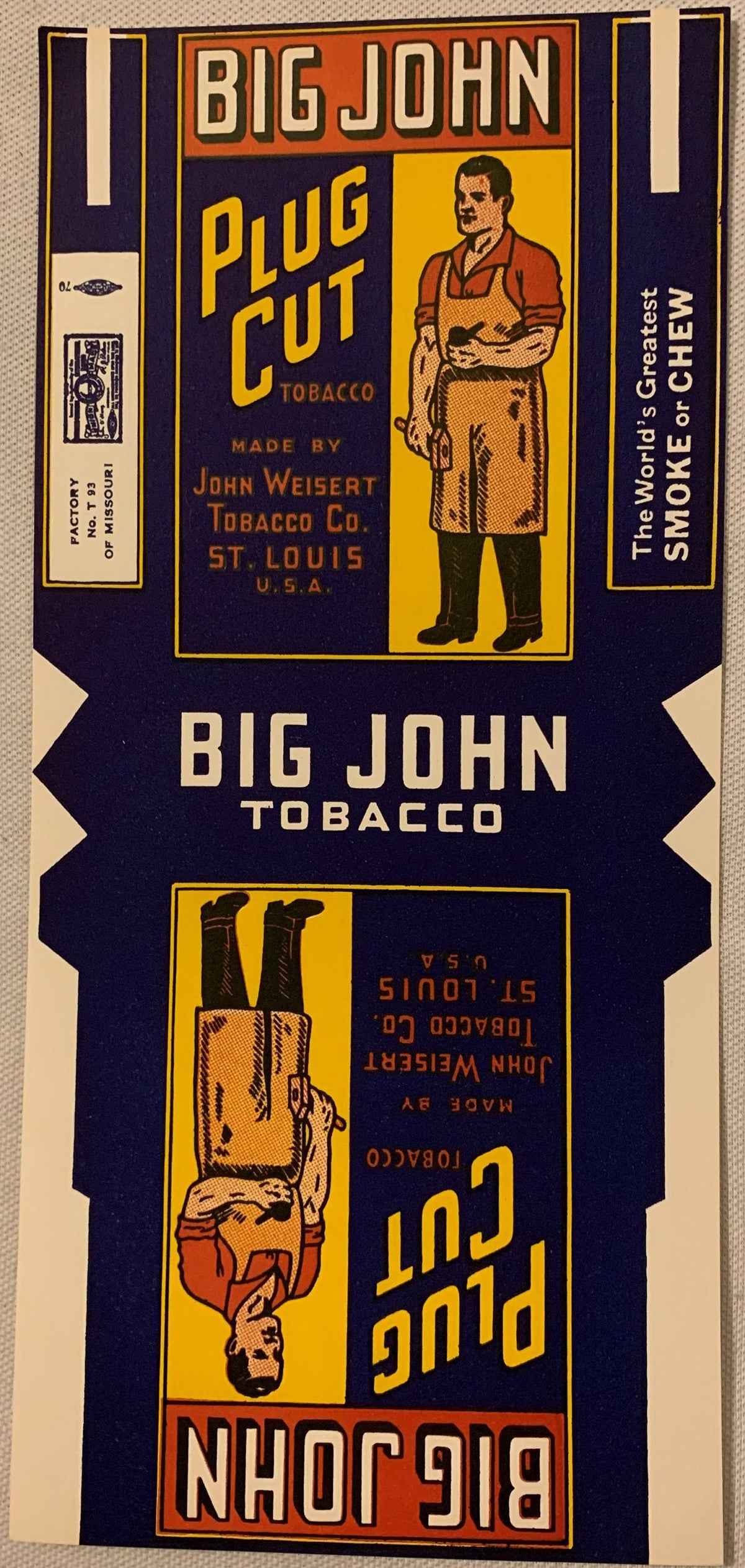
Antique Big John Plug Cut Tobacco Label 🏷️ John Weisert Tobacco Co — St. Louis, Missouri Blue & Gold

Antique Big John Plug Cut Tobacco Label 🏷️ John Weisert Tobacco Co — St. Louis, Missouri Blue & Gold

Regular price 5.50 USD
Regular price Sale price 5.50 USD
Sale Sold out
Shipping calculated at checkout.
Quantity

Could This Be the Last Surviving Piece of St. Louis's Greatest Industrial Legacy? 🏷️

There is a particular feeling that comes over you when you hold something that was never meant to survive. A tobacco label — printed to be pasted, to be handled, to be torn away and discarded — was not designed for the ages. It was designed for commerce, for the moment a shopkeeper's hand reached for a plug of tobacco and a customer's eye caught the bold blue and gold of a brand they trusted. And yet here it is, more than a century later, intact and vivid, still carrying the full weight of an American industry that once made St. Louis the tobacco capital of the entire nation. This Big John Plug Cut Tobacco label by the John Weisert Tobacco Company of St. Louis, Missouri is not merely a piece of printed paper. It is a front-row seat to one of the most fascinating, underappreciated chapters in American manufacturing history — and an exceptionally rare one at that.

Pull up a chair. This one has a story worth telling all the way through.


📋 What You're Looking At

This is an original, period-correct antique advertising label for Big John Plug Cut Tobacco, produced by the John Weisert Tobacco Company, headquartered in St. Louis, Missouri. The label measures a generous 10½ inches by 4½ inches — a wide-format, eye-commanding piece designed to be seen across the room of a general store, a saloon, a barbershop, or any of the hundreds of retail establishments that stocked plug cut tobacco at the turn of the last century. The colorway is a striking blue and gold, the kind of high-contrast palette that lithographers of the era understood would pop off a shelf and register immediately in a buyer's peripheral vision. This is a New Old Stock (NOS) label — meaning it was never applied, never pasted, never put to its original commercial use. It was stored, likely in a warehouse or storeroom, and survived intact through the entirety of the twentieth century. What you are receiving is not a reproduction, not a facsimile, not a decorative reprint. This is the genuine article, printed when John Weisert's name meant something enormous in the American tobacco trade — and when St. Louis was feeding nearly half the nation's appetite for tobacco products.


🏭 John Weisert Tobacco Company — 133 Years of American Industry

To understand this label, you have to understand the company behind it — and to understand the company, you have to understand the city. The John Weisert Tobacco Company was not a minor regional player. It was a titan. Founded in the mid-nineteenth century, the company operated continuously for an extraordinary 133 years, weathering the Civil War's aftermath, Reconstruction, the Gilded Age, two World Wars, the Great Depression, Prohibition, and the full arc of American industrialization — right up until 1989, when the grandson of the original founder, by then the company's sole remaining employee, finally closed the doors for good.

At its peak, John Weisert Tobacco operated under more than 100 distinct brand names. Big John Plug Cut was among them — a name chosen with the deliberate bluntness that tobacco marketing of that era perfected. There was no ambiguity in "Big John." It promised size, strength, and the kind of no-nonsense satisfaction that working men of the era demanded from their tobacco. Plug cut was a particularly prized format — dense, moist, hand-pressed tobacco sold in solid cakes or plugs that could be cut with a pocketknife and either chewed or crumbled into a pipe. It was the format of preference across American railroads, farms, docks, and factory floors through the late 1800s and into the early 1900s.

The John Weisert Tobacco Company Building still stands in St. Louis today as a listed historic landmark, and visitors to the city can still make out the company name painted on the antique brick facade — a ghostly advertisement for a business that outlasted nearly every competitor it ever had. The Missouri State Historic Preservation Office has documented the building and its history in detail, a testament to just how significant this company was to the region's industrial and cultural identity.

The end, when it finally came, arrived in a quietly heartbreaking way. The company had long since wound down most of its operations, but it clung to life through cigar production. That last thread snapped when Louis Applestein, the final hand-roller of cigars in the city of St. Louis, passed away at the age of 83. There was no one to replace him — not because the skill wasn't valued, but because hand-rolling cigars is a craft that takes years to develop and a lifetime to perfect, and the economic conditions of the late twentieth century had not produced a new generation willing to learn it. With Louis gone, the cigars stopped. The dwindling continued. And in 1989, the grandson of the founder locked the door on 133 years of family history. It was, officially, St. Louis's final exit from tobacco manufacturing entirely.

Local legend holds that on the day the Weisert building finally went quiet, a handful of longtime employees and neighborhood old-timers gathered on the sidewalk outside — not for any formal ceremony, but simply because word had gotten around and people felt they ought to be present for it. No speeches were made. But lore passed down among St. Louis collectors of trade ephemera maintains that some of the last remaining label stock, the very kind of NOS pieces that surface today in collections like this one, was quietly taken by those who were there — tucked into coat pockets and carried home as private memorials to a business that had outlasted everything except time itself.


🌉 St. Louis, Missouri — The Tobacco Capital America Forgot

Here is a fact that surprises almost everyone who hears it: in the early years of the twentieth century, St. Louis, Missouri produced nearly 40% of the entire nation's tobacco supply. Not a plurality. Not a regional share. Nearly four dollars out of every ten spent on tobacco in America came from product manufactured in St. Louis. The city that most people associate today with the Gateway Arch, Cardinals baseball, and toasted ravioli was once, without question, the single most important tobacco-producing city in the United States.

The reasons for this are layered and fascinating. St. Louis sat at the convergence of the Missouri and Mississippi Rivers, making it one of the great inland freight hubs of the continent. Tobacco leaf from Kentucky, Tennessee, and Virginia could be shipped upriver with remarkable efficiency. The city's manufacturing infrastructure — built through the Gilded Age on the profits of brewing, meatpacking, and dry goods — gave tobacco companies ready access to machinery, skilled labor, and the distribution networks necessary to move finished product to every corner of the country. And the immigrant communities that built much of St. Louis's industrial workforce brought with them a deep cultural familiarity with tobacco in all its forms.

John Weisert was not the only tobacco company operating in this ecosystem — but he was among the most prolific. Over 100 brands across plug cut, pipe tobacco, cigars, and related products meant that Weisert's operation touched almost every segment of the market simultaneously. The sheer variety was both a strength and, eventually, a reflection of a business model built for an era of abundance that would not last forever.

By mid-century, the tobacco industry's center of gravity had shifted south and east, toward the major cigarette manufacturers in North Carolina and Virginia. Cigarettes — which required industrial-scale manufacturing processes that smaller regional companies couldn't easily replicate — were becoming the dominant format, and the plug cut, pipe, and cigar producers of St. Louis found themselves fighting a current that only got stronger. One by one, the old names closed. Weisert held on longer than any of them. 133 years is not a coincidence — it is a testament to stubbornness, to craft, and to a refusal to concede until there was genuinely nothing left to concede.


🎨 The Artists Behind the Label — Beautiful Work, Forgotten Names

This label did not design itself. Someone sat down at a drafting table — likely in a commercial lithography shop in St. Louis or one of the major printing centers of the Midwest — and made every decision you see on this piece: the bold color choices, the typography, the balance of the design, the proportions that make it command attention at 10½ inches wide. That person was a trained commercial artist, working in an era when lithographic printing was the cutting edge of mass visual communication, and when the competition for shelf presence in America's general stores was fierce enough that the quality of your label could genuinely make or break a brand's fortunes.

What we know about these artists, as a general truth of the trade, is both admirable and sobering. The commercial lithographers and label artists of the late nineteenth and early twentieth centuries were, almost without exception, highly skilled professionals. Many had formal training. All of them possessed a deep understanding of color, composition, and the psychology of commercial persuasion. And nearly all of them worked under conditions of serious economic pressure — paid modest wages for work that would be reproduced in the thousands, with no royalties, no continuing credit, and no expectation that their names would be associated with what they created.

The artist who designed the Big John Plug Cut label almost certainly remains unknown. Their name was not on the label. It was not in the printer's records that survived. But their work did survive — in exactly the way that craft always outlasts circumstance, even when circumstance refuses to acknowledge it. Every collector who places this label in a frame and hangs it on a wall is, in a small but real way, keeping that artist's vision alive. The recognition may come a century late. But it comes.

Lore passed down among paper ephemera collectors in the midwest suggests that some of the finest label work of this era was produced by artists who were, in fact, trained in fine art traditions — portraiture, landscape, illustration — but who found steady commercial work more reliable than the feast-or-famine existence of gallery-dependent fine art careers. If that is true of the Big John label's designer, their talent found a medium that outlasted gallery walls entirely.


🖼️ Display Ideas

  • 🪵 Rustic bar or den wall: Frame it in reclaimed wood and hang it as the anchor piece in a vintage Americana bar cart vignette — the blue and gold will hold their own against exposed brick or barnwood paneling.
  • 📚 Home library or study: Pair it with other period advertising ephemera or antique maps of Missouri and the Mississippi River corridor for a cohesive, deeply researched collector's display.
  • 🏠 Farmhouse kitchen or dining room: The era of this label overlaps perfectly with the golden age of American farmhouse living — it reads as authentic period decor without a moment of visual dissonance.
  • 🎲 Game room or man cave: Big John Plug Cut has the bold, unapologetic energy that suits a well-appointed game room perfectly — this is the kind of piece that becomes the first thing guests notice and ask about.
  • 🏛️ Local history display: For St. Louis residents, Missouri collectors, or anyone with deep roots in the tobacco-growing regions of the American heartland, this label is a primary document of regional identity — worthy of archival framing and a prominent wall placement.
  • 🖼️ Gallery wall centerpiece: At 10½ by 4½ inches, the horizontal format makes it an ideal anchor for a mixed-media gallery wall alongside vintage photographs, maps, or other period ephemera — it brings the color and visual weight the composition needs.

🎁 Who Collects These

Antique tobacco labels occupy a wonderfully broad corner of the collecting world, and the Big John Plug Cut piece has particular appeal across several distinct collector communities.

Advertising and trade card collectors have long recognized that tobacco labels represent some of the finest commercial lithographic printing of the nineteenth and early twentieth centuries. The production values required for labels that would compete on a crowded general store shelf were genuinely high, and the surviving examples — especially NOS pieces that were never applied — are among the cleanest, most vibrant surviving records of the era's commercial art traditions.

Missouri and St. Louis regional historians will immediately grasp the significance of a John Weisert label in their collection. This is not a generic piece of Americana — it is a specific, named artifact from a specific company in a specific city during the era of that city's greatest industrial prominence. For anyone building a collection around St. Louis history, the confluence of the rivers, or Missouri's role in American commerce, this label is a primary source document dressed up as home decor.

Tobacciana collectors — the dedicated community of specialists who focus on tobacco-related antiques, from tins and humidors to caddies, advertising signs, and paper ephemera — will recognize immediately that an intact NOS Weisert label is a serious find. For this buyer, the blue and gold of Big John Plug Cut is a design choice as much as a historical one — and the story behind it is the detail that seals the decision.

Gift-givers searching for something genuinely original — a present for the person who has everything, a meaningful piece for someone with Missouri roots, or an anniversary or birthday gift with real historical substance — consistently find that antique advertising ephemera hits exactly the right note of personal, unexpected, and lasting.


❓ Frequently Asked Questions

Is this label an original antique or a reproduction?

This is a 100% original period label — not a reproduction, not a reprint, and not a licensed facsimile. It was produced by the John Weisert Tobacco Company during the company's active commercial operation, which ran from the nineteenth century through 1989, with the peak of their plug cut production in the late 1800s through early 1900s. The label is classified as New Old Stock (NOS), which means it was printed and stored but never applied to a product container — giving it a state of preservation that applied labels almost never achieve. What you see is the genuine printed piece, aged naturally and authentically over more than a century.

What condition should I expect, and what does NOS mean for a piece this old?

NOS — New Old Stock — refers specifically to the fact that this label was never put to its intended commercial use. It was not pasted onto a tobacco product, never handled in the rough-and-tumble of a working retail environment, and was not subjected to the moisture, tearing, or physical wear that applied labels routinely experienced. For a paper ephemera piece of this age, NOS condition is genuinely the best possible starting point. These are the honest marks of authentic age — the same characteristics that trained collectors and appraisers look for as evidence of genuine vintage status. What NOS assures you is the absence of applied-use damage, which is a significant distinction in the paper ephemera market.

How should I frame and preserve a label like this?

For long-term preservation, archival framing is the gold standard. This means using acid-free matting and backing materials, UV-protective glass or acrylic glazing, and a frame that allows the piece to be mounted without adhesives touching the paper itself. At 10½ by 4½ inches, the label fits comfortably in standard frame sizes with appropriate matting, and the horizontal format lends itself particularly well to wide shadowbox-style frames that give the design room to breathe. Keep it away from direct sunlight and sources of high humidity — the same basic wisdom that applies to any antique paper. If you're framing for serious preservation rather than purely for display, a local frame shop with experience in antique documents or maps will be able to advise on the best materials for your specific display environment.

Is John Weisert Tobacco Company documented historically? Can I learn more?

Yes — and remarkably thoroughly. The Missouri State Historic Preservation Office has a detailed National Register of Historic Places documentation file on the John Weisert Tobacco Company Building, compiled as part of the formal historic landmark designation process. That document covers the company's history, its place in St. Louis's industrial development, the building's architectural significance, and the broader context of Missouri's tobacco industry. It is a serious historical record, not a tourist summary. The building itself still stands in St. Louis and bears the painted name on its brick facade, making it one of the city's quietly extraordinary pieces of industrial heritage. For collectors who want to authenticate the provenance and significance of what they own, this level of documented historical record is unusually robust.

Who was Louis Applestein, and why does his story matter to this label?

Louis Applestein was, by the account that has been preserved in the company's history, the last hand-roller of cigars in the city of St. Louis. He worked for John Weisert Tobacco Company until his death at age 83 — and when he passed, the craft of hand-rolling cigars in St. Louis passed with him. His story is not merely a footnote in the company's history; it is the moment when the end became inevitable. The company had already wound down from its peak operations, but cigar production had kept it alive. Without a hand-roller, that too stopped. The piece you are holding — a label from the Weisert operation — is in a direct line of historical connection to Louis Applestein's working life, to the final years of St. Louis's tobacco industry, and to the 133-year story that ended in 1989. That is not a small thing. It is exactly the kind of human thread that elevates a collectible from a decorative object to a genuine artifact.

What makes plug cut tobacco labels particularly collectible compared to other tobacco ephemera?

Plug cut was the dominant format of American tobacco consumption through much of the nineteenth century and into the early twentieth — which means plug cut labels represent the commercial heart of the era's tobacco industry, not a niche or secondary product. The labels were produced to be bold and immediately recognizable at shelf level, which drove printers and commercial artists to develop genuinely sophisticated lithographic techniques to achieve vivid color and sharp detail on a format that was produced in large quantities. The combination of high production quality, historical centrality, and the physical durability of the plug cut label format — which was typically heavier stock than, say, cigarette package inserts — means that surviving examples in good condition are particularly prized. A NOS Weisert plug cut label at this size, in blue and gold, from a company with this level of documented historical significance, sits firmly in the upper tier of what tobacciana and advertising ephemera collectors are actively seeking.

Is this appropriate as a gift, and for whom does it resonate most strongly?

Antique tobacco labels make exceptional gifts precisely because they are specific. This is not a generic vintage decoration — it is a named brand, from a named company, in a named city, with a documented and genuinely extraordinary story attached to it. For anyone with ties to St. Louis or Missouri, it carries immediate regional resonance. For collectors of Americana, advertising art, or tobacciana, it is a substantive addition to a serious collection. For someone who appreciates the human stories behind objects — the artist who designed it, the workers who made the tobacco, Louis Applestein's long career, the grandson who finally turned out the lights — it is the kind of gift that invites conversation and lingers in the memory. And for anyone who simply loves beautifully designed, authentic period objects with real historical weight, the blue and gold of Big John Plug Cut makes an argument all on its own.

Shipping

🚚 Shipping & Handling

  • Shipping costs and timing are calculated at checkout.
  • Items curated and shipped directly by me include U.S. shipping at no additional cost, professionally packed to ensure safe arrival of your artifact.

Items from Vetted Pro Collectors
Shipping for items offered by vetted Pro Collectors is determined at checkout. All Pro Collector listings are reviewed to ensure fair, reasonable shipping practices.

For full details, please refer to our Shipping Policy.

Returns & Exchange

Take your time — you've got a full six months. If a piece isn't right for you, send it back the way it reached you and we're good.

In the first 30 days your money goes straight back the way you paid. After that it's store credit, so you can put it toward something you'd rather have.

Return shipping we sort out between us, case by case. I don't make this difficult.

If something arrives damaged, or it isn't what I said it was, send me a photo within 48 hours and I'll make it right.

Email info@vintageantiquesgifts.com or call 802-356-9872 — that's me answering, not a call center.

The only things I can't take back are custom or special-order pieces and gift cards.

View full details
  • 5 stars: 3 (100%)
  • 4 stars: 0 (0%)
  • 3 stars: 0 (0%)
  • 2 stars: 0 (0%)
  • 1 star: 0 (0%)
t
tatert1

Thanks for the cheap thrill !!!

Pleasure is all ours, Hope it provides many more!

h
hunebun27

A++ seller; item as described, recommend this seller! Tysm!!

pleasure is all ours!

s
silverd-17

A+ supper highly

Thank you!