Skip to product information
1 of 6

Vintage and Antique Gifts

Retro 2000s Cock 'n Bull Ginger Beer Bottle Cap ๐Ÿ“ Soft Drink Crown, Dr Pepper Bottling, West Jefferson NC

Retro 2000s Cock 'n Bull Ginger Beer Bottle Cap ๐Ÿ“ Soft Drink Crown, Dr Pepper Bottling, West Jefferson NC

Regular price $7.00 USD
Regular price Sale price $7.00 USD
Sale Sold out
Shipping calculated at checkout.

Size: 1 1/4"

๐Ÿšš Free US Shipping โ€” ships within one business day. International shipping calculated at checkout.

Quantity

Where Did the Moscow Mule Come From? ๐Ÿ“๐Ÿ‚ A Cock and Bull Story That Happens to Be True: Hollywood's Moscow Mule Ginger Beer, Capped in the Blue Ridge

Size: 1 1/4" ~ NOS unused stock, little to no storage wear.

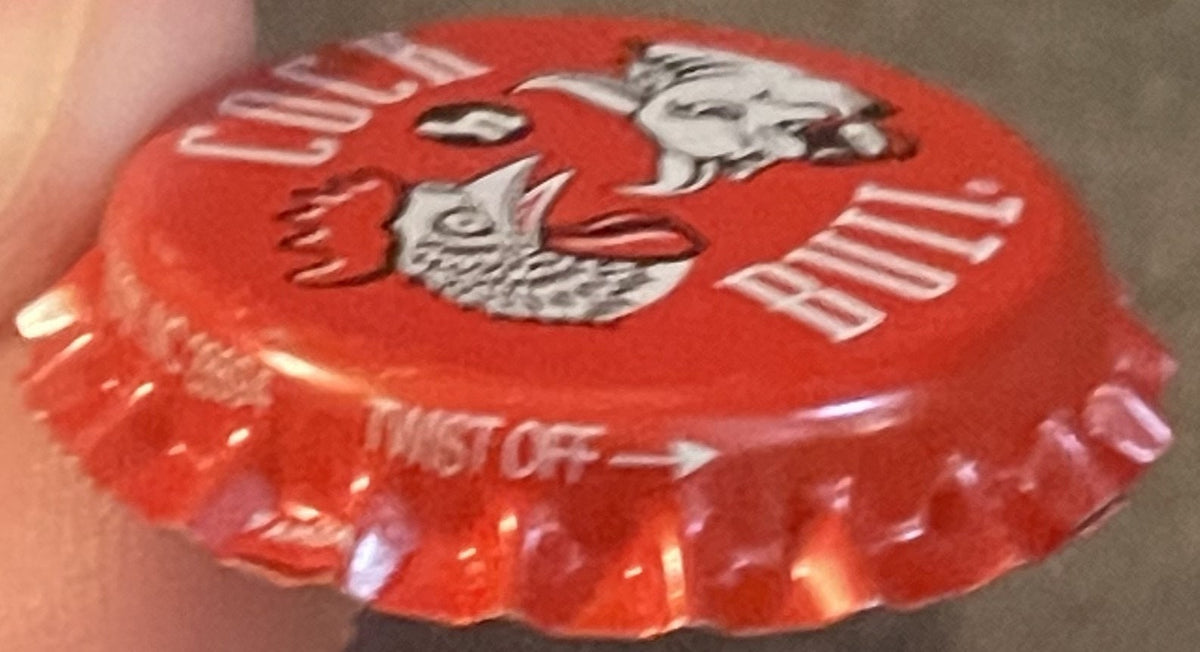
Turn this cap on its edge and read the skirt: "BOTTLED BY DR. PEPPER BOTTLING CO. WEST JEFFERSON, NC." On top is the rooster-and-bull emblem of Cock 'n Bull, the ginger beer born behind the bar of a Sunset Strip tavern where, as the story goes, the Moscow Mule was mixed to clear out a basement full of unsold stock. That tavern closed on October 22, 1987, fifty years to the day after it opened. This crown was made for bottles of that ginger beer filled clear across the country, in a small Ashe County mountain town, at a family bottling plant that opened the same year the tavern did.

Hold onto your taste buds, folks! There's a particular kind of magic in a bottle cap that most people would toss without a second look - a little disc of stamped metal that once sealed something fizzy, sharp and a little bit rebellious. This one is not just a collectible; it's a time machine in your palm. Behind that cartoon face-off is one of the richest, best-documented stories in American beverage history, a story that runs straight through a legendary Hollywood restaurant, a vodka with Russian roots that nobody in America wanted, and the invention of a cocktail that changed what Americans drank at the bar.


๐Ÿ” What Is on This Cap

This is a litho-printed metal crown cap with a red face. "COCK" arches across the top in white capitals and "BULL" runs along the bottom, followed by a registered trademark symbol. Between them, two heads square off. On the left, a wide-eyed rooster with a red comb throws his beak open, red tongue out. On the right, a white bull with curved horns and a red ring through his nose answers with his own mouth open. A small black circle between them holds a white "'n."

"COCK" arcs across the top and "BULL" anchors the bottom, so the whole design reads like a boxing-match poster shrunk down to fit inside a crown's crimped edge, with that little black "'n" doing double duty as punctuation and as the referee in the middle of the standoff. It's playful, it's a little absurd, and it's exactly the kind of graphic confidence that makes soda branding so much fun to collect.

The skirt carries its own printing in white:

  • TWIST OFF with an arrow showing which way to turn it
  • BOTTLED BY DR. PEPPER BOTTLING CO. WEST JEFFERSON, NC, followed by the town's ZIP code - 28694 is West Jefferson's own
  • a small number code along the fluted edge
  • down in the flutes, the tiny mark of the company that made the crown itself: famosa, short for Fรกbricas Monterrey, S.A., which got its start in the early 1920s stamping crowns for the Cuauhtรฉmoc brewery in Monterrey, Mexico

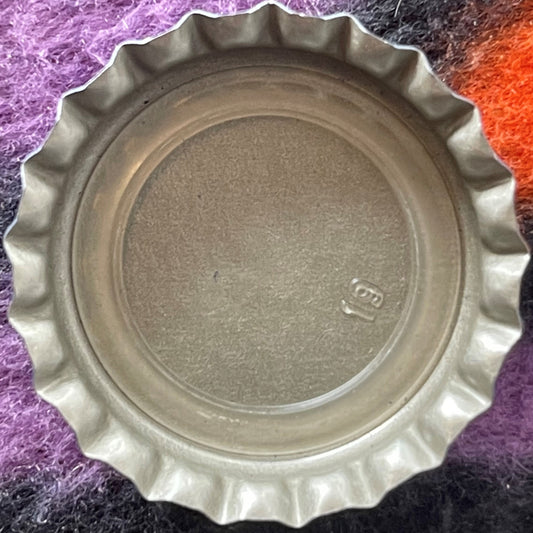
The inside is plain gold-toned metal around a round sealing liner, and the flutes still stand straight, never twisted off a bottle.

That little number code changes from cap to cap. It's an ordinary bit of crown-line bookkeeping, the kind of quiet production mark that shows up on soda and beer crowns of every era, and a nice small detail for anyone comparing caps side by side.

Two details on the skirt help place it. The ZIP code system started on July 1, 1963 - five-digit ZIP Codes came in nationwide that day, and at first nobody was required to use them - so the printing is from 1963 or later. And "TWIST OFF" marks a twist-off crown, the version pressed around a threaded bottle neck so it can be removed by hand instead of pried with an opener. But the artwork is what settles it: those cartoon rooster and bull heads are the Cock 'n Bull design the brand first used at the very end of 2003, according to its own trademark registration, so this is a 2000s crown - a later chapter in a story that begins decades before it. The old bottles from the restaurant days wore a plain script label instead, and the Smithsonian's National Museum of American History even keeps a 1949 Cock'N Bull ginger beer bottle in its collection.

Here's where the story gets good. Cock 'n Bull didn't start as a soda company at all - it started as a restaurant, on the Sunset Strip in what is now West Hollywood.


๐Ÿฅƒ The Cock 'n Bull: Fifty Years on the Sunset Strip

Brothers Jack and Percy Morgan opened the Cock 'n Bull at 9170 Sunset Boulevard on October 22, 1937, in a building put up the year before. They were the sons of a wealthy British expatriate and his American wife, raised in a Tudor mansion in the San Francisco Bay Area, and they built their tavern as an English pub. Its sign was a pub-style picture of a rooster and a bull; Life photographer Alfred Eisenstaedt caught it in 1937, mounted above a big window beside the tavern's red front door.

For half a century it was a clubhouse for Hollywood. A 1949 Photoplay photo showed Robert Mitchum, Barbara Hale and Bill Williams dining there. Hedda Hopper reported in 1947 that Greer Garson took her Moscow Mules in "a glass of alarmingly huge proportions." Director Richard Bare recalled approaching a young woman at the bar without knowing who she was, and hearing, "My name is Kim Novak." Dick Martin tended bar there before he became half of the comedy team Rowan and Martin, and Laugh-In producer George Schlatter was a regular. The brand's own history adds Jack Webb, Richard Burton, Jim Morrison and Rod Stewart to the roll.

Picture that room for a second: a British-style pub dropped into the middle of the Sunset Strip, copper mugs sweating with ice, a house-brewed ginger beer behind the bar, and a crowd that ran from old Hollywood glamour straight through to the rock stars of the counterculture era - Richard Burton, the British stage-and-screen legend, at one end and Jim Morrison of the Doors at the other. Not many addresses bridge that many eras of American celebrity, and fewer still can claim to be the birthplace of a cocktail still ordered by name in bars from coast to coast.

Bare, who said he met three of his wives at the Cock 'n Bull, also painted a "V for Victory" on one of its walls during World War II. When the end came, the regulars held a wake from 11 in the morning until closing. KCBS commentator Bill Stout summed the place up: "Bad behavior was rare," and "The place had class." On the way out, patrons took down the memorial plaque listing departed regulars, Dragnet creator Jack Webb among them, and carried it to the Scandia restaurant, which closed a year or so later.


๐Ÿธ The Moscow Mule: Two Origin Stories and a Basement Full of Dead Stock

Jack Morgan made his own ginger beer at the restaurant, and it would go on to become a national brand. The brand's own history says why: imported ginger beer - the real, spicy, old-world kind - could hardly be had in America, so Morgan made his own. John G. Martin of the spirits firm Heublein had bought the American license for Smirnoff vodka from Rudolph Kunett in 1938, reportedly for $14,000, and Americans were not buying it. They were a whiskey-and-gin crowd, and vodka sat on the shelf unsold. Put those two problems together and you get the legend.

The version West Hollywood historians tell dates the drink to 1940 at the Cock 'n Bull. Head bartender Wes Price later claimed he mixed the first one himself, with no grand plan at all: "I just wanted to clean out the basement. I was trying to get rid of a lot of dead stock." In his telling that stock was Cock 'n Bull ginger beer the tavern made and 100 cases of vodka, and he served the first Mule to actor Broderick Crawford. It "caught on like wildfire."

The recipe that came out of it is the one bars still pour: Morgan's ginger beer, Martin's vodka and a wedge of lime, over ice in a little copper mug. Price's version has a lot less romance and a lot more honesty than the legend - nobody was chasing greatness, they were clearing shelf space - and that's the kind of detail that makes bar history feel real. The brand's own history says the drink was named for vodka's Russian heritage and the ginger beer's added kick.

A second story, printed in the New York Herald Tribune in 1948, puts the invention at Manhattan's Chatham Hotel in 1941, where Morgan, as president of Cock 'n Bull Products, Martin, as president of G.F. Heublein Brothers, and Kunett of the Pierre Smirnoff division worked out vodka, ginger beer and citrus in a few days. Even the copper mug has rival claimants; Sophie Berezinski said she supplied the mugs from the Moscow Copper Company. Both accounts put Jack Morgan's ginger beer in the glass.

Martin sold it bar by bar. He carried one of the new Polaroid cameras from saloon to saloon, photographed each bartender holding a copper mug and a bottle of Smirnoff, left one print with the owner and kept another to show the next bar that the drink was spreading. The Mule caught on in Los Angeles and in Reno, and it helped launch America's taste for vodka. However it happened, it worked: before the Mule, vodka barely registered next to whiskey and gin. Smirnoff says so itself: its own account is that vodka didn't become a popular spirit in the United States until the Moscow Mule came along.


๐Ÿน Why the Moscow Mule Still Matters

Cocktail culture runs in cycles, but the Moscow Mule has had remarkable staying power. Ask any bartender working a craft cocktail program today and they'll know the drink by name and by mug - that squat copper cup has become iconic in its own right, showing up behind bars, on home bar carts and in the kitchen cabinets of people who have never mixed a cocktail in their life but love the look of the thing. Every time someone orders a Moscow Mule, they're invoking, whether they know it or not, that basement full of dead-stock vodka and ginger beer at a Hollywood restaurant on the Sunset Strip.

Right alongside the martini and the Manhattan, the Mule holds its place as one of the handful of cocktails everybody's heard of. For a collector, that staying power is what gives a little cap like this its outsized appeal: it isn't only soda memorabilia, it's a piece of the brand at the center of the Mule's origin story. You can hold the whole backstory in the palm of your hand.


๐Ÿ“œ What the Name Means

The Morgans picked a name with a wink in it. A "cock and bull story" is a far-fetched tale of dubious truth, and the phrase is old: John Day's 1608 play Law-trickes has a character complain, "What a tale of a cock and a bull he told my father." One old dictionary of phrase and fable called it a corruption of "concocted and bully" story.

The favorite legend puts its birthplace in Stony Stratford, England, on the old Watling Street coaching road, where two rival inns, The Cock and The Bull, served travelers changing horses between London and Birmingham. The story goes that passengers swapped news and rumor between the two, each inn trying to outdo the other with the wilder tale, until a "cock and bull story" meant a yarn too good to be true. The Cock dates to at least 1470 and The Bull to before 1600. Word historians call it folk etymology, but it is still the tale told in Stony Stratford.

So ever wonder why a rooster and a bull are squaring off on a ginger beer cap? The art is a visual pun on the brand's name: a rooster, the "cock," and a bull, nose to nose with their mouths open.


๐Ÿ”๏ธ West Jefferson, North Carolina, and the Vannoy Family's Plant

West Jefferson sits in Ashe County in the Blue Ridge, in a valley between Mount Jefferson and Paddy Mountain. It exists because of a railroad: the Norfolk and Western line nicknamed the Virginia Creeper made it a major stop, and the town incorporated in 1909. It once had the only cheese factory in the southeastern United States. Its population in 2020 was 1,279.

What makes a cap like this one interesting is that it belongs to the second act of the Cock 'n Bull story: the move from one Hollywood restaurant's house recipe to a bottled, branded soft drink sold well beyond the Strip. That meant new packaging, new bottling runs, and crowns like this one stamped out to seal bottles bound for shelves far from where the whole thing started. A cap doesn't just tell you what it sealed; it hints at the whole chain that got it from a Sunset Boulevard recipe to a bottling line in the Blue Ridge.

H.R. Vannoy founded the West Jefferson Dr. Pepper Bottling Co. in 1937, and his family still owns it. His son Kyle Vannoy spent 65 years in the business before his death in 2018. In recent years the plant has been out at 2614 NC Highway 163, still filling 12-ounce glass bottles. The plant is known for sweetening its sodas with pure cane sugar instead of corn syrup, and it is one of only two bottlers outside the Pepsi system permitted to produce Mountain Dew. Small independent franchise bottlers like this one filled their lines with many brands besides their namesake, and this cap shows Cock 'n Bull ginger beer was one of them. These came out of the old Dr Pepper bottling plant downtown in West Jefferson, which is how they've stayed flat and bright, never crimped onto a bottle. The town's historic district nomination lists the plant's two-story brick building at 108-110 North Third Avenue, built about 1940, with a "Dr. Pepper-Grapette Bottling Co." sign on its south wing, and notes it was operated by Carl Colvard and H.R. Vannoy in the 1940s.


๐Ÿ‘‘ The Crown Cap Behind the Story

William Painter patented the crown cork on February 2, 1892, as U.S. Patent 468,258. His original design had 24 teeth and a cork seal with a paper backing; the standard crown settled on 21 teeth, and modern liners are plastic rather than cork. The twist-off crown seen here came much later, pressed around screw threads so a thirsty customer could open a bottle bare-handed.


๐Ÿ–ผ๏ธ Display Ideas

  • ๐Ÿน Set it beside a copper mug on a home bar cart and let the Moscow Mule story tell itself to guests
  • ๐Ÿ“ Group it with other rooster-and-farmhouse advertising pieces for a kitchen gallery wall
  • ๐Ÿ—‚๏ธ Slide it into a shadow box alongside other soda and ginger beer crowns for a proper bottle cap collection
  • ๐ŸŽฌ Pair it with Sunset Strip or old Hollywood memorabilia for a themed bar or man-cave display
  • ๐Ÿ‹ Frame it near a lime and copper-toned bar setup as a nod to the cocktail it helped inspire
  • ๐ŸŽ Wrap it up for the cocktail enthusiast or home bartender who already owns the mug but not the history

๐ŸŽ Who Collects This Cap

  • Bottle cap collectors, especially those who chase regional bottler crowns
  • Soda and breweriana collectors who go for bold advertising crowns - that rooster-and-bull standoff holds up beautifully in a display case
  • Cocktail historians and home bartenders who serve Moscow Mules in copper mugs
  • Rooster-themed kitchen and farmhouse decor collectors, who love the artwork on its own merits
  • Cocktail bar and lounge decorators building a whole vintage bar theme
  • Sunset Strip and old Hollywood collectors
  • Ashe County, West Jefferson and Blue Ridge natives
  • Ginger beer and craft soda fans

It's a true crossover piece - equally at home in a soda cap album, on a cocktail bar's wall or in a Hollywood history collection.


๐Ÿ“ About these

Every one I have is new old stock, never put on a bottle. This groovy little gem, unearthed in West Jefferson, NC, is bursting with retro charm and fizzy nostalgia. And guess what? Cock 'n Bull ginger beer is still bubbling away today - C-B Beverage Corp. sells it, and store listings for it still say it has been sold since 1946 - but this West Jefferson crown is its own little piece of the story. It's not just a bottle cap; it's a slice of American history you can hold in your hand! The supply is finite - once these last unused West Jefferson crowns are gone, they'll be very difficult to acquire.

Shipping

๐Ÿšš Shipping & Handling

  • Shipping costs and timing are calculated at checkout.
  • Items curated and shipped directly by me include U.S. shipping at no additional cost, professionally packed to ensure safe arrival of your artifact.

Items from Vetted Pro Collectors
Shipping for items offered by vetted Pro Collectors is determined at checkout. All Pro Collector listings are reviewed to ensure fair, reasonable shipping practices.

For full details, please refer to our Shipping Policy.

Returns & Exchange

Take your time โ€” you've got a full six months. If a piece isn't right for you, send it back the way it reached you and we're good.

In the first 30 days your money goes straight back the way you paid. After that it's store credit, so you can put it toward something you'd rather have.

Return shipping we sort out between us, case by case. I don't make this difficult.

If something arrives damaged, or it isn't what I said it was, send me a photo within 48 hours and I'll make it right.

Email info@vintageantiquesgifts.com or call 802-356-9872 โ€” that's me answering, not a call center.

The only things I can't take back are custom or special-order pieces and gift cards.

View full details
  • 5 stars: 1 (100%)
  • 4 stars: 0 (0%)
  • 3 stars: 0 (0%)
  • 2 stars: 0 (0%)
  • 1 star: 0 (0%)
K
Kimberly Lienesch

Great friendly customer service and help from seller when post office made a mistake with the delivery. The item is in excellent conditionโ€ฆexactly as advertised and I love it. Would definitely buy from this seller again in the future!

Rescuing American History Since 2007

โ€” Travis & the Kids