Skip to product information
1 of 3

Vintage and Antique Gifts

Antique Beechwood Mince Meat Label 🥧 LARGE VERSION, Edgar Brick & Sons Crosswicks NJ, Rum Recipe NOS 1910s

Antique Beechwood Mince Meat Label 🥧 LARGE VERSION, Edgar Brick & Sons Crosswicks NJ, Rum Recipe NOS 1910s

Regular price $10.00 USD
Regular price Sale price $10.00 USD
Sale Sold out
Shipping calculated at checkout.

Size: 9 1/2" x 5"

🚚 Free US Shipping — ships within one business day. International shipping calculated at checkout.

Quantity

Who Made Beechwood Mince Meat? 🥧 Beechwood Mince Meat: A Label From the Largest Mincemeat Maker in America

Size: 9 1/2" x 5"

Crosswicks, New Jersey is a Quaker village you can drive through in a minute. It was also home to the largest mincemeat manufacturer in the United States. Edgar Brick started making his own mincemeat in 1874 because he did not think much of the Philadelphia product he sold in his general store, and he sold 76 pounds that first year. By World War II, Edgar Brick & Sons had 40 workers turning out three million pounds a year. The company gave up mincemeat in 1968 and closed in 1979, and its factory — two farmhouses moved and joined together in 1879 — was listed as endangered in 2017 with sections of its roof collapsed. This unused label, with RUM printed right in the recipe, is a piece of that story that survived intact.

🏷️ What the Label Says

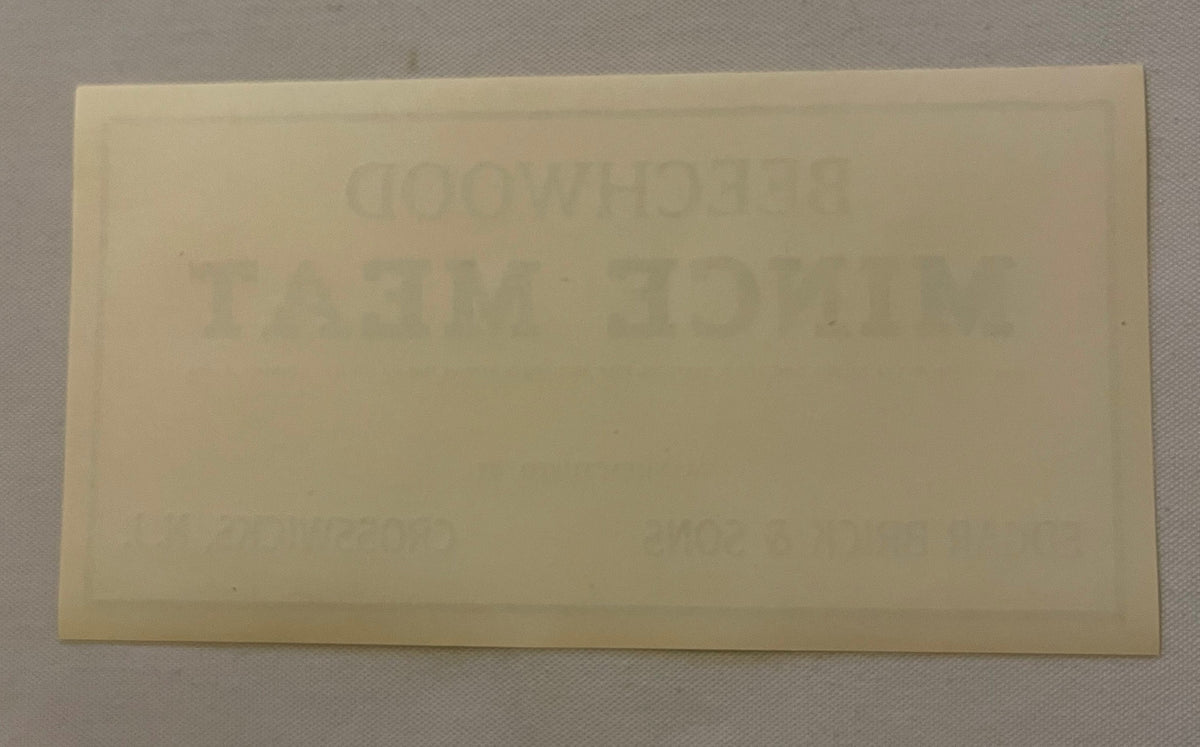
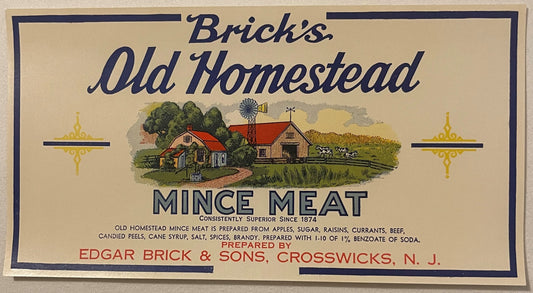
Black ink on cream paper inside a heavy black rule. BEECHWOOD runs across the top in tall serif capitals, and MINCE MEAT sits beneath it in big, heavy slab-serif letters. Then comes a single line of small type that is the whole recipe: "Prepared from APPLES, RAISINS, CANE SYRUP, DEXTROSE, BEEF, SALT, SPICES, STARCH, RUM and 1/10 of 1% BENZOATE of SODA." Below that, "MANUFACTURED BY," and across the foot, EDGAR BRICK & SONS on the left and CROSSWICKS, N.J. on the right. The back is blank, with the printing showing faintly through the paper in reverse, as the last photograph shows. Beechwood was one of the brand names the Brick company put on its mincemeat; Brick's Banquet Hall, Old Homestead and Nonpareil labels are others. Nonpareil is French for "without equal," which is not a modest thing to call your mince pie filling. The full-color Nonpareil and Old Homestead labels were printed in this same 9.5 by 5 inch size.

🏭 Edgar Brick and the 76 Pounds

Edgar Brick and his wife, Susan, came to Crosswicks in the 1850s and opened a general store on Main Street. The store stocked mincemeat made in Philadelphia, and Edgar Brick was not satisfied with it. In 1874 he made his own, and he sold 76 pounds of it the first year. After five years of rising sales he needed a real plant, and in 1879 he got one the practical way: two local farmhouses were moved onto the property and joined together. Additions followed over the decades. By the turn of the twentieth century Edgar Brick & Sons was the largest mincemeat manufacturer in New Jersey. Brick's packed mincemeat in wooden firkins, too. One of them, a 19th-century softwood bucket painted green and black with a bentwood bail handle, still wears two printed paper labels for Brick's Nonpareil Mince Meat, Edgar Brick & Sons, Crosswicks, N.J. That is the same maker's name and town you see across the foot of this label.

Edgar Brick died in 1920, and his three sons, Arthur, Josiah and Charles, took over; Brick family members ran the business for the rest of its life. The peak came during World War II, when the factory employed 40 workers and produced three million pounds of mincemeat a year — more than any other mincemeat maker in the country.

🥃 Rum in the Recipe, and Mince Pie in Federal Court

Traditional mincemeat recipes call for brandy or rum, for flavor and for keeping, and that put the holiday pie in an awkward spot when national Prohibition took effect in January 1920. The kitchen won a round in October 1922, when Old Victory, a Chicago distillery, took Prohibition officials to federal court and argued its case for liquor in cooking largely in the name of mince pie. The distillery won, and culinary products such as mincemeat could lawfully carry alcohol under permit.

Brick's own labels show how that worked in practice. A Brick's Banquet Hall Mince Meat label of the Prohibition years, lettered "Consistently Superior Since 1874," prints "PROOF ALCOHOL BY VOLUME 14 PER CENT" and "FEDERAL PROHIBITION PERMIT N.J. H-926." The Beechwood label names RUM plainly in its recipe line and carries no permit number and no alcohol statement.

🧪 The Benzoate Line — a Food Fight in One Fraction

That fraction is the settlement of one of the great food fights in American history. Harvey Washington Wiley, chief chemist of the U.S. Department of Agriculture, fed common preservatives to young volunteers the newspapers called the Poison Squad, and benzoate of soda was among the chemicals he tested and judged harmful. Wiley's crusade led to the Pure Food and Drug Act of 1906, and his Bureau of Chemistry was handed the job of enforcing it. Then a Referee Board of consulting scientists headed by Ira Remsen of Johns Hopkins University repeated the preservative trials and came down in favor of benzoate, reversing Wiley. In 1909 the Department of Agriculture allowed benzoate of soda in food at no more than one-tenth of one percent, so long as the amount was stated on the package. The small line near the middle of this label is that ruling, printed.

🏘️ Crosswicks: Quakers, a Creek Bridge and a Cannonball

Quaker settlers came to Crosswicks around 1677. The village takes its name from the Lenape word Crossweeksung, translated as "house of separation," though another old reading makes it "a divided creek." The Friends built a log meetinghouse in 1693, and the big brick meetinghouse on the green was begun in 1773, the third on the site.

On June 23, 1778, five days before the Battle of Monmouth, British troops under Sir Henry Clinton marching across New Jersey met American militia at the Crosswicks Creek bridge. The Americans tried to pull up the bridge, and a Burlington County militiaman named Job Clevenger was shot dead trying to cut it away. The fight held up the British column for at least a day, time that helped the Continental Army close the gap before Monmouth. On the north wall of the meetinghouse, between the second-story windows, a cannonball is lodged in the brick. Village tradition holds that it struck during the fight; historians suspect it was set there years later during a repair. Either way, it is still there.

The Brick family left its own mark on the village. Family members were instrumental in bringing electricity to Crosswicks, established a mill and an ice plant, and helped form the Chesterfield Township Historical Society.

🏚️ The Factory After Mincemeat

In 1968 Edgar Brick & Sons began producing alcoholic beverages and stopped making mincemeat altogether. The company closed in 1979 and its original equipment was auctioned. In 1980 the Hamilton Uniform Company bought the building, and after that business closed the old plant stood vacant. In 2017 Preservation New Jersey listed Brick's Mincemeat Factory as endangered: the building was in severe disrepair, sections of the roof had collapsed, and the township had deemed it a safety hazard. The two farmhouses Edgar Brick joined together once held the biggest mincemeat operation in America. Paper like this label is part of how that story is kept.

📦 Condition: New Old Stock

Unused and never applied to a container, with a blank back. Crisp black print on cream paper, as the photographs show.

🖼️ Where It Belongs

Framed in a farmhouse kitchen beside a shelf of old tins; in a New Jersey or Burlington County history collection; among grocery and food labels; with Prohibition memorabilia; or in a Thanksgiving display, where mince pie has always had a seat at the table.

❓ Questions People Ask

Who made Beechwood Mince Meat?
Edgar Brick & Sons of Crosswicks, New Jersey, whose name and town are printed along the foot of the label.

What was in it?
Fruit, beef, two sweeteners, spices and rum, with a declared preservative — the full list is printed in the line under MINCE MEAT.

Why is benzoate of soda listed with a percentage?
A 1909 Department of Agriculture decision allowed it up to one-tenth of one percent if the amount was declared on the label.

Could mincemeat contain alcohol during Prohibition?
Yes, under permit. A Chicago distillery won the point in federal court in 1922, and Brick's Prohibition-era Banquet Hall label printed its federal permit number.

Does the Brick's factory still stand?
It stands in Crosswicks; Preservation New Jersey listed it as endangered in 2017.

Has the label been used?
No. It is new old stock and was never applied to a container.

Shipping

🚚 Shipping & Handling

  • Shipping costs and timing are calculated at checkout.
  • Items curated and shipped directly by me include U.S. shipping at no additional cost, professionally packed to ensure safe arrival of your artifact.

Items from Vetted Pro Collectors
Shipping for items offered by vetted Pro Collectors is determined at checkout. All Pro Collector listings are reviewed to ensure fair, reasonable shipping practices.

For full details, please refer to our Shipping Policy.

Returns & Exchange

Take your time — you've got a full six months. If a piece isn't right for you, send it back the way it reached you and we're good.

In the first 30 days your money goes straight back the way you paid. After that it's store credit, so you can put it toward something you'd rather have.

Return shipping we sort out between us, case by case. I don't make this difficult.

If something arrives damaged, or it isn't what I said it was, send me a photo within 48 hours and I'll make it right.

Email info@vintageantiquesgifts.com or call 802-356-9872 — that's me answering, not a call center.

The only things I can't take back are custom or special-order pieces and gift cards.

View full details

Preserving History: Authentic Objects Across Eras

— Curated by Travis Weigel