Skip to product information
1 of 2

Vintage and Antique Gifts

Antique Banquet Hall Mince Meat Label 🦁 LARGE VERSION, Edgar Brick & Sons Crosswicks NJ, NOS 1910s

Antique Banquet Hall Mince Meat Label 🦁 LARGE VERSION, Edgar Brick & Sons Crosswicks NJ, NOS 1910s

Regular price 11.00 USD
Regular price Sale price 11.00 USD
Sale Sold out
Shipping calculated at checkout.
Quantity

🏷️ A 1910s Banquet Hall Mince Meat Label, Preserved as New Old Stock

Some pieces of grocery history never made it onto a shelf. This is one of them: a genuine early-twentieth-century Banquet Hall Mince Meat label, printed by letterpress for Edgar Brick & Sons of Crosswicks, New Jersey, and preserved exactly as it left the press -- new old stock, never affixed to a tub, never soaked off a container, never trimmed. We curate this the way we curate every piece of paper ephemera in this collection: everything stated as fact here is read directly off the label itself, and everything offered as history or lore is clearly identified as such. Nothing is invented, and nothing about its own printed identity is guessed at.

What makes a survivor like this worth pausing over is exactly the quality that made it disposable in its own time. A label meant for a wholesale tub of mincemeat was never built to last -- it was built to be pasted down, handled in a warm kitchen, and thrown away with the empty container. This one simply never got that far. It sat, flat and unused, for well over a century, and what you are looking at is the same crisp cream sheet that came off Edgar Brick & Sons' press in the 1910s.


📜 Read Straight From the Label

The label is set inside a hand-drawn dashed, chain-link border and reads, exactly as printed, top to bottom:

"BANQUET HALL MINCE MEAT
Combines Apples, Sugar, Raisins, Currants, Candied Peels, Beef, Spices, Salt, Brandy and 1/10 of 1% Benzoate of Soda.
NET WEIGHT 30 LBS.
Manufactured by EDGAR BRICK & SONS, CROSSWICKS, N. J."

That is the whole of it -- there is no illustration, no portrait, no decorative vignette. This is plain commercial letterpress typography doing all the work: a bold condensed display face for the brand name, clean serif text beneath it for the ingredient list, and two ruled double lines dividing the label into its three blocks of information. It is honest, functional printing from a working New Jersey food business, not a piece designed to be pretty -- which is exactly why it reads as so genuine today.


🔍 Dating It From the Label Itself

We do not have to guess at this label's era, because the label dates itself. In 1909, a federal USDA ruling made it mandatory for food packers to declare benzoate of soda -- a common preservative of the period -- directly on the container, specifying the exact percentage used. This label complies precisely, printing "1/10 of 1% Benzoate of Soda" as part of its ingredient statement. That single clause means the label cannot have been printed before 1909.

At the other end of the range, the label plainly declares "Brandy" among its ingredients, and nowhere on the face is there a federal Prohibition permit number -- a marking that period mincemeat labels using alcohol were required to carry once national Prohibition took effect at the start of 1920. A label naming brandy with no permit number printed anywhere is therefore consistent with a printing before that requirement existed. Taken together, those two hard, on-object details bracket this label to the 1910s -- after the 1909 benzoate ruling took hold, and before Prohibition-era permit language became necessary. We date it 1910s on that basis, not on style or guesswork.

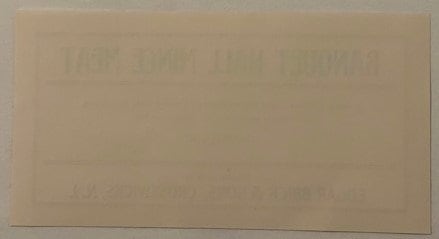
New old stock is also visible in the object itself, not just claimed: the reverse is blank, uncoated stock, with only a faint ghost of the front lettering showing through where the paper has thinned slightly with age -- the unmistakable sign of a label that was printed, stacked, and never pasted onto anything.


🏪 Edgar Brick & Sons: A Crosswicks Family Business

The Brick family's story in Crosswicks began in the 1850s, when Edgar Brick and his wife Susan settled in the village and opened a general store on Main Street. Local history holds that Edgar Brick began making his own mincemeat in 1874 because he was unsatisfied with the Philadelphia-made mincemeat he had been stocking on his own shelves -- so he decided to make a better version himself, right there in Crosswicks. The first year, by the account passed down with the business, he sold a modest 76 pounds. Sales grew steadily, and within five years the operation had outgrown its original space and moved into a larger building.

The company kept growing from there. By the turn of the twentieth century, Edgar Brick and Sons had become the largest mincemeat manufacturer in New Jersey -- a genuine local success story built on a general-store owner's dissatisfaction with somebody else's product. When Edgar Brick died in 1920, the business passed to his three sons, Arthur, Josiah and Charles, who carried the Brick name forward. At its peak during the Second World War, the company employed roughly forty workers and turned out some three million pounds of mincemeat a year, making it, by that point, the largest mincemeat manufacturer in the entire United States -- a remarkable scale for a firm that started with 76 pounds sold out of a small-town general store.

The mincemeat era eventually wound down: American consumption of mincemeat declined through the 1960s, and in 1968 the company pivoted into producing alcoholic beverages, ending its mincemeat production altogether. The business closed for good in 1979, more than a century after Edgar Brick first put his name on a label. No documented connection to any larger parent company has surfaced -- this was, start to finish, an independent Crosswicks family firm. The original factory building has since been recognized by Preservation New Jersey, a quiet acknowledgment of just how significant this small operation once was.


🥕 What "Banquet Hall" Actually Held

Read the ingredient list closely and you get an honest snapshot of turn-of-the-century American mincemeat: apples, sugar, raisins, currants, candied peels, beef, a blend of spices, salt, and brandy, stabilized with a legally declared trace of benzoate of soda. This was a genuinely fruit-forward, spiced, brandy-laced preserve built for holiday baking -- the filling behind a mince pie on a Thanksgiving or Christmas table in the 1910s. The thirty-pound net weight tells you plainly who this label was made for: not a home cook buying a small retail tin off a shelf, but a general store, hotel kitchen, bakery, or restaurant supplier ordering mincemeat in bulk, ready to be portioned out for local sale or for the establishment's own holiday baking. It is a wholesale foodservice label, and reading it that way is part of what makes it such a satisfying piece of grocery-trade history rather than just a pretty bit of paper.


🥂 Brandy, Lore, and the Road to Prohibition

Collectors and old-timers around Crosswicks have long passed along the story that Edgar Brick & Sons used real rum or brandy in their mincemeat recipe, and that during Prohibition mincemeat became especially popular for exactly that reason -- a spiced, fruit-and-alcohol preserve that could still, within limits, legally carry a splash of spirits for flavor. That is local legend and collector lore rather than a claim we can verify against a primary source for this specific label, and we say so plainly. What is documented is the legal backdrop: some later Banquet Hall labels do carry a printed federal Prohibition permit and an alcohol-by-volume statement, and almost as soon as national Prohibition began in 1920, food producers and grocers lobbied hard for culinary exceptions -- a 1922 court ruling ultimately confirmed that culinary products, mincemeat among them, could legally contain liquor under federal oversight. This label, printed earlier and carrying no such permit language, sits right on the eve of that whole controversy -- brandy declared openly, in a country that had not yet begun regulating it in food.


🏘️ Crosswicks, New Jersey: A Village Built by One Family

Crosswicks is a tiny village in Chesterfield Township, Burlington County, New Jersey -- the kind of place where one determined family's business can genuinely shape the whole community, and the Bricks did exactly that. Beyond the mincemeat works, family members were instrumental in bringing electricity to Crosswicks, and they established a mill and an ice plant along Crosswicks Creek, giving the small village industrial infrastructure it would not otherwise have had. They later helped form the Chesterfield Township Historical Society, preserving the very local history their own family had helped write. Edgar Brick's sons funded the Crosswicks firehouse in their father's memory -- a lasting, literal monument to a family that started with a general store on Main Street and a batch of mincemeat nobody had asked for, and ended up building pieces of the town's civic infrastructure. Owning this label is a small way of holding onto that entire arc: general store, family recipe, industrial-scale food company, and civic legacy, all traceable back to one man's dissatisfaction with someone else's mincemeat in 1874.


🖼️ Collecting and Displaying Grocery Advertising Ephemera

Antique food and grocery labels like this one are collected today for exactly the reasons this piece rewards a close look: honest period typography, a fully identified maker and place, and a direct, physical connection to how Americans actually ate a century ago. A letterpress label with no illustration has its own kind of graphic appeal -- bold, confident lettering doing all the persuading, the way commercial printing worked before photography and full-color lithography took over grocery advertising. Framed simply behind glass, it reads beautifully as kitchen wall art, a piece of food-history ephemera, or a conversation-starting addition to a collection of general-store and grocery-trade advertising. It suits a farmhouse kitchen, a holiday-baking nook, a New Jersey local-history collection, or simply a wall dedicated to authentic early-1900s American commercial print.

  • 🏷️ Paper ephemera and grocery-advertising collectors seeking a genuine, unused early-1900s food label.
  • 🗺️ New Jersey and Burlington County local-history enthusiasts researching Crosswicks and Chesterfield Township.
  • 🥘 Holiday-baking and kitchen-history collectors drawn to an authentic mincemeat recipe list from the 1910s.
  • 🖼️ Decorators framing honest period typography as kitchen or dining-room wall art.
  • 🎁 Gift-givers seeking a story-rich, documented piece of American food history.

🎁 An Honest Piece of Food History

We offer this exactly as what it is: a genuine, unused Banquet Hall Mince Meat label, printed by letterpress for Edgar Brick & Sons of Crosswicks, New Jersey, sometime in the 1910s -- dated not by guesswork but by its own printed benzoate-of-soda declaration and the absence of any Prohibition permit language. It survived as new old stock, never pasted down, its plain typography and blank, gently show-through reverse both confirming exactly that. Around its short, factual text sits a genuinely rich piece of American small-town history -- a general-store owner's homemade mincemeat that grew into New Jersey's largest producer, a family that helped electrify and build out its own village, and a brandy-laced recipe that stood at the doorway of Prohibition. It is a small, honest survivor of a Crosswicks kitchen table that became a national food company, offered to whoever will give this label the wall, the frame, or the collection it deserves. 🏷️

Shipping

🚚 Shipping & Handling

  • Shipping costs and timing are calculated at checkout.
  • Items curated and shipped directly by me include U.S. shipping at no additional cost, professionally packed to ensure safe arrival of your artifact.

Items from Vetted Pro Collectors
Shipping for items offered by vetted Pro Collectors is determined at checkout. All Pro Collector listings are reviewed to ensure fair, reasonable shipping practices.

For full details, please refer to our Shipping Policy.

Returns & Exchange

Take your time — you've got a full six months. If a piece isn't right for you, send it back the way it reached you and we're good.

In the first 30 days your money goes straight back the way you paid. After that it's store credit, so you can put it toward something you'd rather have.

Return shipping we sort out between us, case by case. I don't make this difficult.

If something arrives damaged, or it isn't what I said it was, send me a photo within 48 hours and I'll make it right.

Email info@vintageantiquesgifts.com or call 802-356-9872 — that's me answering, not a call center.

The only things I can't take back are custom or special-order pieces and gift cards.

View full details