Skip to product information
1 of 3

Vintage and Antique Gifts

Antique Mince Meat Buyers Special Label 🏷️ Edgar Brick & Sons Crosswicks NJ 🍎 New Old Stock 5x9.5in

Regular price 10.00 USD
Regular price Sale price 10.00 USD
Sale Sold out
Shipping calculated at checkout.

Description

What do you do with a label that never got to do its job? 🥧

There's something quietly moving about paper that was printed for work it never performed. This label never met a brush of paste, never wrapped itself around the curved staves of a fifty-pound tub, never rode a delivery wagon down a Burlington County lane toward a grocer's shelf in the cold weeks before Thanksgiving. It was printed, stacked, and set aside — and there it stayed, crisp and untouched, while the company that commissioned it grew into one of the largest mincemeat manufacturers in the entire country, and then, decades later, went quiet for good. That's the peculiar gift of ephemera like this: it survives precisely because it was never used. What's left in your hands is a small paper witness to a company whose real story was far bigger than any single label ever let on.

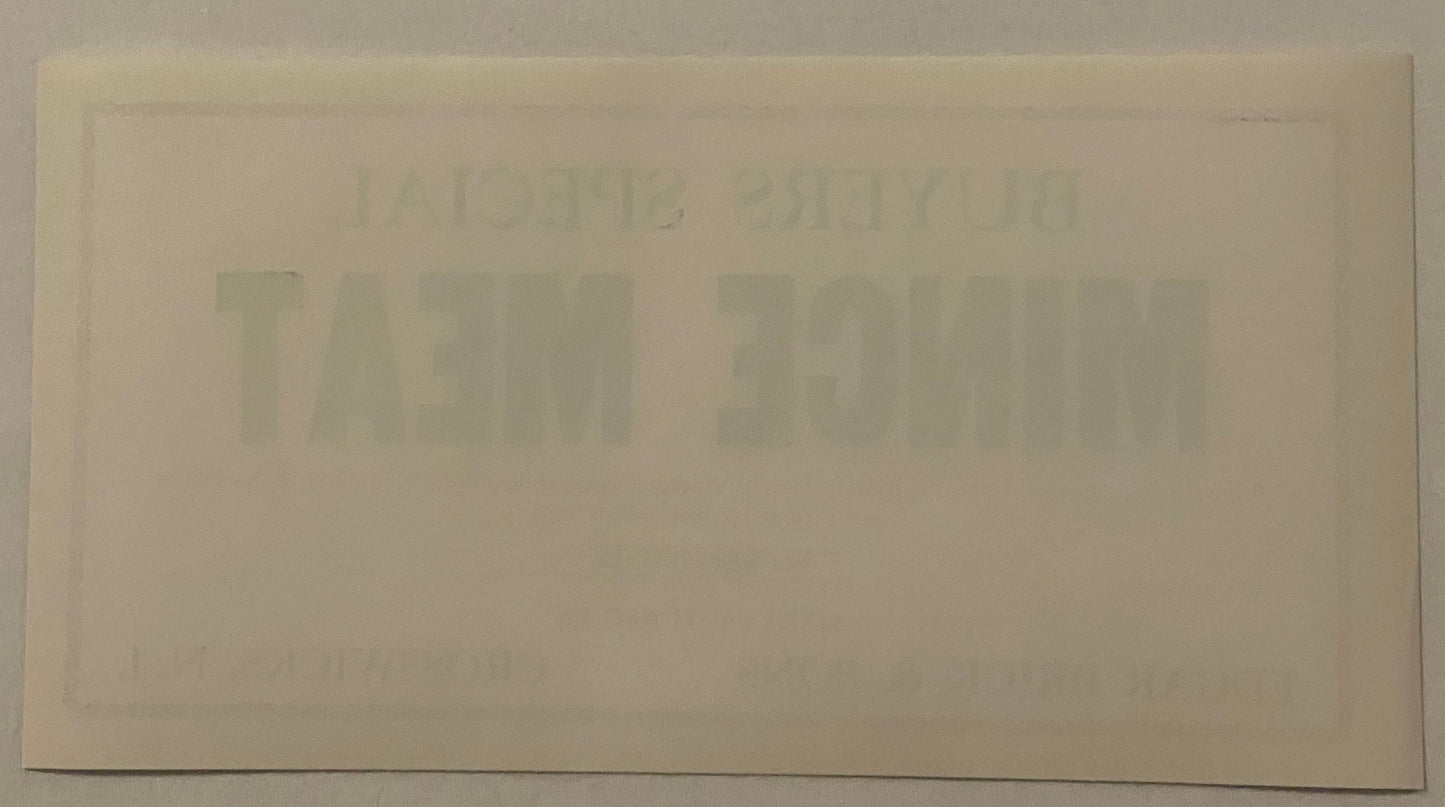
This is a Buyers Special Mince Meat advertising label, manufactured by Edgar Brick & Sons of Crosswicks, New Jersey. It's printed in bold, letterpress-style black ink on cream stock, framed by a precise decorative chain-link border, with the full ingredient declaration — apples, dextrose, raisins, starch, vinegar, beef, candied peel, spices, sherry flavor, and 1/10 of 1% Benzoate of Soda — set in careful centered type beneath the product name. The stated net weight of 50 lbs. marks this as a bulk, wholesale-container label rather than a retail tin label, meant for the wooden firkins and tubs that bakeries and grocers ordered by the barrel in the run-up to the holiday season. The reverse is blank, showing only faint print-through from the front — the mark of a sheet that was printed, stored, and never applied. This is genuine New Old Stock: unused commercial printer's stock, an excellent surviving example of early American grocery advertising art from a company whose reach once stretched coast to coast. Given the "Sherry Flavor" wording and the benzoate-of-soda declaration typical of early food-labeling law, this label sits somewhere in the broad window of the 1910s through the 1940s — a range no single dealer or archive can pin closer, but one the label's own printed conventions comfortably support.


🏭 Edgar Brick's Stubborn Streak — From a General Store to the Largest Mincemeat Maker in America

Every great small-town manufacturing story seems to start with one stubborn, dissatisfied person, and Edgar Brick fits the mold perfectly. He and his wife Susan settled in Crosswicks in the 1850s and opened a general store on Main Street — the kind of shop that stocked everything a rural New Jersey household might need, mincemeat included. For years that mincemeat came shipped in from Philadelphia, and Edgar Brick, by all accounts, simply didn't think much of it. So in 1874, dissatisfied with the product he'd been selling off his own shelves, he started making his own. The first year, he sold 76 pounds. It's an almost comically modest beginning for a company that would eventually measure its output in the millions — but it was enough to prove the idea had legs.

Within five years, demand had outgrown his original space, and in 1879 he moved operations into a larger building — created, in a wonderfully practical bit of nineteenth-century engineering, by physically moving two local farmhouses onto the property and joining them together into one factory. That patchwork building, expanded piece by piece over the decades that followed, became the beating heart of Crosswicks industry. By the turn of the twentieth century, Edgar Brick & Sons had become the largest mincemeat manufacturer in the state of New Jersey. At its peak during World War II, the company employed forty workers and turned out three million pounds of mincemeat a year — making it, by the account preserved by Preservation New Jersey, the largest mincemeat manufacturer in the entire United States.

Edgar Brick died in 1920, and the company passed to his three sons — Arthur, Josiah, and Charles — who kept the family firm running for another 48 years. But tastes change, and by the 1960s mincemeat consumption was in steady decline across the country. In 1968 the company pivoted to producing alcoholic beverages and stopped making mincemeat altogether; it closed for good in 1979, with much of the original equipment and furnishings sold off at auction. In 1980 the old factory building — those two farmhouses joined a century earlier — was purchased by the Hamilton Uniform Company. Collectors who trace Brick's surviving labels note that "Buyers Special" turns up far less often in the market than the company's better-known lines like Nonpareil, Old Homestead, Banquet Hall, and Beechwood — which is part of what makes finding this brand name a genuine treat rather than a routine one.


🏘️ Crosswicks: A Quaker Village That Smelled Like Christmas

Crosswicks sits within Chesterfield Township, Burlington County — a Colonial-era Quaker settlement whose history runs far deeper than any one company. The village's large brick Quaker meetinghouse was raised in 1773, and to this day a cannonball from a 1778 Revolutionary War skirmish remains lodged in its north wall — a small, permanent reminder that this quiet farming village once sat in the path of history. The Brick mincemeat factory occupies a prominent spot within what is today the Crosswicks Village National and State Register Historic District, and antiquarian booksellers who've cataloged the region's ephemera describe Brick's mincemeat as one of the major industries of Crosswicks through the late nineteenth and early twentieth centuries.

The Brick family's fingerprints are all over the town beyond the factory walls. Family members were instrumental in bringing electricity to Crosswicks, in establishing a mill and an ice plant along the Crosswicks Creek, and later in forming the Chesterfield Township Historical Society to preserve the very history their family helped write. Old-timers in the area still recall — and it's a story worth passing along even now — that for a few weeks each autumn, the whole village would carry the warm, spiced scent of simmering mincemeat on the air, as barrels and tubs rolled out of the factory bound for grocers up and down the Eastern Seaboard. The recipe itself never really left town: Chesterfield Township's Heritage Day still serves mincemeat made from Edgar Brick's original 1874 formula, a small but living thread connecting today's residents straight back to that first modest batch of 76 pounds.


📜 A Company History Worth Its Own Chapter Today

What makes this label more than a pretty piece of period graphic design is how well-documented the company behind it turned out to be. Preservation New Jersey has flagged the old Brick factory building as an endangered historic site — the physical shell of those two joined farmhouses still standing as a monument to one family's stubborn, successful idea. Surviving examples of Brick's other brand labels, and even a painted softwood firkin still bearing its original Nonpareil paper label, have crossed the auction block in recent years, giving collectors a rare, tangible window into a vanished corner of American grocery history. A label like this one — printed for a company that once shipped mincemeat across the entire country, from a Quaker village where a Revolutionary cannonball still sits lodged in a meetinghouse wall — carries a story well out of proportion to its size.


🖼️ Display Ideas

  • 🖼️ Framed and matted on its own as a striking piece of early American food advertising typography
  • 🍂 Displayed seasonally in a kitchen or dining room each autumn alongside vintage baking tools
  • 🪵 Paired with an antique wooden firkin, tub, or grocer's crate for a full period tableau
  • 📚 Added to a curated collection of New Jersey company or Burlington County ephemera
  • 🎄 Set out during the holidays as a nod to the mincemeat tins and tubs of Christmases past
  • 🏺 Grouped with other vintage grocery and general-store advertising labels for a gallery wall

🎁 Who Collects These

This label draws in several kinds of collectors at once — those who chase New Jersey company and local history, those building out collections of early American food and grocery advertising art, ephemera collectors who specifically seek out unused, never-applied printer's stock, and anyone with a soft spot for the vanished culture of holiday mincemeat baking. It also appeals to collectors of Quaker and Colonial-village Americana, since Crosswicks itself carries real Revolutionary War history well beyond the factory that once anchored its economy.


❓ FAQ

Is this an original label or a reproduction?
This is an original, unused commercial label — genuine New Old Stock printed for Edgar Brick & Sons and never applied to a container.

What does "New Old Stock" mean here?
It means the label was manufactured and warehoused but never used for its intended purpose. The blank reverse, showing only faint print-through from the front, is consistent with a sheet that sat unused rather than one that was peeled off a tub.

Why is the net weight 50 lbs.? Was this meant for a home kitchen?
No — a 50-pound net weight identifies this as a bulk, wholesale-trade label, meant for the wooden tubs and firkins that bakeries, hotels, and grocers ordered in quantity, rather than a small retail tin sold directly to a household cook.

How old is this label exactly?
No manufacture date is printed on the piece, so an exact year can't be confirmed. Based on the label's ingredient-declaration style and wording, it fits comfortably within the broader 1910s–1940s window of Edgar Brick & Sons production.

Why does the label mention "Benzoate of Soda"?
This was a common, legally required preservative declaration on American food labels following early twentieth-century pure food laws, and its presence here helps place the label within that broader era of food labeling.

What happened to Edgar Brick & Sons?
The family-run company operated for nearly a century, growing into one of the largest mincemeat manufacturers in the United States by World War II, before shifting production and ultimately closing in 1979. Its original factory building — built from two joined farmhouses — still stands in the Crosswicks Village Historic District.

Is "Buyers Special" a rare Brick brand?
Among collectors, it's noted as appearing less frequently than the company's more commonly seen Nonpareil, Old Homestead, and Banquet Hall labels, making it a nice find for anyone building a collection of Brick ephemera.

Shipping

🚚 Shipping & Handling

  • Shipping costs and timing are calculated at checkout.
  • Items curated and shipped directly by me include U.S. shipping at no additional cost, professionally packed to ensure safe arrival of your artifact.

Items from Vetted Pro Collectors
Shipping for items offered by vetted Pro Collectors is determined at checkout. All Pro Collector listings are reviewed to ensure fair, reasonable shipping practices.

For full details, please refer to our Shipping Policy.

Returns & Exchange

Product Page Return Policy

  • 60-Day Returns – Items must be in original condition.
  • Refunds – Issued after inspection (excluding shipping costs).
  • Return Shipping – Customer is responsible unless item is damaged or incorrect.
  • Damaged/Incorrect Items – Contact us within 48 hours for a replacement or refund.
  • Easy Returns – Email [email protected] or call 802-356-9872 to initiate a return.

For full details, visit our Refund Policy.

View full details