Skip to product information
1 of 4

Vintage and Antique Gifts

Antique 1920s BF Goodrich Sport Shoes Advertising Ink Blotter 👟 Grand Gorge NY

Antique 1920s BF Goodrich Sport Shoes Advertising Ink Blotter 👟 Grand Gorge NY

Regular price 35.00 USD
Regular price Sale price 35.00 USD
Sale Sold out
Shipping calculated at checkout.
Quantity

Size: 5.75 inches

🖋️ A Genuine 1920s - 1930s Goodrich Sport Shoes Advertising Ink Blotter, Unused

This is an authentic advertising ink blotter for B. F. Goodrich Sport Shoes, printed in the 1920s or very early 1930s and never put to use. In the days before ballpoint pens, wet fountain-pen and dip-pen ink had to be dried by pressing a sheet of soft, absorbent blotting paper over the fresh writing, and merchants gave away small printed blotters like this one as everyday advertising — a useful desk object that quietly kept a shop's name in front of a customer every time they signed a letter or totted up a column of figures. What survives here is one of the most charming and honest forms of period advertising there is: a bright, colour-lithographed shoe advertisement on the front, and a plain, unmarked, absorbent blotter stock on the back, complete and unused after roughly a century.


📝 Exactly What the Card Says

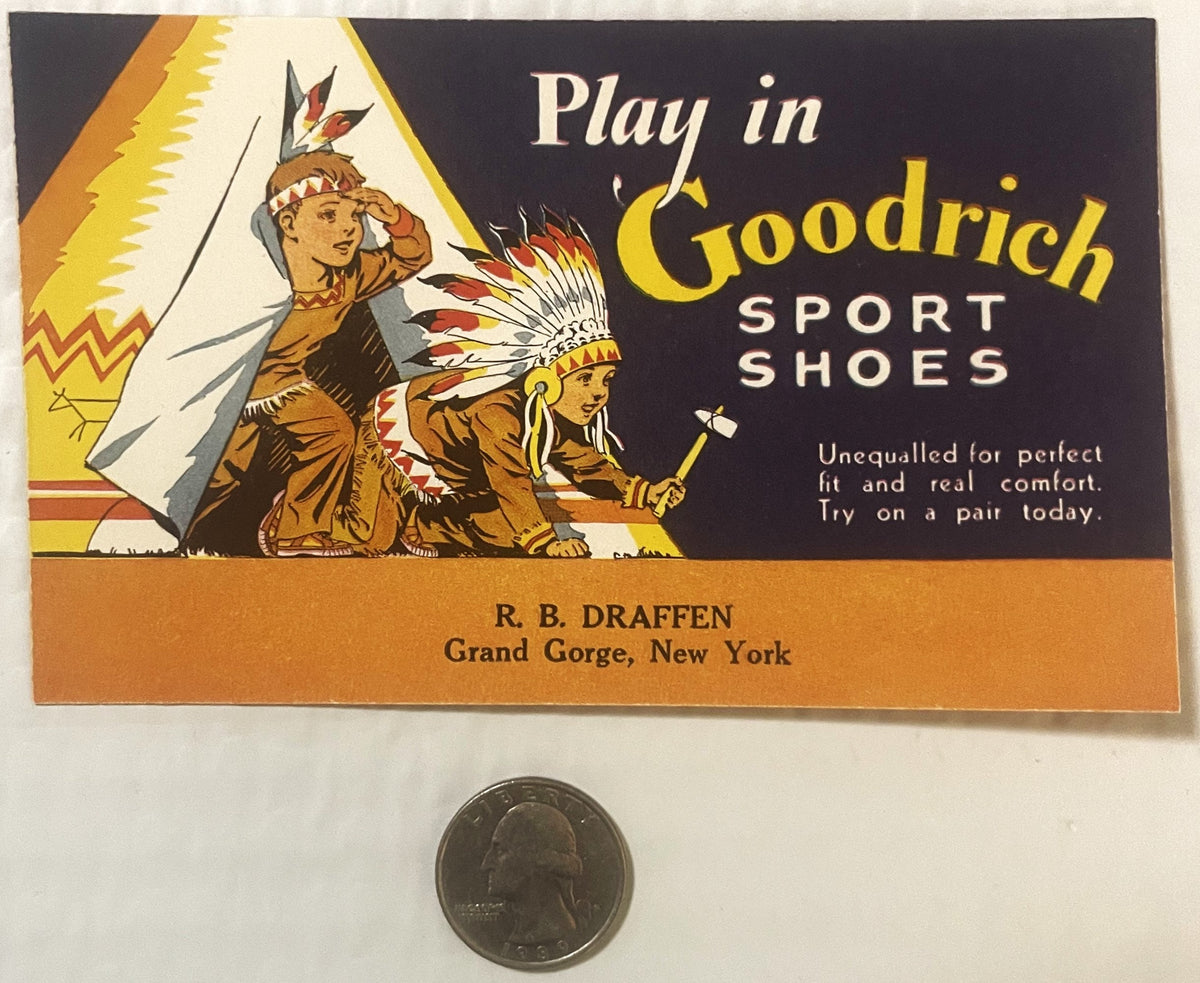
The front is printed verbatim, and it is worth quoting in full because the wording is part of the charm. In large lettering it reads "Play in 'Goodrich SPORT SHOES," the word Goodrich set in a warm golden script against a deep midnight-blue ground. Beneath it, in smaller type, runs the sales line: "Unequalled for perfect fit and real comfort. Try on a pair today." And across the orange band at the foot of the card is the imprint of the local merchant who handed these out: "R. B. DRAFFEN — Grand Gorge, New York." That merchant imprint is the heart of the piece. Nationally printed advertising blanks were customised at the bottom with the name of the individual store that ordered them, which is why this blotter is not just a Goodrich advertisement in the abstract but a specific, datable trace of one shopkeeper's business in one small American town.


🎨 The Artwork

The illustration is a period piece of commercial art, executed in the confident, poster-like style of 1920s advertising lithography. It shows two children dressed in fringed buckskin-style play costumes and feathered headdresses, at play beside a painted teepee. One child kneels and raises a hand to shade the eyes, gazing off into the distance; the smaller child in front wears a tall feathered war-bonnet and holds a little toy hatchet. The teepee behind them is decorated with a zigzag band and a small drawn figure, and the whole scene is framed by that rich blue-and-orange colour scheme. It is described here plainly as what it is: a piece of 1920s children's-costume advertising imagery, the kind of romanticised outdoor-play scene that shoe and sporting-goods brands used constantly in the period to sell the idea of active, barefoot-summer childhood. The printing is crisp, the colours are strong, and the artwork wraps the full width of the card.


🪶 Why "Ink Blotter" Is the Right Word

Collectors search for pieces like this specifically as advertising ink blotters, and turning the card over shows exactly why. The reverse is not printed at all: it is a sheet of soft, faintly fibrous pink blotting stock, the absorbent paper made to soak up excess ink. On this example that blotter back is clean and completely unused — it never dried a single line of writing, which is a large part of what makes it such a well-preserved survivor. A blotter was a giveaway meant to be used up and thrown away, so the ones that reached a desk drawer, were never used, and simply waited out the decades are the exception rather than the rule. Describing this as an ink blotter rather than a vague "display" is both more accurate and more useful: it tells you what the object actually is, how it was used, and why the plain pink back matters as much as the colourful front.


👟 The Story of B. F. Goodrich Footwear

B. F. Goodrich was founded in 1870 and built its name in rubber, becoming one of the great American rubber and tire companies. That mastery of rubber led naturally into footwear: rubber and canvas sport shoes, the ancestors of the modern sneaker, were a booming category in the early twentieth century, and Goodrich was a serious player in it.

The company's athletic-shoe line is remembered today for names such as the P-F Flyer, and Goodrich stayed in the shoe business for decades before eventually stepping back to concentrate on tires in the early 1970s. This blotter dates from the earlier, energetic chapter of that story, when "Goodrich Sport Shoes" was a live brand being pushed into small-town hardware, shoe, and general stores across the country through exactly this kind of cheerful counter-top advertising.

As a footnote of sporting-goods history, the Goodrich athletic-footwear brand of this era is sometimes discussed alongside the great athlete Jim Thorpe as brand context; to be clear and honest, Thorpe is not pictured or named anywhere on this card — the artwork and text are entirely as described above — and he is mentioned here only as part of the wider background of early Goodrich sporting-goods promotion, not as any endorsement printed on this piece.


🗺️ Grand Gorge, New York — the Local Hook

The line "R. B. Draffen, Grand Gorge, New York" roots this blotter in a real and specific place. Grand Gorge is a small hamlet in the town of Roxbury, in Delaware County, in the northern Catskills of New York State — the kind of crossroads community where a single general or dry-goods merchant might carry everything from work boots to sport shoes for the surrounding farms and summer visitors. A blotter imprinted for R. B. Draffen is a tiny, tangible piece of that local commercial history: proof that this Catskills merchant carried the Goodrich sport-shoe line and cared enough about his trade to put his name on giveaways for his customers. For anyone who collects Catskills, Delaware County, or upstate New York local history — or who simply has a connection to Grand Gorge and Roxbury — that imprint turns a generic national advertisement into a genuinely personal artifact of one town's Main Street.


🖋️ The Vanished World of the Advertising Blotter

To appreciate a piece like this it helps to remember how completely the advertising ink blotter has disappeared. For the first half of the twentieth century, before the ballpoint pen made wet ink obsolete, blotters were everywhere: banks, insurance agents, feed stores, druggists, hardware dealers, and shoe shops all handed out printed blotters as inexpensive, genuinely useful advertising. They sat on desks and shop counters, they went home in coat pockets, and they were used until they were saturated and then discarded. Whole categories of beautiful commercial lithography survive today almost entirely on these throwaway blotters. When the ballpoint arrived at mid-century, the reason for the blotter vanished, and the objects went with it. That is why a bright, complete, unused example carrying a named local merchant is such a satisfying thing to own: it is a perfectly preserved specimen of an advertising form that no longer exists, in the exact condition — unused, with the pink stock intact — that is hardest to find.


🌟 A Sole-Source Survivor

Small-town, merchant-imprinted advertising blotters were printed in limited local runs, used up, and thrown away, and there is no reason to expect many — or any — other examples of this exact R. B. Draffen Goodrich blotter to surface. In practical terms this is a sole-source rarity: a specific piece, from a specific merchant, in a specific Catskills town, that you are unlikely to see offered anywhere else. Advertising like this does not come back into the world once it is gone; what is here is what remains. For a collector, that combination — a genuine period Goodrich sport-shoe advertisement, an attractive and quotable design, a named local merchant, and unused condition — is exactly the sort of thing that is far easier to admire in someone else's collection than to find for your own.


🖨️ How a Blotter Like This Was Printed

The bright front of this card is a small example of a printing craft that has largely disappeared. Advertising blotters of the 1920s were produced by commercial lithography, in which each colour was printed from its own stone or plate in careful registration, building up the finished image layer by layer. That is why the deep midnight blue, the warm orange band, the golden Goodrich script, and the buckskin and flesh tones of the artwork all sit so cleanly against one another, and why the whole design has the crisp, confident, poster-like look of the period. The blotting stock itself was chosen for function rather than show: a soft, lightly sized, absorbent paper made to draw wet ink off a freshly written page. Front and back together, the object is a neat marriage of commercial art and everyday utility — a genuine piece of working ephemera, not a decorative reproduction, and all the more charming for it.


🖼️ Ways to Enjoy It

  • 🖼️ Float-mount and frame it — the blue-and-orange lithography reads beautifully on a wall or a shelf.
  • 👟 Group it with vintage sporting-goods, shoe-store, or athletic advertising for an instant collection theme.
  • 🗺️ Pair it with Catskills, Delaware County, or upstate New York local-history pieces for the Grand Gorge connection.
  • 📚 Add it to a collection of advertising ink blotters, that vanished and much-loved category of paper Americana.
  • 🎁 Give it to a collector of shoe or rubber-company advertising, or to anyone with roots in Grand Gorge or Roxbury.

A bright, complete, unused 1920s Goodrich Sport Shoes advertising ink blotter, imprinted for a real Catskills merchant and preserved with its plain pink blotter back intact — a genuine, sole-source piece of American advertising history, described exactly as it is.

Shipping

🚚 Shipping & Handling

  • Shipping costs and timing are calculated at checkout.
  • Items curated and shipped directly by me include U.S. shipping at no additional cost, professionally packed to ensure safe arrival of your artifact.

Items from Vetted Pro Collectors
Shipping for items offered by vetted Pro Collectors is determined at checkout. All Pro Collector listings are reviewed to ensure fair, reasonable shipping practices.

For full details, please refer to our Shipping Policy.

Returns & Exchange

Take your time — you've got a full six months. If a piece isn't right for you, send it back the way it reached you and we're good.

In the first 30 days your money goes straight back the way you paid. After that it's store credit, so you can put it toward something you'd rather have.

Return shipping we sort out between us, case by case. I don't make this difficult.

If something arrives damaged, or it isn't what I said it was, send me a photo within 48 hours and I'll make it right.

Email info@vintageantiquesgifts.com or call 802-356-9872 — that's me answering, not a call center.

The only things I can't take back are custom or special-order pieces and gift cards.

View full details