Skip to product information
1 of 4

Vintage and Antique Gifts

Antique Sulphuric Acid Poison Label ☠️ Lents Pharmacy Portland Oregon Druggist Skull Crossbones

Antique Sulphuric Acid Poison Label ☠️ Lents Pharmacy Portland Oregon Druggist Skull Crossbones

Regular price $6.00 USD
Regular price Sale price $6.00 USD
Sale Sold out
Shipping calculated at checkout.

Size: 2 1/2" x 1 1/2"

🚚 Free US Shipping — ships within one business day. International shipping calculated at checkout.

Quantity

What Was the Old First Aid for Sulphuric Acid? ☠️ An Antique Sulphuric Acid Poison Label, Lents Pharmacy, Portland, Oregon

Size: 2 1/2" x 2 1/2" ~ NOS unused stock, little to no storage wear.

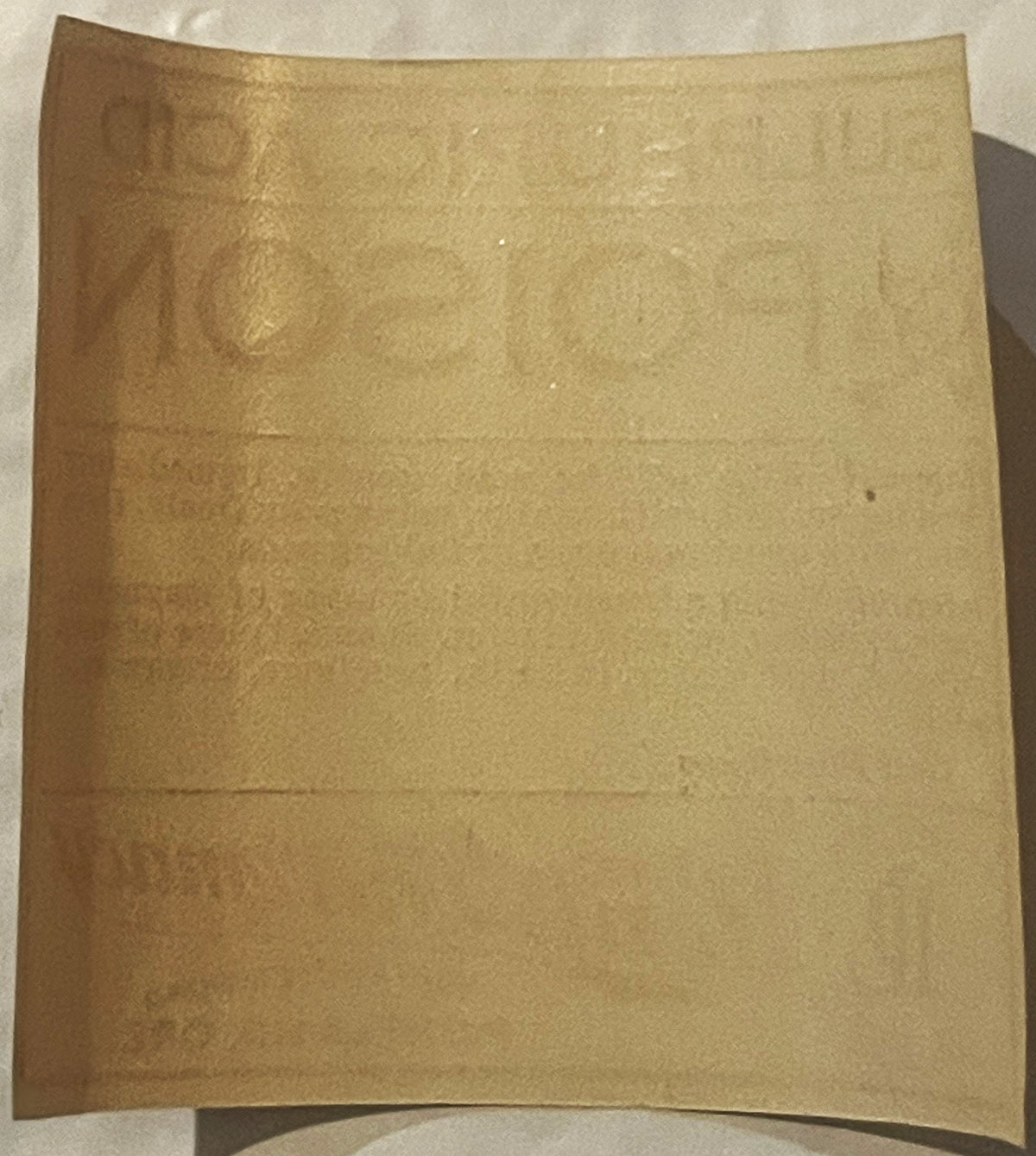
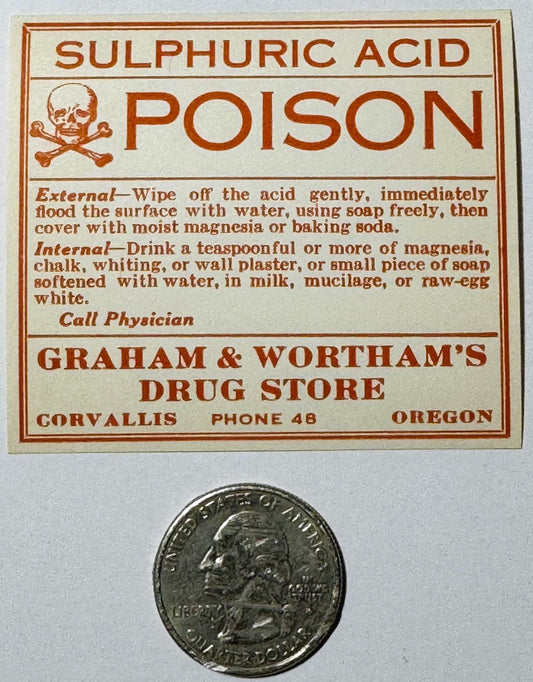
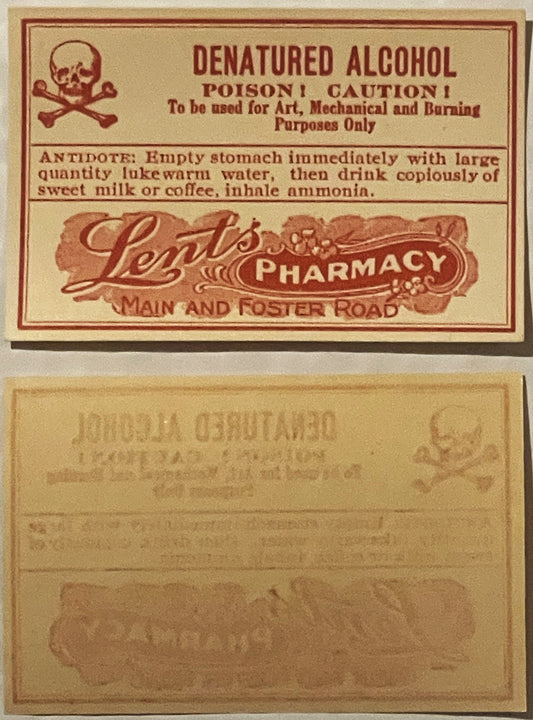
Before poison control hotlines and childproof caps, the only thing between a customer and a bottle of sulphuric acid was a little paper label like this. Printed in one brick-red ink on cream: SULPHURIC ACID and POISON beside a skull and crossbones, then the first aid, External - wipe it off, flood with water, cover with moist magnesia or baking soda - and Internal - magnesia, chalk, whiting or even wall plaster, or a bit of soap, taken in milk, mucilage or raw egg white - and Call Physician. At the foot is a script Lents Pharmacy with an interlocked monogram in a horseshoe, and 9201 FOSTER ROAD, PORTLAND, ORE.

Ever wonder what sat behind Grandpa's corner drugstore counter, locked away and marked with a skull? There's something about holding one of these old labels that pulls you straight back to a slower, more dangerous, more honest era of American retail, when the corner pharmacy sold you your cough syrup, your camera film, your writing paper and, yes, your battery acid, all from the same wooden counter, and the druggist trusted you to read the label carefully. This one comes from a real Oregon storefront, and it has carried that little jolt of drugstore drama for the better part of a century.

Every one of those household remedies is mildly alkaline - kitchen chemistry meant to neutralize the acid. The 1927 Federal Caustic Poison Act required household sulphuric acid to carry the word POISON and directions for treatment, which is exactly what this little label does - a law the Philadelphia throat doctor Chevalier Jackson fought for after treating too many children burned by household lye. Organized poison control centers didn't come along until the 1950s; until then, the druggist's label was the instruction sheet.

Before federal rules made the format uniform, it was the corner druggist who decided how to warn his customers, and most of them reached for the same shorthand: bold red ink, blunt capitals and the skull and crossbones, a symbol older than the pharmacy trade itself, borrowed from ships' flags and grave markers to say one thing in any language - this will kill you if you're careless. Those remedies weren't idle suggestions, either. A druggist in 1930s Portland was, in a very real sense, the neighborhood's first responder, and a label like this was his instruction sheet stuck right onto the danger itself. To be clear about what comes to you: it's the paper label alone, with no acid and no bottle.

📅 The address dates it

The condensed display capitals, the slab-and-roman body type and the flourished script logo are the old-time druggist's look, but the address dates it better than the type does.

That 9201 is a clue. Portland adopted its Great Renumbering in September 1931 and carried it out through 1933, putting the east side on a hundred numbers to the block with Burnside and the river as the baselines. Under the old numbering, the 92nd block of Foster never read 9201 - so this label was printed in the 1930s or a little after.

⚗️ Why every drugstore stocked sulphuric acid

It's easy to picture a bottle marked POISON gathering dust in a back room, but sulphuric acid, the old "oil of vitriol," was one of the most widely used chemicals of the age, so basic to industry that a nation's sulphuric acid output was long treated as a rough gauge of its industrial strength. Its story runs through the Leblanc process, the method that first made sodium carbonate, soda ash, cheap and plentiful. Soda ash went into the soap and washing powders that scrubbed America's laundry, into glassmaking, papermaking and water softening, and into sodium compounds like borax. Closer to home, sulphuric acid was the acid inside the lead-acid batteries of early automobiles and farm machinery. A neighborhood pharmacy like Lents didn't stock it as a curiosity; it stocked it because half the town needed it for something practical, and the druggist was one of the few suppliers in reach.

💊 The Petersons' drugstore

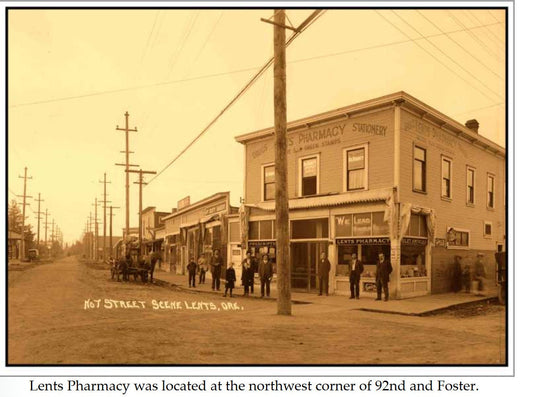
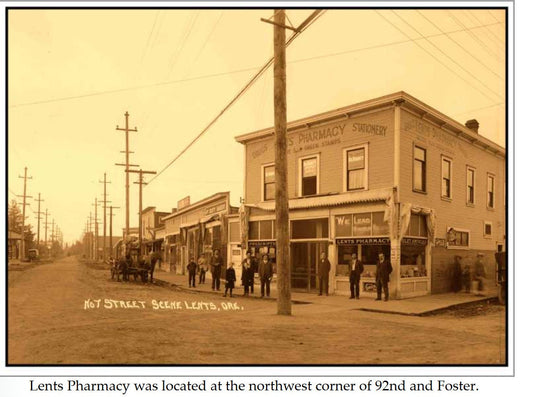
Neighborhood history photos show Lents Pharmacy on the northwest corner of Main Street and Foster Road in 1910, at 9143 SE Foster in 1913 with Mr. Peterson as owner, and at 9201 SE Foster by 1928. His son, Fred Peterson, became a Portland city commissioner in 1941 and Mayor of Portland from 1953 to 1956 - not bad for a kid from the drugstore at 92nd and Foster. A druggist like that compounded prescriptions in back, sold film, stationery and sodas up front, and kept the acids and arsenic behind the counter, all labeled in this same red.

The Lents History photos even catch it in 1918 sharing the corner as "Lents Pharmacy and Mt Hood Ice Cream Parlor" - which tells you everything about what a neighborhood drugstore was. The druggist was Frank R. Peterson. His boy Fred was born in Owatonna, Minnesota, in 1896, came to Portland with the family in 1902, finished Washington High School in 1915, and served as a sergeant in the 162nd Infantry in World War I before coming home a second lieutenant. He went into the family trade - by 1940 he was the pharmacist and proprietor of the Glisan Street Pharmacy - and took his seat as a city commissioner on January 1, 1941, where he ran the Bureau of Health. He served three terms, butted heads with Dorothy McCullough Lee, Portland's first woman mayor, and beat her for the job in November 1952. The Oregonian's headline when he died in 1985 called him Portland's "Elephant Mayor," and I love why: on September 26, 1953, the zoo's newly arrived elephant, Rosy, paid a visit to City Hall on his watch. In June 1955 he rode in the Rose Festival Parade with Harry Truman. Not a bad run for a druggist's son from Foster Road.

Picture the corner the old street photograph keeps: a dirt road, a horse-drawn wagon at the edge, men in long coats and broad hats along the walk, and the store painted up for STATIONERY and S&H GREEN STAMPS - the Sperry & Hutchinson trading stamps that had been around since 1896 - with WE LEAD and PRESCRIPTIONS in the windows and a bakery next door. A drugstore like that was never just a place to buy medicine. It was the neighborhood's unofficial meeting hall, its emergency room, its soda counter and its gossip exchange under one roof, and the dangerous stock - acids, arsenic compounds, strychnine for the rats - stayed behind the counter, each bottle labeled in that same stark red, the little monogram tucked inside its horseshoe like a maker's mark on silverware.

🚋 Lents

Lents was its own small town before it was a Portland neighborhood - a farming and streetcar community out along Foster Road, named for Oliver P. Lent, an early settler. Oliver Perry Lent came west from Ohio in 1852 and settled a 190-acre farm in 1856; his family ran a sawmill on Johnson Creek and started the area's first school. The local story, as the Lent school's own history tells it, is that the settlement's name came down to a coin flip between Lent and another pioneer, William Johnson. Lent won and got the post office; Johnson got the creek, which is still Johnson Creek. Lent's eldest son, George P. Lent, platted the town of Lents in 1892, and in 1912 the community was annexed into the City of Portland. The old photo of the pharmacy corner in my pictures is there for history only and isn't included; you get the label.

Foster Road carries the name of Philip Foster, the pioneer who in 1846 went partners with Sam Barlow on the toll road around Mount Hood at the end of the Oregon Trail. By the early 1900s it had become a streetcar corridor: the Mount Scott line, a steam line from 1892 that was electrified in 1901, ran out Foster Road to Lents until it was abandoned in 1936, and small commercial blocks grew up along it - a butcher, a bakery, a dry goods store and, on the corner, the pharmacy.

🕯️ From the poison shelf to the collector's cabinet

What was once a working safety warning has become something else entirely: a small, self-contained piece of American graphic design. The same skull that once made a customer pause now draws collectors in for the opposite reason, an almost affectionate symbol of a vanished retail world with a darkly playful charm. Corner drugstores like Lents Pharmacy have nearly disappeared from American main streets, replaced by chain pharmacies and printed barcode labels, which is why an unused label like this carries so much weight. It's a direct, physical link to one building, one neighborhood and one era of know-your-customer pharmacy that simply doesn't exist anymore.

☠️ About these

They're about 2 1/2 by 2 1/2 inches. Frame one for an apothecary shelf, a bathroom cabinet with a sense of humor, a Portland wall, or a pharmacist.

That's roughly 6.4 x 6.4 cm, sized to wrap a bottle shoulder, and they show little to no wear from their original roll. Framed on its own, one makes a small, striking piece of graphic Americana. It also suits a home bar cart or back-bar shelf, a curiosity cabinet with other apothecary paper, a Halloween table of vintage oddities, a vignette with old bottles, a mortar and pestle and druggist tins, or a regional history corner matted with other Portland and Pacific Northwest paper.

They speak to pharmacy and apothecary historians chasing the last traces of the corner-drugstore era, to Portland and Lents history collectors, to collectors of early advertising design, and to the oddities crowd who want their skull and crossbones genuinely old. One is as much at home in a serious pharmacy archive as on the shelf of someone who just wants their bar cart to have a story behind it.

The supply is finite - nobody's printing Lents Pharmacy labels again, and once these last unused ones are gone, they'll be very difficult to acquire.

Shipping

🚚 Shipping & Handling

  • Shipping costs and timing are calculated at checkout.
  • Items curated and shipped directly by me include U.S. shipping at no additional cost, professionally packed to ensure safe arrival of your artifact.

Items from Vetted Pro Collectors
Shipping for items offered by vetted Pro Collectors is determined at checkout. All Pro Collector listings are reviewed to ensure fair, reasonable shipping practices.

For full details, please refer to our Shipping Policy.

Returns & Exchange

Take your time — you've got a full six months. If a piece isn't right for you, send it back the way it reached you and we're good.

In the first 30 days your money goes straight back the way you paid. After that it's store credit, so you can put it toward something you'd rather have.

Return shipping we sort out between us, case by case. I don't make this difficult.

If something arrives damaged, or it isn't what I said it was, send me a photo within 48 hours and I'll make it right.

Email info@vintageantiquesgifts.com or call 802-356-9872 — that's me answering, not a call center.

The only things I can't take back are custom or special-order pieces and gift cards.

View full details
  • 5 stars: 1 (100%)
  • 4 stars: 0 (0%)
  • 3 stars: 0 (0%)
  • 2 stars: 0 (0%)
  • 1 star: 0 (0%)
l
lokipoe

Really cool item, fast ship, very kind and generous seller, thanks so much!

Rescuing American History Since 2007

— Travis & the Kids