Skip to product information
1 of 4

Vintage and Antique Gifts

NOS 1944 WWII Pennsylvania 6th War Loan Worker Badge 🎖️ Extra Bonds Minuteman Stick Pin, Mint Whitehead Hoag Complete Steel Coal Factory Home Front Pin New Old Stock

NOS 1944 WWII Pennsylvania 6th War Loan Worker Badge 🎖️ Extra Bonds Minuteman Stick Pin, Mint Whitehead Hoag Complete Steel Coal Factory Home Front Pin New Old Stock

Regular price 8.00 USD
Regular price Sale price 8.00 USD
Sale Sold out
Shipping calculated at checkout.
Quantity

🎖️ A Treasury Flag on One Side, a Promise on the Other

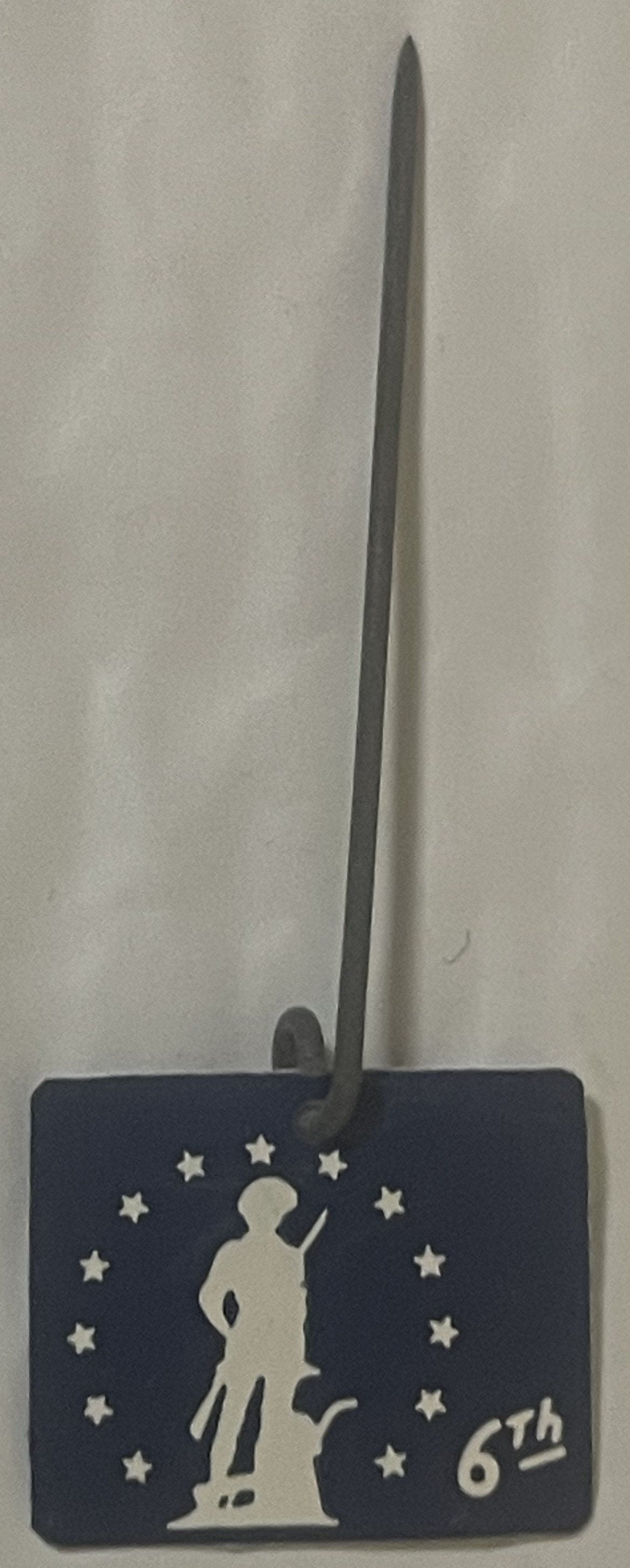
This little 1944 tag tells two stories, one per side. The blue side is a flag in miniature: a white Minute Man in a ring of thirteen white stars, the design the U.S. Treasury patented on August 18, 1942, and awarded as the Minute Man flag to businesses that enrolled 90% or more of their employees in payroll deductions for bonds. A company flew that flag over its building. The person who wore this tag went further, and the cream side says so in plain type: I Bought "EXTRA" Bonds, on top of the ones already coming out of every paycheck.

Whitehead & Hoag of Newark, New Jersey, printed it for the Pennsylvania War Finance Committee and the 6th War Loan drive at the end of 1944. The Payroll Savings Plan it measures itself against outlived the war by eighty years: the Treasury discontinued it on January 31, 2025. This one is new old stock, never issued, still on its stick pin.

🏷️ What the Tag Prints

  • Blue side: white silhouette of the Concord Minute Man with his musket and plow, circled by 13 white stars, with "6th" in the lower right corner
  • Cream side, maker's corner: W. & H. CO. NEWARK, N.J., with the printed figures 2,000,000 and 9-27-44
  • Cream side, center: I Bought "EXTRA" Bonds / Over and above my regular Payroll Savings
  • Cream side, foot: 6TH WAR LOAN / PENNSYLVANIA / WAR FINANCE COMMITTEE
  • Mount: a wire stick pin hooked through a punched hole at the top edge
  • Size: 1 inch
  • Condition: new old stock, complete with its pin

The 2,000,000 and the 9-27-44 are set in the same type as the maker's name, so every tag from that press run carries the identical figures; neither one is a number given to a single tag. The printed date, September 27, 1944, sits almost eight weeks ahead of the drive's opening day on November 20.

💰 "Over and Above": The Extra Bond

By 1944 millions of working Americans bought bonds without lifting a finger. Under the Payroll Savings Plan an employee signed an allotment and a slice of each paycheck went toward a Series E bond. The Treasury's theme was "everybody, every payday," and the plan became a way of life in business, industry and government, and the major source of war bond sales.

The war loan drives asked for something harder: an extra bond on top of the deduction, paid for out of money a household had already spoken for. Posters for this very drive read "Buy Your Extra 6th War Loan Bonds Here." This tag was the receipt you could pin on, the way to show a shop floor, a store counter or an office that you had bought beyond your pledge.

The Treasury rewarded employers as well. The Minute Man flag copied on the blue side marked 90% enrollment, and a second banner, the "T" flag of 1942 to 1945, went to firms where 90% or more of employees put 10% or more of the gross payroll into bonds.

🗓️ The Sixth War Loan, November 20 to December 16, 1944

The 6th War Loan was the sixth of eight national drives; the last of them, the Victory Loan, closed in December 1945. It set out to raise $14 billion and finished with $21.6 billion. Treasury advertising for this drive turned toward Japan as the primary enemy, and advertisers donated well over $11 million worth of space and airtime to it.

President Franklin D. Roosevelt opened the drive with a statement on November 19, 1944, reminding the country that the war in that November alone would cost seven and one-half billion dollars, and that everyone could practice self-denial. The drive closed on December 16, 1944, the same day German armies opened the Battle of the Bulge in the Ardennes.

🦅 The Minute Man: From Concord's North Bridge to the Treasury

The figure on the blue side is not a generic soldier. It is The Minute Man, the bronze Daniel Chester French made for Concord, Massachusetts, which stands by the North Bridge where some 500 militiamen turned back three companies of British troops on April 19, 1775. In 1871 the town set aside $1,000 for a monument and asked the 21-year-old French, a young Concord sculptor whose father was a prominent local lawyer, to design it.

French studied a plaster cast of the Apollo Belvedere at the Boston Athenaeum and the faces of his own neighbors. Instead of a fee he was reimbursed for his studio, tools and materials. The Ames works in Chicopee, Massachusetts, cast the statue from ten Civil War cannons appropriated by Congress, and it was unveiled on April 19, 1875, the centennial of the fight, with President Ulysses S. Grant and Ralph Waldo Emerson in attendance. French had already left to study in Italy and missed it. The granite pedestal carries the first stanza of Emerson's "Concord Hymn," the poem of the embattled farmers and the shot heard round the world.

Acton tells its own story. Legend has it French drew on Captain Isaac Davis, the Acton gunsmith who led his minutemen to the bridge and became the first American officer killed in the Revolution, modeling the face on photographs of Davis's descendants. The same story holds that the plow beside the figure was modeled on Davis's own plow, which is kept at Acton's Town Hall.

When the Treasury launched the Series E Defense Bond, President Roosevelt bought the first one from Treasury Secretary Henry Morgenthau Jr. on April 30, 1941, and sales opened to the public the next day. French's Minute Man became the symbol of the savings bond program. Its silhouette went onto the savings stamps sold in 10¢, 25¢, 50¢, $1 and $5 denominations, onto posters and advertisements, and onto the bonds themselves. The same statue appears on the 1925 Lexington-Concord half dollar, a 1925 five-cent postage stamp, the 2000 Massachusetts state quarter, and the seals of the National Guard.

🏭 Whitehead & Hoag Company, Newark, New Jersey

The initials in the tag's corner stand for the Whitehead & Hoag Company. Benjamin S. Whitehead (1858-1940) and Chester R. Hoag (1860-1935) founded it in Newark in 1892, starting with ribbon badges. In 1896 they introduced the pin-back button and held the patent on it, and in 1903 they built a new factory at 272 Sussex Avenue and First Street with fifty presses, an engraving plant and a shop that made its own tools and dies. The firm could turn out a million buttons a day, alongside medals, calendars, pocket knives and advertising novelties sold by commission salesmen across the country and abroad.

A 1919 reorganization made it a non-union shop, which is why the union seal found on its earlier work drops away. During World War II the company employed more than 400 workers. The decline came after the war. In 1959 Bastian Brothers of Rochester, New York, bought Whitehead & Hoag, the Newark factory closed that May, and the W&H name was phased out by 1964-65. The story goes that the company's records were destroyed when it changed hands, which leaves the small imprint in a corner as the plainest way its wartime work is still identified.

🗺️ The Pennsylvania War Finance Committee

The foot of the tag names the committee that ordered it. In 1943 the Treasury's War Finance Division replaced the War Savings Staff, and state and local War Finance Committees took charge of the drives; wherever one was formed, the old War Savings and Victory Fund committees ceased to function. Across the country the War Finance Committees sold $185.7 billion in securities.

Pennsylvania had a great deal riding on that work. More than 900,000 Pennsylvania men and some 22,000 women served in the armed forces, and the state was the leading producer of the coal and steel the war ran on. A payroll-savings tag from this committee was for the Pennsylvanian on a payroll who had already signed up for a deduction and then bought one more bond.

📈 What the Drives Changed

By the end of the war 85 million Americans, out of a population of about 131 million, had bought bonds. The drives turned a nation of wage earners into direct lenders to their own government, and payroll savings became the legacy that lasted: it stayed the backbone of savings bond sales for decades after 1945, stopped issuing paper bonds through employers on January 1, 2011, and was discontinued on January 31, 2025. The Minute Man flag lasted too; its bar was later lowered to 50% participation and opened to schools, military units and federal agencies.

❓ Questions People Ask

What is a 6th War Loan "I Bought Extra Bonds" tag?
A small stick-pin tag worn during the 6th War Loan, which ran from November 20 until December 16, 1944, by someone who bought a war bond beyond the deductions already taken from their pay. This one names Pennsylvania's committee at the foot.

Who made it?
The W. & H. Co. in the corner is the Whitehead & Hoag Company, the Newark badge and button maker founded in 1892.

Is 2,000,000 a serial number?
No. Both figures are part of the printed plate, like the lettering around them, so every tag from the run shows them. The date reads September 27, 1944.

What does the Minute Man on the blue side mean?
It is the Treasury's savings bond symbol, taken from Daniel Chester French's statue at Concord, and the blue field with its ring of 13 stars copies the Minute Man flag awarded to employers with 90% payroll-savings enrollment.

How big is it?
1 inch.

What condition is it in?
New old stock, never issued.

🎁 Good For

WWII home front and war bond collections, Pennsylvania history, Minute Man and Concord collectors, Whitehead & Hoag button collectors, and a shadow box beside a family's Series E bonds or a veteran's service photograph.

Shipping

🚚 Shipping & Handling

  • Shipping costs and timing are calculated at checkout.
  • Items curated and shipped directly by me include U.S. shipping at no additional cost, professionally packed to ensure safe arrival of your artifact.

Items from Vetted Pro Collectors
Shipping for items offered by vetted Pro Collectors is determined at checkout. All Pro Collector listings are reviewed to ensure fair, reasonable shipping practices.

For full details, please refer to our Shipping Policy.

Returns & Exchange

Take your time — you've got a full six months. If a piece isn't right for you, send it back the way it reached you and we're good.

In the first 30 days your money goes straight back the way you paid. After that it's store credit, so you can put it toward something you'd rather have.

Return shipping we sort out between us, case by case. I don't make this difficult.

If something arrives damaged, or it isn't what I said it was, send me a photo within 48 hours and I'll make it right.

Email info@vintageantiquesgifts.com or call 802-356-9872 — that's me answering, not a call center.

The only things I can't take back are custom or special-order pieces and gift cards.

View full details
  • 5 stars: 1 (100%)
  • 4 stars: 0 (0%)
  • 3 stars: 0 (0%)
  • 2 stars: 0 (0%)
  • 1 star: 0 (0%)
C
Christopher

Thanks for the great items

Hello Christopher! A big thank you for your 5-star review on our 1940s War Bond Pin! It is heartwarming to know you appreciate the uniqueness of our vintage items. Your support is invaluable to us, and we can't wait to serve you with more antique treasures in the future!