Skip to product information
1 of 7

Vintage and Antique Gifts

1970s New York Central & Hudson River Railroad 3.5% Registered Gold Bond Penn Central Era Michigan Central Collateral Vintage 📜

1970s New York Central & Hudson River Railroad 3.5% Registered Gold Bond Penn Central Era Michigan Central Collateral Vintage 📜

Regular price 10.00 USD
Regular price Sale price 10.00 USD
Sale Sold out
Shipping calculated at checkout.
Quantity

🚂 A Gold Bond That Outlived Two Railroads and a Historic Bankruptcy

Some sheets of engraved paper carry more history in their scrollwork than a shelf of textbooks, and this is one of them. It is a genuine New York Central and Hudson River Railroad Company gold bond — but not the well-known bearer bond with a sheet of coupons that most collectors picture. This is the far scarcer registered form, and the story printed and stamped across its face reaches from the Gilded Age all the way into the single most dramatic collapse in American corporate history. We are Vintage and Antique Gifts, and pieces like this are exactly why the shop exists: a real artifact of the age when American railroads financed their empires one engraved promise at a time, that survived long enough to watch the empire itself fall apart. The company that first signed its name to this obligation is gone; the company that was stamped onto it later is gone too. The paper is still here, and it tells the whole arc.

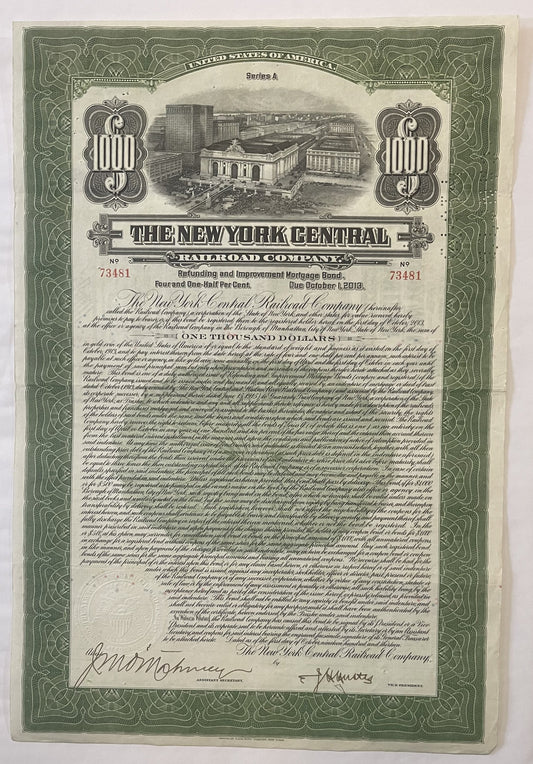
Formally, this is a Three and One-Half Per Cent Registered Gold Bond in the $1,000 denomination, titled "Michigan Central Collateral," engraved and printed by the American Bank Note Company of New York. It belongs to the railroad's 1898 mortgage series — a bond drawn to run a full century, to mature on the first of February, 1998 — and the example photographed here was hand-executed in the early 1970s, under a printed overprint reading "Penn Central Transportation Company, Successor to." That single stamped line is the difference between this bond and every other in its family, and it is the reason this piece is such a remarkable survivor.

📜 Registered, Not Bearer — Why That Matters

The first thing to understand about this certificate is what kind of bond it is, because it sets this piece apart from its better-known relatives. Most surviving railroad gold bonds are bearer bonds: whoever physically held the certificate owned it, and each came with a sheet of detachable coupons to be clipped and cashed for interest. This is different. It is a registered bond, meaning the obligation was recorded in the name of a specific holder on the books of the railroad, and the interest was paid directly to that registered owner rather than against clipped coupons. The engraved text on the face spells it out precisely: the bond is "transferable by the registered holder thereof, in person or by attorney duly authorized, on the books of the Railroad Company, at its office or agency in the City of New York, upon surrender and cancellation of this bond."

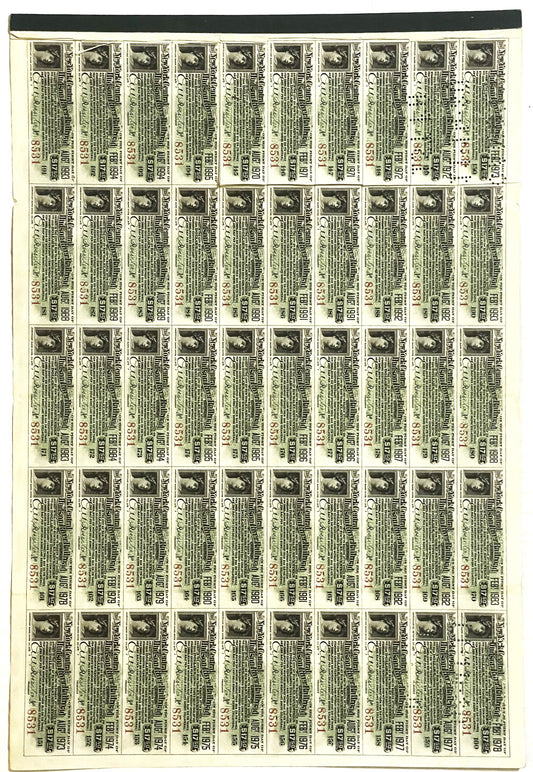
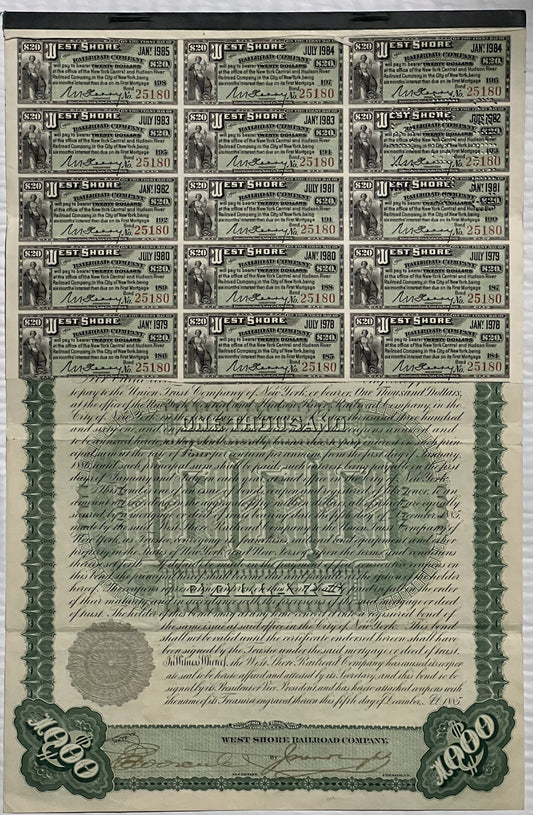
Because it is a registered bond, there are no coupons here — and that is exactly as it should be. Where our bearer-bond family members display a full uncut coupon sheet, this piece tells its story through its formal registration and its cancellation instead. Each certificate in this registered series was individually recorded to a named holder and hand-executed by the company's officers, then, when retired, cancelled with the era's standard punch — small holes driven straight through the paper to close out the obligation for good. The example shown carries that punch cancellation, the honest, tactile mark of a genuine issued-and-retired security. This is not unused stock and it is not a modern reproduction; it is a real, executed, registered, and cancelled period document, the same class of genuine survivor that scripophily collectors prize most.

🏔️ Michigan Central Collateral: The Empire Behind the Paper

The bond's title, "Michigan Central Collateral," names the security behind it, and it opens a window onto how a continental railroad was actually financed. The engraved obligation describes a series of Three and One-Half Per Cent gold bonds issued under an indenture the railroad executed back on the 13th of April, 1898, to the Guaranty Trust Company of New York as Trustee. To back that enormous borrowing — an aggregate not to exceed twenty-one million, five hundred and fifty thousand dollars at any one time outstanding — the New York Central and Hudson River pledged the capital stock of the Michigan Central Railroad Company as collateral. In plain terms: the great trunk line used its ownership of another railroad as security to raise the vast sums needed to lay track, build bridges, and buy locomotives on a scale the country had never seen.

This was Cornelius "Commodore" Vanderbilt's railroad, the system he built by threading the Hudson River and New York Central lines into a single road reaching from the docks of Manhattan, up the Hudson, across upstate New York, along the shore of Lake Erie, and on toward Chicago and the Great Lakes. The name across the top of this certificate — The New York Central and Hudson River Railroad Company — is the name of that empire at its height. And the promise it printed was as serious as language could make it: repayment "in the Gold Coin of the United States of America," of a fixed standard of weight and fineness, with interest paid every February and August. On the 1898 gold standard, that gold clause was the most ironclad guarantee an investor could ask for — the difference between a great railroad's word and an ordinary IOU.

🖋️ The Engraving: American Bank Note Company at Its Finest

Every line of this bond is the work of the American Bank Note Company, the New York security-printing house whose engravers spent generations perfecting the visual language of financial trust — the same craft that produced United States currency and postage. The design is classic Wall Street intaglio: deep brown and sepia printing on cream stock, with a laurel-crowned classical portrait bust set inside an oval medallion at the top centre, flanked by twin ornamental panels each stating the $1,000 face value in bold engraved numerals wrapped in guilloché scrollwork — the fine, lathe-turned line-work built specifically to defeat the counterfeiter. Below the portrait the registered number sits in its own decorative cartouche, and the body runs in dense, formal letterpress laying out the obligation, the collateral, and the terms. Under a raking light the engraving lifts from the paper; under a glass, the guilloché resolves into thousands of unbroken lines. It is a genuinely beautiful object, engineered to be trusted and, as it happens, to be admired on a wall a century later.

🚦 The Penn Central Twilight — This Bond's Real Distinction

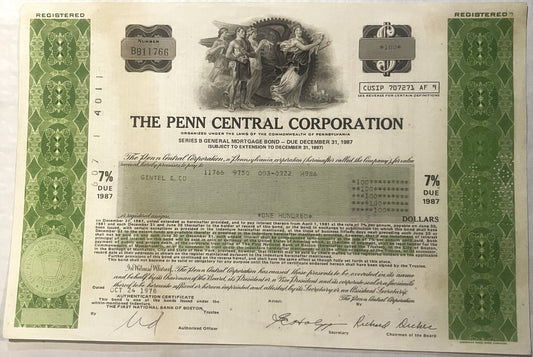
Here is where this certificate parts company with every other bond in its family. By the mid-twentieth century the world that created this obligation had changed beyond recognition. Highways, trucks, automobiles, and airliners had pulled passengers and freight off the rails, and even the mighty New York Central found itself squeezed. In 1968 it did the once-unthinkable and merged with its ancient rival, the Pennsylvania Railroad, to form the Penn Central Transportation Company — at the time one of the largest corporate mergers the nation had ever seen. It went catastrophically wrong. Within roughly two years, in 1970, Penn Central collapsed into what was then the largest corporate bankruptcy in American history, a shock that rattled the financial markets and eventually pushed Congress to create Conrail out of the wreckage of the Northeast's freight railroads.

And that is precisely the moment this piece captures. The overprinted stamp reading "Penn Central Transportation Company, Successor to The New York Central and Hudson River Railroad Company" is a printed acknowledgment that the old 1898 gold-bond obligations did not vanish when the New York Central name faded — they were formally assumed by the successor company. The example photographed was hand-executed in the early 1970s, its officers' signatures inked in beneath that "Successor to" line — which means it was drawn up and registered by Penn Central in the very depths of, or the immediate wake of, that historic collapse. Think about that: a promise first written in the confident spring of 1898 to run all the way to 1998, being formally re-executed a lifetime later by a failed railroad in the middle of the biggest bankruptcy the country had ever seen. To hold this bond is to hold both bookends of the American railroad story at once — Vanderbilt's Gilded Age ambition on one end, and the hard, twilight reckoning of Penn Central on the other. That is a story none of its bearer-bond siblings can tell, and it is stamped right onto the page.

🖼️ Display Ideas

  • 🖼️ Floated in an acid-free mat behind glass, it makes a commanding framed piece for a study, library, or boardroom wall.
  • 🚂 Paired with a vintage map of the New York Central's Water Level Route for a railroad-history vignette.
  • 💼 Grouped with other scripophily in a shadow box themed around Gilded Age finance and the Penn Central era.
  • 🏛️ Displayed near Grand Central or New York Central memorabilia, tying the paper to the empire that issued it.
  • 🛤️ Set beside a model-railroad layout to anchor the display in genuine corporate history.
  • 📜 Matted with a period photograph of a New York Central locomotive for a layered historical grouping.

🎁 Who Collects These

Scripophily — the collecting of antique stocks and bonds — prizes exactly this combination: a great American name, engraving fine enough to hang, and a story that reaches beyond the paper. Railroad historians and devotees of the New York Central system are drawn to a document tied straight to the Vanderbilt empire and its dramatic unraveling into Penn Central. Collectors of American financial history and Gilded Age Americana love the gold-clause language and the classical engraving. And because the registered form is scarcer than the familiar coupon bonds, and this one carries the Penn Central "Successor to" overprint, it appeals to the advanced collector hunting for the specific detail that sets a piece apart. It also makes a genuinely memorable gift for anyone with ties to the railroad industry, Wall Street, or American corporate history.

✨ Why We Keep Pieces Like This

Our whole reason for being is to find the genuine survivors — the objects that carry a real date, a real place, and a real story on their face — and to pass them on intact to the next steward. This registered gold bond is a near-perfect example: an obligation engraved to fund a railroad empire, drawn to run a hundred years, formally re-executed by a successor company in the middle of the largest bankruptcy in American history, and preserved whole enough that you can still read the promise, study the seal-work, and trace the whole arc from 1898 to Penn Central. Please note that this is a deep-stocked issue and each certificate is its own individual, hand-registered document — the serial number, registered holder, and exact execution date vary from one example to the next, so the specific piece you receive will be its own genuine unit of this same historic series. Bring one home and you become the keeper of a promise that outlived the railroads that made it.

🏔️ Where the System Began — and How Large the Certificate Is

Long before Vanderbilt and long before Penn Central, this system began with the Mohawk & Hudson Railroad, chartered in 1826 to run between Albany and Schenectady — among the very first railroads in the United States. In 1853, Erastus Corning consolidated ten small upstate lines into a single New York Central Railroad, giving travelers one continuous ride from Albany to Buffalo. The Hudson River Railroad was folded in by 1867 to create the New York Central & Hudson River name printed across the top of this bond, and in 1869 the road extended its reach toward Chicago by taking control of the Lake Shore & Michigan Southern Railway. The certificate itself is a large, framable document, measuring approximately 13½ x 9 inches.

❓ FAQ

How is this different from your other New York Central gold bonds?

Most are bearer bonds with a coupon sheet. This is the scarcer registered form — recorded to a named holder, with no coupons — and it carries the "Penn Central Transportation Company, Successor to" overprint, tying it directly to the early-1970s Penn Central era. It is the Michigan Central Collateral series, distinct from the Consolidation and the Refunding & Improvement issues.

Why does a New York Central bond say "Penn Central"?

Penn Central was formed by the 1968 merger of the New York Central and the Pennsylvania Railroad. As successor company it formally assumed the older railroad's outstanding bond obligations, which is why its name appears as an overprinted "Successor to" stamp above the signature block on these certificates.

What does "Michigan Central Collateral" mean?

It names the security behind the bond: the railroad pledged its shares of Michigan Central Railroad Company stock as collateral under the original 1898 mortgage indenture, giving bondholders a specific claim on those assets.

Is this an original document or a reproduction?

It is an original, genuinely executed and registered period certificate, engraved by the American Bank Note Company and punch-cancelled as retired securities were. It is not a modern reprint.

Are there interest coupons with it?

No — and there should not be. This is the registered form, on which interest was paid directly to the recorded holder rather than against clipped coupons, so no coupon sheet was ever attached.

Can it still be redeemed?

No. These are collected today purely as historical artifacts and engraved Americana, not as active or redeemable financial instruments.

Will I receive the exact certificate in the photos?

This is a stocked issue of the same historic series, and each certificate is individually registered, so the serial number, registered holder, and exact execution date vary from one example to the next. You will receive a genuine certificate of this same Michigan Central Collateral registered gold bond series, with the Penn Central overprint.

An issued certificate picks up the marks of its working life: endorsements and signatures on the reverse, transfer-agent and registrar stamps, revenue or documentary tax stamps, punch or cut cancellations at redemption, staple holes from being bound into a transfer book, and pencil ledger notations. Those marks are the paper trail of a financial instrument that actually did its job.

Shipping

🚚 Shipping & Handling

  • Shipping costs and timing are calculated at checkout.
  • Items curated and shipped directly by me include U.S. shipping at no additional cost, professionally packed to ensure safe arrival of your artifact.

Items from Vetted Pro Collectors
Shipping for items offered by vetted Pro Collectors is determined at checkout. All Pro Collector listings are reviewed to ensure fair, reasonable shipping practices.

For full details, please refer to our Shipping Policy.

Returns & Exchange

Take your time — you've got a full six months. If a piece isn't right for you, send it back the way it reached you and we're good.

In the first 30 days your money goes straight back the way you paid. After that it's store credit, so you can put it toward something you'd rather have.

Return shipping we sort out between us, case by case. I don't make this difficult.

If something arrives damaged, or it isn't what I said it was, send me a photo within 48 hours and I'll make it right.

Email info@vintageantiquesgifts.com or call 802-356-9872 — that's me answering, not a call center.

The only things I can't take back are custom or special-order pieces and gift cards.

View full details