Skip to product information
1 of 10

Vintage and Antique Gifts

Antique 1897 Lake Shore & Michigan Southern Railway Gold Bond 🚂 with Coupon Sheet

Regular price 18.00 USD
Regular price Sale price 18.00 USD
Sale Sold out
Shipping calculated at checkout.
Style

Description

🚂 What Did It Feel Like to Hold a Piece of the Vanderbilt Railroad Empire in Your Hand?

Long before stock certificates lived in a brokerage app, they lived in a safe deposit box — thick, engraved, and proud of it. This 1897 Lake Shore & Michigan Southern Railway Company gold bond is one of those documents, a survivor from the age when the railroad and Wall Street were, quite literally, printed on the same green banknote paper. Somewhere out there, an investor tucked one of these into a strongbox, trusting a great American railroad to make good on its promise twice a year, every year, for a hundred years. That kind of confidence — in steel rails, in gold coin, in a company's name — is a story worth holding onto.

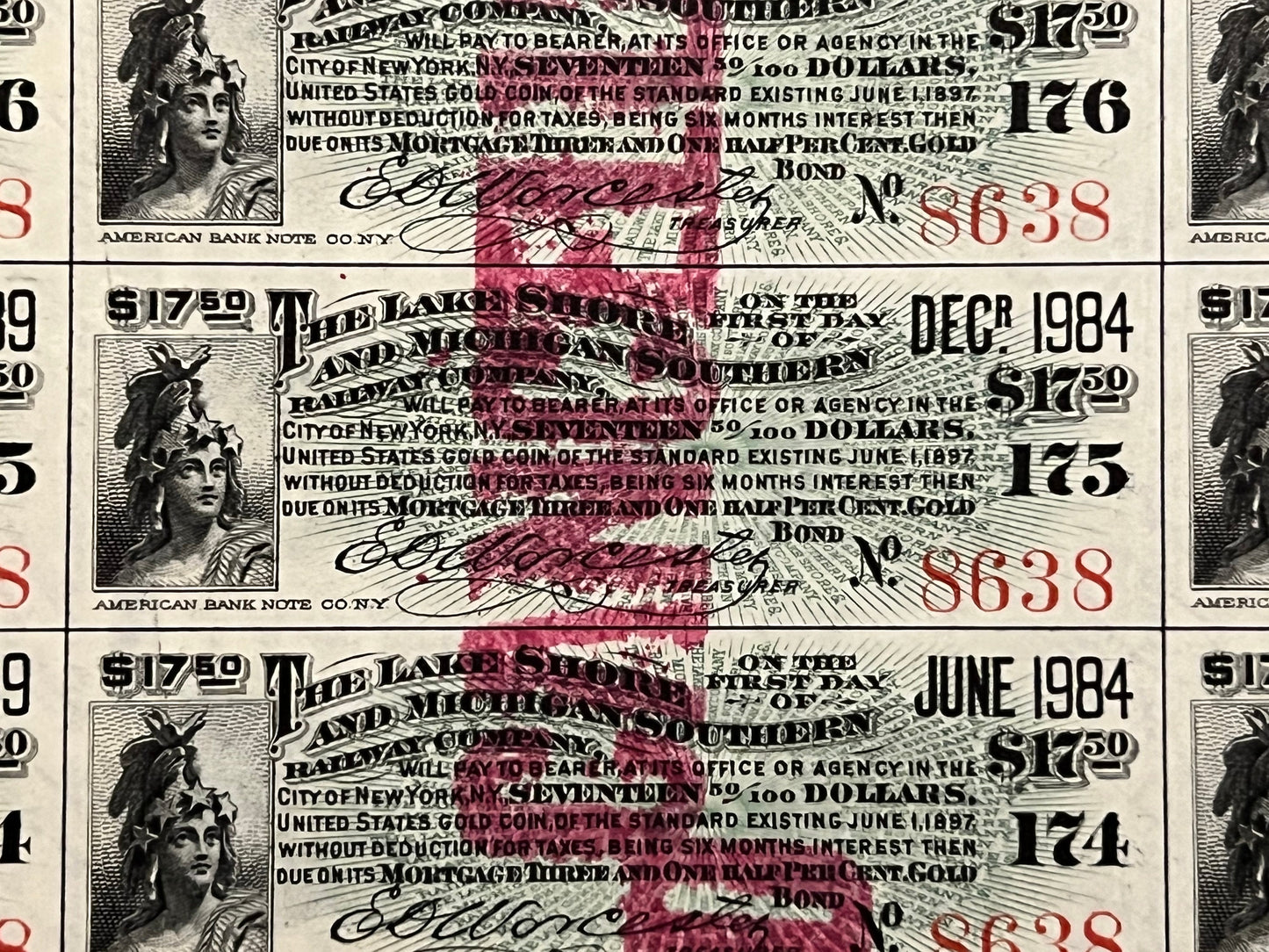
This is an original, New Old Stock (NOS) $1000 par value gold bond issued by The Lake Shore and Michigan Southern Railway Company, dated June 1, 1897, complete with its attached coupon sheet. It measures approximately 15 x 10 inches (38 x 25 cm) for the bond itself, with the full sheet running larger once the coupon strip is included. Printed in rich engraved green with the banner "UNITED STATES OF AMERICA" arched across the top, the piece bursts with the visual language of Gilded Age finance: intricate lathework guilloche borders meant to defeat forgers, bold "$1000" medallions scrolled into each corner, and a central oval vignette of a formally dressed gentleman of the era, framed in a deep, almost basket-woven engraved border. Flanking him on either side are twin steam locomotives, each numbered 590, facing outward with cars in tow and smoke rolling from their stacks — a classic bank-note engraver's tableau of industrial progress. Below, in bold raised-looking lettering, the railway's name runs the full width of the document, followed by its formal title: "THREE AND ONE-HALF PER CENT GOLD BOND." Along the edge runs the coupon sheet itself, row after row of small dated certificates, each one a miniature promise waiting to be redeemed.


🏛️ The Vanderbilt Empire and the Water Level Route

The Lake Shore and Michigan Southern Railway Company came into being in 1869, forged from the consolidation of two predecessor lines — the Lake Shore Railway and the Michigan Southern & Northern Indiana Railroad — into a single trunk line running roughly 540 miles from Buffalo, New York, along the southern curve of Lake Erie through Erie, Pennsylvania, and Cleveland and Toledo, Ohio, then west across northern Indiana through Elkhart, terminating in Chicago. It didn't take long for the railroad to catch the eye of Commodore Cornelius Vanderbilt, who was busy stitching together what would become one of the great transportation empires of American history. Vanderbilt already controlled the New York Central & Hudson River Railroad, running from New York City up to Buffalo. The Lake Shore was the missing link — the road that would carry his trains the rest of the way to Chicago.

Once folded into the Vanderbilt system, the LS&MS became a cornerstone of what railroad men proudly called the Water Level Route — a nod to the fact that, unlike the rival Pennsylvania Railroad's line, which had to claw its way over the Alleghenies, the New York Central's route to Chicago followed rivers, lake shores, and valley floors nearly the entire way. No mountain grades meant faster schedules, lower fuel costs, and heavier trains — a genuine competitive edge that the Vanderbilts never let the traveling public forget. It's said that the fight for control of Lake Shore stock in the years just after its formation was one of the fiercest of the era's notorious railroad stock battles, the kind of Wall Street corner-and-counter-corner drama that also swept up names like Jay Gould and Daniel Drew during the same turbulent Gilded Age years. By 1897, when this bond was issued, the Lake Shore & Michigan Southern was no speculative upstart — it was one of the most solid, most trusted names a conservative investor could put money behind, formally bound to the fortunes of the New York Central itself. That relationship became official in 1914, when the LS&MS was folded directly into the New York Central & Hudson River Railroad, consolidating into the New York Central Railroad system that generations of railfans came to know.


🌾 A Gold Bond Born in the Shadow of the "Cross of Gold"

Look closely at the language engraved across this bond and you'll find it promises payment "in gold coin of the United States" — a phrase that meant far more in 1897 than it might seem today. Just one year earlier, the nation had been consumed by the fiercest currency debate of the century, when William Jennings Bryan delivered his famous "Cross of Gold" speech and the country argued bitterly over gold versus silver as the foundation of American money. Against that backdrop, a company that could issue a bond explicitly backed by gold coin — and be believed — was making a real statement about its financial strength. Railroads that could offer "gilt-edged" securities, as the safest bonds of the era were affectionately known on Wall Street, attracted exactly the kind of buyer this bond was built for: trusts, insurance companies, widows and estates, and cautious investors who wanted their money working quietly for decades rather than chasing speculative swings.

What makes this particular issue especially remarkable is its term. The printed text promises repayment not in ten years, not in thirty, but on the first day of June in the year 1997 — a full century after it was issued, with interest paid faithfully every June and December along the way at three and one-half percent per annum. Century bonds were rare even in their own time, reserved for companies whose backers believed, without much doubt, that the railroad — and the country — would still be standing to honor the debt a hundred years later. This bond was part of a broader refinancing effort in the railroad's later nineteenth-century years, when older, higher-interest mortgage debt was rolled into new gold bonds like this one, secured by a mortgage and deed of trust filed with the United States Trust Company of New York as trustee over the railway's property and franchises. It is, in every sense, a piece of paper built to outlive the person who bought it.


🌉 The Night the Bridge Went Down at Ashtabula

No history of the Lake Shore & Michigan Southern is complete without the night of December 29, 1876, when the railroad's Pacific Express plunged through a collapsing iron bridge into the frozen ravine at Ashtabula, Ohio, during a blinding snowstorm. Close to ninety passengers and crew lost their lives in what became one of the deadliest rail disasters of the nineteenth century, and the tragedy sent shockwaves through the entire industry. The bridge's designer, the railroad's own chief engineer, was so consumed by grief and public blame in the disaster's aftermath that, by local account, he never recovered from it. The Ashtabula disaster became a turning point for American bridge engineering, hastening the industry-wide shift away from certain iron truss designs and toward far stricter standards of railroad bridge inspection — a somber but real thread in the story of the very railroad whose name is engraved across this bond two decades later, a company that had, by 1897, spent years rebuilding both its infrastructure and its reputation for safety and soundness.


🚉 The Towns and the People Along the Line

Follow the route this bond financed and you trace a chain of towns whose identities were shaped by the railroad passing through them: Buffalo at the eastern gateway, Erie hugging the Pennsylvania shoreline, Cleveland and Toledo anchoring Ohio's industrial north, and Elkhart, Indiana, which grew for generations around the railroad's yards and shops into something close to a company town in spirit if not in name — old-timers in the region still speak of Elkhart as a place where the whistle of a Lake Shore train once set the rhythm of daily life. At the western end sat Chicago, the great funnel through which so much of the nation's rail traffic converged.

It's worth pausing, too, on the coupon sheet itself, because it carries a piece of language still used today. Bondholders of this era would literally clip each small dated coupon from the sheet as it came due and carry it to a bank counter to be redeemed for cash — twice a year, without fail, for as long as they held the bond. That simple, genteel ritual is exactly where the old phrase "clipping coupons," still used to describe a life of comfortable,

Shipping

🚚 Shipping & Handling

  • Shipping costs and timing are calculated at checkout.
  • Items curated and shipped directly by me include U.S. shipping at no additional cost, professionally packed to ensure safe arrival of your artifact.

Items from Vetted Pro Collectors
Shipping for items offered by vetted Pro Collectors is determined at checkout. All Pro Collector listings are reviewed to ensure fair, reasonable shipping practices.

For full details, please refer to our Shipping Policy.

Returns & Exchange

Product Page Return Policy

  • 60-Day Returns – Items must be in original condition.
  • Refunds – Issued after inspection (excluding shipping costs).
  • Return Shipping – Customer is responsible unless item is damaged or incorrect.
  • Damaged/Incorrect Items – Contact us within 48 hours for a replacement or refund.
  • Easy Returns – Email [email protected] or call 802-356-9872 to initiate a return.

For full details, visit our Refund Policy.

View full details