Skip to product information
1 of 3

Vintage and Antique Gifts

Antique Big Wolf Cigar Label 🚬 Gold Embossed Chromolithograph, James W. Smith Cigar Co., Snarling Wolf Head Die-Cut Label, NOS

Antique Big Wolf Cigar Label 🚬 Gold Embossed Chromolithograph, James W. Smith Cigar Co., Snarling Wolf Head Die-Cut Label, NOS

Regular price 12.00 USD
Regular price Sale price 12.00 USD
Sale Sold out
Shipping calculated at checkout.
Quantity

🐺 What Kind of Cigar Needed a Wolf on the Box to Sell Itself?

There's a particular kind of American salesmanship that died out somewhere in the middle of the last century — the kind that didn't have television, didn't have radio jingles, didn't have a billboard on the highway. All it had was the box itself, sitting behind a glass counter in a tobacco shop, competing against fifty other boxes for the same customer's eye. And so the box had to shout. It had to promise something — danger, luxury, patriotism, romance, whatever the name called for — in a single glance, before a word was ever spoken. Somewhere, some art director looked at a blank cream-colored sheet and decided that "Big Wolf" cigars needed exactly what the name implied: a snarling, fanged, unmistakably storybook wolf, baring a full set of ivory teeth right off the lid. Not a friendly dog. Not a noble timber wolf posed nobly on a ridge. A wolf pulled straight out of a fireside fairy tale, the one your grandmother warned you about before bed. That's the piece in front of you, and it has lost none of its bite.

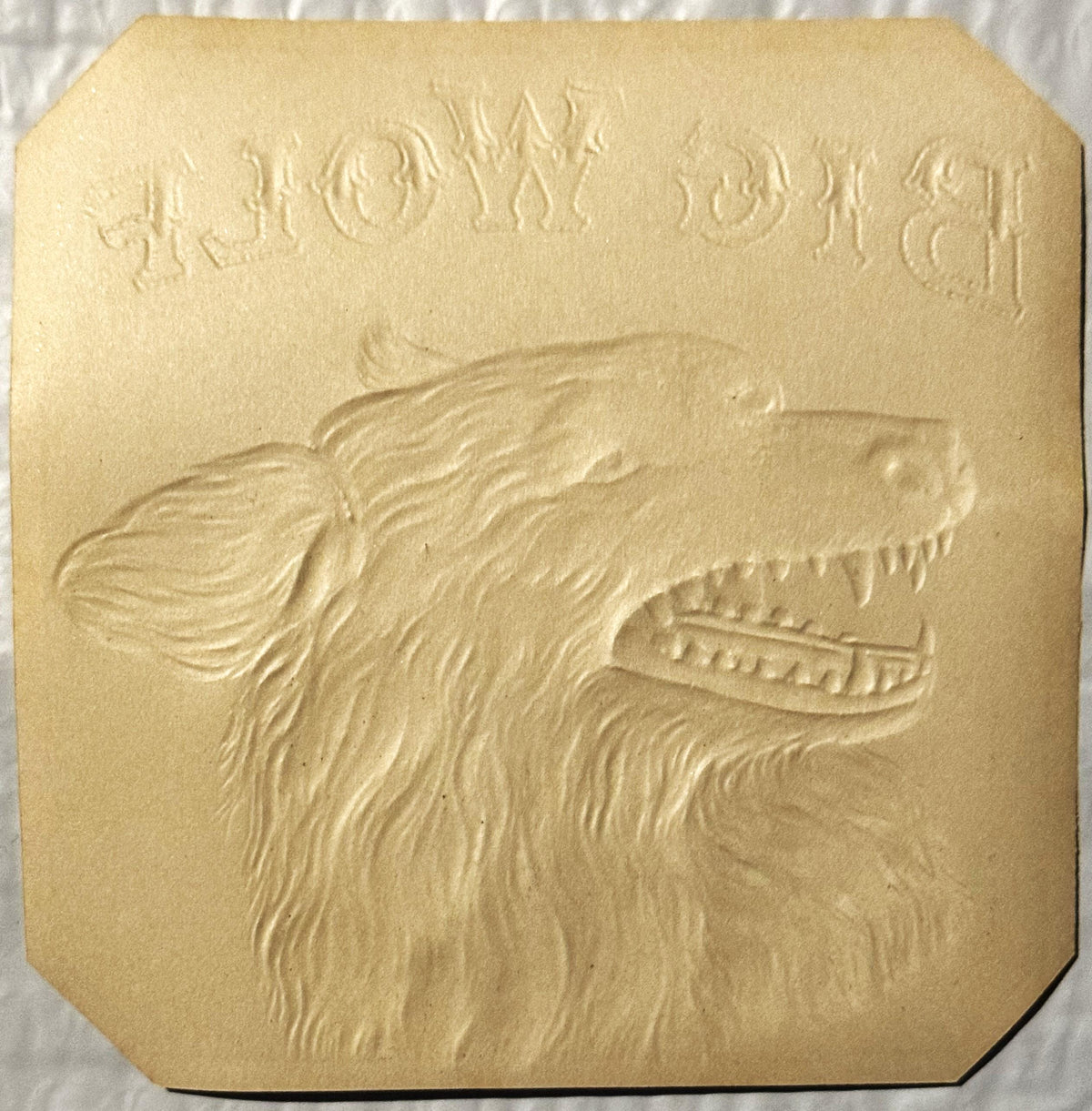
This is an antique Big Wolf cigar label, produced for the James W. Smith Cigar Co., printed as a chromolithograph and finished with gold foil stamping and embossed detailing — the raised lettering and the raised outline of the wolf's head are worked right into the paper itself, not merely printed flat on top of it.

The palette is bold and unapologetic: deep forest green and inky black shade the wolf's fur and face, blood-red lettering trimmed in gold announces the brand name arched overhead, and it all sits against a warm cream field bordered in gold. The wolf is shown in profile, mid-snarl, jaws parted to show two rows of pointed teeth, with the shadowed suggestion of a second wolf's head looming just behind the first — a clever bit of layered illustration that gives the whole image depth and a little extra menace.

The label is die-cut into an octagonal shape, measuring 4.5 x 4.5 inches, and survives as New Old Stock (NOS) — meaning it was printed and finished by the lithographer but never put into service on an actual cigar box, so what you're looking at is the artwork exactly as it left the press, never handled as part of a working product line.

Dating this piece to a single year would be dishonest; no manufacture mark on the sheet is legible enough to pin down an exact date. What can be said with confidence is that it belongs to the era when embossed, gold-stamped chromolithographed cigar art was at its absolute peak — broadly, the early 1900s through the 1930s — a span that covers the golden age of this particular art form from its most elaborate flourishing through its slow fade as cigarette smoking overtook the cigar trade.


🐾 The Big Wolf Brand: Storybook Menace as Marketing

Cigar brand names of this era were almost never subtle, and "Big Wolf" fits right into that tradition. Dealers who have handled companion pieces from this same brand family have described the artwork plainly as the big bad wolf of storybook lore — and looking at it, it's hard to argue otherwise. The pose, the bared teeth, the theatrical shadow-wolf lurking just behind the visible one — this was built to unsettle you a little, the same way a fireside fairy tale unsettles a child before the happy ending arrives.

That unease was the entire point. A tobacco shop counter in this period was a crowded battlefield of imagery: eagles clutching arrows, mustachioed generals, exotic beauties in far-off costumes, prizefighters mid-swing, and yes, fearsome animals lifted straight out of folklore and fable. Each brand needed something instantly legible, something a customer could read from ten feet away without a single word of copy.

A wolf snarling off the lid told you, without explanation, that whatever was rolled up inside that box had some bite to it too. It was advertising built entirely on gut reaction — and more than a century later, it still works exactly as intended. You look at this label and your eye goes straight to those teeth.


🏭 James W. Smith Cigar Co. — A Name the Trade Nearly Forgot

Here's where I want to be straightforward with you, because that's always been my approach with a piece like this rather than dressing up a guess as settled fact. The imprint at the base of the label reads plainly: "Title and Design Owned by the James W. Smith Cigar Co." — and that ownership line is corroborated independently by other dealers and collectors who have handled companion Big Wolf labels over the years, all attributing the brand to this same company.

What has proven far harder to track down is the company itself. No trade directory entry, no factory record, no tax-stamp district notation on the surviving examples of this label has ever surfaced to tell us definitively where James W. Smith Cigar Co. actually operated, or who James W. Smith himself was as a person. This isn't unusual — it's actually the norm for cigar manufacturing in this period.

The trade was staggeringly fragmented. Thousands of small-to-midsize cigar makers operated across the country, each registering its own trademarked brand names by the dozen, and most of them left only the faintest paper trail: a label here, a cigar band there, and then nothing. Big companies with famous names got remembered in trade journals and company histories.

Smaller regional operations, even ones producing beautiful, expensive artwork like this one, often simply vanish from the record the moment they closed their doors, leaving nothing behind but the labels themselves as the only surviving evidence they ever existed at all.

That's precisely why a piece like this matters as much as it does. Somewhere, in a city or town whose name has been lost to us, a company called James W. Smith Cigar Co. commissioned this artwork, paid a chromolithographer for the gold stamping and embossing, and put its name on a wolf snarling off a cigar box lid. The label is the last witness left to tell that story. I won't pretend to know which city that was — I'd rather tell you honestly that it's unconfirmed than invent a hometown for the sake of a tidier narrative.


🗺️ Pennsylvania's Cigar Towns: The World This Label Was Born Into

What I can tell you, and what I think is worth preserving even without a direct documented link to this specific company, is what the American cigar trade actually looked like during the decades this label belongs to. Pennsylvania in particular was an enormous force in American tobacco. By the late 1800s the state ranked as the third largest tobacco-growing state in the country, and small cigar factories sprang up in towns all across it, often employing a majority of the local working population.

Red Lion, in York County, is one of the most famous examples — a genuine boomtown built almost entirely on cigars. Local histories record that not long after the borough was incorporated and a rail depot was established there, a cigar factory opened its doors, and from that modest beginning Red Lion grew into one of Pennsylvania's legendary "cigar towns." By the height of its production, Red Lion's factories were said to employ two thousand men and women, paying out nearly three million dollars in wages annually and turning out well over two hundred million cigars a year — an almost unbelievable output for a single small town, and a source of enormous local pride that residents celebrated for generations afterward.

Lehigh County, home to Allentown, had its own deep cigar-making roots as well, with small partnerships and family-run factories operating there from the 1870s onward. Whether James W. Smith Cigar Co. had any connection to towns like these, I genuinely cannot say — no documentation ties this specific company to a specific place.

But this was the world the Big Wolf brand was born into: a landscape of hundreds of small, fiercely competitive cigar factories, each one betting its livelihood on artwork exactly like this, hoping a snarling wolf or a soaring eagle or a general's mustache would be the thing that made a customer reach for their box instead of the one sitting next to it on the shelf.


🎨 The Craft Behind the Snarl: Chromolithography and Gold Embossing

It's worth pausing on just how much skilled labor went into a single sheet like this one. Chromolithography — printing in full color using a separate hand-prepared stone or plate for each individual color — was the premier commercial printing process of its day, and cigar box art was one of its showcase applications. A label like this one required multiple passes through the press, each one laying down a different color with painstaking registration, before the gold foil stamping and embossing were added as a final, separate finishing step.

That embossing is what gives the lettering and the wolf's outline their raised, dimensional quality — you can trace the ridges of the letters "BIG WOLF" arched across the top, each one outlined in gold against its red field, and feel the raised contour of the wolf's snout and ears where the embossing die pressed the design up out of the paper.

This was expensive work, reserved for brands that wanted to project quality and confidence on the shelf. Cigar makers of this era understood that the box itself was doing half the selling, and they were willing to pay lithographers accordingly. Labels like this one were typically produced as part of a matched family of pieces cut for a single cigar box — a larger outer label for the box face, smaller "nail tag" seals, and an inner top sheet meant to sit over the cigars themselves — each one carrying variations on the same central artwork so that the wolf greeted the customer at every stage, from the shop counter to the moment the lid was finally lifted.


📦 Why New Old Stock Like This Is So Scarce Today

Cigar labels were, by design, meant to be consumed — pasted onto a box, and then thrown away along with the box once the last cigar was smoked. The overwhelming majority of labels from this era never survived past the point of use; they went into the trash with the empty box, or they were pasted down and eventually damaged in the process of removal by later collectors trying to salvage them. A sheet like this one, printed and embossed but never put into service, is a genuine rarity by comparison — it skipped that entire life cycle of use and disposal. It sat, instead, in a printer's or distributor's stock, preserved exactly as it came off the press, until it found its way into the hands of collectors decades later. That's the real significance of "New Old Stock" in the world of cigar label collecting: it isn't a grading term, it's a survival story. This label never had the chance to be discarded, because it was never used in the first place.


🖼️ Display Ideas

  • 🐺 Framed alone under glass as a bold, conversation-starting piece of graphic art for a den, office, or man cave
  • 🚬 Paired with other cigar box labels of the era in a grouped gallery wall celebrating vintage American advertising art
  • 🏛️ Displayed alongside Pennsylvania or general tobacco-trade memorabilia for a themed regional history collection
  • 📚 Set into a shadow box with a magnifying glass beside it, inviting a closer look at the gold embossing detail
  • 🎨 Used as a standalone accent piece in a study or library that leans into rich, saturated color and bold Victorian-era lettering
  • 🎁 Given as a gift to a collector of animal-themed advertising art, folklore imagery, or antique tobacciana

🎁 Who Collects These

Cigar label collecting is a genuinely dedicated corner of the antiques world, with its own vocabulary, its own dealer networks, and its own long memory for brands like Big Wolf that show up again and again in trade discussions even when the issuing company itself has faded from the record. Collectors of tobacciana specifically hunt down labels like this one for the artwork as much as the history — the animal and folklore imagery in particular has a strong following, since pieces built around a recognizable character like the storybook wolf tend to cross over into broader collecting categories beyond just cigar ephemera.

Graphic designers and illustrators collect this era of chromolithographed advertising art for the sheer craft of it — the color separation, the linework, the confident use of red, green, black, and gold together in a single small sheet. Pennsylvania and regional history collectors are drawn to pieces tied, even loosely, to the state's once-massive cigar trade.

And then there are simply lovers of good, bold, unapologetic vintage design, who don't need to know a single fact about James W. Smith to appreciate a snarling green-black wolf staring them down from a gold-trimmed cream field. This label sits comfortably at the intersection of all of those interests.


❓ FAQ

Is this label New Old Stock, and what does that mean?

Yes — this is New Old Stock (NOS). It was printed, embossed, and gold-stamped by the lithographer but never pasted onto an actual cigar box or put into commercial use, so it comes to you exactly as it left the press rather than as a label that was ever handled as part of a working cigar line.

How old is this label exactly?

No legible manufacture mark survives to give an exact year, and it would be dishonest to invent one. What can be said with confidence is that it belongs to the broad era of embossed, gold-stamped chromolithographed cigar labels, roughly spanning the early 1900s through the 1930s.

What size is the label?

It measures 4.5 x 4.5 inches, die-cut into an octagonal shape typical of outer cigar box labels of this style.

Where was James W. Smith Cigar Co. located?

Honestly, this isn't confirmed. No surviving trade directory, tax-stamp record, or factory listing has been located that pins down the company's home city or state, despite the brand being confirmed across multiple independent dealer listings of Big Wolf labels.

Why does the wolf design have a second, shadowed wolf head behind it?

It's a layered illustration technique common in cigar box art of the period — a darker, ghosted secondary image behind the main figure to add depth and a bit of extra visual drama to the design, reinforcing the sense of a lurking, menacing presence.

Was Big Wolf a well-known cigar brand in its day?

It was one of many trademarked brand names competing in an extremely crowded American cigar market. The imagery itself — a storybook wolf snarling with bared fangs — was clearly designed to grab attention instantly at a tobacco shop counter, which was the whole game for a brand at this level of the trade.

Is this a good piece for someone who doesn't collect cigar memorabilia specifically?

Absolutely — its appeal reaches well past tobacciana collectors into anyone drawn to bold vintage American advertising art, animal and folklore imagery, or early 20th-century graphic design and printing craft.

Shipping

🚚 Shipping & Handling

  • Shipping costs and timing are calculated at checkout.
  • Items curated and shipped directly by me include U.S. shipping at no additional cost, professionally packed to ensure safe arrival of your artifact.

Items from Vetted Pro Collectors
Shipping for items offered by vetted Pro Collectors is determined at checkout. All Pro Collector listings are reviewed to ensure fair, reasonable shipping practices.

For full details, please refer to our Shipping Policy.

Returns & Exchange

Take your time — you've got a full six months. If a piece isn't right for you, send it back the way it reached you and we're good.

In the first 30 days your money goes straight back the way you paid. After that it's store credit, so you can put it toward something you'd rather have.

Return shipping we sort out between us, case by case. I don't make this difficult.

If something arrives damaged, or it isn't what I said it was, send me a photo within 48 hours and I'll make it right.

Email info@vintageantiquesgifts.com or call 802-356-9872 — that's me answering, not a call center.

The only things I can't take back are custom or special-order pieces and gift cards.

View full details
  • 5 stars: 4 (100%)
  • 4 stars: 0 (0%)
  • 3 stars: 0 (0%)
  • 2 stars: 0 (0%)
  • 1 star: 0 (0%)
B
Bob Rust (St Louis, US)
Rare

I love the company and they are extremely well run. I just wish they had more stuff!

n
n***d (3269)

Great Piece +++++ Fast Arrival +++++ No Problems Here +++++

k
k***7 (1084)

Awesome 👌, quality vintage!! 😊 Love it, TY!! Great sellers, A+++ 🐺

a
a***x (1260)

Nice piece, great seller AAA+++