Skip to product information
1 of 4

Vintage and Antique Gifts

Antique Coca-Cola Bottling Co. Bank Check 1920s Forest City Branch Asheville NC Signed Ephemera 🥤

Antique Coca-Cola Bottling Co. Bank Check 1920s Forest City Branch Asheville NC Signed Ephemera 🥤

Regular price 17.00 USD
Regular price Sale price 17.00 USD
Sale Sold out
Shipping calculated at checkout.
Quantity

🥤 A Coca-Cola Bottler's Own Check, From the Decade Coca-Cola Was a Thousand Hometown Businesses

In 1899 Asa Candler signed over the right to bottle Coca-Cola across most of the United States for one dollar. He later decided he had made a grave mistake. The two Chattanooga lawyers who got the contract, Benjamin Thomas and Joseph Whitehead, did not bottle the country themselves. They signed up local bottlers to work within set territories, and in twenty years the number of plants grew from two to more than 1,000, ninety-five percent of them locally owned and operated.

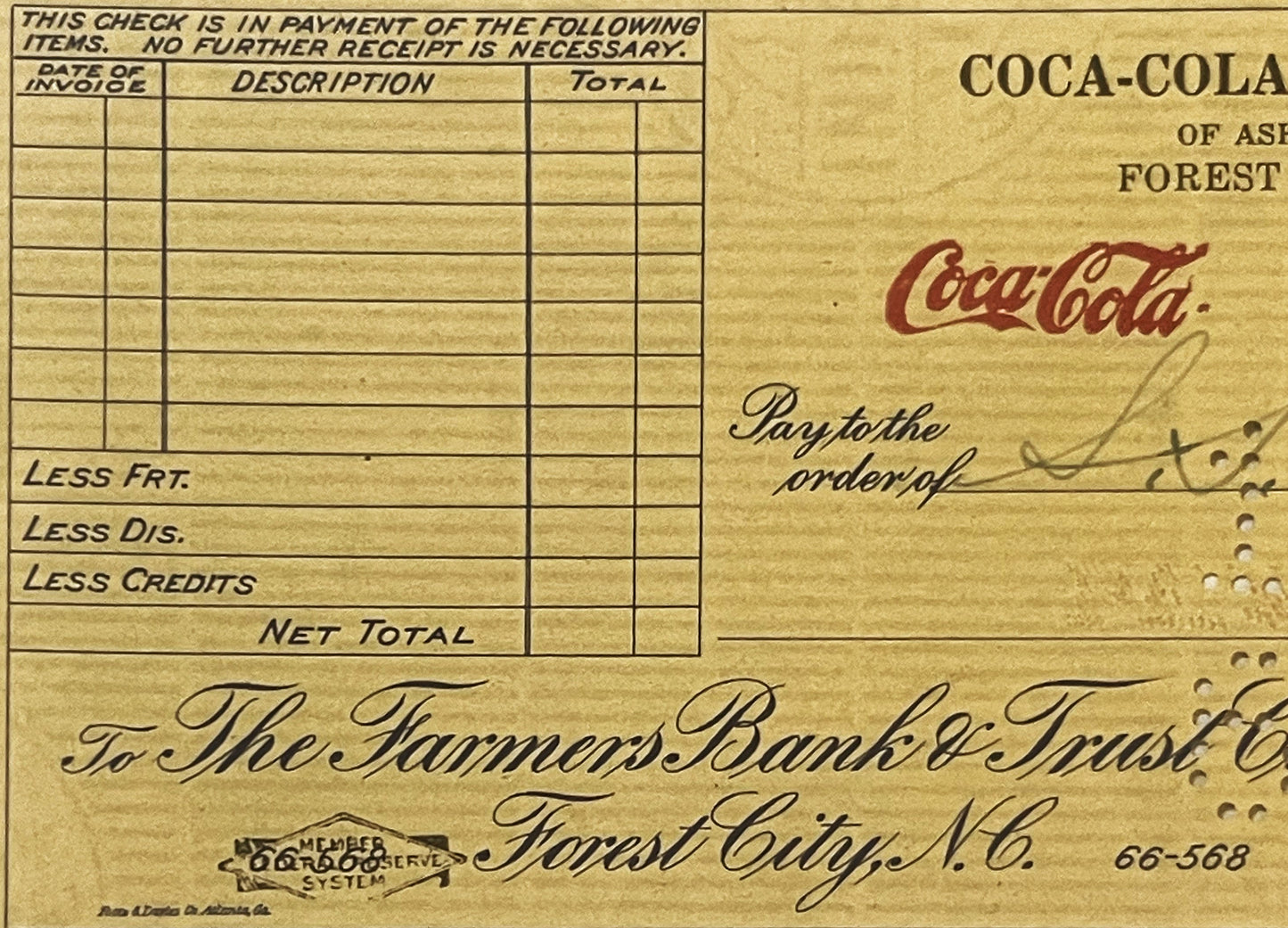
This is the working paper of one of those hometown businesses: an original antique cancelled Coca-Cola bottler's check from the Forest City Branch of the Asheville bottler, drawn on a Forest City, North Carolina bank. The date line comes with the decade already printed, 192_, so the form was made to be filled in during the 1920s.

Every check is its own. Each one was written out by hand, so the check number, date, payee, amount and signature differ from one check to the next. You receive an original check of the kind shown, not the exact check in the photographs.


📋 What Is Printed on It

  • COCA-COLA BOTTLING CO., / OF ASHEVILLE, N. C. / FOREST CITY BRANCH in black capitals across the top
  • The Coca-Cola script trademark, printed in red
  • A script city line, Forest City, N.C., with 192_ printed into the date
  • To The Farmers Bank & Trust Co., Forest City, N.C., with the transit number 66-568
  • A small diamond reading MEMBER FEDERAL RESERVE SYSTEM
  • COCA-COLA BOTTLING CO. over a signature line marked By and Manager
  • A voucher table at the left headed THIS CHECK IS IN PAYMENT OF THE FOLLOWING ITEMS. NO FURTHER RECEIPT IS NECESSARY., with columns for date of invoice, description and total, and lines for LESS FRT., LESS DIS., LESS CREDITS and NET TOTAL
  • A tiny printer's line at the bottom left: Foote & Davies Co., Atlanta, Ga.

Then come the marks of use: ink entries on the date, payee and amount lines, a hand signature over the Manager line, rubber-stamped bank marks, and a pattern of punched holes driven through the paper once the check was paid.

🥤 From a Five-Cent Glass in Atlanta to a Plant in Every Town

Coca-Cola started as a fountain drink. John Pemberton's creation was first sold at Jacob's Pharmacy in Atlanta on May 8, 1886, for five cents a glass. His bookkeeper, Frank Mason Robinson, came up with the name and chose the cursive Spencerian script, the dominant formal handwriting of the day. That is the script printed in red on this check.

Asa Candler, who took over the company from Pemberton's circle, built it on syrup sold to soda fountains. Bottling came from outside. Joseph Biedenharn first bottled Coca-Cola at his candy company in Vicksburg, Mississippi, on March 12, 1894. Then came the 1899 contract, which gave Thomas and Whitehead the bottling rights throughout the United States except Mississippi. The deal has passed into business legend for its price.

What made it work was the territory system. The contract holders found capable local people and let them set up Coca-Cola bottling in defined areas. Independent bottlers were soon established in small and middle-sized towns all over America, and many of those families became very wealthy. The company itself changed hands in 1919, when a group led by Ernest Woodruff bought it for $25 million. By 1920 the contour bottle, chosen at the 1916 bottlers' convention, was the standard bottle.

A heading like this one tells you how far the system had reached. The bottler is of Asheville, and the check belongs to its Forest City Branch, a second location in another town, with its own checks and its own local bank.

🏦 66-568 and the Federal Reserve Diamond

The number beside the bank's name is its transit number. The American Bankers Association released its routing codes in May 1911 to speed up check sorting. The numbers 1 to 49 went to cities and 50 to 99 went to states, and 66 is North Carolina. The 568 identifies the bank itself.

The diamond is newer history still. President Woodrow Wilson signed the Federal Reserve Act on December 23, 1913, creating the Federal Reserve System. Every nationally chartered bank had to join, and banks chartered by their states were given the option. This form carries MEMBER FEDERAL RESERVE SYSTEM right beside the bank's name.

🏘️ Forest City, the Town Once Called Burnt Chimney

The town printed on this check was incorporated in 1877 as Burnt Chimney. The chimney was the remains of the McArthur home, left standing at the crossroads where the town began. In 1887 it took the name Forest City, after a prominent citizen named Forest Davis. In 1927 the U.S. Department of Agriculture picked it as one of the ten most beautiful and best planned towns in the United States.

The Farmers Bank and Trust building on Main Street dates to 1923. It is one of the buildings in Forest City's Main Street Historic District, which developed from the late 1880s through the 1920s and was added to the National Register of Historic Places in 2002.

⛰️ Asheville, the Home Office

Asheville prospered in the 1910s and 1920s. The first railroad reached the city on October 3, 1880, and a planning document counted about 28,500 people there in 1922. The boom ran on borrowed money. By 1929 the city and Buncombe County had taken on more than $56 million in bonded debt, and on November 20, 1930, eight local banks failed in a single day. Asheville chose not to default and paid its debts over the next fifty years.

The city's most famous son wrote about exactly those years. Thomas Wolfe's first novel, Look Homeward, Angel, came out in 1929, and its town of Altamont is Asheville. Its portraits of people and families estranged Wolfe from many in his hometown.

🖨️ Printed in Coca-Cola's Home City

The form itself came from Atlanta. Its printer, Foote & Davies, worked in the same city where Coca-Cola was first sold. The firm lasted: a 1959 photograph in the Digital Library of Georgia shows the Foote and Davies book printers' factory in Atlanta.

✒️ A Check That Was Also a Receipt

The table on the left explains how the bottler did business. Instead of sending a separate receipt, the office listed the invoices being paid right on the check, took off freight, discounts and credits, and wrote the net total. The printed promise at the top, NO FURTHER RECEIPT IS NECESSARY, made the cancelled check the proof of payment. The punched holes and bank stamps show it went through the bank and came back paid.

📜 Why a Bottler's Check Matters

Coca-Cola collectors know the trays, signs and bottles. This is the other side of the business: the paper that paid the bills at a hometown bottling branch in the 1920s, with the famous red script printed on it. Business checks were written to be paid and filed away, not saved, and a bottler's check from a small North Carolina town is a scarce thing to find today.


Shipping

🚚 Shipping & Handling

  • Shipping costs and timing are calculated at checkout.
  • Items curated and shipped directly by me include U.S. shipping at no additional cost, professionally packed to ensure safe arrival of your artifact.

Items from Vetted Pro Collectors
Shipping for items offered by vetted Pro Collectors is determined at checkout. All Pro Collector listings are reviewed to ensure fair, reasonable shipping practices.

For full details, please refer to our Shipping Policy.

Returns & Exchange

Take your time — you've got a full six months. If a piece isn't right for you, send it back the way it reached you and we're good.

In the first 30 days your money goes straight back the way you paid. After that it's store credit, so you can put it toward something you'd rather have.

Return shipping we sort out between us, case by case. I don't make this difficult.

If something arrives damaged, or it isn't what I said it was, send me a photo within 48 hours and I'll make it right.

Email info@vintageantiquesgifts.com or call 802-356-9872 — that's me answering, not a call center.

The only things I can't take back are custom or special-order pieces and gift cards.

View full details
  • 5 stars: 1 (100%)
  • 4 stars: 0 (0%)
  • 3 stars: 0 (0%)
  • 2 stars: 0 (0%)
  • 1 star: 0 (0%)
l
l***k (151)

Quick response with cool product. I could be no happier.