Skip to product information
1 of 4

Vintage and Antique Gifts

Vintage Coca-Cola Bottling Co. Bank Check 🧾 Forest City Branch, Asheville NC Certificate

Regular price 24.00 USD
Regular price Sale price 24.00 USD
Sale Sold out
Shipping calculated at checkout.

Description

🥤 What Did It Take to Keep a Small-Town Coca-Cola Plant Running in the Early 1920s? 💵

Long before Coca-Cola was a global name splashed across billboards from Tokyo to Times Square, it was a local business — quite literally, town by town, plant by plant, check by check. Somewhere in the foothills of western North Carolina, a bookkeeper at the Coca-Cola Bottling Co.'s Forest City Branch pulled a check from a bound ledger book, filled in a payee, dipped a pen, and paid a bill. It was an unremarkable moment in an ordinary business day. And yet that scrap of paper survived when tens of thousands like it did not — cashed, punched, filed, and eventually lost to time. This one wasn't. It's a genuine window into the working, breathing machinery behind one of the most iconic brands in American history, back when that brand was still finding its footing town by town across the rural South.

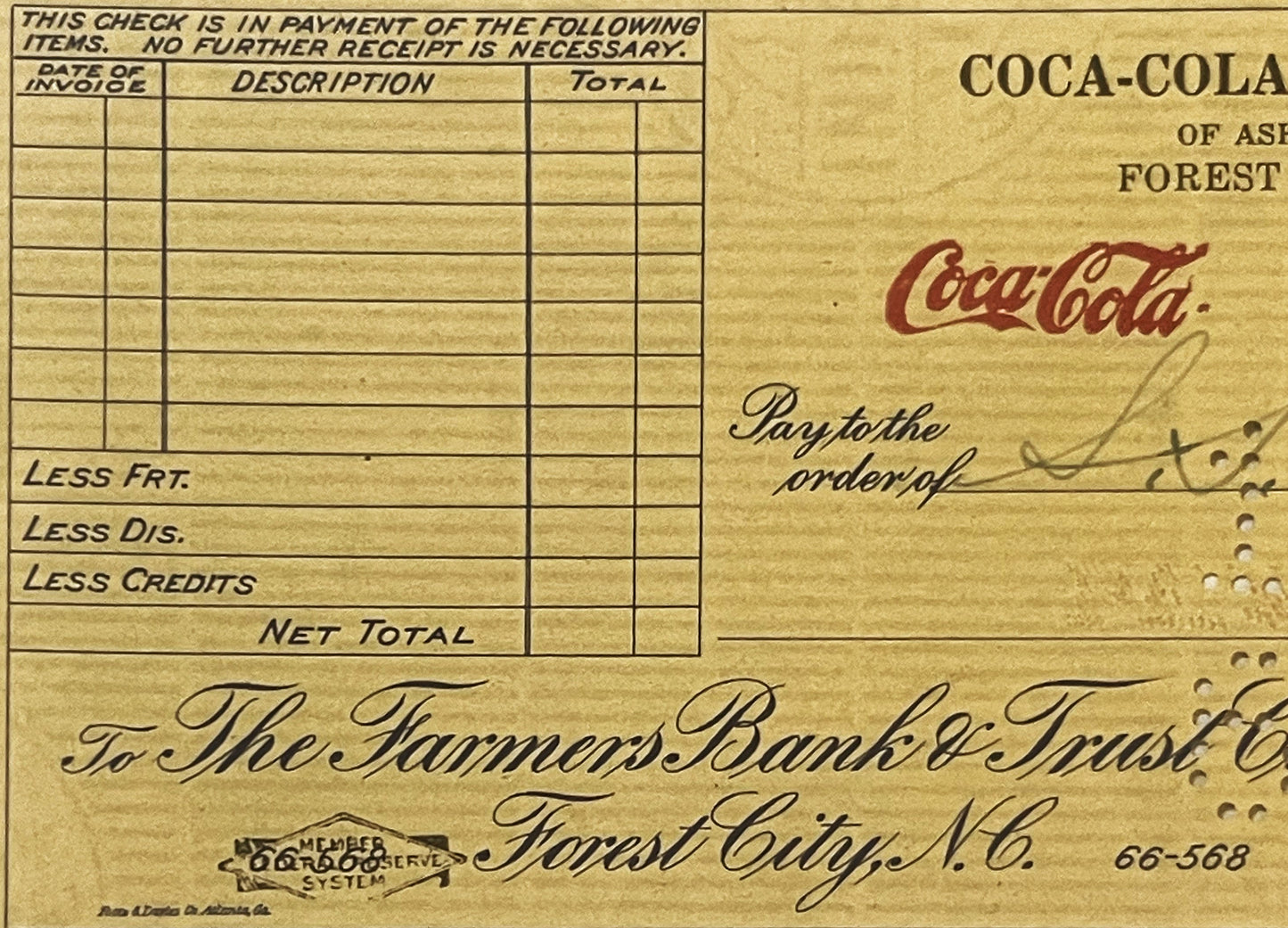
What you're looking at is an original bank check issued by the Coca-Cola Bottling Co. of Asheville, N.C. — Forest City Branch, drawn on The Farmers Bank & Trust Co. of Forest City, North Carolina. These checks date to the early 1920s, with the example pictured carrying a 1922 date, printed and completed in the working style of that era — letterpress black lettering laying out the company name, the branch designation, and the payment terms, topped by a bold red script Coca-Cola trademark logo in the brand's signature Spencerian hand. The payee line, the date, the dollar amount, and the manager's own signature are all filled in by hand in period cursive ink, giving each surviving check its own individual character. Across the face runs a scatter of small cancellation punch-holes — the bank's own mechanical mark confirming the check was paid and closed out, a small but genuine piece of early 20th-century banking practice stamped right into the paper. Down in the corner, a printer's credit reads Foote & Davies Co., Atlanta, Ga. — the commercial print house responsible for producing it. This is a real, issued and cancelled piece of Coca-Cola bottling business history, not a modern reproduction, and it stands today as an excellent early example of American commercial ephemera and early Coca-Cola advertising design working in tandem.


🥤 The Franchise Deal That Built an Empire, One Small Town at a Time

To understand why a check like this even exists, you have to go back to 1899, when Coca-Cola Company owner Asa Candler sold the rights to bottle his fountain drink to two Chattanooga lawyers, Benjamin Thomas and Joseph Whitehead, for a sum so small it's practically a footnote — the story goes it was handled for just a dollar, since Candler didn't believe bottled soda had much of a future compared to the soda fountain trade. That deal turned out to be one of the most consequential business decisions in American commercial history. Rather than build and operate bottling plants themselves, Thomas and Whitehead — and the regional bottlers who came after them — sub-licensed the right to bottle Coca-Cola to independent local businessmen all across the country. Each one bought Coca-Cola syrup from Atlanta, mixed it with their own carbonated water, financed their own plant, hired their own drivers, and ran their own books.

By the early 1920s, that franchise system had multiplied into hundreds of locally owned bottling operations stretching across the American South and beyond — each one a genuine small business with its own payroll, its own local bank account, its own manager's signature on the bottom line. The Coca-Cola Bottling Co. of Asheville was one of these regional operators, and by the time this check was written, it had grown successful enough to extend its reach outward with satellite branches — like this one in Forest City — feeding Coca-Cola out to the small towns, general stores, and soda fountains of the surrounding mountain foothills. A check like this one is direct, tangible proof of that decentralized business model in action: a genuine local company, with a genuine local bank, paying genuine local bills, decades before "Coca-Cola" meant a single monolithic corporation rather than a patchwork of hometown bottlers all pulling in the same direction.


⛰️ Asheville and Forest City — Mountain Towns on the Rise

Asheville, North Carolina in the 1920s was a city riding high. Tucked into the Blue Ridge Mountains, it had become one of the premier resort destinations in the American South, drawing wealthy visitors escaping the summer heat of the lowlands, filling grand hotels, and building a reputation as a genteel mountain retreat. It was also, not coincidentally, the hometown of novelist Thomas Wolfe, whose sprawling 1929 novel "Look Homeward, Angel" immortalized the Asheville of this very era — its boardinghouses, its ambitions, its striving. Amid all that growth, Asheville supported real industry too, and a locally owned Coca-Cola bottling operation was part of the fabric of a city coming into its own.

Forest City, the branch town named right on this check, tells a different but equally real story. Sitting in Rutherford County in the foothills below Asheville, Forest City in this era was very much a mill town — its economy built on cotton and textile manufacturing, the kind of small Southern community where a payroll check from the local Coca-Cola bottler would have circulated through the same hands as wages from the cotton mill down the road. That the Asheville company thought it worthwhile to open and staff a dedicated branch in a town the size of Forest City says something about how deeply Coca-Cola's bottling network had already worked its way into the daily commerce of even the smaller communities of the rural South by the early 1920s — not just the big resort cities, but the mill towns and crossroads towns too.


🏦 The Farmers Bank, the Punch of Cancellation, and an Atlanta Printer

The bank named on this check, The Farmers Bank & Trust Co. of Forest City, N.C., was exactly the kind of hometown institution that small Southern businesses of this era relied on — a local bank for local business, its routing figures (66-568) printed right on the check face the same as any community bank check of the period. Once a check like this was paid out and processed, the bank ran it through a mechanical perforator, punching a pattern of small holes straight through the paper. That was standard banking practice of the era — a simple, physical way of marking a check as cancelled so it could never be redeposited, altered, or reused fraudulently. It's a small detail, but it's a genuine, tactile piece of early 20th-century financial history, permanently stamped into the paper itself.

Down at the bottom of the check, the printer's credit reads Foote & Davies Co., Atlanta, Ga. — a commercial printing house based in the same city as Coca-Cola's own corporate headquarters. Atlanta in this era was home to a thriving trade of commercial print shops turning out business forms, ledgers, checks, and advertising material for companies across the South, and it's a fitting detail that the paperwork behind a Coca-Cola bottler's daily business was itself produced just down the road from where the drink was born.


💵 Payroll, Ice, and Sugar — The Daily Business Behind the Brand

It's easy to think of Coca-Cola purely in terms of its advertising — the red trays, the Christmas Santas, the soda fountain glasses — and forget that behind every bottle sold at a country store was a working operation of real people doing real jobs. Checks like this one were how a bottling branch actually functioned day to day: paying the driver who ran routes out to the crossroads stores, the man who delivered ice for the cooling tanks, the supplier who brought in sugar and glass bottles, the local worker who kept the bottling line running. The example pictured here was written out for a modest, everyday sum and made payable to one of the many local hands who kept the Forest City branch operating — the kind of routine payment that would have been written, signed, cashed, and forgotten within the week. The check numbering itself, climbing into the thousands, hints at just how much volume a single small-town branch could process in a business as constantly in motion as bottling and distributing soda.


📜 Why So Few of These Survive

Business checks were never meant to be kept. They were written, cashed, cancelled, filed away, and — sooner or later — thrown out, exactly as bookkeeping records from any working company eventually are. Nobody in 1922 was filing away a payroll check from the Forest City Coca-Cola branch with an eye toward posterity; it was simply paperwork, doing its job and then done. That's precisely what makes a surviving example like this one worth holding onto today — it slipped through the decades that claimed nearly all of its counterparts, carrying with it the red Coca-Cola script, the hand-inked signature of a long-ago branch manager, and the physical proof of a cancellation stamp that closed the books on a transaction a century ago. Pieces like this represent a genuinely uncommon category of early Coca-Cola material — not the advertising trays and calendars that collectors chase by the thousands, but the quiet operational paperwork that rarely got saved at all.


🖼️ Display Ideas

  • 🖼️ Framed alongside a vintage Coca-Cola advertising print for a striking side-by-side of the brand's public face and its private ledger books
  • 🏢 Displayed in a home office or den as a conversation piece on early American small-business history
  • 🥤 Paired with other Coca-Cola collectibles — bottles, trays, signs — to round out a themed collection with a genuinely different kind of artifact
  • 📚 Matted in a shadow box with a short typed card noting the Forest City Branch and Asheville connection, for a museum-style presentation
  • 🎓 Used as a teaching piece on the history of franchise business, banking practices, or Southern industrial history
  • 🎁 Gifted to a Coca-Cola collector, a North Carolina native, or a banking/financial history enthusiast as a genuinely uncommon find

🎁 Who Collects These

This kind of piece draws a particular crossover crowd — serious Coca-Cola collectors who've moved past trays and bottles into the deeper cut of corporate and bottling history, paper ephemera and financial-document collectors who prize old bank checks for their engraving, cancellation marks, and local-bank history, and North Carolina and Southern regional history buffs drawn to anything tied to Asheville or the Rutherford County mill towns. It also appeals to anyone with a soft spot for the small-business story behind big American brands — the local managers, the hometown banks, the everyday paperwork that built something much larger than any one branch ever intended.


❓ FAQ

Is this an original check, or a reproduction?

This is a genuine, original bank check issued and cancelled by the Coca-Cola Bottling Co. of Asheville, N.C., Forest City Branch, drawn on The Farmers Bank & Trust Co. of Forest City, N.C.

What do the small punch holes across the check mean?

Those are the bank's own cancellation marks, mechanically punched through the paper once the check was paid out — a standard early 20th-century banking practice to prevent a paid check from being reused or altered.

What year does this check date to?

These Forest City Branch checks date to the early 1920s, with the example shown here carrying a 1922 date printed and hand-completed on its face.

Who printed this check?

The printer's credit at the bottom reads Foote & Davies Co., Atlanta, Ga., a commercial print house based in the same city as Coca-Cola's own corporate headquarters.

Does the payee name or amount vary between checks?

Yes — as genuine business documents, each surviving check carries its own individually hand-written payee, dollar amount, date, and check number, along with its own original manager's signature.

Was Coca-Cola always one big company, or was it run locally like this?

In this era, Coca-Cola operated on a franchise-bottling model — independent local businessmen bought syrup from Atlanta and ran their own bottling plants, payrolls, and bank accounts, exactly as this Asheville-based branch operation did.

What's the best way to display a piece of paper ephemera like this?

Framing or matting is popular for preserving the printed detail and handwriting while making it easy to display alongside other Coca-Cola or Southern history pieces.

Shipping

🚚 Shipping & Handling

  • Shipping costs and timing are calculated at checkout.
  • Items curated and shipped directly by me include U.S. shipping at no additional cost, professionally packed to ensure safe arrival of your artifact.

Items from Vetted Pro Collectors
Shipping for items offered by vetted Pro Collectors is determined at checkout. All Pro Collector listings are reviewed to ensure fair, reasonable shipping practices.

For full details, please refer to our Shipping Policy.

Returns & Exchange

Product Page Return Policy

  • 60-Day Returns – Items must be in original condition.
  • Refunds – Issued after inspection (excluding shipping costs).
  • Return Shipping – Customer is responsible unless item is damaged or incorrect.
  • Damaged/Incorrect Items – Contact us within 48 hours for a replacement or refund.
  • Easy Returns – Email [email protected] or call 802-356-9872 to initiate a return.

For full details, visit our Refund Policy.

View full details