Skip to product information
1 of 3

Vintage and Antique Gifts

🦌 Antique Hello Bill BPOE Elks Celluloid Pinback Button 1890s NOS Fraternal Greeting Purple & White Collectible

🦌 Antique Hello Bill BPOE Elks Celluloid Pinback Button 1890s NOS Fraternal Greeting Purple & White Collectible

Regular price 18.00 USD
Regular price Sale price 18.00 USD
Sale Sold out
Shipping calculated at checkout.

Description

🦌 Two Little Words That Crossed a Continent

Picture a warm July afternoon in Minneapolis in 1897. The streets are thick with thousands of visiting Elks, in town for the great National Re-Union of the Benevolent and Protective Order of Elks. Strangers from lodges in a hundred different cities are shaking hands, slapping backs, and calling out to one another with a phrase that, in just a day or two, would travel from a single committee headquarters to the far ends of the earth: "Hello Bill!"

This little celluloid button carries those exact two words, printed in the deep royal purple of the Order against a clean cream-white ground. It is a genuine antique relic of one of the most beloved fraternal greetings in American history — a phrase that began as an inside joke at a convention and became, almost overnight, the universal password of brotherhood for hundreds of thousands of men. To hold it is to hold a perfectly preserved fragment of turn-of-the-century American fellowship.

🍺 Before the Elks, There Were the Jolly Corks

To understand "Hello Bill," you first have to understand where the Elks themselves came from — and that story is one of the most charming origin tales in all of American fraternalism.

In the years just after the Civil War, New York City was home to a community of actors, singers, minstrel performers, and vaudeville entertainers. These were men who worked nights and lived by their wits, and on Sundays — the one day the city's strict blue laws shut the saloons and theaters tight — they had nowhere convivial to gather. So they gathered anyway, privately, around a charismatic English-born entertainer named Charles Algernon Sidney Vivian.

Vivian had a party trick involving corks, a game played on the uninitiated to win a round of drinks, and from that bit of barroom mischief the little club took its name: the Jolly Corks. For a time, that was the whole of it — good fellowship, music, and laughter on a quiet Sunday.

Then, just before Christmas of 1867, one of their members died, leaving a wife and children with nothing. The Jolly Corks passed the hat, and in that moment of generosity they realized their merry little society could be something more enduring than a Sunday drinking club. On February 16, 1868, they formally organized themselves into the Benevolent and Protective Order of Elks. The actors and entertainers who had once dodged the Sunday blue laws had become the founders of one of the great charitable fraternities of the nation.

🎩 The Birth of "Hello Bill" — Minneapolis, 1897

Thirty years on, the Elks had grown from a theatrical curiosity into a national institution with lodges in cities coast to coast. And it was at the 1897 National Re-Union in Minneapolis that the greeting on this button was born.

The man at the center of it was William Goddard, a longtime treasurer of Minneapolis Lodge No. 44 and the chairman of the committee handling the arrangements for that year's enormous gathering. Goddard knew everything and everyone, and so whenever a visiting Elk had a question, the answer was always the same: "Go see Billy Goddard." "Billy can tell you." "Ask Billy, he knows."

The refrain was repeated so endlessly that visiting members began walking up to Goddard and greeting him, half in jest, with "Hello, Bill! I was told to see you." The joke caught fire. Within a day or two it had spilled out of the committee headquarters and into the streets, where Elks from every corner of the country sang it out to one another as they passed. They carried it home to their own lodges, and the cheerful salutation of one helpful Minneapolis treasurer became, in the words of the Order's own historians, a greeting that found its way around the world.

That is the moment this button captures. Not a secret password, not a coded signal — a warm, open, joyful hello between brothers. It is the sound of American fellowship at the very turn of the twentieth century, pressed into celluloid and royal purple ink.

💜 Royal Purple and White — The Colors of the Order

Look closely at the design and you will see it is built entirely from the two official colors of the Benevolent and Protective Order of Elks: Royal Purple and White. This was no accident of the printer's whim. Purple has long been the color of dignity, loyalty, and remembrance, and the Elks adopted it as their own — so a member wearing this button on his lapel was instantly recognizable to any other Elk across a crowded convention hall or a busy city street.

The bold, hand-lettered "HELLO BILL!" — that exclamation point giving it all the cheerful energy of a shouted greeting — sits at the heart of a clean white field, ringed by a solid band of that unmistakable royal purple. It is a masterclass in early advertising-button design: simple, graphic, and readable from across a room. More than a century later, it remains one of the most instantly charming pieces of fraternal Americana a collector can own.

🔘 The Golden Age of the Celluloid Pinback

This button belongs to a very specific and beloved moment in American manufacturing history. The modern celluloid pinback button — a printed paper design sealed beneath a thin protective layer of celluloid and crimped into a metal collar with a pin on the reverse — became possible only after the process was patented in 1896 by the Whitehead & Hoag Company of Newark, New Jersey.

That single innovation set off an explosion of buttons across the country. Suddenly, political campaigns, advertisers, clubs, and fraternal orders could produce crisp, colorful, durable badges cheaply and in quantity. The years from the late 1890s through the 1910s are considered the golden age of the celluloid button, and the "Hello Bill" greeting — born in 1897, right at the dawn of the technology — is a perfect specimen of the form. The construction of this piece, with its celluloid-over-paper face crimped into a metal rim and a straight pin across the back, is entirely consistent with these earliest celluloid pinbacks.

🗓️ Dating This Piece: The 1890s

This button is confidently placed in the 1890s, and the dating rests on solid, converging evidence:

✨ The "Hello Bill" greeting itself is documented to the 1897 Minneapolis National Re-Union — it could not have appeared on a button before that date.

✨ The celluloid pinback process was patented in 1896, making this style of button a brand-new technology exactly when the greeting was coined.

✨ The simple two-color graphic design, the lettering style, and the construction all align with the earliest wave of celluloid greeting buttons produced in the closing years of the decade.

✨ The collectible market has long and consistently catalogued this "Hello Bill" greeting button as a 1890s piece, and that attribution holds.

Taken together, these point squarely to the late 1890s — the very first years this greeting and this technology existed side by side.

🔍 What You're Looking At

🦌 A genuine antique celluloid pinback button measuring 1¼" in diameter — a satisfying, substantial size, larger than the common smaller buttons of the era.

💜 Royal purple "HELLO BILL!" lettering on a cream-white celluloid face, ringed in solid Elks purple.

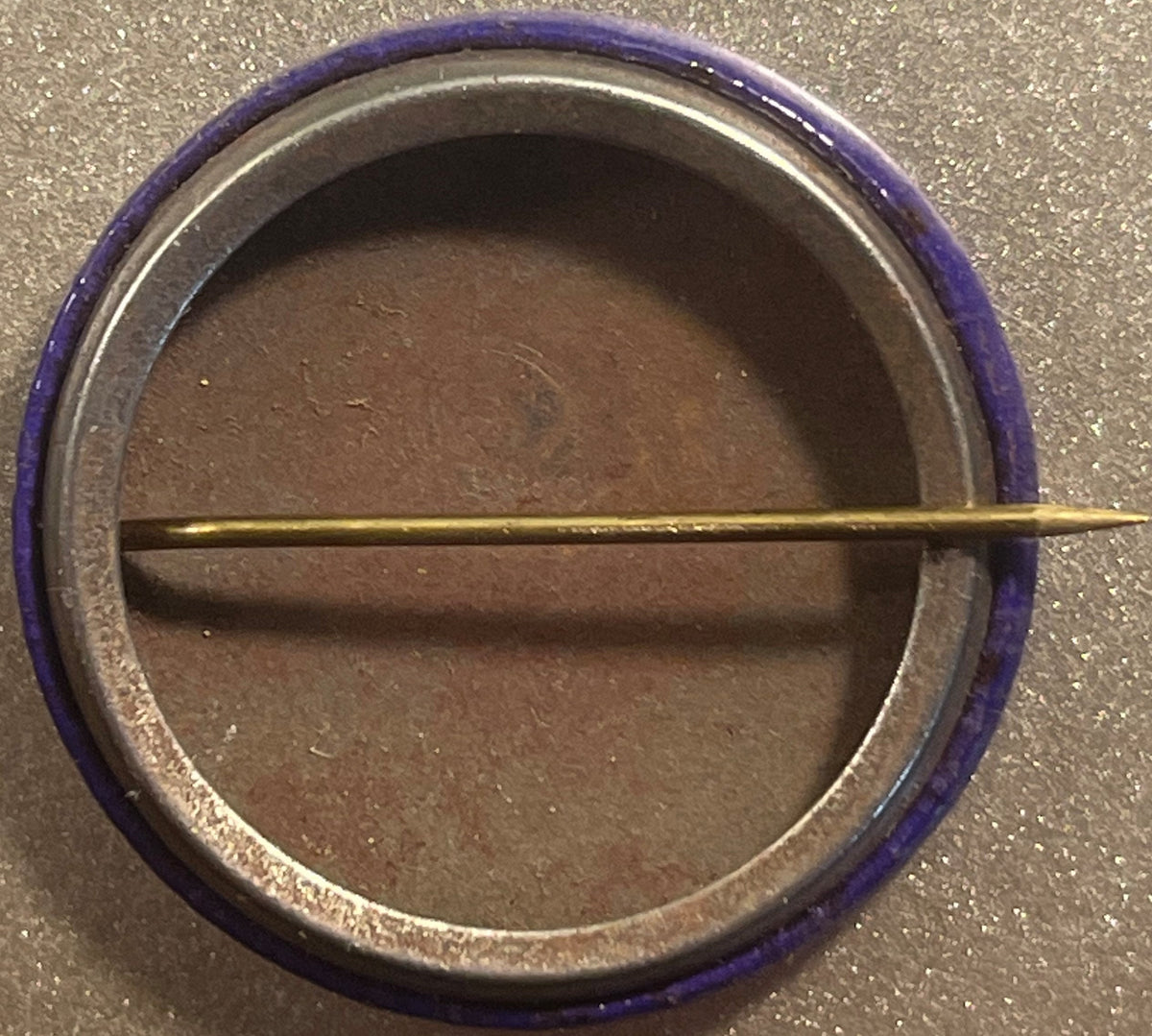
🔘 Original metal collar and pin assembly on the reverse, in the classic early celluloid pinback construction.

📜 Any maker's backpaper that may once have been present is no longer legible, as is common with pieces of this age — but the form and construction speak clearly to its turn-of-the-century origin.

Condition: New Old Stock

This button is New Old Stock — unused and never worn. It was never pinned to a lapel, never carried through a convention, never put to its working life as a badge. It has spent its entire existence in storage, and it survives today as a bright, original, unhandled example of a piece that most often turns up well-worn.

In the hand, the celluloid is clean and the purple is rich and deep. An unused survivor like this is exactly what advanced collectors of fraternal memorabilia hope to find — the piece as it left the button-maker's bench, not the piece as it lived a hard life on a coat.

🏛️ Why Collectors Treasure Elks Memorabilia

The Benevolent and Protective Order of Elks is woven deep into the fabric of American community life. Founded in 1868, it grew into one of the largest fraternal and charitable organizations in the country, with lodges anchoring the social life of towns and cities from coast to coast. Generations of American men — fathers, grandfathers, veterans, businessmen, civic leaders — wore the antlers and the royal purple with pride.

That deep cultural footprint is exactly why Elks memorabilia is so widely collected today. Celluloid buttons, convention badges, ribbons, watch fobs, postcards, and lodge regalia all carry the history of American fraternalism, civic charity, and small-town fellowship. And among all of them, the "Hello Bill" greeting button holds a special place: it is the physical embodiment of the Order's friendliest tradition, the cheerful hello that bound brothers together. For the collector of fraternal Americana, antique advertising, celluloid pinbacks, or turn-of-the-century social history, it is a cornerstone piece.

🎁 A Piece of American Fellowship

Whether it joins a serious collection of Elks and fraternal memorabilia, takes its place in a display of antique celluloid buttons, or becomes a meaningful gift for an Elks member, a lodge, or anyone who treasures Americana, this little button carries an outsized story. Two words, royal purple ink, a Minneapolis summer in 1897, and the spirit of brotherhood that turned a treasurer's nickname into a greeting heard around the world.

🛍️ Add this antique Hello Bill BPOE Elks celluloid pinback button to your collection and own a perfectly preserved piece of American fraternal history — the cheerful hello that crossed a continent.

Shipping

🚚 Shipping & Handling

  • Shipping costs and timing are calculated at checkout.
  • Items curated and shipped directly by me include U.S. shipping at no additional cost, professionally packed to ensure safe arrival of your artifact.

Items from Vetted Pro Collectors
Shipping for items offered by vetted Pro Collectors is determined at checkout. All Pro Collector listings are reviewed to ensure fair, reasonable shipping practices.

For full details, please refer to our Shipping Policy.

Returns & Exchange

Product Page Return Policy

  • 60-Day Returns – Items must be in original condition.
  • Refunds – Issued after inspection (excluding shipping costs).
  • Return Shipping – Customer is responsible unless item is damaged or incorrect.
  • Damaged/Incorrect Items – Contact us within 48 hours for a replacement or refund.
  • Easy Returns – Email info@vintageantiquesgifts.com or call 802-356-9872 to initiate a return.

For full details, visit our Refund Policy.

View full details