Skip to product information
1 of 3

Vintage and Antique Gifts

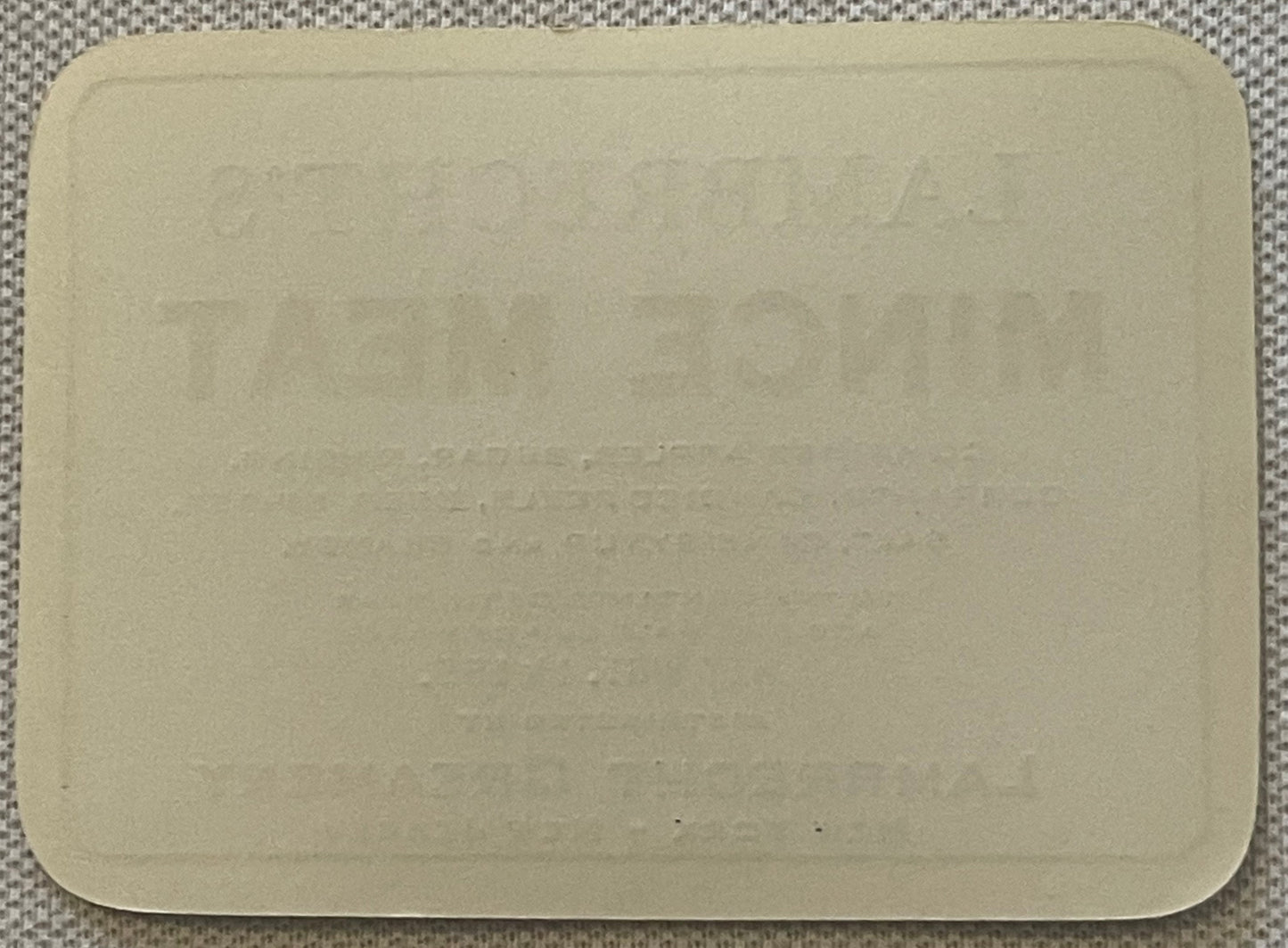
Antique Lambrecht's Mince Meat Jar Label 🏷️ Lambrecht Creamery New York & New Jersey NOS 1910s–1930s

Antique Lambrecht's Mince Meat Jar Label 🏷️ Lambrecht Creamery New York & New Jersey NOS 1910s–1930s

Regular price 9.50 USD
Regular price Sale price 9.50 USD
Sale Sold out
Shipping calculated at checkout.
Quantity

What Does a Label Printed Before the Jazz Age Actually Feel Like in Your Hands? 🏷️

There is a particular stillness that comes over you the first time you hold a piece of paper that has outlasted everyone who ever touched it before you. Not a document, not a photograph — something humbler than that. A jar label. A small rectangle of cream-colored stock, inked in navy blue, designed by a compositor who has been gone for decades, printed on a press that probably ran by belt drive in a building that may or may not still be standing somewhere between New York and New Jersey. And yet here it is: crisp, clean, fully legible, smelling faintly of old paper and something you can't quite name. This is what New Old Stock feels like. This is what survival looks like in miniature.

The label in this listing is an original antique paper label for Lambrecht's Mince Meat, produced and distributed by the Lambrecht Creamery operating out of New York and New Jersey during the active company window of roughly the 1910s through the 1930s. It was never glued to a jar. It was never soaked, torn, or folded into someone's kitchen drawer and forgotten. It survived the better part of a century in genuinely beautiful, collector-grade condition — what the trade calls New Old Stock (NOS) — and it has arrived at this moment fully intact, typography crisp, color bright, paper clean. The kind of find that makes experienced collectors put down their coffee and look twice.


🏺 What You're Actually Holding: The Label in Detail

Let's talk about the object itself, because every measurement and every design choice on this label is a window into how American food companies presented themselves to the public in the early twentieth century. The label measures approximately 3 inches by 2¼ inches — a compact rectangle scaled precisely to wrap the shoulder of a standard glass mince meat jar of the period. Nothing about that dimension is accidental. Label printers and canneries worked in close coordination during this era; the label was engineered to the container the way a suit is cut to a body.

The stock is cream-colored paper, and the printing throughout is executed in dark navy blue — a color pairing that was both economical (single-color lithography or letterpress required only one ink pass) and visually authoritative. Navy on cream reads as serious, trustworthy, domestic. It is the color language of the pantry shelf, designed to reassure the housewife doing her holiday shopping that what was inside the jar was exactly as respectable as the label suggested.

At the top of the label, the brand name appears in a classic serif display typefaceLAMBRECHT'S — presented with the possessive apostrophe that signals a founder's pride, a family name staked to a product. Below it, MINCE MEAT is set in bold, confident block lettering of the kind that was absolutely the house style of early American food packaging: no ornamentation for its own sake, just clean weight and legibility at a distance. The ingredient declaration follows — "Combines apples, sugar, raisins, currants, candied peels, beef, spices, salt, cane syrup and brandy" — which is itself a small time capsule, because the ingredient list as a legal requirement was still relatively new in this period, a direct legacy of the Pure Food and Drug Act of 1906. Preparation instructions read: "To the contents of this jar add one half cup of water." Net weight is stated at 1¾ lbs. The bottom of the label identifies the distributor as the Lambrecht Creamery, New York and New Jersey — a dual-state identity that tells us something important about the scale and ambition of the company.


🏙️ The Company, the Industry, and the Geography That Made This Label Possible

The Lambrecht Creamery sits at the intersection of two of the most important stories in American food history: the rise of the regional dairy-and-provisions company in the Northeast corridor, and the transformation of holiday food traditions from purely home-kitchen affairs into commercially packaged products available year-round on the grocer's shelf. By the 1910s and into the 1930s, the stretch of territory running from New York City north through the Hudson Valley and west through New Jersey was one of the most densely networked food-production regions in the world. Creameries, canneries, cold-storage facilities, and distribution warehouses existed in a kind of industrial symbiosis — connected by rail freight, by delivery wagon, by the great immigrant workforce that moved perishable goods from farm gate to kitchen table with remarkable speed for the era.

A creamery that also put up mince meat was not unusual in this context. Regional food companies of the period were often more diversified than their names suggest. A "creamery" might produce butter, cream, soft cheese, and — particularly around the late autumn season — preserved goods like mince meat, which had a natural market from October through the winter holidays and which could be produced using the same careful, temperature-controlled facilities that the dairy trade demanded. Mince meat itself, by the early twentieth century, had evolved considerably from its medieval origins as a true meat preservation technique. The Lambrecht formula — apples, sugar, raisins, currants, candied peels, beef, spices, salt, cane syrup, and brandy — represents the Americanized version of the recipe that had been codified through the nineteenth century: fruit-forward, sweetly spiced, with beef and brandy present but clearly subordinate to the dessert character of the filling. This was a product aimed at pie, at the holiday table, at the smell of a warm kitchen in November.

The dual New York–New Jersey identity stamped at the bottom of this label is a geographic signature worth pausing on. Many food companies of the 1910s–1930s maintained operations across state lines not merely for production reasons but for regulatory and distribution reasons. New Jersey offered significant advantages in manufacturing space and labor costs during this period, while a New York address — or at minimum a New York distribution point — carried marketing weight. The label's dual attribution suggests a company of meaningful regional reach, not a purely local operation.


🧑‍🍳 The People Behind the Label: Lambrecht, the Creamery, and the Families Who Bought This Jar

The name Lambrecht carries German-American roots — the kind of surname that arrived in the United States in significant numbers during the great waves of German immigration in the mid-to-late nineteenth century. German immigrant families made enormous contributions to the American dairy and food-processing industries during precisely this period: bringing with them traditions of precise, methodical food production, a cultural comfort with fermented and preserved foods, and a business ethic that favored family operation and incremental growth. Whether the Lambrecht Creamery was founded by a first-generation immigrant or by an American-born son or daughter of immigrant parents is a detail that has not survived cleanly in the public record — but the cultural context is consistent with what the name and the era suggest.

Whether the story is literally true in every household or whether it reflects the broader truth that branded holiday provisions built fierce regional loyalty in the era before national advertising homogenized the pantry shelf, it captures something real about what these labels represent.

The survival of a clean, unglued label like this one is almost always a story of sudden discontinuity: the jar it was meant to dress never got filled, for reasons that now can only be guessed at. That particular silence — the gap between printing and preservation — is part of what makes NOS food labels so quietly compelling to serious collectors.

Think about the hands this label passed near without touching: the compositor who set the type, the pressman who ran the sheets, the stock boy who boxed them, the buyer who may have handled the sealed case before it went into storage. And then — nothing. Until now. Until your hands.


📜 Why Antique Food Labels Matter: Ephemera, History, and the Archive We Almost Lost

Paper ephemera — labels, trade cards, almanacs, broadsides, packaging inserts — were never meant to last. They were designed to be functional, to be used, and to be discarded. Labels like this were printed to be pasted onto a jar and thrown away with it, which is why an unused one is worth keeping whole. What looks like a small rectangle of printed paper is, to the trained eye, a primary source document: evidence of graphic design conventions, of ingredient labeling practices, of company geography, of consumer culture, and of the particular aesthetic confidence that American regional food producers brought to their products before the Second World War reorganized the industry almost beyond recognition.

Food labels from this period also sit at the intersection of several major collector categories simultaneously: advertising ephemera, kitchen and pantry collectibles, New York and New Jersey regional history, holiday and seasonal Americana, and paper arts and graphic design history. That cross-category appeal is part of what makes a piece like this genuinely versatile — it belongs in more than one kind of collection, which means it resonates with more than one kind of collector.

The ingredient list on this label — precise, legally mandated, and historically informative — is also a window into the regulatory history of American food. The Pure Food and Drug Act of 1906, championed in no small part by the muckraking journalism of the Progressive Era, required manufacturers to disclose what was in their products honestly and completely. A label like this one, then, is not just design history. It is evidence of one of the first great moments of consumer protection legislation in the United States, made visible in the very typography of the ingredient declaration.


🖼️ Display Ideas

  • 🪟 Frame it in a small shadowbox alongside a period glass mason jar and a vintage holiday recipe card for a layered kitchen vignette that tells a complete seasonal story.
  • 📚 Mount it in a museum-quality archival sleeve within a paper ephemera album organized by region — it sits beautifully alongside other New York and New Jersey food trade labels from the same era.
  • 🎄 Center it in a holiday-themed display with vintage mince pie tins, old illustrated cookbook pages, and other early twentieth century kitchen ephemera for a warm, period-authentic holiday vignette.
  • 🖼️ Float-mount it under UV-protective glass in a narrow antique gilt frame — at 3 by 2¼ inches, it fills a small frame with extraordinary presence, especially when the navy typography catches the light.
  • 🏡 Incorporate it into a "pantry wall" gallery arrangement alongside other antique food labels, seed packets, and trade cards from the same decade — a curated collector's wall that reads as both art and archive.
  • 🎁 Present it as a centerpiece gift tucked into a vintage recipe box or small antique tin — a deeply personal gift for the food history enthusiast, the kitchen decorator, or the serious ephemera collector in your life who thinks they've seen everything.

🎁 Who Collects These — and Why This One Specifically

Antique food labels occupy a warm and growing corner of the American paper ephemera market, and the collectors who pursue them are a remarkably diverse group. At one end of the spectrum are the serious paper ephemera specialists — collectors who approach labels with the same rigor a bibliophile brings to first editions, grading condition meticulously, researching printing histories, and building thematically organized archives that document the visual culture of American commerce across decades. For these collectors, the NOS condition of this label is the headline: this one was never glued, never soaked and never trimmed to fit, so every line of the printing survives exactly as it left the press.

Then there are the regional and local history enthusiasts — New Yorkers and New Jerseyans especially — who collect objects specifically tied to the commercial and cultural history of their home states. A Lambrecht Creamery label speaks directly to the food industry heritage of the New York–New Jersey corridor in a way that no photograph or newspaper clipping quite matches. It is a tangible piece of that specific geography's economic history.

Kitchen and hearth collectors — those who decorate with antique and vintage pantry items, cookware, recipe books, and food packaging — find labels like this one irresistible for their display value. The cream-and-navy color palette is genuinely beautiful, the typography is period-perfect, and the scale (small, precise, frameable) makes it easy to incorporate into almost any kitchen or dining room aesthetic.

Holiday Americana collectors represent a particularly passionate subset here. Mince meat is inextricably linked to the American holiday table — Thanksgiving, Christmas, the whole warm corridor of the autumn-into-winter season. A label from a mince meat jar, especially one from the early twentieth century, carries that seasonal emotional weight in concentrated form. It is the smell of a grandmother's kitchen compressed into 3 by 2¼ inches of printed paper.

And finally: the graphic design historians and typography enthusiasts who collect early American printed ephemera as evidence of the visual language of an era before digital design flattened everything into sameness. The serif display face on this label, the weight of the block lettering, the precise economy of the layout — these are design decisions made by a human compositor working with physical type, and they tell a story about what "professional" and "trustworthy" looked like to an early twentieth century consumer that no textbook chapter can replicate.


❓ Frequently Asked Questions

Is this label genuinely from the 1910s–1930s, or is the dating approximate?

The dating range of approximately 1910s through 1930s reflects the known active years of the Lambrecht Creamery in the New York–New Jersey market. Paper ephemera from this era is typically dated by a combination of factors: the company's documented operating history, the printing style and typography conventions of the label itself, the paper stock and ink chemistry, and sometimes regulatory details embedded in the label text — such as ingredient declaration formats, which changed meaningfully over the course of the Progressive Era through the New Deal period. All of these factors are consistent with the stated window. Within that range, a more precise date would require additional archival research into the Lambrecht Creamery's specific label production records, which — as is typical with small regional food companies of this period — are not comprehensively preserved in public archives. The range is honest and well-supported rather than artificially narrow.

What exactly does "New Old Stock (NOS)" mean for a paper label like this?

New Old Stock, in the context of a paper jar label, means the label was never applied to a jar — it was never glued, never dampened, never subjected to the wear of a product's active use life. It survived in unissued condition, almost certainly as part of a production overrun or a stock that was boxed and stored when the company reduced or ended production of a particular product or label run.

For paper ephemera, NOS condition is the highest achievable grade, because it means the object exists exactly as it left the print shop: ink fully set, paper uncreased, edges clean, typography crisp. For archival storage, acid-free polyester sleeves or mylar envelopes are the collector standard — they allow full visibility while providing a physical barrier against handling oils and environmental moisture.

For display, UV-protective glazing (either UV-filtering glass or acrylic) in a frame or shadowbox will significantly slow light-related degradation. Floating the label on an acid-free backing mat rather than adhesive-mounting it preserves the paper's integrity and allows future repositioning without damage. These are the same standards applied by paper conservators at museum institutions, and they are entirely achievable for home collectors with modest investment in the right archival materials.

Is mince meat as a product still made today, and why does that matter for this label's historical significance?

Mince meat persists as a product in the contemporary market, though it occupies a dramatically smaller cultural footprint than it did in the early twentieth century, when it was a holiday staple across virtually every American household with access to a grocery. The trajectory of mince meat from ubiquitous holiday provision to niche specialty item is itself a story about how industrialization, refrigeration, and the homogenization of American food culture reshaped the pantry shelf over the course of the twentieth century. A label from the Lambrecht Creamery's production window captures mince meat at the height of its commercial and cultural moment — when a regional creamery could stake its holiday season on the product, when families asked their grocer to hold a case, when the ingredient list (brandy included, honestly declared) reflected a product made without apology for the adult holiday table. That cultural context gives this label a historical weight that transcends its small physical dimensions.

The label lists brandy as an ingredient — is that unusual for a commercially packaged food product of this era?

Not at all, though the timeline is worth noting: the inclusion of brandy on a commercially labeled food product places this label either before Prohibition's national implementation in January 1920, or after its repeal in December 1933, or — interestingly — possibly within the Prohibition era itself under a medicinal or preservative exemption, which was sometimes invoked for food products containing alcohol. Mince meat's traditional recipe had included spirits (brandy, cider, or whiskey) for centuries, and some manufacturers maintained alcohol-containing formulas throughout the Prohibition period under specific regulatory frameworks. The honest, above-board declaration of brandy in the ingredient list is itself historically significant — it reflects the post-1906 transparency requirements and suggests either a pre-Prohibition production date or a confident post-repeal return to the traditional formula. Either interpretation adds a layer of historical texture to what is already a richly documented little artifact.

What makes this label different from reproduction or reprint food labels available elsewhere?

An original antique paper label carries physical characteristics that no reproduction can replicate: the specific tooth and aging of the paper stock, the slight variance in ink density that comes from letterpress or early lithographic printing, the particular way a century-old label catches and holds light differently from modern offset printing. Beyond the purely physical, an original NOS label is a primary source artifact — it existed contemporaneously with the product it dressed, the company that produced it, and the consumers who bought the jar. It is evidence in the truest historical sense. Reproduction labels, however skillfully made, are interpretations of history; an original is history itself. For the collector, the distinction is fundamental, and the provenance of a piece like this — NOS condition, intact from an original label stock — is precisely what gives it its value and its presence as an object.

Is this a good entry point for someone just beginning to collect antique food ephemera?

It is an excellent entry point, for several reasons. First, the price point for individual antique food labels is typically accessible relative to other categories of American antiques, which makes the category genuinely welcoming to collectors at every stage. Second, a label this well-preserved — NOS, clean, crisp, fully intact — gives a new collector an immediate and clear benchmark for what high-condition paper ephemera actually looks and feels like, which is invaluable education in itself. Third, the cross-category appeal of this particular piece (regional history, holiday Americana, graphic design history, kitchen collectibles) means it can anchor a collection that grows in multiple directions simultaneously. And fourth, the Lambrecht Creamery's dual New York–New Jersey footprint makes this label a natural starting point for a geographically focused regional ephemera collection — a collecting strategy that experienced paper collectors consistently recommend as one of the most rewarding and manageable ways to build a coherent, meaningful archive over time.

Shipping

🚚 Shipping & Handling

  • Shipping costs and timing are calculated at checkout.
  • Items curated and shipped directly by me include U.S. shipping at no additional cost, professionally packed to ensure safe arrival of your artifact.

Items from Vetted Pro Collectors
Shipping for items offered by vetted Pro Collectors is determined at checkout. All Pro Collector listings are reviewed to ensure fair, reasonable shipping practices.

For full details, please refer to our Shipping Policy.

Returns & Exchange

Take your time — you've got a full six months. If a piece isn't right for you, send it back the way it reached you and we're good.

In the first 30 days your money goes straight back the way you paid. After that it's store credit, so you can put it toward something you'd rather have.

Return shipping we sort out between us, case by case. I don't make this difficult.

If something arrives damaged, or it isn't what I said it was, send me a photo within 48 hours and I'll make it right.

Email info@vintageantiquesgifts.com or call 802-356-9872 — that's me answering, not a call center.

The only things I can't take back are custom or special-order pieces and gift cards.

View full details
  • 5 stars: 2 (100%)
  • 4 stars: 0 (0%)
  • 3 stars: 0 (0%)
  • 2 stars: 0 (0%)
  • 1 star: 0 (0%)
h
h***h (75)

Great piece and great service!

a
amlantiques

Great item. Great transaction.

Thank you!