Skip to product information
1 of 8

Vintage and Antique Gifts

Rare 1955 New York Central Railroad 500 Dollar Bond Blue Collateral Trust 6 Percent with Coupon Sheet 📜

Rare 1955 New York Central Railroad 500 Dollar Bond Blue Collateral Trust 6 Percent with Coupon Sheet 📜

Regular price 17.00 USD
Regular price Sale price 17.00 USD
Sale Sold out
Shipping calculated at checkout.
Quantity

🚂 What Did It Feel Like to Hold a Piece of the Vanderbilt Railroad Empire?

There's a particular kind of quiet drama in an old railroad bond — bigger than a dollar bill, dressed up like a diploma, and backed by a company that once ran the busiest rail corridor in America. Long before anyone tracked an investment on a screen, a bond like this one was the tangible promise itself: a folded sheet of heavy paper you could hold, frame, or lock in a safe deposit box, with a whole ladder of coupons trailing down the side waiting to be clipped, one by one, as the interest came due. This is one of those pieces — a $500 Collateral Trust 6% Gold Bond from The New York Central Railroad Company, complete with its attached coupon sheet, and it still carries every bit of the formality and craftsmanship that made these documents feel less like paperwork and more like heirlooms.

This is a New York Central Railroad Company Collateral Trust 6% Bond, issued out of New York City and dated April 1, 1955, with a stated maturity of April 1, 1980. It is a genuine issued bond, sized at a substantial 15 x 10 inches (about 38 x 25.5cm) — large enough to command real presence on a wall or in a display case.

The face is worked in blue, black, and cream, framed by an ornate blue engraved border of scrollwork and fine lattice detail. Front and center sits a steel-engraved allegorical vignette in the grand 19th/20th-century financial tradition: a draped female figure, one arm resting on a globe turned to show the Americas, seated above a bustling tableau of steam locomotives, a riverboat, a girder bridge, and a sleek streamlined train pulling into a skyline of towers and smokestacks — industry, commerce, and transportation all gathered around her.

Just below, the NYC monogram sits inside its own oval medallion, and beneath that the bold lettering announces THE NEW YORK CENTRAL RAILROAD COMPANY across the top of the certificate. Running down the right side of the sheet is a column of coupons, each one its own miniature engraved note promising a bearer payment, each headed by a small oval portrait vignette and dated in sequence — April and October, working forward toward the bond's 1980 due date.

An embossed corporate seal near the signatures lists the states drawn together into the company, and the printer's imprint, Security Banknote Company, appears in small type along the border — the mark of a specialist engraving house doing the exacting, counterfeit-resistant intaglio work that this kind of financial paper always demanded.


🛤️ The New York Central: Grand Central's Railroad

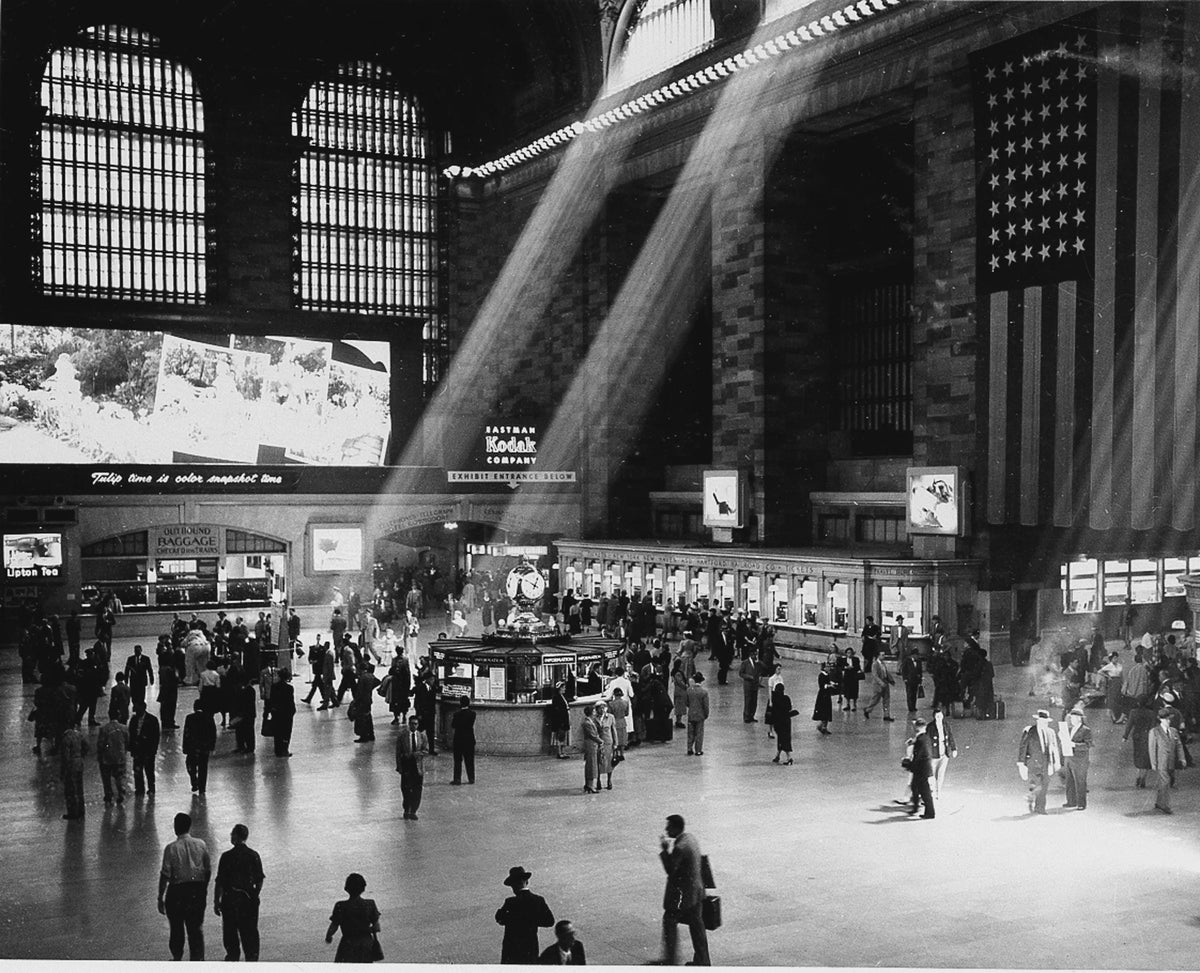
The New York Central traces itself back to an 1853 consolidation of a chain of small upstate New York railroads, later folded together with Cornelius Vanderbilt's Hudson River Railroad to become one of the great Vanderbilt-controlled trunk lines of the American rail age. From its seat at Grand Central Terminal in Manhattan, the NYC built out a web of track linking New York and Boston westward to Chicago, with major stops at Cleveland, Cincinnati, Detroit, and St. Louis along the way — the "Water Level Route," as its own advertising loved to call it, tracing the Hudson and the Great Lakes rather than climbing mountain grades the way its great rival, the Pennsylvania Railroad, was forced to do. Old railroad hands still speak of the 20th Century Limited, the NYC's flagship overnight express between New York and Chicago, with its red carpet rolled out for boarding passengers and a reputation for speed and glamour that made it a genuine cultural touchstone of mid-century American travel — a train that showed up in movies, in advertising, in the daily imagination of a country that still measured status by which train you rode.

The text engraved right into this bond's seal — "Consolidated Dec. 23, 1914" — points to a real and well-documented corporate event: the reorganization that formally merged the New York Central and Hudson River Railroad with a long list of affiliated and leased lines across Pennsylvania, New York, Ohio, Michigan, Indiana, and Illinois into the single unified corporation named on this certificate. That 1914 date belongs to the company's history, not to this bond itself, which was printed decades later — but it's the very consolidation that gave the New York Central Railroad Company its legal identity, the one whose name and seal you see engraved here.

The company's fortunes, like those of most Northeastern trunk lines, turned hard in the decades after the Second World War. Automobiles, long-haul trucking, and the rise of commercial air travel all chipped away at the passenger and freight business that had once made railroads the undisputed kings of American transportation. In 1968, the New York Central merged with its longtime rival the Pennsylvania Railroad to form the Penn Central Transportation Company — ending, after well over a century, the independent life of the New York Central name. Penn Central's collapse into bankruptcy in 1970 was, at the time, the largest corporate bankruptcy in American history, and it set off a chain of federal intervention that reshaped the industry: Amtrak took over intercity passenger rail in 1971, and Conrail was formed in 1976 to absorb the freight operations of Penn Central and other failed northeastern carriers. Which makes this bond's printed 1980 maturity date a small piece of irony sitting right there in the engraving — a promise stretched out to a due date the New York Central Railroad Company itself would never see arrive as an independent company.


💰 What a Collateral Trust Bond Actually Was

A collateral trust bond was a specific and common tool in early-to-mid 20th-century railroad finance — rather than being secured directly against track, rolling stock, or real estate, this type of bond was backed by other securities (stocks and bonds of subsidiary or affiliated companies) pledged to a trustee bank, in this case named on the certificate as the Second Bank-State Street Trust Company.

Large railroad holding structures, with their webs of leased lines and controlled subsidiaries, leaned on this instrument heavily, and the trustee's certificate of authentication printed on the bond — signed by an authorized officer and attested by an assistant secretary — was the formal guarantee that the bond had actually been issued under the terms of the governing indenture.

The coupon sheet running down the side of the certificate was the practical, everyday mechanism of collecting that interest: twice a year, on the printed date, the bearer would present a coupon and be paid, then clip it free from the sheet. Collectors today prize bonds like this precisely because that coupon sheet survives — a visual ladder of history running from the early 1970s up toward 1980, each little engraved note a snapshot of a payment that, in this case, was likely never made on the terms originally intended, given how the company's fortunes turned out.


🏙️ New York City and the Age of Engraved Paper

This bond was issued out of New York City, the financial and corporate capital where the New York Central kept its offices and where its bonds and stock certificates were transacted at the office or agency named right on the document, in the Borough of Manhattan. It's worth remembering that a security like this wasn't simply printed — it was engraved, by specialist firms like Security Banknote Company, using the same intaglio steel-plate methods and fine-line lathe work that protected currency itself from counterfeiting.

Old-timers in the scripophily hobby — the collecting of historic stock and bond certificates — talk about this era of American finance as something of a golden age for this kind of paper: railroads, canal companies, and industrial trusts commissioning artwork every bit as elaborate as a banknote, because the engraving itself was the security feature.

Collectors say the allegorical figures that turn up again and again on bonds like this one — commerce, industry, and progress personified as classical female figures surrounded by trains and ships — were a deliberate visual language of the era, meant to project permanence and trustworthiness to anyone who held the paper in their hands.


📜 The Legacy Today

The New York Central name itself didn't survive past its 1968 merger, but its bonds, stock certificates, and timetables have become a genuine specialty within the broader scripophily and railroadiana collecting worlds. Pieces like this one are sought after not for any lingering financial claim — that ended long ago — but as tactile, beautifully engraved artifacts of an American railroad giant at the peak of its corporate life, printed just as the postwar highway and jet age were quietly beginning to erode the empire it represents.


🖼️ Display Ideas

  • 🚆 Frame it alongside vintage railroad timetables or photographs for a den or home office with a transportation theme
  • 🏢 Hang it in a finance or business office as a conversation-starting piece of Wall Street-era history
  • 🗽 Pair it with other New York City ephemera for a themed collection celebrating the city's commercial history
  • 📚 Display it flat under glass in a library or study, letting the engraved vignette and coupon column take center stage
  • 🎓 Give it as a milestone gift to a finance professional, economics student, or railroad enthusiast
  • 🖋️ Group it with other scripophily pieces — bonds, stock certificates, banknotes — for a rotating gallery wall of American financial history

🎁 Who Collects These

Scripophily collectors chase New York Central material specifically because the company's name, its Vanderbilt pedigree, and its dramatic fall into the Penn Central bankruptcy give these bonds a story that a plain stock certificate from a lesser-known company simply doesn't carry. Railroad history buffs want them for the same reason train photographers chase old depots — this is the paper trail of an empire that ran the rails between New York and Chicago for well over a century. Finance and business history fans are drawn to the engraving craft itself, and to the collateral trust structure as a real artifact of how American infrastructure was financed before public capital markets looked anything like they do now. And plenty of buyers simply want a strikingly engraved, oversized historical document to frame — something that reads as substantial and authentic the moment it's hung on a wall.


❓ FAQ

Is this bond still financially valid — can it be redeemed?

No. This is sold strictly as a historical collectible. The New York Central Railroad Company ceased to exist as an independent company in 1968, and bonds of this series carry no financial claim today.

What is a collateral trust bond, exactly?

It's a bond secured not by direct company property but by other securities pledged to a trustee bank — a financing structure widely used by large railroad holding companies of this era, with the trustee named right on the certificate.

Why does it have a whole sheet of coupons attached?

The coupon sheet was the original mechanism for collecting semi-annual interest — bondholders would clip and present each dated coupon to the paying agent as it came due, working through the sheet year by year toward the bond's maturity date.

Coupons were made to be clipped away, and most bonds of this age lost theirs one payment at a time until only the certificate was left, so a sheet that came through the decades still attached is the exception rather than the rule. When a road went under, holders commonly taped the last coupon back onto the bond and held on in hope of collecting what they were owed, so a bond that still carries that taped final coupon is the better one to end up with. The coupon count can run a few more or a few fewer than what is pictured.

Who printed this bond?

Security Banknote Company, one of the specialist security-printing houses of the era that produced steel-engraved intaglio financial certificates using the same exacting techniques applied to currency.

What happened to the New York Central Railroad?

It merged with its longtime rival, the Pennsylvania Railroad, in 1968 to form Penn Central, which collapsed into bankruptcy in 1970 — a turning point that eventually led to the creation of Amtrak and Conrail.

What size is the bond, and is it good for framing?

It measures 15 x 10 inches, a substantial size that gives the engraved vignette, lettering, and coupon column plenty of presence when matted or framed.

Is the condition graded?

This is an original issued bond, punch-cancelled when it was retired, offered as an excellent example of mid-century American railroad security engraving and financial history.

These are issued instruments rather than blanks. Bonds and debentures of this type were registered to a holder, authenticated by the trustee, and punch- or cut-cancelled when they were finally redeemed. Expect financial writings, markings, stamps, hole punches and staple holes as part of the life of the instrument: endorsements and signatures, trustee and registrar stamps, revenue or documentary tax stamps, cancellation punches, staple holes from being bound into a transfer book, pencil ledger notations. That is the paper trail of a security that actually did its job, and it is what separates a document that lived from a blank that never did. No two are alike: holder details, serial numbers, dates, signatures, stamps and punch patterns vary from example to example, so the photographs show the type rather than the exact sheet that ships. The coupon count can run a few more or a few fewer than pictured.

Shipping

🚚 Shipping & Handling

  • Shipping costs and timing are calculated at checkout.
  • Items curated and shipped directly by me include U.S. shipping at no additional cost, professionally packed to ensure safe arrival of your artifact.

Items from Vetted Pro Collectors
Shipping for items offered by vetted Pro Collectors is determined at checkout. All Pro Collector listings are reviewed to ensure fair, reasonable shipping practices.

For full details, please refer to our Shipping Policy.

Returns & Exchange

Take your time — you've got a full six months. If a piece isn't right for you, send it back the way it reached you and we're good.

In the first 30 days your money goes straight back the way you paid. After that it's store credit, so you can put it toward something you'd rather have.

Return shipping we sort out between us, case by case. I don't make this difficult.

If something arrives damaged, or it isn't what I said it was, send me a photo within 48 hours and I'll make it right.

Email info@vintageantiquesgifts.com or call 802-356-9872 — that's me answering, not a call center.

The only things I can't take back are custom or special-order pieces and gift cards.

View full details
  • 5 stars: 1 (100%)
  • 4 stars: 0 (0%)
  • 3 stars: 0 (0%)
  • 2 stars: 0 (0%)
  • 1 star: 0 (0%)
7
7***3 (122)

Excellent service and fast delivery would do business again and package was well secure and the shipping costs are great and the item was as described in the description