Skip to product information
1 of 10

Vintage and Antique Gifts

Vintage 1955 New York Central Railroad $1,000 Bond 🚂 Collateral Trust 6% Due 1980, Coupon Sheet Attached, Scripophily

Vintage 1955 New York Central Railroad $1,000 Bond 🚂 Collateral Trust 6% Due 1980, Coupon Sheet Attached, Scripophily

Regular price 13.00 USD
Regular price Sale price 13.00 USD
Sale Sold out
Shipping calculated at checkout.
Quantity

What if a single sheet of paper once promised to help keep the New York Central's trains running clear from Grand Central Terminal to the shores of Lake Erie? 🚂

There's a particular kind of green that only lives on mid-century railroad bonds — a deep, confident emerald, the color of old money and older ambition. Hold one of these up and you're not just holding a canceled financial instrument, you're holding the paper promise of a company that once ran ten thousand miles of track, whose name was etched into the skyline of Manhattan itself, and whose engineers knew every curve of the Hudson River by heart. This is that promise, printed, engraved, and dressed up in allegorical splendor — and it's been sitting quietly in my collection waiting for someone who feels the same pull toward railroad history that I do.

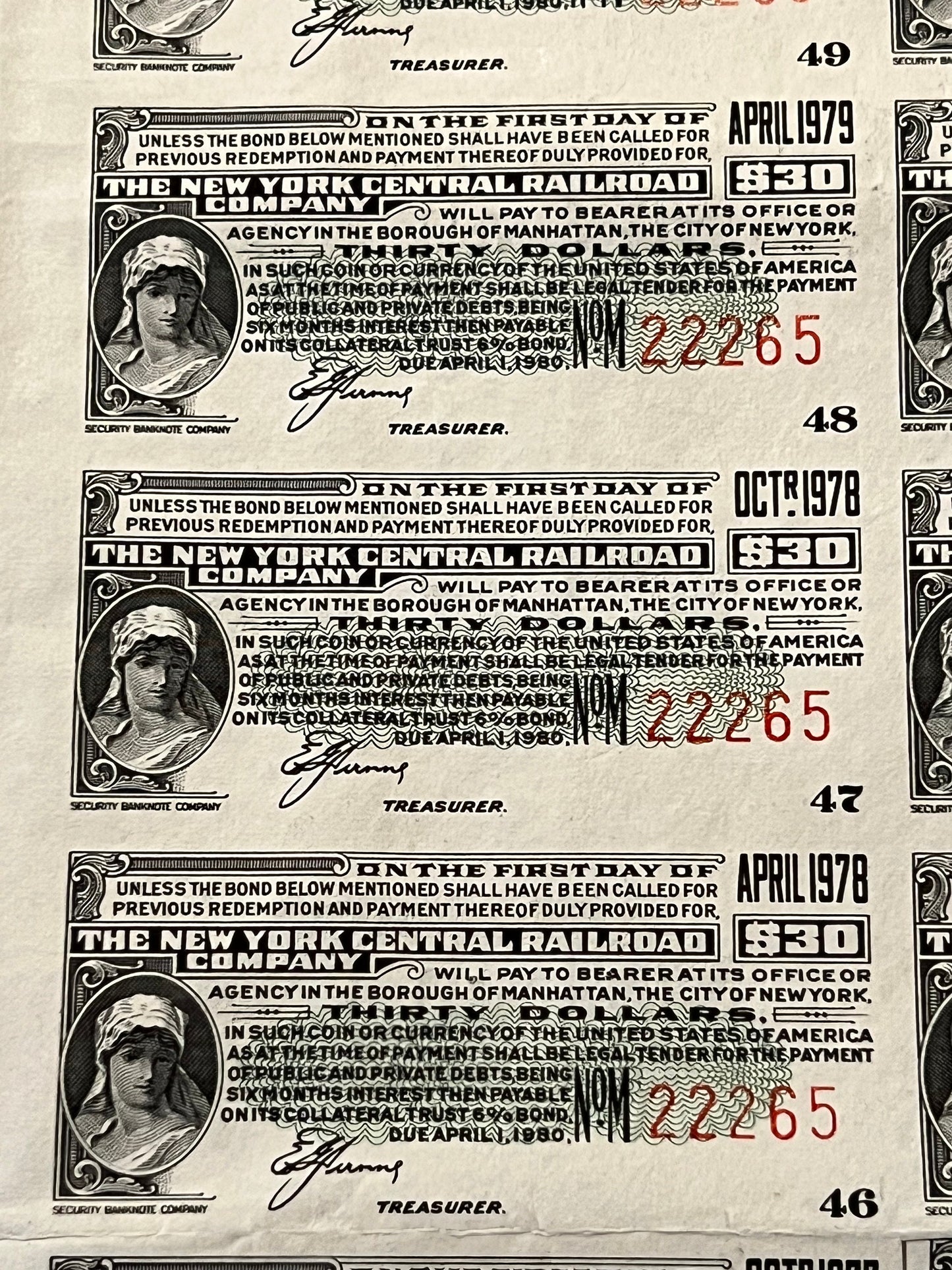
This is a large-format New York Central Railroad Company Collateral Trust 6% Bond, issued in the $1,000 denomination, measuring a substantial 15 x 10 inches (about 38 x 25.5 cm) — genuinely poster-sized for a financial document, and printed to be looked at, not just filed away. The certificate is a genuine issued bond, punch-cancelled through the face when it was retired and preserved ever since. Across the top, twin "$1000" medallions flank a breathtaking central vignette: a classically draped allegorical woman — Progress, or perhaps Commerce herself — seated atop the world, one hand resting on a globe turned to show the Americas, framed by a steam locomotive on one side and a sleek streamlined diesel engine on the other, with a riverboat, a swing bridge, and a distant city skyline filling out the background. It's a remarkable piece of engraving, compressing the entire arc of American transportation — steam to diesel, riverboat to rail — into one dense, gorgeous panel, all wrapped in an ornate green scrollwork border with the interlocking "NYC" monogram anchoring the center. Below, in bold engraved lettering, the bond identifies itself as a New York Central Railroad Company Collateral Trust 6% Bond, and running down the side of the sheet is a column of small dated interest coupons, each one a miniature repeat of the same locomotive imagery, meant to be clipped twice a year by whoever held the bond.


🚉 A Railroad Built to Rival an Empire

The New York Central didn't start as one railroad at all — it started as ten. Back in 1853, ten small lines running parallel to the old Erie Canal between Albany and Buffalo were consolidated into a single company, and the earliest of those roads, the Mohawk and Hudson, holds the distinction of being New York State's very first railway, dating back to 1831. The man who pulled the consolidation together was Erastus Corning, a four-time mayor of Albany who had already spent twenty years running one of the constituent lines, and who stayed on as president of the newly formed New York Central until 1864. Because of Corning, Albany became the railroad's mechanical heart — the company's primary repair shops sat on 300 acres at West Albany, complete with a classification yard and even livestock pens, and those shops remained the Central's backbone facility clear through the end of steam operations.

Then came the Vanderbilts. In 1867, Cornelius Vanderbilt famously fought his way into control of the company, merging it with his own New York and Hudson lines running down to Manhattan, then adding the Lake Shore and Michigan Southern, the Michigan Central, and eventually the West Shore and Buffalo Railroad under his son William. By 1900, with the addition of the Boston & Albany, the New York Central had grown into a genuine empire — 10,000 miles of rail stretching from Boston and Montreal to Chicago and St. Louis, one of the most powerful corporations in the entire country.


🏙️ The Address Above Grand Central

The New York Central's headquarters sat directly above its own crown jewel — Grand Central Terminal — in the building now known as the Helmsley Building on Park Avenue. That address alone tells you everything about the company's stature: this wasn't a regional line, it was a railroad whose front door was one of the most famous train stations on earth. From that address the Central ran its flagship, the Twentieth Century Limited, a legendary 16-hour express between Grand Central and Chicago's LaSalle Street Station that began service in 1902 and became shorthand for luxury rail travel — red carpet literally rolled out for boarding passengers — right up until 1967. Decades earlier, in 1893, the Central had already made headlines of a different kind: its Empire State Express, pulled by the now-famous locomotive No. 999, hit 112 miles per hour and was declared the fastest land vehicle in the world. Old railroad hands still tell that story with a note of pride, as if the record still belonged to them.


📆 1955 — The Year Everything Started to Turn

Bonds of this style and denomination were part of a Collateral Trust 6% series carrying a due date of April 1, 1980, and this particular series arrives at a genuinely pivotal moment in the company's story. Just the year before, in 1954, financier Robert R. Young had won control of the New York Central in one of the era's most talked-about corporate proxy fights, and he installed Alfred E. Perlman as president — Perlman would turn out to be the last man to ever hold that title at the New York Central. Perlman set to work trimming costs and modernizing operations, and by most accounts he left the Central in noticeably better financial shape than its old rival, the Pennsylvania Railroad. It's a detail that collectors of railroad scripophily love to point out: merger talk between the Central and the Pennsylvania — the deal that would eventually reshape American railroading entirely — was already being discussed as early as 1955, the very year this bond series was issued. Whoever first held a bond like this was investing in the Central at the exact hinge point between its Vanderbilt-built past and the turbulent decade that lay ahead.


🛤️ The Long Decline and the Merger That Followed

Postwar America was hard on the passenger railroad. Between 1946 and 1958, the Central dropped four of its six daily fast passenger runs between New York and Chicago, as automobiles, buses, and — soon — the new interstate highways authorized under the 1956 Federal-Aid Highway Act ate into the traffic that had once been the railroad's bread and butter. Perlman himself would later testify that without dramatic action, the Central's ability to compete would "continue to decline to the point of ineffectiveness," and in 1962 shareholders of both the New York Central and the Pennsylvania Railroad voted to merge. The deal finally closed on February 1, 1968, forming Penn Central — technically an acquisition of the Central by the Pennsylvania — and the following year the struggling New York, New Haven and Hartford Railroad was folded in as well.

What happened next is one of the most dramatic collapses in American corporate history: barely two and a half years after the merger, Penn Central filed for bankruptcy on June 21, 1970 — at the time, the largest bankruptcy the country had ever seen, brought down by a combination of incompatible corporate cultures, duplicated infrastructure, the flight of heavy industry from the Rust Belt, and the costly absorption of the bankrupt New Haven line. The federal government stepped in, and Conrail was formed to absorb the wreckage of Penn Central along with six other failed railroads, beginning operations in 1976. Conrail itself was eventually split between CSX Transportation and Norfolk Southern in 1999 — the final chapter in a lineage that began with Erastus Corning's ten little railroads along the Erie Canal.


🌆 What Remains Today

Here's the part that still gives me chills: the New York Central's old Water Level Route between New York and Chicago, hugging the Hudson and the Great Lakes just as it did in the age of steam, is still in daily use today — carrying Amtrak passengers and freight over rails first laid down by a railroad that no longer exists on paper but never really left the landscape. Grand Central Terminal still stands, the Helmsley Building still crowns Park Avenue, and collectors quietly agree that pieces like this bond are some of the last tangible fragments of a company whose name once meant something enormous in American life. Lore passed down among scripophily collectors holds that these Collateral Trust bonds, with their long coupon sheets still intact, were often kept by employees and small investors as keepsakes long after the underlying debt was retired — framed mementos of a paycheck, a pension, or simply a hometown railroad worth believing in.


🖼️ Display Ideas

  • 🚂 Frame the full sheet — bond and coupon column together — as a single wide statement piece for a home office or den
  • 🏙️ Pair it with a vintage map of the New York Central system to tell the "empire built along the Hudson" story visually
  • 📚 Tuck it into a library or study alongside other Americana and financial ephemera for a curated collector's-corner look
  • 🛤️ Hang it in a model railroad room as a grown-up companion piece to the layout below
  • 💼 Mount it in a shadow box near a rail pass, timetable, or other Grand Central Terminal memorabilia
  • 🎨 Let the engraved vignette stand alone as art — the allegorical figure and locomotives hold their own even out of financial context

🎁 Who Collects These

Scripophily collectors — people who specifically seek out old stock and bond certificates for their artwork and history — are drawn to New York Central material as some of the most visually rich in the entire hobby. Beyond that dedicated crowd, this piece speaks to railroad enthusiasts who want a genuine Grand Central-era artifact, fans of New York and Albany history tracing the Vanderbilt and Corning legacy, students of American business history interested in the Penn Central story, and anyone furnishing an office, library, or train room who wants a large, engraved, conversation-starting piece of the past on the wall.


❓ FAQ

Is this an original bond or a reproduction?

This is an original, issued New York Central Railroad Collateral Trust 6% Bond certificate, cancelled at the end of its working life.

Does it still have value as a financial instrument?

No — bonds like this are long since matured and canceled as debt instruments. They're collected today purely for their engraved artwork and their connection to New York Central Railroad history.

What size is the certificate?

The full sheet, including the attached coupon column, measures 15 x 10 inches (about 38 x 25.5 cm) — large enough to be a genuine framed statement piece.

Are the interest coupons still attached?

Each certificate includes its printed coupon sheet, part of the original engraved design, giving the piece extra visual texture beyond the main bond panel.

Coupons were made to be clipped away, and most bonds of this age lost theirs one payment at a time until only the certificate was left, so a sheet that came through the decades still attached is the exception rather than the rule. When a road went under, holders commonly taped the last coupon back onto the bond and held on in hope of collecting what they were owed, so a bond that still carries that taped final coupon is the better one to end up with. The coupon count can run a few more or a few fewer than what is pictured.

What does the imagery on the bond depict?

An engraved allegorical figure seated on a globe, flanked by a steam locomotive and a streamlined diesel engine, with a riverboat, bridge, and city skyline in the background — a compact visual history of American transportation framed by the interlocking NYC monogram.

Why is 1955 significant for New York Central history?

It falls right at the moment Robert R. Young and president Alfred E. Perlman took the helm of the company and merger discussions with the rival Pennsylvania Railroad — the deal that would eventually reshape the entire industry — first began.

Is every certificate identical?

Each is a genuine example of this New York Central Railroad Collateral Trust bond series, sharing the same engraved design, denomination, and printed history described here.

These are issued instruments rather than blanks. Bonds and debentures of this type were registered to a holder, authenticated by the trustee, and punch- or cut-cancelled when they were finally redeemed. Expect financial writings, markings, stamps, hole punches and staple holes as part of the life of the instrument: endorsements and signatures, trustee and registrar stamps, revenue or documentary tax stamps, cancellation punches, staple holes from being bound into a transfer book, pencil ledger notations. That is the paper trail of a security that actually did its job, and it is what separates a document that lived from a blank that never did. No two are alike: holder details, serial numbers, dates, signatures, stamps and punch patterns vary from example to example, so the photographs show the type rather than the exact sheet that ships. The coupon count can run a few more or a few fewer than pictured.

Shipping

🚚 Shipping & Handling

  • Shipping costs and timing are calculated at checkout.
  • Items curated and shipped directly by me include U.S. shipping at no additional cost, professionally packed to ensure safe arrival of your artifact.

Items from Vetted Pro Collectors
Shipping for items offered by vetted Pro Collectors is determined at checkout. All Pro Collector listings are reviewed to ensure fair, reasonable shipping practices.

For full details, please refer to our Shipping Policy.

Returns & Exchange

Take your time — you've got a full six months. If a piece isn't right for you, send it back the way it reached you and we're good.

In the first 30 days your money goes straight back the way you paid. After that it's store credit, so you can put it toward something you'd rather have.

Return shipping we sort out between us, case by case. I don't make this difficult.

If something arrives damaged, or it isn't what I said it was, send me a photo within 48 hours and I'll make it right.

Email info@vintageantiquesgifts.com or call 802-356-9872 — that's me answering, not a call center.

The only things I can't take back are custom or special-order pieces and gift cards.

View full details
  • 5 stars: 3 (100%)
  • 4 stars: 0 (0%)
  • 3 stars: 0 (0%)
  • 2 stars: 0 (0%)
  • 1 star: 0 (0%)
J
John (Montvale, US)
NY Central Bond Certificate

Excellent condition , as described. Great piece of history. Shipped out same day, thanks.

M
Miguel Lopez

Beautiful purchase, great experience as always, this has to be the best etsy shop ive bought stuff from, they write the best heart filled letters to their customers which i really appreciate, God Bless this Family and their Father ❤

H
Hillary

This is interesting. Thank you

Hello Hillary! Thank you for the fabulous 5-star review. It's heartwarming to learn that the 1955 New York Central Railroad Gold Bond Certificate brought joy to you. Your support keeps the vintage spirit alive and flourishing in our community. We can't wait to serve you again!