Skip to product information
1 of 3

Vintage and Antique Gifts

Antique 1923-1924 Oklahoma City Building & Loan Stock Certificate 🏠 Homes Make Happiness, Globe Vignette

Antique 1923-1924 Oklahoma City Building & Loan Stock Certificate 🏠 Homes Make Happiness, Globe Vignette

Regular price 7.00 USD
Regular price Sale price 7.00 USD
Sale Sold out
Shipping calculated at checkout.
Quantity

What Did It Mean to a Family in 1920s Oklahoma City to Hold a Piece of Paper Like This? 🏦

Long before FHA loans, before 30-year fixed mortgages, before a bank on every corner offered a home loan over the counter, ordinary families built their futures one small deposit at a time through a building and loan association. A nickel here, a dollar there, a share of installment stock purchased on faith that steady saving would eventually become a roof overhead. This certificate is a survivor of that world — a genuine piece of paper that once represented a real family's real stake in The Oklahoma City Building & Loan Association, an institution that helped turn a raw prairie boomtown into a city of homeowners.

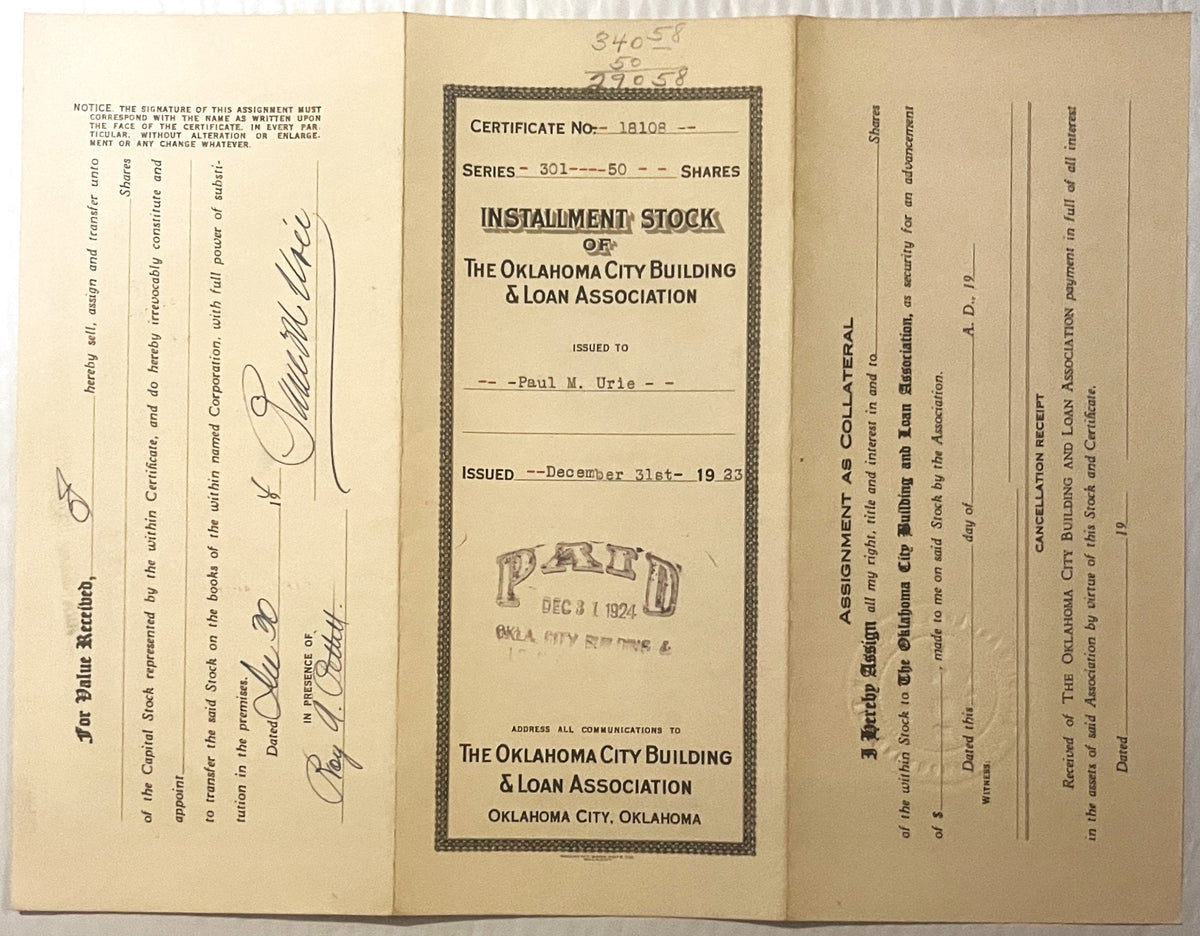
What you're looking at is an Installment Stock certificate issued by The Oklahoma City Building & Loan Association of Oklahoma City, Oklahoma, dating to the early-to-mid 1920s — the printed issue dates found on surviving examples of this series fall in 1923 and 1924, right in the thick of the association's most active building years.

Measuring a substantial 12 x 8 inches (roughly 30.5 x 20 cm), this is a large, formal document, printed on sturdy sepia-toned stock with dense black engraved ink and rich brown accent shading — the kind of heavy, dignified paper stock reserved for legal and financial instruments of the era. The border is a wall of Victorian-to-Deco ornamental scrollwork, tight geometric bandwork, and floral corner medallions framing the whole certificate like a picture frame in its own right.

Across the top, bold gothic-revival lettering spells out THE OKLAHOMA CITY BUILDING & LOAN ASSOCIATION, its letters shadowed and shaded to look almost three-dimensional against the aged paper. Front and center sits the certificate's most striking feature: an engraved globe vignette showing North America wrapped in a banner reading "HOMES MAKE HAPPINESS" — the association's motto, cast in relief against a bank of stylized clouds that billow out across the entire width of the certificate.

An embossed corporate seal presses its raised impression into the paper near the signature lines, and the document is completed in period ink with the engraved signature lines of the association's president and secretary. Certificates in this series were genuinely issued and put to work — filled out to a named shareholder, sealed, and signed — and many carry the further evidence of a life actually lived: an attached assignment and collateral stub, a rubber-stamped "PAID" notation marking a matured obligation, and a handwritten transfer signature where a shareholder once assigned their shares to another party.

This is not a blank specimen sitting untouched in a printer's drawer — it is a document that did exactly the job it was engraved to do.

This kind of certificate can collect a paper trail the way any real financial document does: things like endorsements or signatures on the back, a transfer-agent or registrar stamp, a revenue or documentary tax stamp, a punch or cut cancellation, a staple hole from a bound stock book, or a pencil ledger notation. Read that way, marks like these are not a knock against the piece — they are part of its story.


🏦 The Association That Helped Build a City

The Oklahoma City Building & Loan Association wasn't a Johnny-come-lately outfit riding a real estate boom — it was organized in 1898–1899, making it the very first building and loan association in Oklahoma City, founded barely a decade after the Land Run of 1889 had planted the townsite in the first place. In a city that had sprung up almost overnight out of the unassigned lands, there was no deep well of old banking capital to draw on. What Oklahoma City had instead was ambition, hard work, and a lot of families who wanted to own the ground under their own feet. Building and loan associations like this one were the mechanism that made that possible — cooperative savings institutions where members bought "installment stock" in regular payments, and the pooled capital was lent back out to members to build or buy homes.

The association's first president was Anton H. Classen, a name that looms large over early Oklahoma City history. Classen wasn't just a building and loan executive — he was one of the central architects of the city itself. He developed entire residential districts on the city's north side (the boulevard that still bears his name, Classen Boulevard, is his direct legacy), championed the extension of streetcar lines out into those new neighborhoods so families could actually live in the homes his association helped finance, and pushed hard for paved city streets at a time when Oklahoma City's roads were still largely dirt.

He led the Oklahoma City Commercial Club, the forerunner of today's Chamber of Commerce, and used that platform to promote the city aggressively — organizing street fairs, boosting civic pride, and even helping bring Theodore Roosevelt's Rough Riders reunion to Oklahoma City in 1900, a genuine national spotlight moment for a town not yet out of its infancy.

Classen was also instrumental in helping finance the Methodist-affiliated Epworth University, the institution that would eventually grow into what we know today as Oklahoma City University. In other words, the man whose association issued this certificate spent his career building the roads, the rail lines, the schools, and the neighborhoods that this very same certificate helped finance one household at a time.

It's a rare thing to hold a piece of paper connected so directly to the person who quite literally laid out the map of a city.


🌍 "Homes Make Happiness" — Reading the Globe Vignette

Take a close look at the engraved globe at the certificate's center. It isn't decoration for decoration's sake — vignette imagery like this was the visual shorthand nineteenth and early-twentieth-century engravers used to sell an institution's whole philosophy in a single glance. Here, a full globe of the Earth is wrapped diagonally by a ribbon banner bearing the association's motto, "HOMES MAKE HAPPINESS," positioned directly across North America. The message is unmistakable: homeownership wasn't framed here as a mere transaction, it was framed as a universal human good, on the scale of the whole world. That kind of imagery was common currency among building and loan associations of the period, which liked to position themselves not simply as lenders but as institutions with a mission — helping working families put down roots, in the belief that a family that owned its own home was a happier, steadier, more invested member of the community. The clouds billowing around the lettering and the ornate scrollwork bracketing the whole vignette give the certificate a lofty, almost aspirational feel — this was meant to look and feel like something worth saving toward.


🏙️ Oklahoma City in the Building & Loan Era

To understand why a document like this mattered, it helps to picture the Oklahoma City this association was operating in. The city had been founded in a single, chaotic day — the Land Run of April 22, 1889, when tens of thousands of settlers raced onto unclaimed land to stake their claims by nightfall. Within a generation, that raw townsite had exploded into a genuine metropolis, driven by railroads, cattle, cotton, and eventually oil.

By the 1920s, Oklahoma City was in the thick of an extraordinary building boom — new residential additions were being platted constantly, streetcar lines were pushing neighborhoods further from downtown, and a rising middle class of clerks, merchants, and tradesmen wanted in on the American ideal of home ownership. Building and loan associations were the financial engine that made that possible for ordinary families who had no other route to a mortgage.

Local legend around Oklahoma City still credits men like Classen with quite literally drafting the shape of the modern city — his fingerprints are on the boulevards, the streetcar routes, and the neighborhoods that grew up around institutions exactly like this one. It's easy to imagine a young family in this era, having just paid off their final installment on a block of stock like this, standing on the porch of a brand-new bungalow in one of Classen's additions and feeling, quite literally, that homes make happiness.


💰 How Installment Stock Actually Worked

Certificates like this one weren't stock in the modern sense of a publicly traded company you'd buy for dividends and resale. Installment stock in a building and loan association functioned more like a structured savings plan. A member subscribed for shares — each carrying a par value printed right on the certificate — and paid into that stock in regular installments over time.

As the pool of members' payments grew, the association lent that capital back out, primarily as home loans to its own membership, on the theory that everyone's savings were, indirectly, building everyone else's houses. Once a member's shares matured — meaning the installments plus accumulated earnings equaled the certificate's full face value — the stock was considered "paid" and the shareholder could redeem it, often using the value as the down payment or full purchase price on a home, or as collateral against a loan.

That's precisely the mechanism reflected in the printed language on the reverse of certificates like this one: sections for assignment, for using the stock "as collateral" for an advancement, and for a formal cancellation receipt once the obligation was settled. The association's printed capital stock figure of $25,000,000 gives a sense of just how large-scale this cooperative savings machine had grown by the 1920s — thousands of small family accounts, pooled into a fund big enough to bankroll a genuine city-building boom.


📜 A Document That Did Its Job

What makes certificates in this series so compelling to hold today isn't just the engraving — it's the evidence of real use stamped and written across them. Many surviving examples carry a rubber-stamped "PAID" notation, applied the following year, marking the moment a shareholder's installment stock matured and the obligation was satisfied in full. Others show the assignment portion completed in period ink, a shareholder's own handwritten signature transferring their shares — sometimes to another individual, sometimes pledged back to the association itself as collateral for a loan. These aren't decorative flourishes; they're the actual financial life of a family recorded directly on the document, decade after decade, exactly the way it was designed to be used. The dense engraved border, the shaded lettering, and the raised embossed corporate seal are the marks of a company that took its printed instruments seriously — this was meant to look every bit as trustworthy and permanent as a banknote, because in a very real sense, for the family who held it, that's exactly what it was.


🏛️ From Building & Loan to Federal Savings

Institutions like The Oklahoma City Building & Loan Association didn't simply vanish when the building and loan model itself evolved through the twentieth century — many were absorbed into or reorganized as the savings and loan institutions that would come to define American home lending for the rest of the century, with the historical thread of this association eventually running into what became known as Oklahoma City Federal Savings & Loan. That evolution mirrors the story of the entire American thrift industry: cooperative, member-owned building and loan associations gradually consolidated and federalized, eventually giving rise to the savings and loan institutions that dominated home financing well into the later 1900s. A certificate like this one sits right at the root of that whole family tree — a tangible artifact from the very earliest chapter of organized American home finance, printed in a Oklahoma City just a generation removed from the Land Run itself.


🖼️ Display Ideas

  • 🖼️ Frame it as a stand-alone piece of Oklahoma history for a home office, study, or library wall
  • 🏡 Pair it with other Oklahoma City ephemera — postcards, maps, or photographs — for a themed gallery wall on the city's boomtown years
  • 💼 Display it in a real estate office, mortgage brokerage, or title company as a conversation-starting nod to the roots of home lending
  • 🎓 Hang it alongside Oklahoma City University memorabilia, tying back to Anton Classen's role in founding Epworth University
  • 📚 Use it as an anchor piece in a collection of American financial ephemera — stocks, bonds, and building and loan certificates from across the country
  • 🎁 Give it as a meaningful gift to someone with Oklahoma City roots, a genealogy connection to the area, or a fascination with early American home finance

🎁 Who Collects These

Collectors of scripophily — the hobby of collecting antique stocks and bonds — prize building and loan certificates precisely because they capture a financial world that's now entirely gone: cooperative, community-funded home lending, run out of a local office by men whose names are still on the street signs. Oklahoma City history buffs and genealogists researching family ties to the early city seek these out for the direct link to figures like Anton Classen and the earliest wave of Oklahoma City development. Real estate professionals, mortgage brokers, and title companies like to display them as a nod to the roots of their own industry. And anyone drawn to the graphic art of early twentieth-century American engraving — the ornate borders, the allegorical vignettes, the confident gothic lettering — will find this certificate a striking example of commercial engraving at its most ambitious, worthy of a frame on its own merits.


❓ FAQ

What exactly is a Building & Loan installment stock certificate?

It's a savings-and-lending instrument from the era before conventional mortgage banking. A member purchased shares in the association and paid into them in installments; the pooled installment payments from all members funded home loans back out to the membership, and once a member's own shares matured to full value, the stock could be redeemed, often to buy or finance a home.

Who was Anton H. Classen and why does he matter to this certificate?

Classen was the first president of The Oklahoma City Building & Loan Association and one of the most influential figures in shaping early Oklahoma City — developing residential additions, championing streetcar expansion and street paving, leading the city's Commercial Club, helping bring the Rough Riders reunion to town in 1900, and helping finance the university that became Oklahoma City University.

What does the "Homes Make Happiness" globe design mean?

It was the association's motto, engraved as a banner wrapped around a globe centered on North America — a visual statement that homeownership was a universal good worth building an entire institution around, common imagery for building and loan associations of this period.

How large is the certificate and how should I display it?

It measures 12 x 8 inches (about 30.5 x 20 cm), a genuinely substantial document with a dense ornamental border and central vignette, well suited to framing as a stand-alone piece of wall art.

Is every certificate identical?

The engraved design, motto, vignette, and layout are consistent across the series, but each certificate was individually completed by hand for its own shareholder — meaning the name, share amount, series number, and issue date differ from one certificate to the next, making every surviving example its own unique piece of paper.

Did The Oklahoma City Building & Loan Association survive into modern banking?

The historical thread of the institution carried forward as building and loan associations across the country evolved into federally chartered savings and loan institutions, with this association's lineage eventually connected to Oklahoma City Federal Savings & Loan

Shipping

🚚 Shipping & Handling

  • Shipping costs and timing are calculated at checkout.
  • Items curated and shipped directly by me include U.S. shipping at no additional cost, professionally packed to ensure safe arrival of your artifact.

Items from Vetted Pro Collectors
Shipping for items offered by vetted Pro Collectors is determined at checkout. All Pro Collector listings are reviewed to ensure fair, reasonable shipping practices.

For full details, please refer to our Shipping Policy.

Returns & Exchange

Take your time — you've got a full six months. If a piece isn't right for you, send it back the way it reached you and we're good.

In the first 30 days your money goes straight back the way you paid. After that it's store credit, so you can put it toward something you'd rather have.

Return shipping we sort out between us, case by case. I don't make this difficult.

If something arrives damaged, or it isn't what I said it was, send me a photo within 48 hours and I'll make it right.

Email info@vintageantiquesgifts.com or call 802-356-9872 — that's me answering, not a call center.

The only things I can't take back are custom or special-order pieces and gift cards.

View full details