Skip to product information
1 of 7

Vintage and Antique Gifts

Vintage Strawberry Crush Soda Bottle Cap 🍓 Cork Lined Crown, 1960s

Vintage Strawberry Crush Soda Bottle Cap 🍓 Cork Lined Crown, 1960s

Regular price 7.00 USD
Regular price Sale price 7.00 USD
Sale Sold out
Shipping calculated at checkout.
Quantity

🍓 What Did Soda Pop Taste Like Before Anyone Asked What Was Actually In It?

Long before ingredient panels and "natural flavors" disclaimers became second nature, a soda cap just told you the truth in plain red letters: artificially colored and flavored. No apology, no fine print buried on the back — right there on the crown, staring up at you from the drugstore cooler. That kind of blunt, unbothered honesty is part of what makes a piece like this so much fun to hold. It's a tiny snapshot of a soda fountain era when a strawberry soda didn't need an actual strawberry anywhere near it to become somebody's favorite flavor at the corner store.

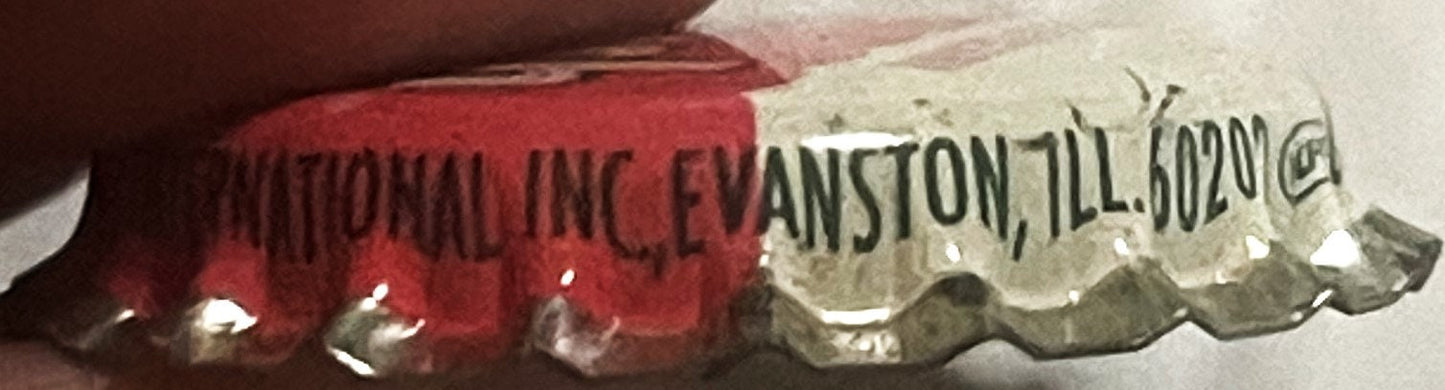
This is a Strawberry Crush bottle cap — a cork-lined crown from the brand's imitation strawberry soda, carrying the full mid-century Crush identity: bold white "Crush" script arched across a red scalloped field, "STRAWBERRY" stamped in red across the cream-colored crown, and the brand's ingredient declaration — "IMITATION STRAWBERRY SODA, ARTIFICIALLY COLORED AND FLAVORED, PRESERVED WITH 1/20 OF 1% SODIUM BENZOATE" — wrapped around the lower rim in tidy white lettering. Flip it, and the cork liner itself carries its own little surprise: a circular Crush logo and the word "CRUSH" stamped directly into the tan cork disc, a small branding touch that plenty of other soda caps from the same years skipped entirely. The crimped gold-and-silver skirt still holds its full scallop, and this piece is offered as New Old Stock (NOS) — a genuine, never-used survivor from a production run that never made it onto a bottle. Cork-lined crowns like this one place it in the window running from the 1950s into the 1960s, the last stretch of American soda history before cork liners quietly disappeared from bottling lines for good.


🧪 A Chemist, an Eye Injury, and an Orange Grove Dream

The Crush story starts with a Los Angeles chemist named Neil C. Ward, who'd lost the use of an eye in an explosion years earlier and found his way into the flavor and extract business almost by accident, through a job at a Los Angeles ice and cold storage company. Somewhere around the mid-1910s, working among the actual orange groves of Southern California, Ward perfected a fruit-flavored soda formula that would become Orange Crush — and the marketing leaned hard into that Southern California imagery, with early advertising boasting that the drink was "perfected in Los Angeles, in the midst of the beautiful orange groves." Ward stayed close to the company he helped build, eventually rising to company president in the early 1930s and remaining there until his death in 1939.

Here's a detail worth savoring: from its earliest days, the Crush company understood that a soda's appearance of authenticity mattered just as much as its taste. Old accounts describe how bottles of Orange Crush were given a visual boost with added pulp-like texture to suggest fresh-squeezed juice — a bit of harmless showmanship, no actual fruit required. So when your Strawberry Crush cap declares itself proudly "artificially colored and flavored," it isn't a confession — it's practically a company tradition, stated right out loud instead of hidden.


🤝 The Handshake That Named a Soda

Ward didn't build the company alone. He partnered with a businessman named Clayton J. Howel, who already had experience in the soft drink trade from an earlier venture of his own. Together they incorporated the company and, in keeping with the naming customs of the era — where a soda often carried its inventor's own surname right there on the label — the drink was first sold as "Ward's Orange Crush." Howel would go on to lead the company for decades, passing away in 1964, having watched his little citrus soda grow into a nationwide name with a whole family of fruit flavors following behind it, strawberry among them.


🎨 When Norman Rockwell Painted Soda Ads

Here's a fact that tends to stop collectors in their tracks: in the early 1920s, the Orange Crush company commissioned none other than Norman Rockwell to paint a dozen advertising illustrations promoting its three original flavors — orange, lemon, and lime. Long before Rockwell became a household name synonymous with Americana itself, he was putting his brush to work selling fruit soda to a thirsty postwar public. It's a small reminder of just how seriously soft drink companies of the era took their advertising — treating a bottle of soda pop as worthy of fine art, not just a jingle.


🏭 One Recipe, a Thousand Hometowns

What's easy to forget about a company like Crush is that it never bottled a single drop of its own soda. Crush was a syrup company — it manufactured the concentrated flavor extract, shipped it out across the continent, and left the actual bottling, carbonating, and capping to a sprawling network of independent local bottlers. By 1924, that network had already grown to roughly 1,200 bottlers across the United States and Canada, each one a small regional business mixing Crush syrup with carbonated water under license and slapping their own hometown name on the truck out front.

Old bottling ledgers tell some wonderful local stories from this arrangement. In Chemung County, New York, for instance, the Gardner Bottling Company on William Street in Elmira picked up the Orange-Crush license around 1919 and kept bottling it for roughly half a century — a single hometown operation quietly serving up "world-famous" soda under a licensed name for two generations. Multiply that story by a thousand towns, from small-town bottling works to big-city plants, and you start to understand why a Crush cap from this era could turn up almost anywhere — each one capped locally, even while the flavor itself traced back to that same Los Angeles formula.


🧢 The Cork Disc That Marks a Moment in Time

The crown bottle cap itself is one of the great unsung inventions of American industry — patented by William Painter back in 1892, and remarkably little-changed in basic form ever since. What has changed, and what makes this particular cap collectible in a very specific way, is the liner tucked up inside the crimped metal crown. Early crowns used a solid disc of cork; by around 1915, bottlers shifted to a composite liner made from pressed cork shavings — exactly the kind of tan, textured cork liner you'll find stamped with the Crush logo on this cap. That composite cork liner remained the industry standard for decades, right up until the mid-1950s, when plastic liners began replacing cork on bottling lines across the country, a changeover that played out gradually through the rest of that decade and into the 1960s until cork had all but vanished from the crown cap entirely.

That transition is exactly what lets a cap like this one be placed with confidence in the 1950s into the 1960s — cork liners simply weren't being manufactured much past that window. And the branded cork itself is a nice touch worth pointing out: not every bottler bothered stamping a logo into the liner underneath the metal crown. Whoever ordered this particular Crush cap wanted the brand identity doubled up — visible on the crown top, and again, quietly, on the cork disc most drinkers probably never gave a second glance.


🍶 From Krinkly Glass to the Big New Bottle

The bottle this cap once sealed went through its own visual evolution across the mid-century decades. Early Crush bottles were sold in a distinctive ribbed clear glass nicknamed the "Krinkly" bottle for its rippled texture. In 1937, the company introduced an amber version — the "Krinkly Brown" — before finally retiring the ribbed amber look altogether in 1955 in favor of a smoother, more modern silhouette the company itself marketed as simply "the Big New Bottle." A cap like this one would have topped off bottles somewhere along that same stretch of packaging history, part of a soda aisle that was constantly reinventing its look to keep pace with a changing decade.


🏢 A Brand That Outlived Its Founders

Both men behind Crush were gone well before the twentieth century finished with their creation — Ward in 1939, Howel in 1964 — but the brand they built kept moving through the hands of one American beverage giant after another. It passed through Consolidated Foods in the early 1960s, was purchased by Procter & Gamble in 1980, and changed hands again in 1989 when P&G sold its Crush International holdings to Cadbury Schweppes. It's a corporate journey that mirrors the whole shape of twentieth-century American soda business — regional syrup makers and independent bottlers gradually folding into ever-larger beverage conglomerates, the little hometown bottling plant becoming a footnote to a much bigger balance sheet.


🕰️ Why a Little Bottle Cap Still Matters

It's easy to walk past a bottle cap without a second thought — they were made by the millions, tossed in a jar by the register, or swept off a soda fountain counter without a thought. Old-timers who grew up in that era remember bottle caps as their own kind of currency: kids collected them, traded them, nailed them to boards for games, and used them for anything from tiddlywinks to makeshift checkers on a rainy afternoon. A cap wasn't trash — it was a tiny trophy from whatever flavor you'd just finished.

Today, that same disposability is exactly what makes a surviving cork-lined crown worth pausing over. These weren't built to last — they were built to be popped, tossed, and forgotten. A cap that instead sat unused, cork liner intact and never crimped down onto a bottle, is a small miracle of accidental preservation. It carries an entire vanished manufacturing process — the cork liner itself, a technology quietly phased out of American bottling for good — alongside a style of blunt, plainspoken food labeling that soft drink makers don't write anymore. Collectors of soda pop advertising and closed-crown bottle caps alike prize this kind of survivor precisely because it wasn't meant to survive at all.


🖼️ Display Ideas

  • 🧃 Group it inside a shallow shadow box alongside other vintage soda flavors for a mini soda-fountain wall gallery
  • 🪞 Set it in a small display stand or clear acrylic cap holder on an open shelf where the cork liner catches the light
  • 🧲 Mount it to a magnetic board with other vintage crowns for a rotating kitchen or bar display
  • 🍺 Tuck it into a vintage bottle cap collection case built for cataloguing crowns by brand and flavor
  • 🏡 Style it on a mid-century kitchen shelf next to other soda fountain and drugstore Americana
  • 🎁 Pair it with a full Crush flavor lineup as a themed gift for a soda pop or advertising collector

🎁 Who Collects These

This little crown speaks to several overlapping corners of the collecting world at once. Soda pop and beverage advertising collectors chase Crush material specifically, since the brand's early Rockwell-illustrated ad campaigns and colorful fruit-flavor lineup give it a reputation well beyond most regional sodas. Bottle cap and "closed crown" collectors — a hobby all its own — seek out cork-lined examples in particular, since the liner material marks a specific, closed chapter in bottling history. Americana and mid-century kitchen decorators love the bold red-and-white graphic design for exactly the reason it was made: it's cheerful, punchy, and instantly nostalgic. And plenty of buyers simply grew up loving strawberry soda and want a genuine piece of that flavor's own history sitting on a shelf.


❓ FAQ

Is this cap actually unused?

Yes — it's offered as New Old Stock (NOS), meaning it was never crimped onto a bottle and never entered circulation.

Why does the cork liner matter for dating this piece?

Cork liners were the industry standard inside crown caps for decades, but bottlers began switching over to plastic liners starting in the mid-1950s, with cork phased out almost entirely by the 1960s. A cork-lined cap like this one belongs squarely in that closing window.

Was Strawberry Crush a real strawberry soda?

No — like most fruit sodas of its era, it was artificially colored and flavored, exactly as the cap itself plainly states, with no actual strawberry content.

Did Crush make other fruit flavors besides orange?

Yes — the company built out a whole flavor lineup over the years including lemon, lime, grape, and strawberry, expanding well beyond its original orange soda roots.

Who invented Crush soda?

A Los Angeles chemist named Neil C. Ward developed the formula, partnering with businessman Clayton J. Howel to found the company that would carry the Crush name forward.

Why would a Crush cap not show a specific hometown or bottler?

Crush was a syrup company, not a bottler — it licensed its formula to hundreds of independent regional bottling plants across the country, so the actual bottling town varied enormously from one cap to the next.

What does the stamped design on the cork liner show?

The cork liner carries its own circular Crush logo and the word "CRUSH" impressed directly into the cork — a branding detail beyond just the printed crown top.

Shipping

🚚 Shipping & Handling

  • Shipping costs and timing are calculated at checkout.
  • Items curated and shipped directly by me include U.S. shipping at no additional cost, professionally packed to ensure safe arrival of your artifact.

Items from Vetted Pro Collectors
Shipping for items offered by vetted Pro Collectors is determined at checkout. All Pro Collector listings are reviewed to ensure fair, reasonable shipping practices.

For full details, please refer to our Shipping Policy.

Returns & Exchange

Take your time — you've got a full six months. If a piece isn't right for you, send it back the way it reached you and we're good.

In the first 30 days your money goes straight back the way you paid. After that it's store credit, so you can put it toward something you'd rather have.

Return shipping we sort out between us, case by case. I don't make this difficult.

If something arrives damaged, or it isn't what I said it was, send me a photo within 48 hours and I'll make it right.

Email info@vintageantiquesgifts.com or call 802-356-9872 — that's me answering, not a call center.

The only things I can't take back are custom or special-order pieces and gift cards.

View full details
  • 5 stars: 1 (100%)
  • 4 stars: 0 (0%)
  • 3 stars: 0 (0%)
  • 2 stars: 0 (0%)
  • 1 star: 0 (0%)
K
Kristin

It's perfect, just want I was looking for. Thank you!!! <3

Hi there! Thank you for your kind words! We're so glad our Rare Vintage 1950s Strawberry Crush Soda Cork Bottle Cap was just what you were looking for. It's always a pleasure to help our customers find exactly what they're looking for. Enjoy your new find!