Skip to product information
1 of 4

Vintage and Antique Gifts

Vintage 1960s Vietnam War Protest Button ✊ 1-2-3-4 W.D.W.Y.F.W. Peace Sign Rally Pin 3"

Vintage 1960s Vietnam War Protest Button ✊ 1-2-3-4 W.D.W.Y.F.W. Peace Sign Rally Pin 3"

Regular price 19.00 USD
Regular price Sale price 19.00 USD
Sale Sold out
Shipping calculated at checkout.
Quantity

Can Four Numbers and Six Letters Still Stop You Mid-Sentence? ✊

You see the peace circle first, riding up top like a signal flare over the rest of the design. Then your eye drops to "1-2-3-4," marching across the middle in bold, condensed type — the kind of lettering built to be shouted, not whispered. Underneath that sits an initialism: six letters, five periods, nothing you'd find in a dictionary, and yet it carries its own rhythm before you've even worked out what it stands for. Anchoring the whole composition is an outlined two-finger hand, the V held up plain and unadorned. None of it explains itself. It doesn't need to. This little disc was made to be read at a glance, from across a crowd, by people who already knew exactly what it meant — and holding it now is a little like holding that chant itself, gone quiet, waiting for someone to pick it back up.

This is a genuine Vietnam War–era protest pinback button, a true 3 inches (about 7.6 cm) across — roughly three times the width of a U.S. quarter, large enough to be read from the back of a crowd rather than just up close on a lapel. The face is printed in black ink on cream, off-white stock, finished under a clear celluloid dome that gives the whole design its glassy shine: the peace symbol at top, the chanted numerals "1-2-3-4" beneath it, the initialism "W.D.W.Y.F.W." under that, and the plainly outlined V-sign hand grounding the bottom of the composition.

There is no maker's imprint anywhere on the piece — no printer's name, no union bug, no campaign sponsor — which fits exactly how buttons like this actually moved through the world: not issued by any organization, but printed anonymously and sold off a card for pocket change, the kind of thing you'd find on a spinner rack in a head shop or gift shop rather than handed out at a rally headquarters.

This example is New Old Stock — produced during the anti-war movement's own era of the 1960s into the early-to-mid 1970s, and never carried into a crowd, never pinned to a jacket or a picket sign. It has simply been held back and kept, an unworn survivor of one of the loudest visual languages twentieth-century America ever produced.


📣 The Chant Hidden in the Letters

Anyone who spent real time around protest ephemera from this period can tell you exactly what those six letters spell, because this was no obscure inside joke — it was one of the most widely chanted phrases of the entire Vietnam era. Marching through the streets, sitting-in outside induction centers, packed shoulder to shoulder on university quads, crowds by the tens of thousands called out the same four-count refrain: "One! Two! Three! Four! We don't want your [expletive] war!" The reference archive Alpha History dates the slogan as an anti-war chant first reported in print in 1969, and a field-recording catalogue held by the Pro Sound Effects Library actually documents students chanting it at Columbia University in May 1968 — a full year earlier than its first print citation, which tells you it was already loose in the streets before anyone thought to write it down. It sat in the same rally vocabulary as "Hell no, we won't go," "Draft beer, not boys," and "Make love, not war" — and, notably, sources that reprint the slogan today specifically confirm it was "seen on buttons and other materials," which is exactly the kind of object you're holding.

Button printers of the day loved compressing a chant like that one into shorthand — numerals plus an initialism — for a couple of very practical reasons at once. It let a slogan built around an obscenity get printed and worn in mixed company without the print shop or the wearer courting real trouble over it. And it turned the button into a small puzzle: a stranger who had to lean in and decode "W.D.W.Y.F.W." was a stranger who remembered the message a lot longer than if it had simply been spelled out.

It's worth noting, honestly, that this exact four-count cadence is sometimes linked to Country Joe McDonald's "I-Feel-Like-I'm-Fixin'-to-Die Rag" and its famous "Fish Cheer" — the version McDonald made a mass-audience sing-along at Woodstock in August 1969, later printed as an obscenity spelled out on-screen in the concert film.

But McDonald's own chorus counts "one, two, three, what are we fightin' for?" — three beats, not four, and phrased as a question rather than a flat refusal. The two are clearly cousins in spirit, born of the same moment, but there's no documented line connecting one directly to the other. They're best understood as parallel expressions of the same national mood rather than one descending from the other.


☮️ Gerald Holtom's Circle — Born on the Road to Aldermaston

The symbol sitting at the top of this button has a birth date, a named designer, and a named road, and it's worth telling properly, because almost nobody who wears the peace sign today knows where it came from. It was designed in 1958 by Gerald Holtom, a professional designer and Royal College of Art graduate who had served as a conscientious objector during the Second World War, working a farm in Norfolk rather than take up arms. Working out of Twickenham, he was asked to create the visual identity for a march organized by the Direct Action Committee Against Nuclear War, a small pacifist group formed in the wake of activist Harold Steele's 1957 protest against British hydrogen bomb testing.

The design does double duty. According to the University of Bradford's Special Collections, which holds Holtom's original drawings, the shapes are the semaphore flag positions for the letters N and D — Nuclear Disarmament — folded into a single human figure. In a 1973 letter to Peace News editor Hugh Brock, Holtom described exactly what he'd drawn: "I was in despair. Deep despair. I drew myself: the representative of an individual in despair," arms flung downward in the posture of Goya's condemned peasant facing a firing squad. Then he circled it, and called the whole thing, in his own words, a puny thing — a description history has not agreed with.

The symbol made its public debut over the Easter weekend of 1958, carried on the march from Trafalgar Square in London to the Atomic Weapons Research Establishment at Aldermaston, Berkshire — the actual site where Britain's nuclear warheads were made. And here's a detail almost nobody records: the symbol's colors carried their own meaning from day one. Roughly 500 cardboard "lollipops" were produced for that march, half printed black-on-white and half white-on-green, deliberately flown on different days of the long walk — black and white for Good Friday and Saturday, green and white for Easter Sunday and Monday — tracking the same shift the church calendar makes over Easter, from Winter to Spring, from Death to Life. Even before it reached a single American picket line, this symbol was built on liturgical color the way a stained-glass window is.

Its very first badges weren't stamped tin at all — they were pottery. Eric Austin of Kensington CND fired the earliest badges from white clay, the symbol painted in negative in black, and handed them out with a note explaining that in the event of nuclear war, these small ceramic discs would be among the few human artifacts to survive the blast. A wearable badge quite literally designed to outlast the wearer. And in a decision that shaped everything that came after, including the button in your hand: Holtom never copyrighted the design. Multiple sources record that choice as deliberate, and design historians point to it as the exact reason the symbol was free to travel — nobody owned it, so nobody could stop it from crossing an ocean.


How a Bag of Badges from England Became an American Rally Staple

The symbol's first documented sighting in the United States came in 1958, when pacifist sailor Albert Bigelow rigged the small boat Golden Rule with the CND flag as he sailed toward a planned nuclear test site in protest. But the buttons themselves — actual wearable badges — arrived by hand, and the story of how is genuinely one of the best-kept threads in this whole history.

In 1960, Philip Altbach, then a freshman at the University of Chicago, traveled to England as a delegate of the Student Peace Union to meet with British peace organizations. He came home with a supply of the English badges, persuaded the Student Peace Union to adopt the symbol as its own, and between 1960 and 1964 the SPU reprinted and sold thousands of them, hand to hand, on college campuses across the country.

By 1968, the peace symbol had shed its original nuclear-disarmament meaning almost entirely and become a general emblem of the counterculture and the movement against the war in Vietnam — the very context this button belongs to. Civil rights strategist Bayard Rustin, who had been present at the original Aldermaston march, is also widely credited with helping carry the symbol into American civil rights marching, though that particular thread is more loosely sourced than Altbach's campus-button pipeline.

The upshot worth sitting with: the American peace button was never a corporate product. It was grassroots fundraising merchandise, sold student to student on campus quads, descended in a straight line from a bag of English badges one undergraduate carried home in his luggage.


✌️ The V-Sign's Long Trip from Churchill to the Chants

The outlined hand at the bottom of this button has arguably the sharpest reversal of meaning of anything on the piece. The gesture is credited to Victor de Laveleye, a Belgian politician and former Minister of Justice who, on January 14, 1941, directed the BBC's Belgian French-language broadcasts and urged occupied Belgians to chalk the letter V on walls across the country — V for victoire in French and vrijheid in Flemish, victory and freedom in the nation's two languages at once. Winston Churchill publicly adopted the gesture that July, making the two raised fingers famously his own, and by most accounts the sign had spread across occupied Europe as a quiet act of resistance well before the war's end.

Then, a generation later, it flipped entirely. By the late 1960s, the Vietnam-era counterculture had taken the same two fingers Churchill once raised for total military victory and turned them to mean the opposite: end the war, now, unconditionally. The very gesture born to rally a nation toward war was repurposed to demand one stop. That reversal, stacked right here beside Holtom's despairing circle and a chant too profane to print in full, means this small disc actually carries three separate acts of symbolic hijacking on one face — each one taken from an older, often opposite context, and remade by a generation that needed new language fast.


🏷️ The Pinback Button's Own American Story

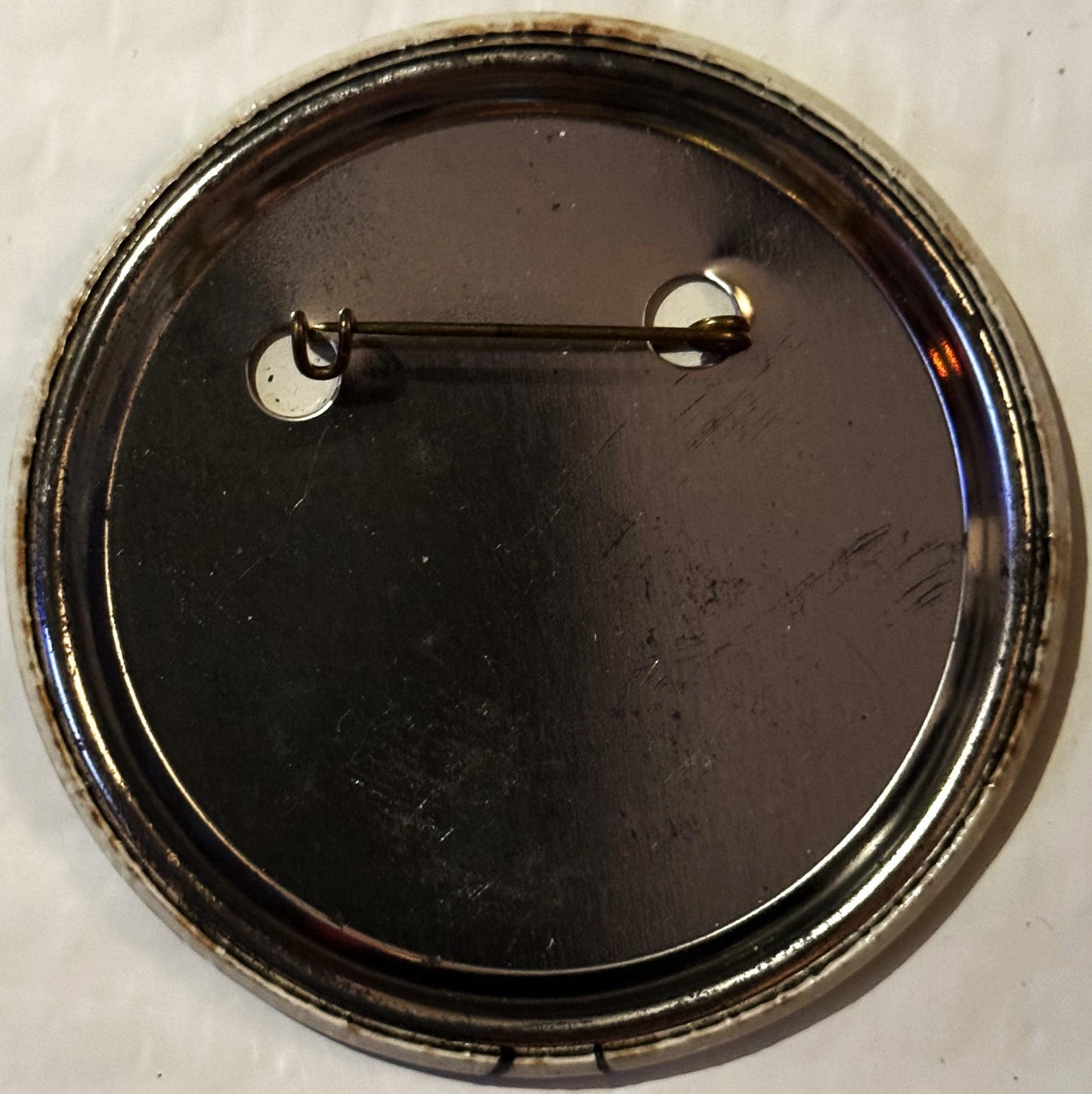
The format itself — a printed paper face sealed under a clear celluloid dome, crimped onto a metal shell with a simple pin on the back — has its own century-long American pedigree. It traces back to the Whitehead & Hoag Company of Newark, New Jersey, which bought up a cluster of button patents through the 1890s, with the defining patent dated to 1896: the first design to combine a see-through celluloid cover with a metal shell and pin in a single, cheap, mass-producible unit. That format is what turned the pinback button into a true mass medium, famously flooding the 1896 McKinley–Bryan presidential race, and it remained the workhorse construction for badges of every stripe — campaign buttons, advertising premiums, and eventually protest buttons like this one — well into the twentieth century.

By the time the anti-war movement needed millions of cheap, wearable slogans, that Newark-born construction had spread into a whole retail world of its own. Design historians note that the 1960s and '70s were a genuinely prolific era for protest buttons, kicking off with the 1964 Free Speech Movement and expanding fast from there — sold not through any single manufacturer or campaign office, but through gift shops and head shops, much of it text-only, much of it deliberately blunt or profane, exactly the kind of shorthand a button like this one traffics in. It's a genuinely anonymous piece of that world: no printer's mark, no sponsor, just a slogan compressed into letters and a symbol borrowed from a British peace march, sold for whatever a few coins would buy at the counter of a shop that knew exactly what its customers wanted to say without saying it out loud.


🗣️ Backlash, Rumor, and the Fights Over a Symbol

No symbol this visible escaped pushback, and the peace circle drew plenty of it — worth recording here as the passed-down lore it genuinely is, even where it doesn't hold up. Right-wing groups in this period circulated bumper stickers mocking the peace symbol as the "footprint of the American chicken," a jab at the movement's supposed cowardice. Around the same time, the John Birch Society and allied groups spread a persistent rumor that the design was actually a "broken cross," a sign of the Antichrist, with at least one adherent tracing it back to Nero and to medieval devil-signs — a claim that researchers looking into it later found no good evidence for, and one flatly contradicted by Holtom's own 1973 account of drawing a despairing human figure. A national newsletter of the period also noted, in passing, a resemblance to a World War II–era emblem — treated by most who've looked closely as coincidence rather than intent.

There was even a brush with commercial ownership: reporting from October 1970 recorded that the U.S. Patent Office had tentatively considered registering the peace symbol as a commercial trademark. It's a small irony that the symbol's whole ability to spread — from a Twickenham drawing board to a London-to-Berkshire peace march to a Chicago dorm room to buttons like this one — rested on Holtom's decision never to claim ownership of it in the first place. That refusal to copyright it is precisely why no single company ever got to lock it up.


🖼️ Display Ideas

  • 📌 Pin it to a cork board or memo board alongside other Vietnam-era ephemera for a mini protest-history corner
  • 🖼️ Mount it in a shallow shadow box with a strip of period newspaper clipping or a small printed chant card beside it
  • 🎓 Set it on a small stand on a bookshelf next to your Vietnam War-era reading — it makes a striking, conversation-starting anchor piece
  • 🧥 Clip it to the lapel of a denim or army-surplus jacket for an authentic period styling touch
  • 🗂️ Add it to a curated tray or display case of 1960s-70s protest buttons, grouped by theme or chant
  • 🏛️ Gift it to a history-minded friend, teacher, or collector who values the story as much as the object itself

🎁 Who Collects These

Vietnam-era protest buttons draw a genuinely wide range of collectors: political ephemera specialists building out a full run of anti-war slogans and chants, peace-symbol collectors chasing the design's whole journey from Aldermaston to American campuses, historians and teachers looking for tangible classroom pieces that make the era feel real rather than textbook-flat, and everyday nostalgia buyers — often people who marched themselves, or whose parents did — looking to hold a physical piece of a decade defined by exactly this kind of blunt, coded, unforgettable slogan. Because so much of this material was printed anonymously and sold cheaply through shops rather than issued by any organized campaign, well-kept examples like this one are genuinely satisfying finds for anyone building a serious protest-ephemera collection.


❓ FAQ

What does "W.D.W.Y.F.W." actually stand for?

It's the tail end of a well-documented Vietnam-era rally chant: "One, two, three, four, we don't want your [expletive] war." The numerals "1-2-3-4" printed above it are the chant's opening count-off.

Why would a button spell out a chant in initials instead of the full words?

Reducing a profane slogan to numerals and letters let it be printed and worn openly in a way the full words couldn't be — and it also turned the button into a small puzzle that made people lean in to decode it, which helped the message stick.

Is this connected to Country Joe McDonald's "Fish Cheer"?

They're contemporaries in spirit — both born of the same anti-war moment — but McDonald's own chorus counts to three and phrases it as a question, not four and a flat refusal. There's no documented line connecting one directly to the other; they're best understood as parallel, not parent and child.

Where did the peace symbol at the top actually come from?

It was designed in 1958 by British designer Gerald Holtom for a nuclear disarmament march from London to Aldermaston, England — combining semaphore letter shapes for "Nuclear Disarmament" with a figure Holtom described as a person in despair. It reached American campuses starting in 1960 and became attached to the anti-Vietnam War movement by the later 1960s.

What does the two-finger hand at the bottom mean?

The V-sign was launched in 1941 by Belgian broadcaster Victor de Laveleye as a resistance symbol for "victory," later made famous by Churchill. By the late 1960s, the counterculture had flipped its meaning entirely — from victory in war to an outright demand to end one.

How old is this button?

It belongs to the Vietnam War protest era of the 1960s through the early-to-mid 1970s, based on its printing style, materials, and iconography.

What condition is this piece in?

This is New Old Stock — printed during the era itself and never worn or carried into a crowd, kept back rather than lived in.

Shipping

🚚 Shipping & Handling

  • Shipping costs and timing are calculated at checkout.
  • Items curated and shipped directly by me include U.S. shipping at no additional cost, professionally packed to ensure safe arrival of your artifact.

Items from Vetted Pro Collectors
Shipping for items offered by vetted Pro Collectors is determined at checkout. All Pro Collector listings are reviewed to ensure fair, reasonable shipping practices.

For full details, please refer to our Shipping Policy.

Returns & Exchange

Take your time — you've got a full six months. If a piece isn't right for you, send it back the way it reached you and we're good.

In the first 30 days your money goes straight back the way you paid. After that it's store credit, so you can put it toward something you'd rather have.

Return shipping we sort out between us, case by case. I don't make this difficult.

If something arrives damaged, or it isn't what I said it was, send me a photo within 48 hours and I'll make it right.

Email info@vintageantiquesgifts.com or call 802-356-9872 — that's me answering, not a call center.

The only things I can't take back are custom or special-order pieces and gift cards.

View full details
  • 5 stars: 54 (98%)
  • 4 stars: 0 (0%)
  • 3 stars: 1 (2%)
  • 2 stars: 0 (0%)
  • 1 star: 0 (0%)
_
_***s (100)

Loved it

C
Chelsea

Absolutely awesome! Will definitely be ordering other items!!

C
Carrie Washburn

Very nice and very large! Perfect addition to my backpack and came with a lovely note

h
h***b (286)

Great site with a host of products. Condition was just as described. Fast shipping at a fair cost. And a little something else thrown in.

t
t***n (4227)

Great price and fast shipping

2
2***m (2535)

Fantastic sellers, great people to do business with!!!

s
s***7 (2069)

Super nice condition and quality for being so old. Look nice in a shadow box good price, Seller easy to work with. I give them an AAAAAAAA######

h
h***o (2708)

Very nice item with super fast shipping. Super nice guy to deal with. How eBay is done. Thanks

b
b***e (650)

Thank you very much

r
reenie1us

Love the sentiment on this vintage product; the letter alone was worth the purchase, would shop here again

9
9***9 (1196)

Nice old pin and quick shipping.

s
s***9 (3924)

Great button thanks!

t
t***c (2175)

Very nice. Thank you 🙏

2
2***2 (825)

A piece of history.

y
y***y (500)

Nice product and fast delivery!

n
n***c (26)

Perfect! Quick, excellent condition, safe and secure packaging, nice communications.

c
c***u (235)

I'm extra pleased with this item. It's as described. The extra is because my item is twice as big as I assumed and it's my age too. Thanks guys. John

p
p***p (1531)

Very Nice Vtg Pin.....A+++++.....Thank You

e
e***i (99)

Fast safe shipping item as described very nice historic pin the real deal five star thank you

n
n***d (36)

Cool vintage button!

8
8***1 (2788)

Excellent job well done my friend. Thank you ☮️

c
c***o (6434)

Just perfect!

r
r***u (1810)

Very nice pin that fits well in my collection. Was packaged well and shipped fast. Seller communicated through out the process........A+!!!

o
o***r (569)

Really wanted the item, I still do not know what happened to it. Was lost in the mail ?? I STILL WOULD LIKE the Viet button

Sir, You opened a case and never responded. It only gives me one option: to refund. I messaged you four different times. I even called and left a voicemail on your cell phone. I will not send another rare piece out unless I can communicate with you and confirm the address to see if there is an issue. After this review, I tried to contact you six more times unsuccessfully to help. I can't help if you won't let me.

2
2***w (633)

The pin arrived in perfect condition because of the care that the vendor took in the superb packaging.

a
a***s (3402)

You make eBay a pleasure…. Thanks!

r
r***l (61)

Fantastic seller!

1
1***9 (8565)

Great service, thanks

_
_***a (8)

The item arrived in good time and as described. It will be used as an artifact for a class on the Vietnam War Era. I appreciate buying from a small business.

z
zack

Great service, thank you for the letter too. Definitely recommend.

r
r***r (1326)

Nice piece of my history I apposed the war. Nicely packed and shipped fast thank you