
Nice shirt!
Very nice nickel. Charming vender. Fast service. He has other very cool stuff on sale as well.
Very nice labels in excellent condition. Well packaged and arrived timely.
The Cadillac poster was great, very well made and great graphics.
Everything authentic. Nothing reproduced. 🏛️ Vintage and Antique Gifts is a multi-channel...
$0.00 USD
Vintage and Antique Gifts
Size: 12" x 6"
🚚 Free US Shipping — ships within one business day. International shipping calculated at checkout.
Couldn't load pickup availability
Size: 12" x 6"
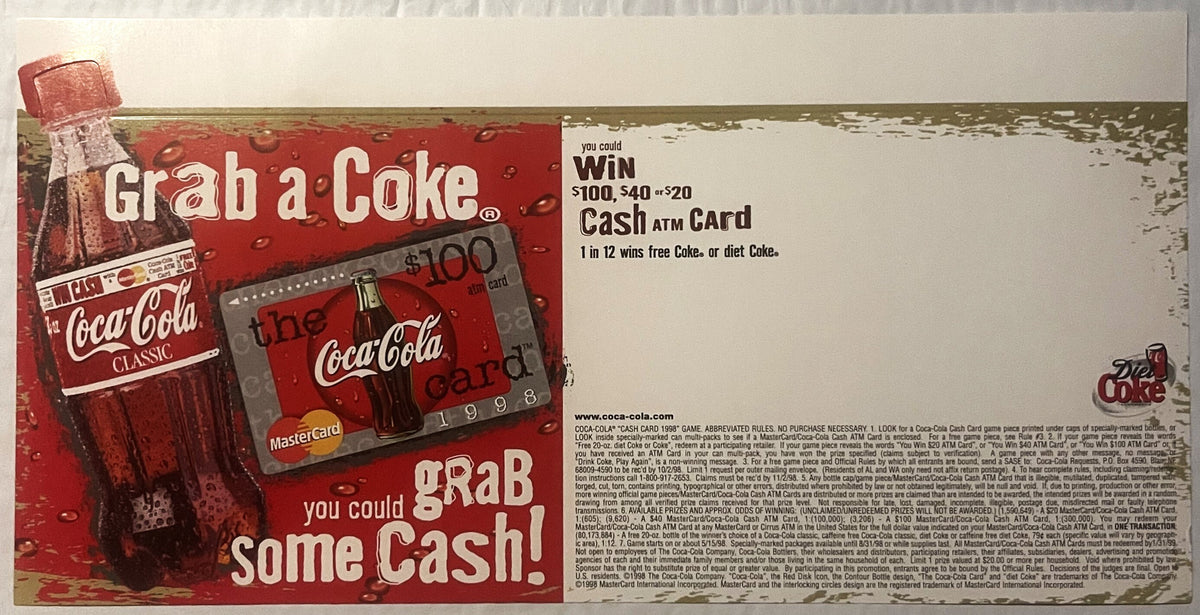
In the summer of 1998 Coca-Cola hid real MasterCard ATM cards under bottle caps and inside can multi-packs. This store display sold the game, and its fine print gives away the scale: 1,590,649 cards worth $20, 9,620 worth $40, 3,206 worth $100, and 80,173,884 free 20-ounce Cokes. Run the printed odds and they come to roughly 962 million game pieces. Nearly every one of those caps went in the trash, and so did most of the cardboard that advertised them. This display never went up.
Heavy printed cardstock, 12" x 6". On the left, a sweating 20-ounce Coca-Cola classic contour bottle with a red cap and a neck band advertising the cash card game, set against a red field spattered with water drops. Big white hand-drawn letters read "Grab a Coke" with a registered mark, and below, "you could grab some Cash!" In the middle floats a silver "$100 atm card" lettered "the Coca-Cola card," with a glass contour bottle inside a red disk, the MasterCard interlocking circles and the year 1998 across the bottom.
The right-hand panel announces "you could WIN $100, $40 or $20 Cash ATM Card" and "1 in 12 wins free Coke or diet Coke," then runs the abbreviated official rules in tiny type under www.coca-cola.com, with a diet Coke logo in the corner. The back is plain cream board with a scored flap along the top edge, and here's the clever part: the red bottle cap is die-cut right into that flap, so when you fold it back along the score the cap pops up above the top of the card. It is unused old stock, flat and clean; one of them is shown still sealed in its original shrink wrap.
The rules printed on this display lay it out. Shoppers looked for a Coca-Cola Cash Card game piece under the caps of specially-marked bottles, or opened specially-marked can multi-packs to see if an actual MasterCard/Coca-Cola Cash ATM Card was tucked inside. A cap reading "You Win $20 ATM Card," "You Win $40 ATM Card" or "You Win $100 ATM Card" was a winner; "Free 20-oz. diet Coke or Coke" was redeemed at the store; "Drink Coke, Play Again" meant try another bottle. No purchase was necessary: a stamped envelope to Coca-Cola Requests at a post office box in Blair, Nebraska, brought a free game piece.
Add up the printed prize counts and Coca-Cola was putting more than $32.5 million in ATM cash into circulation, almost all of it in $20 cards, on top of eighty million free sodas.
The prize art borrows the name and look of The Coca-Cola Card, a trademark listed right in this display's fine print. In 1998 that was an entire program aimed at teenagers: tens of millions of MasterCard-branded Coca-Cola Cards handed out in high schools, pizza places and spring-break towns, printed in hundreds of local versions matched to bottling territories and good for discounts at nearby businesses when you bought a Coke. The next summer Coca-Cola added free voice mail accounts unlocked by codes under 20-ounce bottle caps and ran a cryptic teaser campaign before revealing the brand; Coca-Cola spokeswoman Diana Garza, speaking from Atlanta, Georgia, explained that the company wanted kids talking about it before they knew Coke was behind it. Pop-culture writers have since called the card one of the most confusing marketing campaigns ever made. The cash ATM cards pictured here were its flashier cousin.
The trademark line on this display names "the Contour Bottle design," and the bottle in the artwork is the plastic 20-ounce version of it. The shape goes back to 1915, when Coca-Cola's bottlers challenged glass companies to create a bottle so distinctive you could recognize it by feel in the dark or lying broken on the ground. The Root Glass Company of Terre Haute, Indiana, won. Bottle designer Earl R. Dean and auditor Clyde Edwards were sent to the local library for ideas, where they found an illustration of a cocoa pod in the Encyclopaedia Britannica, elongated and ribbed, and built the bottle around it. The story goes that they had gone looking for the coca leaf or the kola nut, the two ingredients behind the name, and came back with cocoa instead: a mix-up that produced the most famous package in the world.
The design patent went out in the name of Alexander Samuelson, the Root Glass plant supervisor, and was granted on November 16, 1915. Its 1923 renewal fell on December 25, which is why collectors call that version the Christmas bottle, and on April 12, 1960, the shape itself was registered as a trademark, something highly unusual for a package back then. Coca-Cola carried the contour into plastic with the 20-ounce bottle, the size this whole promotion was built around.
The label on the bottle still reads Coca-Cola classic, a name born of the company's most famous blunder. In April 1985 Coca-Cola replaced its formula with New Coke; the backlash was so fierce that the original returned that July as Coca-Cola classic, and the word stayed on the label for years afterward. The diet Coke mark on the rules panel belongs to the brand launched in 1982, and the fine print offers the free-bottle prize in Coca-Cola classic, caffeine free Coca-Cola classic, diet Coke or caffeine free diet Coke.
Every no-purchase request for this game was mailed to Blair, the Washington County seat north of Omaha. Blair was platted in 1869 when the Sioux City and Pacific Railroad reached it and was named for railroad magnate John Insley Blair. A century later its name became familiar to prime-time television audiences through the sweepstakes company D.L. Blair, a pioneer of contest judging and fulfillment, which made "Blair, Nebraska" one of the most-printed addresses in American promotions.
They're 12 by 6 inches, unused, flat and clean. Frame one as a long, low panel for a game room, a home bar or a kitchen, or fold it along its original score so the die-cut cap pops up and stand it on a shelf the way it stood in the store, next to a 20-ounce contour bottle and your other late-90s Coke things. The supply is finite - nobody's printing Grab a Coke displays again, and once these last unused ones are gone, they'll be very difficult to acquire.
Items from Vetted Pro Collectors
Shipping for items offered by vetted Pro Collectors is determined at checkout. All Pro Collector listings are reviewed to ensure fair, reasonable shipping practices.
For full details, please refer to our Shipping Policy.
Take your time — you've got a full six months. If a piece isn't right for you, send it back the way it reached you and we're good.
In the first 30 days your money goes straight back the way you paid. After that it's store credit, so you can put it toward something you'd rather have.
Return shipping we sort out between us, case by case. I don't make this difficult.
If something arrives damaged, or it isn't what I said it was, send me a photo within 48 hours and I'll make it right.
Email info@vintageantiquesgifts.com or call 802-356-9872 — that's me answering, not a call center.
The only things I can't take back are custom or special-order pieces and gift cards.

Preserving History: Authentic Objects Across Eras
Nice shirt!
Looks great !
Very nice nickel. Charming vender. Fast service. He has other very cool stuff on sale as well.
Very nice labels in excellent condition. Well packaged and arrived timely.
The Cadillac poster was great, very well made and great graphics.
Nice shirt!
Looks great !
Very nice nickel. Charming vender. Fast service. He has other very cool stuff on sale as well.
Very nice labels in excellent condition. Well packaged and arrived timely.
The Cadillac poster was great, very well made and great graphics.