Skip to product information
1 of 9

Vintage and Antique Gifts

Vintage Susan Rini World Champion 1969 Miracle Mets Uncut Press Sheet 🃏 Tom Seaver Nolan Ryan, Historic Limited Editions MLB Licensed Postcard Art

Vintage Susan Rini World Champion 1969 Miracle Mets Uncut Press Sheet 🃏 Tom Seaver Nolan Ryan, Historic Limited Editions MLB Licensed Postcard Art

Regular price 70.00 USD
Regular price Sale price 70.00 USD
Sale Sold out
Shipping calculated at checkout.
Quantity

Size: 22 x 17 inches

⚾ The One Sheet the Scissors Never Reached

Some collectibles were only ever meant to pass through the world in pieces. This one refused to. What you are looking at is the whole, uncut press sheet from which Susan Rini's 1969 New York Mets postcards were cut, and it is the reason the whole listing exists. Rini's painted tribute to the Miracle Mets was released to the public by Historic Limited Editions as a set of trimmed postcards, boxed and sold as neat little cards a collector could shuffle, mail, or slot into an album. Those cards were sliced apart from parent sheets exactly like this one. The cards turn up. The trimmed sets turn up. But the parent sheet, complete and never divided, with all thirty-six painted panels still shoulder to shoulder the way the press laid them down, is a thing that almost nobody kept. In all of our searching we have not found another example of this uncut sheet offered for sale anywhere. We will not tell you none exists, because we cannot prove that. What we can tell you is that we went looking and came up empty, and that is the heart of what makes this worth stopping for: a piece of familiar baseball art in the one format the hobby almost never sees.

🧩 What You Are Actually Looking At

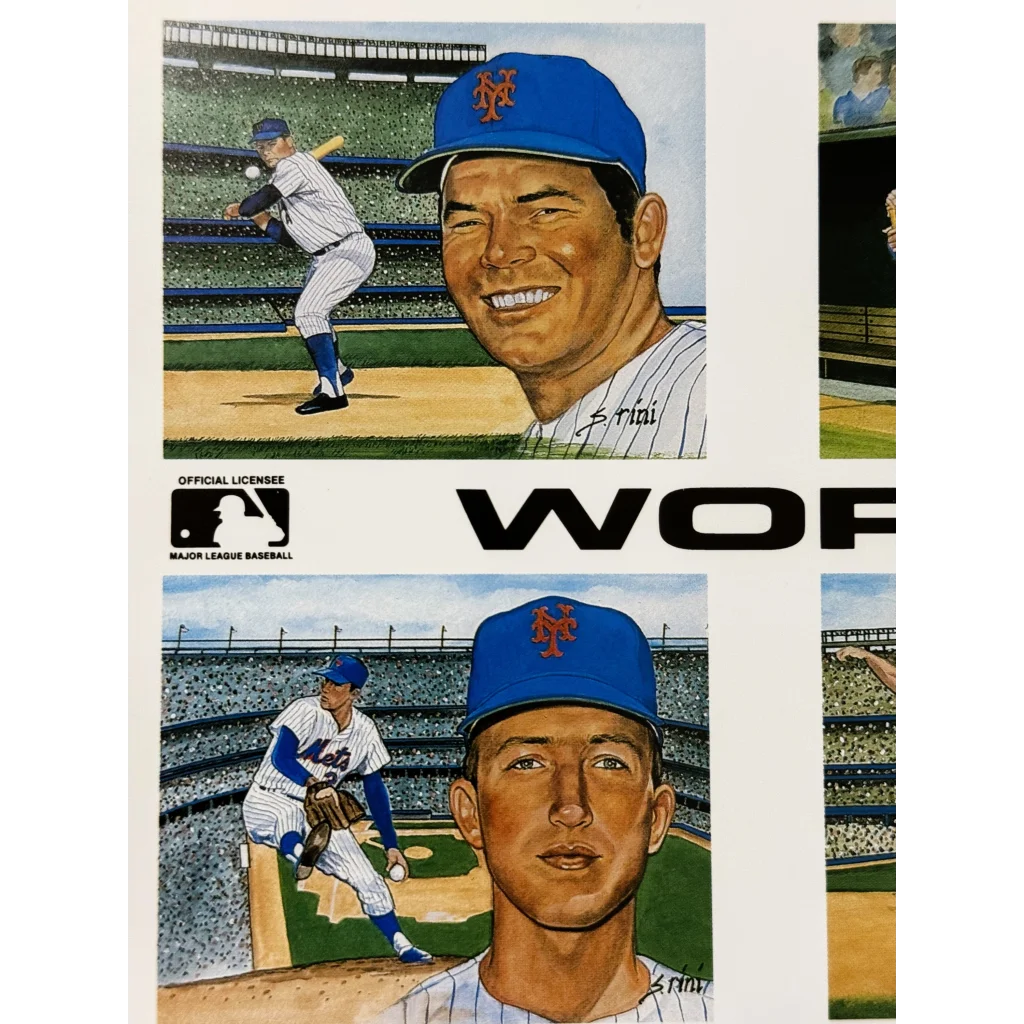
Let us be exact, because the format is the entire point. This is a single sheet of light cardstock, roughly twenty-two by seventeen inches, carrying thirty-six individual painted panels arranged six across and six down. Running straight through the middle of the sheet is a bold black title strip that reads, in capital letters a viewer can read from across a room, WORLD CHAMPION 1969 METS.

At each end of that title strip sits the Major League Baseball "Official Licensee" logo, the familiar batter silhouette above the words MAJOR LEAGUE BASEBALL, printed twice, once to the left and once to the right, a small but genuine mark of the license behind the artwork. Look into the individual panels and you will find Rini's cursive "S.

Rini" signature worked into the paintings themselves. Most of the thirty-six panels pair a warm, close portrait of a face with a smaller full-figure action scene set inside the ballpark, so that each little rectangle tells you at a glance both who the man was and what he did between the lines. A handful of the panels step outside the roster to picture the World Series trophy, a view of the stadium, and the men who called the games.

It is one object, printed once, holding an entire championship season.


🏆 Worst to First, and Why "Miracle" Is Not a Marketing Word

To understand why anyone would frame a sheet of baseball art, you have to understand what these thirty-six faces did. The Mets came into the world in 1962 as an expansion club and spent their first seven seasons as the game's most lovable disaster, a team that lost more than a hundred games in a year more than once and turned futility into a kind of civic comedy.

Nobody, including the people who loved them, expected 1969 to be any different. Then something broke the pattern. Carried by a young and frankly frightening pitching staff, the Mets ran down the heavily favored Chicago Cubs in the closing weeks of the season, swept the Atlanta Braves in the very first National League Championship Series, and walked into the World Series against the powerhouse Baltimore Orioles as enormous underdogs.

They won it in five games. A franchise that had never once finished higher than ninth place was, suddenly and permanently, the champion of baseball, and the phrase "Miracle Mets" entered the language and never left. That is the story printed across the center of this sheet. The word "Champion" there is not a boast added later.

It is simply what happened, and it is the reason a keepsake of this particular team carries a charge that a poster of a merely good club never could.


🎨 The Hand Behind It: Susan Rini

The artwork on this sheet is the work of Susan Rini, a recognized sports artist whose painted portraits of ballplayers have earned a real following among collectors who care about how the game has been pictured. Her approach is unmistakable here. Rather than reproduce a photograph, she painted each subject by hand, giving every man a soft, careful, genuinely lifelike likeness and then setting a small action vignette behind or beside him, painted right down to the grass and the grandstands.

These are portraits, not snapshots run through a filter, and the difference shows in the warmth of the faces. Rini is regarded seriously in the sports-memorabilia world, and her original paintings have been sold through major sports-memorabilia auctions, including a subject drawn from this very 1969 Mets project. That matters for a simple reason: this sheet is not a mass-market poster built from a stock team photo.

It is a printing of thirty-six pieces of original commissioned artwork by a named, collected painter, gathered together in one place. Holding it up to the light is about the closest you can come to seeing her entire 1969 Mets undertaking laid out at once, in a single glance, the way she must have.


📮 Historic Limited Editions and the Postcards It Was Meant to Become

The publisher behind Rini's licensed tribute art was Historic Limited Editions, a house that issued painted homages to legendary championship teams. In the late 1980s and early 1990s it released her work as numbered, limited postcard printings, sold to the public as trimmed cards, and the 1969 Mets were a natural subject for the treatment. This sheet is the printed source of that Mets postcard art: thirty-six subjects, one per card, all still joined on the parent sheet before the trimming. It is worth saying plainly what that means for dating. The team, the season, and the title strip are 1969, but the printing itself belongs to that later era of tribute issues, so this is a genuine period keepsake of a 1980s-into-1990s printing that celebrates a 1969 champion, not a 1969 artifact. The trimmed cards from Rini's runs are collectible in their own right and still change hands among team and player collectors. This sheet is where those cards began, one step before the blade, preserved whole instead of cut. That is an unusual survival, because industrially speaking the entire purpose of a sheet like this was to be cut apart and then to vanish.


✂️ Why the Uncut Sheet Is the Rare One

Here is the part worth reading slowly, because it is the whole value story. In the manufacture of a card set, the sheet is a means to an end. It exists to be cut, and once it has done its job it is normally destroyed or thrown away, because the finished, trimmed cards are the only thing the public was ever supposed to see. So while Rini's cut 1969 Mets cards and assembled sets do circulate, the uncut sheet is a different animal entirely, a format that essentially does not come to market. We searched, and we did not find another example of this uncut sheet offered for sale anywhere. We frame that carefully and on purpose: it is an honest report of what our own looking turned up, which was nothing comparable, and not a claim that no other sheet exists in the world. That combination is what gives the piece its weight. It is a familiar and chased subject, the 1969 Miracle Mets, surviving in a display format that dwarfs the cards it was built to make, in a state almost no one bothered to keep. It is scarce not because a small number were deliberately printed, but because sheets like it were simply never the thing anyone saved.


⭐ The Faces Gathered on the Sheet

A championship is never one or two men, and this sheet honors the whole club, which is a large part of its charm. We looked closely at the panels and will tell you exactly what we can and cannot pin down. The one panel we can point to and verify by uniform number is Tom Seaver's: he appears in his pitching windup with a clearly legible number 41, the number he wore, beside his portrait, and Seaver was the ace and the reigning face of that staff, the Cy Young winner at the center of the miracle.

We can also point with confidence to the beloved coach Yogi Berra, whose smiling, unmistakable face Rini painted into one of the panels. Beyond those, the sheet gathers the complete thirty-six-subject tribute to the 1969 World Champions, which is documented to include the full roster of that team, among them a young Nolan Ryan, then a hard-throwing member of the championship staff years before he became the sport's all-time strikeout king.

Rounding out the thirty-six are the men who told the story from the booth, the team's broadcasters, and a set-piece panel of the World Series trophy itself. Every one of the thirty-six panels is present and pictured; where we can prove a name by the number on the jersey, we have said so, and where we are relying on the documented makeup of the set, we have said that too.


🏟️ Shea Stadium, Painted Into the Background

Spend a minute behind the portraits and the sheet quietly rewards you. Rini did not stand her Mets against a blank studio wall; she set them inside the world of their ballpark and painted that world in with them. One panel is given over entirely to a view of the stadium itself, the great round bowl of Shea rising against the sky. In the action vignettes behind the players you can pick out the furniture of the place: the outfield walls carrying the period advertising of the era, with the Rheingold beer mark long tied to Mets baseball, the Longines clock on the scoreboard, and a Tribune sign among the billboards, plus the round Mets team roundel repeated on the walls. The grandstands are filled with a painted, stippled crowd rather than left empty. These are the details that separate a lazy tribute from a loving one, and they are the reason the sheet keeps giving at close range long after the big black banner has told you, from across the room, exactly which team you are looking at.


🖼️ A Poster-Scale Piece Built for a Wall

Think for a moment about the sheer physical presence of this thing. At roughly twenty-two by seventeen inches it is not a card you tuck into a binder; it is a poster-scale display, large enough to command a wall on its own. Framed, it becomes exactly the kind of piece that stops a visitor in a den, a finished basement, a sports room, or an office: a full grid of hand-painted Mets under a bold championship banner, with the MLB license marks and the artist's signatures adding the fine print that rewards a close look. Because it is a single unbroken sheet rather than a mounted collage of separate cards, the composition holds together as one designed object, the way the printer arranged it, with the title strip anchoring the middle and the panels marching out in even rows. It is the rare collectible that works from across the room, read instantly as the 1969 Mets, and also up close, where the individual portraits, the little action scenes, and the "S. Rini" signatures reveal themselves one by one. A simple mat and a clean frame would settle the sheet flat and let it show for exactly what it is.


🃏 A Whole Set, Surviving as One Uncut Object

And then there is the other way to love it, as a card collector's genuine oddity, the kind of piece that turns the usual hobby on its head. Most collectors chase cards one at a time, hunting singles, slowly assembling a set over months or years. This sheet hands you the entire set at once, and in the one state a set almost never survives: uncut, whole, every panel still joined to its neighbors exactly as printed. It is a set and a single object at the same moment, thirty-six cards that were never cut into cards. Collectors have always had a soft spot for uncut sheets for precisely this reason, because they are the state a finished set was never supposed to last in, the physical proof of how the thing was actually made just before the trimming. For anyone who collects Rini, or Historic Limited Editions issues, or 1969 Mets material, or uncut and oddball formats as a category, that is an unusual thing to be able to add: not one more trimmed card to sit beside the others, but the parent object they all came from, preserved intact. It is the kind of piece that anchors a collection rather than merely joining it.


🔍 Condition, Told Honestly

This is new old stock, unused and uncut and never separated, and we would rather describe it plainly than oversell it. On the printed side the sheet presents bright and clean, with strong color, crisp portraits, a sharp black title strip, and the two MLB logo marks reading clearly, with no tears, no tape, and no writing. Like most large cardstock that has been stored for years, it carries a gentle curl or wave rather than lying perfectly dead flat, the sort of thing that settles down under a mat and behind glass. The back of the sheet is blank, unprinted cream cardstock; in the photographs you can see a faint, soft show-through of the front art and a small amount of light handling, with the surface otherwise clean and the corners intact. None of this touches the painted images on the front. It is offered exactly as pictured, which means the five photographs are the true and complete record of the piece you would receive, and we would rather you trust your own eyes on them than any adjective of ours. Please look closely and let the images be the final word.


🎁 Who This One Is For

This sheet quietly finds several kinds of people at once. There is the lifelong Mets fan who wants a single striking wall piece that says 1969, the Miracle, the one championship of that generation, without hanging a wall of separate little frames. There is the Susan Rini collector, or the collector of Historic Limited Editions issues, for whom the uncut parent sheet is a step beyond the cards they may already own. There is the vintage-card and oddball specialist who prizes uncut sheets precisely because they are the format that so rarely lasts. There is the person shopping for a gift who wants something genuinely memorable for the baseball fan in their life, a piece that arrives with a story attached rather than just a logo. And there is the collector who simply understands scarcity, who hears "we could not find another of these offered for sale anywhere" and knows exactly what that sentence is worth. For any one of them, this is not a piece that comes around often.


❓ Questions Worth Answering

Is this the cards, or the uncut sheet?

It is the uncut sheet: one piece of cardstock, roughly twenty-two by seventeen inches, carrying all thirty-six painted panels together exactly as printed, before any cutting. It is not a set of trimmed cards.

Is Tom Seaver really on it?

Yes. Seaver appears in his pitching windup with a clearly legible number 41, his uniform number, and we verified that panel directly from the photographs.

What about Nolan Ryan and the rest of the roster?

The sheet is the complete thirty-six-subject tribute to the 1969 champions, which is documented to include the full roster of that team, among them a young Nolan Ryan, along with coach Yogi Berra, the broadcasters, and a World Series trophy panel. We can point to Seaver by his number; the remaining subjects are the documented makeup of this complete set, and every one of the thirty-six panels is present and pictured.

Is it officially licensed?

Yes. The Major League Baseball "Official Licensee" logo is printed on the sheet twice, once at each end of the WORLD CHAMPION 1969 METS title strip.

Was it made in 1969?

No, and we would not claim it was. The subject and the title are 1969, but the printing belongs to the later Historic Limited Editions era of tribute issues, so it is a period keepsake celebrating a 1969 champion, not a 1969 artifact.

How rare is the uncut sheet, honestly?

Cut cards and trimmed sets from Rini's 1969 Mets art do circulate. The uncut sheet does not, so far as our own searching can tell; we did not find another example offered for sale anywhere. We state that as what we found, not as proof that none exists.


✨ Why It Matters

Most sports collectibles are one of many. This one is a survivor of a format that was built to be destroyed, the uncut source sheet of Susan Rini's Historic Limited Editions postcard art for the 1969 World Champion New York Mets, with the whole miracle roster still gathered together on a single poster-scale piece of cardstock, under a Major League Baseball license, signed panel by panel. Cut cards from this art exist and can be found. The uncut sheet, so far as our own looking can tell, does not come to market. It is at once a wall-worthy display of one of baseball's greatest underdog stories and a card collector's true oddity, an entire set in one uncut object. New old stock, offered exactly as pictured, and, in every sense that matters to the person who wants it, a hard thing to find twice.

Shipping

🚚 Shipping & Handling

  • Shipping costs and timing are calculated at checkout.
  • Items curated and shipped directly by me include U.S. shipping at no additional cost, professionally packed to ensure safe arrival of your artifact.

Items from Vetted Pro Collectors
Shipping for items offered by vetted Pro Collectors is determined at checkout. All Pro Collector listings are reviewed to ensure fair, reasonable shipping practices.

For full details, please refer to our Shipping Policy.

Returns & Exchange

Take your time — you've got a full six months. If a piece isn't right for you, send it back the way it reached you and we're good.

In the first 30 days your money goes straight back the way you paid. After that it's store credit, so you can put it toward something you'd rather have.

Return shipping we sort out between us, case by case. I don't make this difficult.

If something arrives damaged, or it isn't what I said it was, send me a photo within 48 hours and I'll make it right.

Email info@vintageantiquesgifts.com or call 802-356-9872 — that's me answering, not a call center.

The only things I can't take back are custom or special-order pieces and gift cards.

View full details