Skip to product information
1 of 5

Vintage and Antique Gifts

Vintage Bionicle Mighty Kids Meal Bag 🧱 McDonald's LEGO Bohrok Card Pack NOS 2002

Regular price 14.00 USD
Regular price Sale price 14.00 USD
Sale Sold out
Shipping calculated at checkout.

Description

What Was Threatening Mata Nui in 2002? 🧬

That's the actual riddle printed right on this bag — "WHAT IS THREATENING MATA NUI?" — posed in the little coded glyph alphabet that LEGO used across its BIONICLE packaging that year, the same puzzle-style symbol code kids were encouraged to decode on canisters and promo pieces throughout the line. If you were a kid standing at a McDonald's counter in 2002 clutching your tray, you already knew the answer before you even cracked the code: the Bohrok were awake, the Toa were in trouble, and somewhere in that little foil pack stuck to your lunch bag were five cards that might just tell you how the story continued. That's the exact feeling this piece was built to deliver, and it's the same one it delivers today, decades later, still sealed.

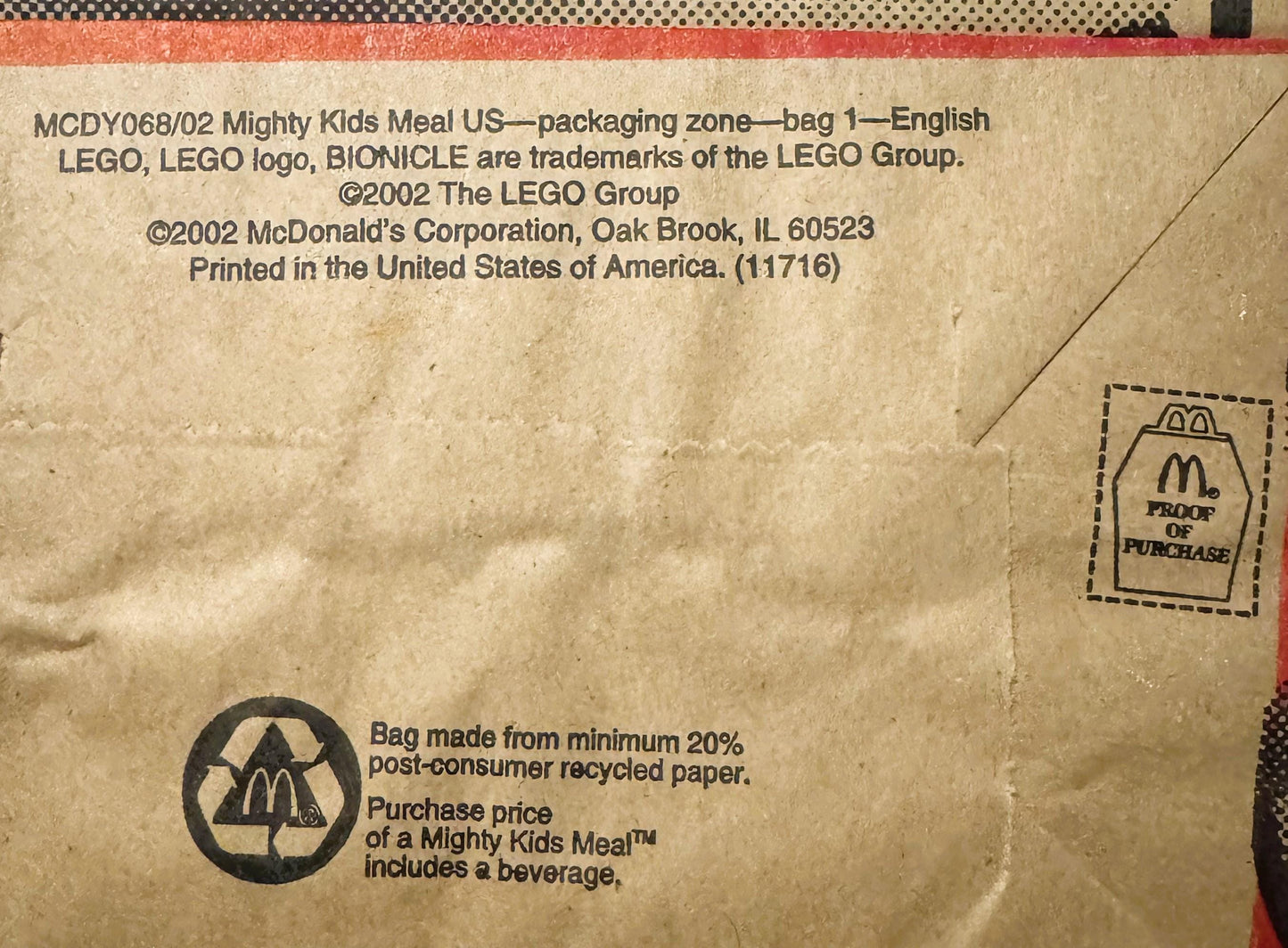
This is a new old stock (NOS), unopened BIONICLE "The Bohrok Awake" trading card pack, still sealed in its original glossy black foil blister, presented on its original brown paper McDonald's Mighty Kids Meal bag. The bag measures 12 x 8.5 inches, printed in bold halftone offset lithography across kraft-brown paper stock in red, yellow, black, white, and green — the classic look of early-2000s fast-food promotional packaging, all rough newsprint texture and punchy primary color. The card pack itself carries the LEGO logo, the BIONICLE wordmark, and full-color artwork of a Bohrok swarm in action, along with "TRADING CARD GAME," "COLLECT ALL 30 CARDS," and "5 CARDS PER PACK PLUS ONE MINI COMIC INSIDE" printed directly on the foil. The bag itself is stamped with its manufacture code — MCDY068/02, Mighty Kids Meal US, bag 1, English — and the copyright line "©2002 The LEGO Group, ©2002 McDonald's Corporation, Oak Brook, IL 60523. Printed in the United States of America. (11716)" — which is how we know precisely when this piece was made: 2002, at the height of the BIONICLE phenomenon, and at a moment when McDonald's corporate offices still called Oak Brook, Illinois home.


🧱 LEGO, Billund, and a Toy That Arrived Just in Time

The LEGO Group traces back to 1932, founded in the small Danish town of Billund by a carpenter named Ole Kirk Christiansen, whose original household-goods business had been battered by the Great Depression. The name LEGO is a contraction of the Danish phrase "leg godt" — "play well" — and, as LEGO itself has long noted with some delight, it also happens to translate from Latin as "I collect," "I compose," or "I read." Seven decades later, that same company would need every bit of that "play well" spirit to survive one of the roughest patches in its history — and BIONICLE would turn out to be a huge part of the reason it did.

BIONICLE launched as a new "Constraction" line — LEGO's blend of "construction" and "action figure" — first tested quietly in Europe and Australasia in December 2000, then rolled out across North America in mid-2001. The reception was massive: in its very first year, BIONICLE reportedly brought in roughly £100 million for the LEGO Group. That timing mattered enormously. By 2003, LEGO was staring down a budget shortfall of roughly kr. 1.4 billion (about $220 million US), a crisis serious enough that Kjeld Kirk Kristiansen — Ole Kirk's own grandson — stepped back in as president, and nearly a thousand employees were laid off the following year. Among longtime LEGO fans and historians, it's widely repeated that BIONICLE arrived at exactly the right moment to help carry the company through those darkest years — a plastic-and-story-driven lifeline that gave an entire generation of kids something genuinely new to build and follow, right when LEGO needed it most.

⚔️ The Bohrok Awake — the Story Behind the Name on This Pack

This particular card pack ties to the second full year of BIONICLE storytelling. The 2001 saga had introduced the six heroic Toa Mata and the mystery of the sleeping island-being Mata Nui; 2002 cracked the story wide open with the Bohrok — mechanical swarm creatures that attacked the Matoran village of Ta-Koro not long after the Toa believed their fight was won. The Toa quickly discovered the real threat wasn't the Bohrok shells themselves, but the living Krana controlling them from within. Six comics and an accompanying video game carried the arc forward that year, culminating in the Toa trapping the swarm queens — the Bahrag — in a cage of Protodermis, and then falling into Energized Protodermis themselves, emerging transformed into the more powerful Toa Nuva. That's the exact story this pack's cover art and title, "The Bohrok Awake," are built around — and it's why the bag itself poses "what is threatening Mata Nui" as its little decoded riddle.

🍔 McDonald's, Oak Brook, and the Bag Built for Bigger Kids

McDonald's traces its own beginning to 1955, when Oak Park native Ray Kroc — at the time a salesman of milkshake machines — became the exclusive franchising agent for a hamburger stand he'd discovered belonging to brothers Richard and Maurice McDonald, and opened his own restaurant in Des Plaines, Illinois, the very first McDonald's in the Chicago area. By the time this bag was printed, McDonald's corporate headquarters sat in Oak Brook, Illinois — exactly as printed on the bag's copyright line — years before the company's eventual 2018 return to downtown Chicago, the city where its main office had actually first been located from 1955 to 1971.

The bag itself belongs to a very specific McDonald's chapter: the Mighty Kids Meal, launched nationwide on Friday, March 30, 2001, aimed squarely at customers eight to ten years old who'd started to feel a little too grown-up for a standard Happy Meal. It kept the same toy and the same size fries and drink as the Happy Meal, but swapped in a double hamburger, double cheeseburger, or six-piece Chicken McNuggets as the entrée — and, notably, it came in this more "mature-looking" brown paper bag rather than the white, kid-activity-printed Happy Meal bag. Unlike the Happy Meal bag, which changed with every promotion, the Mighty Kids Meal bag largely stayed the same generic design across promotions — which is exactly why you'll find the skateboarder joke ("Why is a skateboarder so fast? Because he can catch air!") and the classic "What did the hamburger say to the bun? Nice to meat you" gag printed right alongside the BIONICLE riddle: the bag was standard Mighty Kids Meal stock, and the sealed card pack was the promotional tie-in glued onto that standing design. The BIONICLE promotion is also documented as one of the earliest instances where a McDonald's collectible was offered exclusively through the Mighty Kids Meal rather than the standard Happy Meal — a distinction that made this particular giveaway a little different from the toy premiums most collectors associate with McDonald's from that era.

🃏 Upper Deck and the Cards Inside

While LEGO owned the BIONICLE brand and McDonald's ran the promotion, the trading card game itself was developed by a different name entirely: The Upper Deck Company, founded in 1988 and headquartered in Carlsbad, California. Upper Deck built its reputation in sports cards first — it was granted an MLB license by founders Bill Hemrick and Paul Sumner in December 1988, and its debut 1989 baseball set turned heads with glossy card fronts, an extra color photo on the back of every card, and a tiny anti-counterfeit hologram, at a time when that kind of production value simply wasn't standard in the hobby. By the early 2000s, the company's Upper Deck Entertainment division had expanded well beyond sports into licensed collectible card games, eventually producing titles as varied as the Yu-Gi-Oh! Trading Card Game and the World of Warcraft Trading Card Game. BIONICLE: The Bohrok Awake was Upper Deck's contribution to the BIONICLE universe that year — a standalone game, distinct from the later BIONICLE: Bohrok Swarm release, built around a 30-card set split evenly between 15 foil and 15 non-foil cards. Each pack held five cards in roughly a four-to-one ratio of non-foil to foil, occasionally turning up more than one foil in a single pack, plus one of three different mini-comics tucked in alongside. Two special foil cards were reserved for each of the six original Toa — one showing the Toa themselves, the other showing their Kanohi Nuva mask — making the full 30-card set a genuine little chase for anyone trying to complete it back in 2002.

👤 The People Behind the Pieces

A handful of names run through this piece's real history. Ole Kirk Christiansen built LEGO from a carpenter's workshop in Billund in 1932, and his grandson Kjeld Kirk Kristiansen personally stepped back into the president's chair during the company's early-2000s financial crisis — the very years BIONICLE was posting its biggest numbers. Ray Kroc turned a milkshake-machine sales route into the McDonald's Corporation starting in 1955, opening the first Chicago-area location in Des Plaines before the company's headquarters eventually settled in Oak Brook. On the storytelling side, BIONICLE's principal writer, Greg Farshtey, shaped the Bohrok saga and the wider BIONICLE mythology across comics and books, and later carried that same voice into another LEGO theme entirely, Ninjago. And on the card side, Bill Hemrick and Paul Sumner's Upper Deck — a company that started out chasing a baseball card license it initially lacked the connections to land — grew into exactly the kind of licensed-game powerhouse that a global toy brand like BIONICLE would turn to a decade later.

📈 Why BIONICLE Still Echoes Today

BIONICLE's storyline ran a full decade, expanding across comics, video games, and feature films before LEGO wrapped the saga in 2010, as the continuity had grown large enough that the line's momentum began to slow. A 2015 reboot brought the story back down to a single island and six heroes, though that revival lasted only two years before ending in 2016. But BIONICLE's real legacy is visible all over LEGO's catalog long after its own toy line ended — it's widely credited as the creative and commercial template behind later LEGO story-driven themes including Knights' Kingdom, Exo-Force, Ninjago, Legends of Chima, and Nexo Knights, and it directly inspired a successor line, Hero Factory, launched in 2010. For a company that was laying off staff and facing a nine-figure shortfall in the very years this card pack was riding home in Mighty Kids Meal bags across the country, that's no small footnote — it's a genuine turning point in toy industry history, and this little sealed pack was riding shotgun for it.


🖼️ Display Ideas

  • 🧱 Set it beside a shelf of vintage BIONICLE canisters or figures as the story piece that ties the whole display together
  • 🖼️ Frame the sealed pack and bag together in a shadow box to preserve the full 2002 Mighty Kids Meal presentation
  • 🍟 Pair it with other early-2000s McDonald's promotional ephemera for a themed fast-food collectibles case
  • 📚 Display alongside BIONICLE comics or the Bohrok-era storyline media for a complete 2002 story-arc grouping
  • 🎓 Use as a teaching piece for younger collectors curious how LEGO's biggest turnaround story actually began
  • 🏠 Stand it on a desk or bookshelf ledge as a quick, colorful pop of early-2000s toy nostalgia

🎁 Who Collects These

This one draws from a few different directions at once. LEGO collectors chase it for the BIONICLE tie-in, especially those focused on the early Mata Nui and Bohrok years before the storyline expanded into later islands and characters. Trading card collectors are drawn to it as a lesser-known Upper Deck release, sitting alongside the company's better-known sports and licensed-game output. And fast-food collectible hunters — the folks who chase vintage Happy Meal and Mighty Kids Meal ephemera specifically — value it as a clean example of that short-lived, "grown-up" McDonald's meal format from the early 2000s. It's also a natural pickup for anyone building out a broader early-2000s pop culture or toy-industry-history collection, since it sits right at the intersection of three very different, very recognizable brands: LEGO, McDonald's, and Upper Deck.


❓ FAQ

Is this card pack sealed or opened?

This is new old stock — the BIONICLE "The Bohrok Awake" card pack remains sealed in its original glossy foil blister, still presented on its original Mighty Kids Meal bag.

What year was this made?

2002, confirmed directly by the copyright line printed on the piece: "©2002 The LEGO Group, ©2002 McDonald's Corporation, Oak Brook, IL 60523."

Who actually made the trading card game?

The Upper Deck Company, a Carlsbad, California trading card company founded in 1988, developed and produced the BIONICLE: The Bohrok Awake card game under license, separate from LEGO's own manufacturing of the BIONICLE toy line itself.

How many cards are in the full set, and how many come in this pack?

The complete set totals 30 cards — 15 foil and 15 non-foil — and each individual pack contains 5 cards plus one of three different mini-comics.

Why is this on a brown paper bag instead of a white Happy Meal bag?

This card pack was distributed exclusively through McDonald's Mighty Kids Meal, a format launched in 2001 for older kids that used a distinct brown paper bag design rather than the white, activity-printed Happy Meal bag.

Why does BIONICLE matter beyond just being an old toy line?

BIONICLE launched in 2001 and became one of LEGO's biggest early-2000s successes, arriving right as the company faced serious financial difficulty — it's widely credited among LEGO fans and historians as a major factor in the company's turnaround, and its story-driven format went on to influence numerous later LEGO themes.

Shipping

🚚 Shipping & Handling

  • Shipping costs and timing are calculated at checkout.
  • Items curated and shipped directly by me include U.S. shipping at no additional cost, professionally packed to ensure safe arrival of your artifact.

Items from Vetted Pro Collectors
Shipping for items offered by vetted Pro Collectors is determined at checkout. All Pro Collector listings are reviewed to ensure fair, reasonable shipping practices.

For full details, please refer to our Shipping Policy.

Returns & Exchange

Product Page Return Policy

  • 60-Day Returns – Items must be in original condition.
  • Refunds – Issued after inspection (excluding shipping costs).
  • Return Shipping – Customer is responsible unless item is damaged or incorrect.
  • Damaged/Incorrect Items – Contact us within 48 hours for a replacement or refund.
  • Easy Returns – Email [email protected] or call 802-356-9872 to initiate a return.

For full details, visit our Refund Policy.

View full details