Skip to product information
1 of 6

Vintage and Antique Gifts

Vintage Teal Princess Phone Keychain Charm ☎️ Bell System Rotary Bedroom Telephone Mid-Century Novelty Ornament

Regular price 10.00 USD
Regular price Sale price 10.00 USD
Sale Sold out
Shipping calculated at checkout.

Description

Remember when the telephone finally got its own bedroom? ☎️

There was a moment — right at the turn of the 1960s — when the telephone stopped being strictly a fixture of the kitchen wall or the hallway table and became something a teenage girl could actually want sitting on her own nightstand. That shift is the whole reason this little teal charm exists. It's a miniature echo, cast in glossy plastic and strung on a silver ball chain, of one of the most beloved telephones Bell System ever put into an American home: the Princess. Hold it in your palm and you're holding a tiny piece of the exact moment the phone became decor.

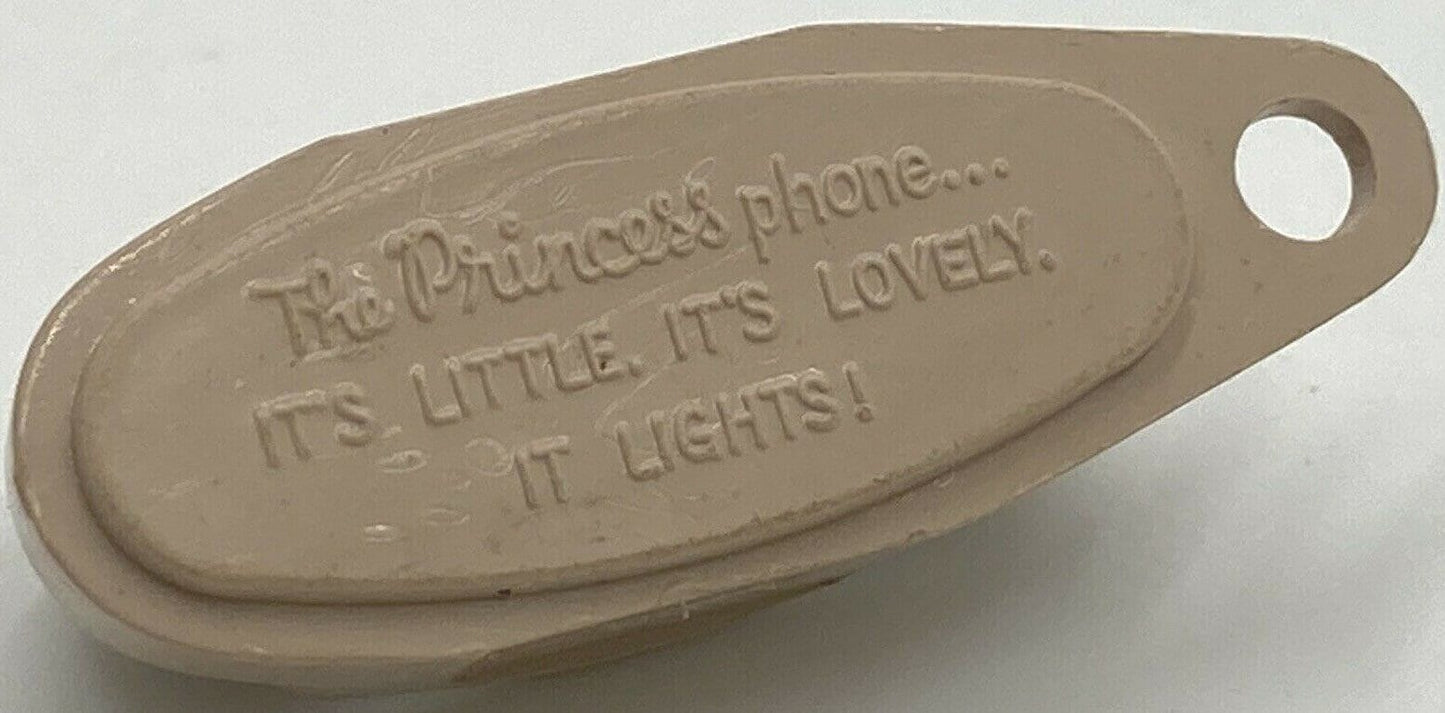
What you're looking at is a **figural Princess-style telephone charm**, molded in a soft teal (with a companion silver ball-chain for keyring or handbag use), built as a small-scale tribute to the real Bell System Princess telephone rather than a generic toy phone shape. It measures **1.5 inches (about 3.8 cm) long** — a genuinely tiny, pocket-and-keyring scaled piece, not a tabletop novelty — and it comes to you as **new old stock (NOS)**, meaning it was never carried on a set of keys or clipped to a bag and used through the decades; it's been resting in storage since it left circulation. The molded body captures the real Princess's low, curved silhouette with real fidelity: a gently sloped handset resting across the top, a raised oval rotary dial set into the base with simplified finger-hole indents standing in for the ten numbered positions, and a glossy injection-molded shine across the whole teal shell that was very much the finish of the era's plastic novelty pieces. Style-wise — that molding technique, that glossy teal plastic, that ball-chain hardware — places it in the **1960s–1970s** window of mid-century telephone promotional giveaways, the same broad stretch of years when the real Princess phone itself was ringing in bedrooms all over the country.


☎️ The Real Phone Behind the Charm — Bell's Princess

To understand why a phone company would ever hand out a keychain shaped like one of its products, you have to understand just how big a deal the Princess telephone was when Bell System introduced it in 1959. Up to that point, a telephone was a telephone — a black or beige workhorse bolted to the wall or planted on a desk, built for function and nothing else. The Princess flipped that idea on its head. It was designed specifically as a bedside phone, sized to take up roughly a third of the footprint of a standard desk set, so it could live comfortably on a nightstand crowded with a lamp, an alarm clock, and a stack of magazines. And it carried a party trick nobody had ever put into a telephone before: a dial that glowed softly in the dark, so it doubled as a night-light.

Bell leaned hard into that glow in its advertising, and the line they used became one of the most quotable slogans of the whole mid-century advertising era: "It's little... it's lovely... it lights." It showed up on print ads, on counter displays, on point-of-sale cards in phone company lobbies — and, collectors believe, on little promotional keepsakes exactly like this one, handed out to spread the word about the newest thing in home telephones.

The real full-size Princess went through changes worth knowing if you're building out a Bell System collection around a piece like this. The very first Princess sets, model 701, arrived in 1959 with their ringer mounted externally — often screwed right to the wall's baseboard — because Bell's engineers hadn't yet figured out how to shrink a working ringer down small enough to tuck inside that graceful little base. That solution didn't arrive until 1963, when Bell Labs finally cracked a ringer compact enough to live inside the phone itself, giving later models like the 702B (documented into 1969) the fully self-contained, no-external-hardware look most people picture when they picture a Princess phone today. The phone was formally unveiled to the Bell System's own internal trade audience in the September/October 1960 issue of "The Transmitter" magazine — a detail that tells you just how quickly this little bedside phone became a story worth telling company-wide.

Princess phones were sold in what Bell called "decorator colors" — white, beige, pink, powder blue, and a soft turquoise/teal — meant to coordinate with the era's bathroom tile, bedspreads, and vanity counters rather than disappear into the woodwork the way a plain black desk phone always had. The teal shade this charm was molded in sits squarely in that decorator family, and it's a lovely reminder of just how deliberately color-matched mid-century home telephones were designed to be.


🏢 Western Electric and the Bell System Behind It

Every Princess telephone that ever rang in an American bedroom was built by **Western Electric**, the manufacturing arm of the Bell Telephone System. In the era this charm comes from, you didn't walk into a store and buy your own telephone the way you'd buy a toaster — Bell operating companies leased you the hardware as part of your phone service, and Western Electric was the single manufacturer supplying nearly every physical phone connected to that vast, unified national network. That's an important piece of context for understanding why a little give-away charm like this one exists at all: Bell wasn't just selling a product, it was selling an upgrade to an existing relationship. A customer already renting a wall phone in the kitchen could be talked into adding a Princess to the bedroom, and a small, charming keepsake handed across the counter was exactly the kind of low-cost, high-goodwill nudge phone company reps loved to use.

That whole arrangement — the Bell monopoly, the leased hardware, Western Electric's singular manufacturing role — held for decades before it finally came apart with the 1984 breakup of the Bell System, the moment that reshaped American telephone service into the competitive, multi-carrier landscape we'd recognize today. A piece like this teal charm, then, isn't just cute — it's a small physical artifact of that entire lost era of one company, one network, one phone in every color you could ask for.


🎨 The Designer and the Slogan Man

The Princess telephone's whole graceful, low-slung shape came from the drafting table of **Henry Dreyfuss**, one of the towering names of twentieth-century American industrial design, a man whose studio also shaped everything from Bell's own standard desk phones to Deere tractors to the interiors of ocean liners. Dreyfuss designed the Princess with a very specific customer in mind: a teenage girl, or a young woman, wanting a phone of her own rather than sharing the one bolted to the kitchen wall. He shrank the footprint, softened every line, and tucked that glowing dial in as the finishing touch — and in doing so, he quietly kicked off a shift in how Americans thought about the telephone: not just as shared household equipment, but as a personal object, an expression of taste, a thing you could pick in your favorite color.

The equally famous slogan that sold that idea to the country — "It's little... it's lovely... it lights" — is credited to **Robert Karl Lethin**, an AT&T employee whose three short phrases did more to define the Princess in the public imagination than almost any other piece of Bell advertising copy from the era. It's the kind of tight, rhythmic, three-beat slogan that mid-century advertising did so well, and it's very likely the exact phrase that once appeared on the counter cards and promotional materials this style of keychain charm accompanied.


🏙️ Passed Down at the Phone Company Counter

Collectors and old-timers who remember visiting their local Bell operating company office tell a consistent story about how little give-aways like this one made their way into people's pockets and junk drawers. Local legend among phone-memorabilia collectors holds that these miniature Princess charms were handed across the counter at the neighborhood phone company office — a small thank-you for stopping by to pay a bill, order new service, or, best of all, sign up for an actual Princess phone for the bedroom. Sales reps loved a prop that let the phone practically sell itself; a customer turning a tiny glossy teal replica over in their hand while the rep talked up the real thing's glowing dial and decorator colors was exactly the kind of soft-sell moment Bell's local offices were built around in that era.

It's worth noting, too, that Bell wasn't shy about using miniature Princess replicas as promotional pieces more broadly — a larger tabletop version, several inches long and stamped with the "It's little, it's lovely, it lights" slogan right on its base, is documented as having been handed out at the Bell System's exhibit at the 1962 Seattle World's Fair, one of the great showcases of American mid-century optimism and design. This little keychain-sized charm belongs to that same spirit of promotion — sized instead for a keyring, a purse clasp, or a charm bracelet rather than a display shelf — carrying the Princess story into pockets and handbags all across the country rather than onto a fairground table.

No separate maker's mark identifies which novelty firm actually molded these little Bell giveaway charms — they were a promotional tool of the phone company, not a branded collectible in their own right at the time — which is part of why so few of them survive with their story intact today. That's exactly what makes finding one in stored, unused condition worth pausing over.


📺 Why It Still Resonates Today

For anyone who grew up with a rotary phone — or grew up hearing parents and grandparents talk about "the phone in my room" like it was the height of teenage independence — this little charm hits a very specific nostalgic note. It's a physical reminder of party lines, of stretching a coiled cord as far as it would go to get some privacy, of a single ringing phone bringing the whole household running before caller ID or cell phones ever existed. And for a younger generation who may not even recognize the shape as a telephone at all, it becomes something else entirely: a conversation starter, a tiny mystery object that opens the door to explaining what a rotary dial was, why a phone would ever need to glow in the dark, and why anyone would want their very own phone color-matched to their bedspread.


🖼️ Display Ideas

  • 📞 Clip it back onto its silver ball chain and hang it from a small hook alongside other Bell System keepsakes for an instant mini telephone museum
  • 🗝️ Slide it onto an actual keyring and let it do double duty as a genuinely wearable piece of Bell history
  • 🎀 Loop the chain through a vintage charm bracelet for a wearable nod to mid-century advertising
  • 🖼️ Set it in a small shadowbox or printer's tray alongside other tiny mid-century novelties and phone company ephemera
  • 💚 Pair it with a full-size vintage Princess phone or a Bell System ad tear-sheet for a color-matched decorator vignette
  • 🎄 Tuck it into a stocking or gift box for the phone-history lover or mid-century design fan in your life

🎁 Who Collects These

This little charm draws a wonderfully specific crowd: Bell System and telephone-history collectors chasing every corner of the Princess phone story, mid-century design lovers who appreciate Henry Dreyfuss's work across categories, advertising and promotional-giveaway collectors who love a good "phone company counter" artifact, charm bracelet and vintage keychain collectors always hunting for a genuinely unusual figural piece, and gift-givers looking for something small, nostalgic, and full of story for the retro-phone enthusiast on their list. It also finds its way into curated printer's-tray and shadowbox displays, where a piece this small can carry an outsized amount of conversation.


❓ FAQ

What exactly is this charm modeled after?

It's a miniature figural replica of the Bell System Princess telephone, the compact, decorator-colored bedside phone introduced in 1959 and designed by Henry Dreyfuss.

Was this really given away by the phone company, or is it just a novelty toy?

Lore passed down among Bell System collectors ties charms of this style directly to phone company promotional give-aways — handed out at local offices to promote the Princess phone rather than sold as a standalone toy.

Why is it teal instead of the classic pink or white Princess colors?

The real Princess phone was sold in several "decorator colors" meant to match mid-century home interiors, and teal (often called turquoise in Bell's own materials) was one of the original lineup, right alongside white, beige, pink, and blue.

Does the dial actually light up like the real phone?

The charm is a molded tribute to the real Princess phone's famous glowing dial — the feature that made "it lights" part of Bell's own slogan — captured here in its rotary-dial shape rather than as a working light.

What does "new old stock" mean for a piece like this?

It means this charm has been kept in storage since it left circulation rather than carried and used on keys for years — it comes to you exactly as it sat all this time, not as a piece pulled off someone's daily key ring.

How big is it, and will it fit on a normal keyring?

It measures about 1.5 inches (roughly 3.8 cm) long, a genuinely small, pocket-and-keyring scaled charm that attaches easily to its included silver ball chain.

Is the ball chain original to the charm?

The charm is paired with a silver ball chain of the style used on keychain novelties of its era, giving it the flexibility to hang from keys, a bag, or a display hook.

Shipping

🚚 Shipping & Handling

  • Shipping costs and timing are calculated at checkout.
  • Items curated and shipped directly by me include U.S. shipping at no additional cost, professionally packed to ensure safe arrival of your artifact.

Items from Vetted Pro Collectors
Shipping for items offered by vetted Pro Collectors is determined at checkout. All Pro Collector listings are reviewed to ensure fair, reasonable shipping practices.

For full details, please refer to our Shipping Policy.

Returns & Exchange

Product Page Return Policy

  • 60-Day Returns – Items must be in original condition.
  • Refunds – Issued after inspection (excluding shipping costs).
  • Return Shipping – Customer is responsible unless item is damaged or incorrect.
  • Damaged/Incorrect Items – Contact us within 48 hours for a replacement or refund.
  • Easy Returns – Email [email protected] or call 802-356-9872 to initiate a return.

For full details, visit our Refund Policy.

View full details