Skip to product information
1 of 3

Vintage and Antique Gifts

Vintage 1940s-60s Gee's Linctus Label 🧪 Very Rare, Opium and Alcohol

Vintage 1940s-60s Gee's Linctus Label 🧪 Very Rare, Opium and Alcohol

Regular price $17.00 USD
Regular price Sale price $17.00 USD
Sale Sold out
Shipping calculated at checkout.

Size: 3" x 1 1/2"

🚚 Free US Shipping — ships within one business day. International shipping calculated at checkout.

Quantity

Opium and Alcohol in a Cough Linctus? 🧪 Vintage Gee's Linctus Label

Size: 3" x 1 1/2"

🏺 What's Printed On It

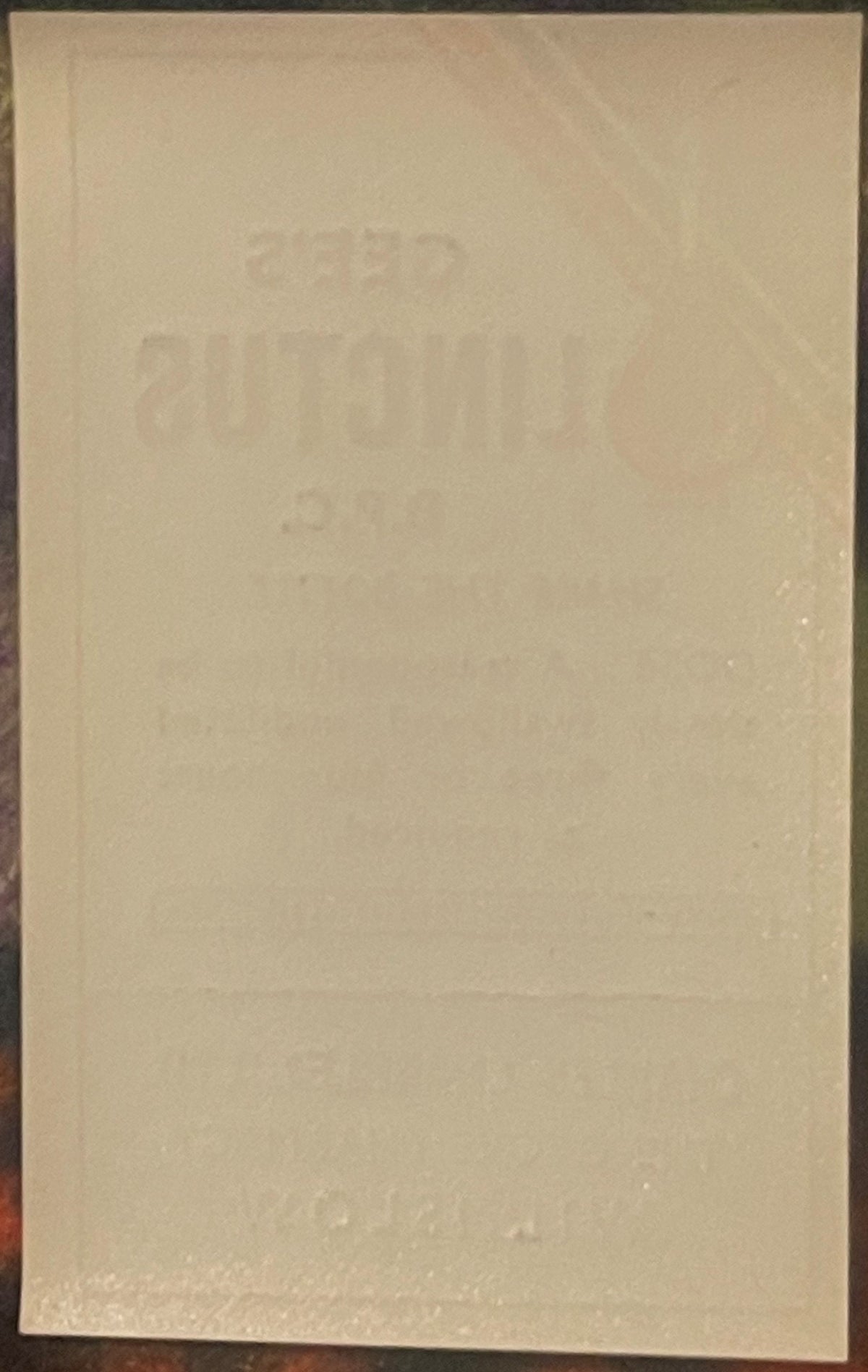
Every word here comes straight off the label: GEE'S LINCTUS, B.P.C., in bold condensed type; SHAKE THE BOTTLE; DOSE: A teaspoonful to be slowly swallowed undiluted every three or four hours as required; then, boxed off, CAUTION.—IT IS DANGEROUS TO EXCEED THE STATED DOSE; and below a rule, CHARLES CHARNLEY LTD., THE GROVE PHARMACY, WILMSLOW. In the top corner, a red-orange dispensing bottle with a stopper sits over diagonal red and black stripes. No printer's mark, no date, no price, no volume anywhere on it.

📅 Not the 1910s - The Caution Line Dates It

The label dates itself. That boxed caution line is, word for word, the wording the British government required on medicines like this one under the Poisons Rules, and those rules didn't take effect until 1936. The typeface matches Gill Sans - the slanted top on the t's, the double-story a - which Monotype didn't release until 1928, with this bold condensed cut following in 1932. So this label can't be earlier than 1928, and realistically it's 1936 or later. The teaspoon dose - not a 5ml plastic spoon - fits anywhere before Britain's dispensing went metric in 1969. And the name at the bottom narrows it further: the shop's newspaper ads call it "Charles Charnley, Pharmacist" as late as September 1946, and the first "Charles Charnley Ltd" turns up in May 1949. So my best read is the late 1940s into the 1960s.

💊 What Was Actually In The Bottle

Gee's Linctus was a real, standardized formula out of the British Pharmaceutical Codex - equal parts Compound Tincture of Camphor, Oxymel of Squill, and Syrup of Tolu. Its formal name was Opiate Squill Linctus, and the Science Museum in London keeps it in its collections three times over: a glass shop round full of Gee's Linctus from 1850 to 1900, a tin carton of Gee's Linctus Pastilles (opium tincture and all) from 1950 to 1965, and a two-liter bottle labeled "Opiate Squill Linctus (Gee's Linctus)" from 1960 to 1985. Compound Tincture of Camphor is camphorated opium tincture - paregoric, in other words - so yes, there's real opium in here, dissolved in alcohol, alongside a squill-based expectorant and a tolu syrup to make it all go down easy. A linctus is meant to be swallowed slowly, coating the throat rather than gulped. Opium and alcohol, I'm quite sure, cures almost anything temporarily. And it's not gone - a version is still made today by Thornton & Ross, though obviously not on a chemist's own label anymore.

👨‍⚕️ The Name Behind It

Gee's Linctus takes its name, the story goes, from Dr. Samuel Jones Gee - a real, well-documented Victorian physician. Gee moved to the Hospital for Sick Children at Great Ormond Street in 1865, working his way up from house surgeon to consulting physician by 1904, with an appointment at St. Bartholomew's Hospital as well, and he's credited with the first full modern description of coeliac disease, in 1888. A real doctor, worth knowing about, whether or not the formula was named for him specifically.

🏛️ Charles Charnley, The Grove Pharmacy

Charles Charnley was a real Wilmslow chemist, and a good chunk of his business is sitting in the Wellcome Collection in London right now - two recipe and prescription books, one inscribed "Charles Charnley, 16 May 1866," running in assorted hands from 1866 to 1940, the other a register of actual prescriptions dispensed to named patients, 1869 to 1925. That's the pharmacy's own paper trail, not just a claim. The shop's own labels from an earlier style call it "Est. 1864," under the name "C. Charnley, M.P.S." - the "Ltd." on this label came later, once the business had incorporated. A Stockport Advertiser notice from 22 July 1938 still lists Charnley at the Grove Pharmacy, so the name was alive and well into the late 1930s.

The Wilmslow paper fills in the rest of the story. Charles Charnley was advertising as a dispensing chemist on Grove Street by 1875, the shop's phone number was 4X around 1909 and 59 by 1914, and by 1946 it was "Charles Charnley, Pharmacist," at Wilmslow 3059. Sometime between 1946 and 1949 the business became Charles Charnley Ltd, and in time it added a second shop at 20 London Road in Alderley Edge. In 1998 the paper called it Wilmslow's oldest chemist shop and talked to 87-year-old Charles Charnley, whose ancestors, it said, founded the business in 1863.

📍 Wilmslow, Cheshire

Wilmslow sits eleven miles south of Manchester and seven miles northwest of Macclesfield. It's a town with some remarkable neighbors. Lindow Man, the Iron Age body found preserved in the peat of Lindow Moss after some 2,000 years, is one of the most important Iron Age finds in Britain and went to the British Museum. And Alan Turing, the mathematician whose work broke the German Enigma codes and helped invent the computer, made his home in Wilmslow from his Manchester University years until his death in 1954. It was a scattering of farms around a parish church until the railway arrived in 1842, after which Manchester's merchants and mill owners started building villas there and commuting in by train. The old town center was Bank Square, Grove Street and Water Lane, and Slater's 1911 directory lists "Charnley Charles, chemist" right there on the north side of Grove Street, between Grove Avenue and Water Lane. That's the Grove in The Grove Pharmacy. In 1936 the urban district grew to take in Handforth and Styal. Today the area's known as part of the "Golden Triangle," one of the wealthier corners of the north of England - a long way from a chemist's counter dispensing opium and squill by the teaspoon.

🏭 A Friday Night Story

The story goes they used to hand these out to factory workers around the country on a Friday night, a teaspoon of opium and alcohol after a hard week in the cotton mills. Quarry Bank Mill, just up the road at Styal, spun cotton until 1959, so Wilmslow had its mill hands close by. It was also the kind of thing people asked the chemist for by name and kept in the cupboard alongside Germolene and Milk of Magnesia. I've never come across another copy of this exact label, so it's a rare one. Wayfair sells posters of this label for $100's of dollars, but a poster is ink on modern paper. These are the labels themselves, never put on a bottle.

This label is not seen much and is very rare, especially in this condition, and big home-decor stores sell posters of it for hundreds of dollars, if that gives you an idea of how collectible it is. I don't know about you, but I prefer to have the original.

Shipping

🚚 Shipping & Handling

  • Shipping costs and timing are calculated at checkout.
  • Items curated and shipped directly by me include U.S. shipping at no additional cost, professionally packed to ensure safe arrival of your artifact.

Items from Vetted Pro Collectors
Shipping for items offered by vetted Pro Collectors is determined at checkout. All Pro Collector listings are reviewed to ensure fair, reasonable shipping practices.

For full details, please refer to our Shipping Policy.

Returns & Exchange

Take your time — you've got a full six months. If a piece isn't right for you, send it back the way it reached you and we're good.

In the first 30 days your money goes straight back the way you paid. After that it's store credit, so you can put it toward something you'd rather have.

Return shipping we sort out between us, case by case. I don't make this difficult.

If something arrives damaged, or it isn't what I said it was, send me a photo within 48 hours and I'll make it right.

Email info@vintageantiquesgifts.com or call 802-356-9872 — that's me answering, not a call center.

The only things I can't take back are custom or special-order pieces and gift cards.

View full details

Preserving History: Authentic Objects Across Eras

— Curated by Travis Weigel