Skip to product information
1 of 3

Vintage and Antique Gifts

Vintage 1960s-1970s Special Police Toy Badge 🚔 Commonwealth of Massachusetts Tin Litho New Old Stock on Original Card

Vintage 1960s-1970s Special Police Toy Badge 🚔 Commonwealth of Massachusetts Tin Litho New Old Stock on Original Card

Regular price 18.00 USD
Regular price Sale price 18.00 USD
Sale Sold out
Shipping calculated at checkout.
Quantity

# What Did It Feel Like the First Time You Pinned On a Badge? 🚔

There is a moment — and if you've ever held one of these, you know exactly what I'm talking about — where the object in your hand simply stops you. You're not looking at a toy anymore. You're not even really looking at a piece of tin. You're looking at a whole mood, a whole era, a whole American childhood compressed into about an inch and a half of brilliantly lithographed metal. The red is still vivid. The eagle still looks like it means serious business. And that golden banner across the bottom still reads POLICE in the kind of confident, no-nonsense script that could make a seven-year-old stand up a little straighter in 1955 — and that still makes a grown collector pause in exactly the same way, seventy years later.

This is one of those pieces I genuinely look forward to telling the story of. Not just because it's beautiful — though it absolutely is — but because it carries so much layered history in such a small, unpretentious package. It's the kind of thing that turns up in an estate lot or the back corner of an old five-and-dime liquidation box and makes you stop everything else you're doing.


What Exactly Is This Piece?

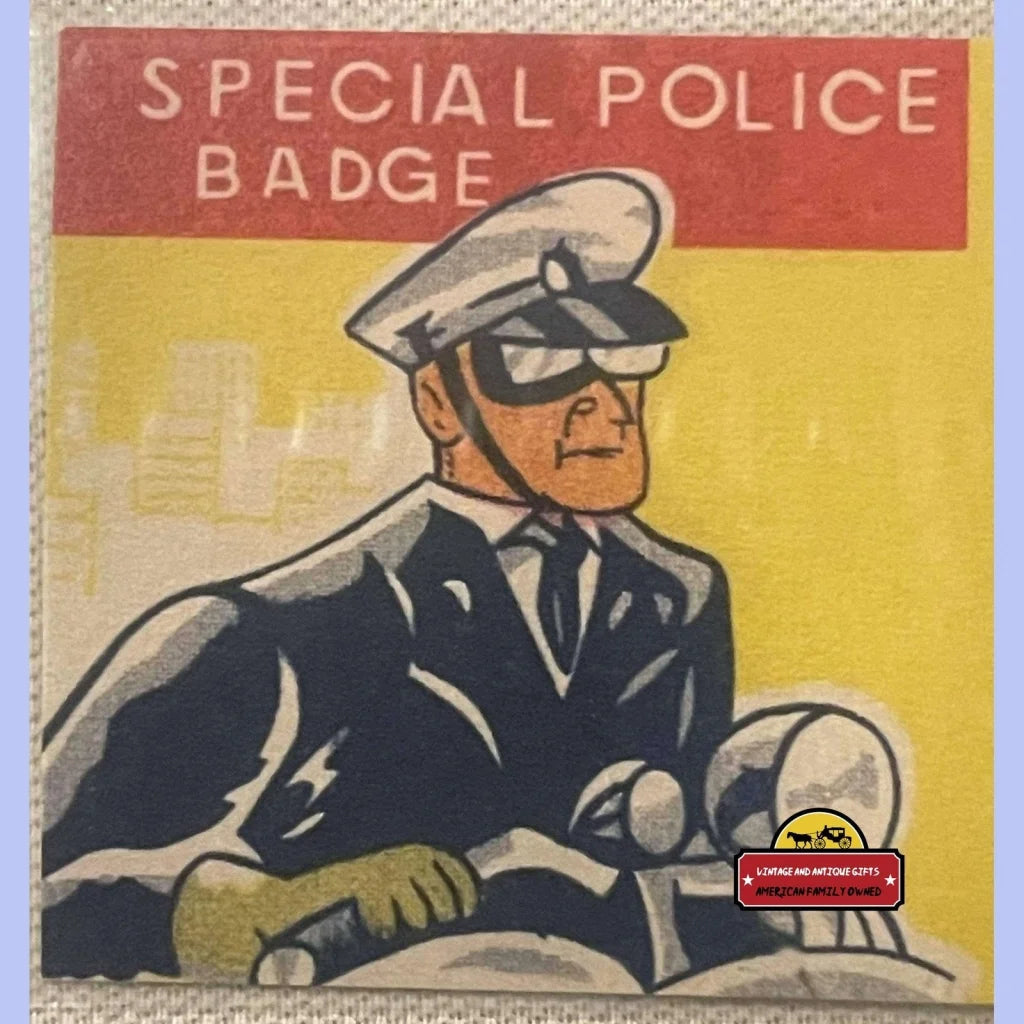
This is a New Old Stock 1950s tin lithography Special Police Badge, Commonwealth of Massachusetts variant, and it is still riding on its original illustrated display card — never separated, never pinned to a shirt, never played with, never touched by the decades except to age gracefully in whatever dry storage kept it safe until now. The badge itself measures approximately 1.5 inches across — that compact, satisfying size that fits perfectly in a child's palm or in a specimen frame — and the original illustrated card it mounts on measures 4 inches by 2.25 inches, printed in the illustrated graphic style that defined mid-century toy and novelty packaging.

The badge face is a deep, saturated red tin lithography background carrying a full heraldic design. At the top, a spread-winged eagle fans out in warm orange and amber tones — that classic American heraldic posture, wings wide, rendered with the kind of confident draftsmanship that took real skill to translate into the lithography process. Below the eagle, an elaborate crest spreads across the center: blue oak leaves, silver scrollwork, botanical flourishes, and at the heart of it all, a central medallion bearing the seal of the Commonwealth of Massachusetts — the state coat of arms rendered in miniature, deep navy, with the Massachusetts heraldic device clearly legible inside. Ringing that central seal in white lettering on a navy band: COMM. OF MASSACHUSETTS. And then, sweeping across the lower face in a golden ribbon banner, the word that made every kid in the neighborhood understand who was in charge: POLICE.

The construction is tin lithography on the face with a thick plastic back — the standard construction method for quality novelty badges of this period — and the whole assembly remains on its original card in the kind of condition that tells you it never made it out of whatever stockroom or storage it was quietly waiting in. This is genuine New Old Stock: unplayed with, unissued, and original in every sense of the word.


🏭 The World That Made This Badge

To understand why this little badge is worth knowing deeply, you have to understand the novelty and toy industry of mid-century America — and specifically the remarkable pipeline that connected American children's imaginations to the manufacturing floors of postwar production.

The 1950s were the golden age of the tin lithography novelty badge. Law enforcement play sets, cowboy gear, space ranger kits, detective badges — these were the currency of American childhood, and the demand was enormous. Five-and-dime chains like Woolworth's, Kresge's, and Ben Franklin stores stocked these by the gross. Carnival prize booths carried them. Mail-order novelty catalogs listed them by the sheet. They were inexpensive enough to be impulse buys but well enough made that many of them have survived in exactly this condition — vivid color, tight construction, original card intact.

The tin lithography process itself was a marvel of industrial craft. Flat tin sheets were printed using offset lithography — ink applied in precisely registered layers to build up color, shadow, and detail — then die-cut and formed into the badge shape. The heraldic designs on these pieces required skilled engravers and plate-makers to translate complex coat-of-arms imagery into something that could be printed at mass-production scale without losing its visual authority. Look closely at the Massachusetts state seal on this badge and you'll see they didn't cut corners: the imagery is recognizable, accurate, and rendered with genuine care for the design.

What makes the Commonwealth of Massachusetts variant particularly appealing to collectors is the specificity of the regional design. These weren't generic "POLICE" badges with a made-up shield — they carried actual state seal imagery, which required whoever designed the lithography plate to work from real heraldic reference. Massachusetts collectors, New England nostalgia hunters, and law enforcement memorabilia specialists all converge on this piece for different reasons, and that intersection of collector communities is exactly what makes regional variants like this one hold their value and their interest.

A badge still on its original illustrated card is therefore meaningfully rarer than a loose badge of identical quality, because the card itself was considered disposable packaging at the time. The people who kept the cards intact were either unusually careful shop owners or — more likely — this stock simply never made it to the sales floor before the store closed, the stockroom was cleared, and the lot passed into collector hands decades later.


🖼️ Display Ideas

Pieces like this deserve to be shown, not hidden in a drawer. Here are a few ways collectors and gift-givers have put this badge to work beautifully:

  • 🖼️ Frame it on its original card in a small shadow box or specimen frame — the 4 x 2.25 inch card fits perfectly in standard small frames, and the red and gold against a dark mat is genuinely striking on a wall
  • 🗄️ Place it in a flat display case alongside other tin litho law enforcement badges from the 1950s to build a state-by-state or era-specific badge collection
  • 🏛️ Use it as a centerpiece in a Massachusetts-themed display — pair it with other Commonwealth ephemera, vintage maps, or mid-century New England memorabilia for a regional display wall
  • 👨‍👦 Gift it still on its original card to a law enforcement professional, a Massachusetts native, a collector, or a family member with a connection to the Commonwealth — the original packaging makes it a presentation-ready gift without any additional work
  • 🎨 Display it in a collector's curio cabinet among vintage police patches, badges, and law enforcement memorabilia — it holds its own visually against much larger and more expensive pieces
  • 📚 Use it as a reference piece or teaching piece in a collection focused on American graphic design, tin lithography art, or mid-century novelty manufacturing — the heraldic draftsmanship on this badge is a legitimate example of the form at its best

🎁 Who Collects These

The honest answer is: more people than you'd expect, coming from more different directions than you might think.

Law enforcement memorabilia collectors are the obvious first audience — people who collect vintage badges, patches, insignia, and police-related artifacts as a dedicated specialty. Within that world, tin litho novelty badges occupy a specific and beloved subcategory: they're affordable, visually rich, historically grounded, and they tell a story about how American culture romanticized law enforcement during the postwar era.

Massachusetts and New England collectors have an obvious regional pull toward this piece. State-specific memorabilia — anything bearing the Commonwealth seal, the state imagery, or a Massachusetts regional identifier — has a dedicated collector base among people with roots in the Bay State. This is the kind of piece that resonates immediately with someone who grew up in Massachusetts, whose family has deep New England ties, or who simply has an affection for Commonwealth history and iconography.

Tin lithography and graphic arts collectors approach this piece from a completely different angle — they're drawn to it as an artifact of the printing and manufacturing craft, appreciating the heraldic draftsmanship, the color registration, the die-cutting, and the overall quality of the design work as expressions of a printing tradition that produced some of the most visually interesting objects of the twentieth century.

Gift-givers round out the audience in a genuinely meaningful way. This is the kind of piece — NOS, on its original card, in exceptional condition — that makes an extraordinary gift for a retiring officer, a Massachusetts native with a sense of humor and history, a young collector getting their start, or simply someone who appreciates the real thing. It arrives ready to give: the original card is the packaging.

And finally, there are the collectors who simply know what they're looking at — people who have been picking up vintage Americana long enough to recognize NOS condition immediately, who understand what it means that the red is still vivid and the card is still intact, and who don't need to be convinced that a piece this well-preserved, this specific, and this evocative of a particular American moment is worth adding to the shelf.


❓ Frequently Asked Questions

Is this a real police badge or a toy/novelty badge?

This is a genuine mid-century novelty badge — a tin lithography collectible made in the 1950s for the toy, novelty, and five-and-dime market, not an issued law enforcement credential. It is not a functional law enforcement badge and was never intended to be one. What it is is a historically authentic artifact of mid-century American popular culture: a real object, made in a real era, with real craftsmanship, that has survived in genuinely exceptional New Old Stock condition. Collectors of law enforcement memorabilia, vintage Americana, and tin lithography art all regard these as legitimate and desirable collectibles in their own right.

What does "New Old Stock" mean, and why does it matter here?

New Old Stock (NOS) means this badge was manufactured in the 1950s, entered inventory or storage, and was never sold, played with, or separated from its original card. It is not a reproduction. It is not a badge that has been cleaned, restored, or "refreshed." The vivid red you see in the photographs is the original lithography, unaltered by time. The card is the original illustrated backing card from the period. NOS condition in tin lithography items is genuinely significant because most pieces that were sold at the time were played with, pinned to clothing, lost, or discarded — items that survive in original, unissued condition are meaningfully rarer than their played-with counterparts and represent the piece exactly as it left the factory.

How do I know this is actually from the 1950s?

The dating of this piece to the 1950s is supported by several converging factors: the tin lithography construction method (which was the standard for novelty badges of this era), the graphic design aesthetic of both the badge and the backing card (consistent with mid-century novelty and toy packaging conventions), and the materials used (the combination of printed tin face and early plastic back is characteristic of the period). The heraldic design style and typography are also consistent with 1950s American novelty production. Pieces like this have been documented and collected as 1950s-era artifacts within the tin litho and law enforcement memorabilia collecting communities for decades.

What condition is the badge in — is the color really still vivid?

Yes — genuinely, accurately yes. Because this is New Old Stock that was never played with and apparently stored in good conditions, the lithography has retained its original color saturation in a way that played-with examples simply cannot. The red background is deep and vivid. The gold of the banner lettering retains its warm, metallic quality. The eagle's orange and amber tones are clear. The navy of the Massachusetts seal ring is distinct. This is not a touched-up description — it is what NOS condition actually looks like when a piece has been properly preserved, and it's exactly why NOS condition commands the attention it does among serious collectors.

Is this a good gift for someone in law enforcement, or for a Massachusetts native?

It is an exceptional gift for either — or for both at once, which is a combination that comes up more than you might think. For a law enforcement professional, especially one with Massachusetts connections, a NOS 1950s tin litho badge bearing the Commonwealth seal has genuine sentimental and historical resonance. It's the kind of thing that goes on a display shelf or in a case, not in a drawer. For a Massachusetts native or a collector of New England memorabilia, the state-specific design makes this immediately meaningful in a way that generic police badge collectibles simply are not. And because it is still on its original illustrated card, it arrives presentation-ready — the original card is the display.

How does this fit into a broader law enforcement or badge collection?

Beautifully, and at a scale that works with almost any collection. At 1.5 inches, this badge is the right size to display alongside vintage patches, larger badge formats, insignia cards, and other mid-century law enforcement ephemera without being lost. Collectors who focus specifically on tin lithography novelty badges often build state-by-state sets, and a Massachusetts NOS example in this condition is a genuine anchor piece for that kind of display. Collectors who focus on Massachusetts law enforcement memorabilia will find that state-specific novelty badges from this era appear with much less frequency than official or issued badges — making NOS examples particularly sought after within that specialty.

Can this be framed or displayed without damaging it?

Yes — and framing it is one of the best things you can do with it. The badge on its original card (4 x 2.25 inches) fits comfortably in a small shadow box frame or specimen frame, and the visual impact of the red, gold, and navy heraldry against a dark mat is genuinely striking. Because this is NOS and the card is still intact, you have the option to display the complete original assembly — badge plus card — which tells the full story of what this object is and where it comes from. If you choose to remove the badge from the card for display in a badge case or collection tray, the pin-back construction makes that straightforward. Either approach preserves the piece; the choice comes down entirely to your display preference.

⭐ When Kids Really Did Get Badges from the Law

The mid-century American childhood this badge comes from was full of real badges given by real officers. Junior deputy programs let sheriffs swear in schoolkids as honorary deputies; school safety patrol programs, organized since the 1920s, put badges and belts on millions of children; police departments handed out badges at parades, fairs, and classroom visits as a matter of civic routine. A Commonwealth of Massachusetts Special Police badge was the dime-store cousin of all that — the badge a kid could buy with pocket change. That documented world of junior programs is the backdrop this little survivor belongs to.

Shipping

🚚 Shipping & Handling

  • Shipping costs and timing are calculated at checkout.
  • Items curated and shipped directly by me include U.S. shipping at no additional cost, professionally packed to ensure safe arrival of your artifact.

Items from Vetted Pro Collectors
Shipping for items offered by vetted Pro Collectors is determined at checkout. All Pro Collector listings are reviewed to ensure fair, reasonable shipping practices.

For full details, please refer to our Shipping Policy.

Returns & Exchange

Take your time — you've got a full six months. If a piece isn't right for you, send it back the way it reached you and we're good.

In the first 30 days your money goes straight back the way you paid. After that it's store credit, so you can put it toward something you'd rather have.

Return shipping we sort out between us, case by case. I don't make this difficult.

If something arrives damaged, or it isn't what I said it was, send me a photo within 48 hours and I'll make it right.

Email info@vintageantiquesgifts.com or call 802-356-9872 — that's me answering, not a call center.

The only things I can't take back are custom or special-order pieces and gift cards.

View full details
  • 5 stars: 2 (100%)
  • 4 stars: 0 (0%)
  • 3 stars: 0 (0%)
  • 2 stars: 0 (0%)
  • 1 star: 0 (0%)
h
h***p (1648)

Thank You……….Rick

A
Alisa

Wow! I am so happy I purchased from you. Love what I purchased and love the extras too. Very nice package. Thank you to Charice and Myles especially.

Hello Alisa! We're over the moon with your 5-star review! Your support for our vintage Police Badge is very much appreciated. We love to know you appreciate the fine details of our collection as much as we do. Thank you for being such a fabulous customer. Here's to more vintage shopping sprees with you! ‍♀️