Skip to product information
1 of 3

Vintage and Antique Gifts

Vintage Tin Litho Special Police Badge 🚔 Herb Cooper Special Security Patrol Pin — Made in Japan, 1950s–60s

Regular price 29.00 USD
Regular price Sale price 29.00 USD
Sale Sold out
Shipping calculated at checkout.

Description

What If the Badge on Your Lapel Could Tell a Story Nobody Else on the Block Could Tell? 🚔

There is a moment — and every serious collector knows exactly what it feels like — when you pick up a small object and the whole mid-century world comes flooding back in one rush. The dime store. The spinner rack by the front door. The glass counter with the candy and the pocket toys and the little carded novelties that cost a quarter but felt like treasure. This is one of those objects. A round tin lithograph pin-back button dressed in red, white, green, and gold, centered on a bold phoenix rising with wings spread wide, ringed by the words HERB COOPER SPECIAL SECURITY PATROL — mounted on its original illustrated card, still sealed in its original clear plastic sleeve, exactly as it would have sat waiting for the right kid or the right collector since the day it left the factory floor.

Pick it up. Hold it. It stops you cold.

---

🎖️ What You Are Actually Looking At

This is a New Old Stock mid-century tin lithograph pin-back novelty badge — carded, sealed, and unissued — bearing the full printed identity of the Herb Cooper Special Security Patrol. The badge itself is a round tin litho button rendered in a rich palette of red, white, green, gold, and black. At its center, a phoenix — or an eagle rendered in that heroic, spreading-winged posture that mid-century graphic designers used whenever they wanted to signal authority, protection, and power — rises against a deep teal-green field. Across the bird's breast, in bold red capital lettering: PATROL. Arching around the top of the white outer ring: HERB COOPER. Completing the circle on the lower arc, split to the left and right of the bird's tail feathers: SPECIALSECURITY. A green border ring frames the whole composition. The printing is precise, the colors are vivid, and the whole design has the confident graphic weight of mid-century commercial art at its best — flat, bold, immediately readable, built to catch a child's eye at three feet and a collector's eye at thirty years' distance.

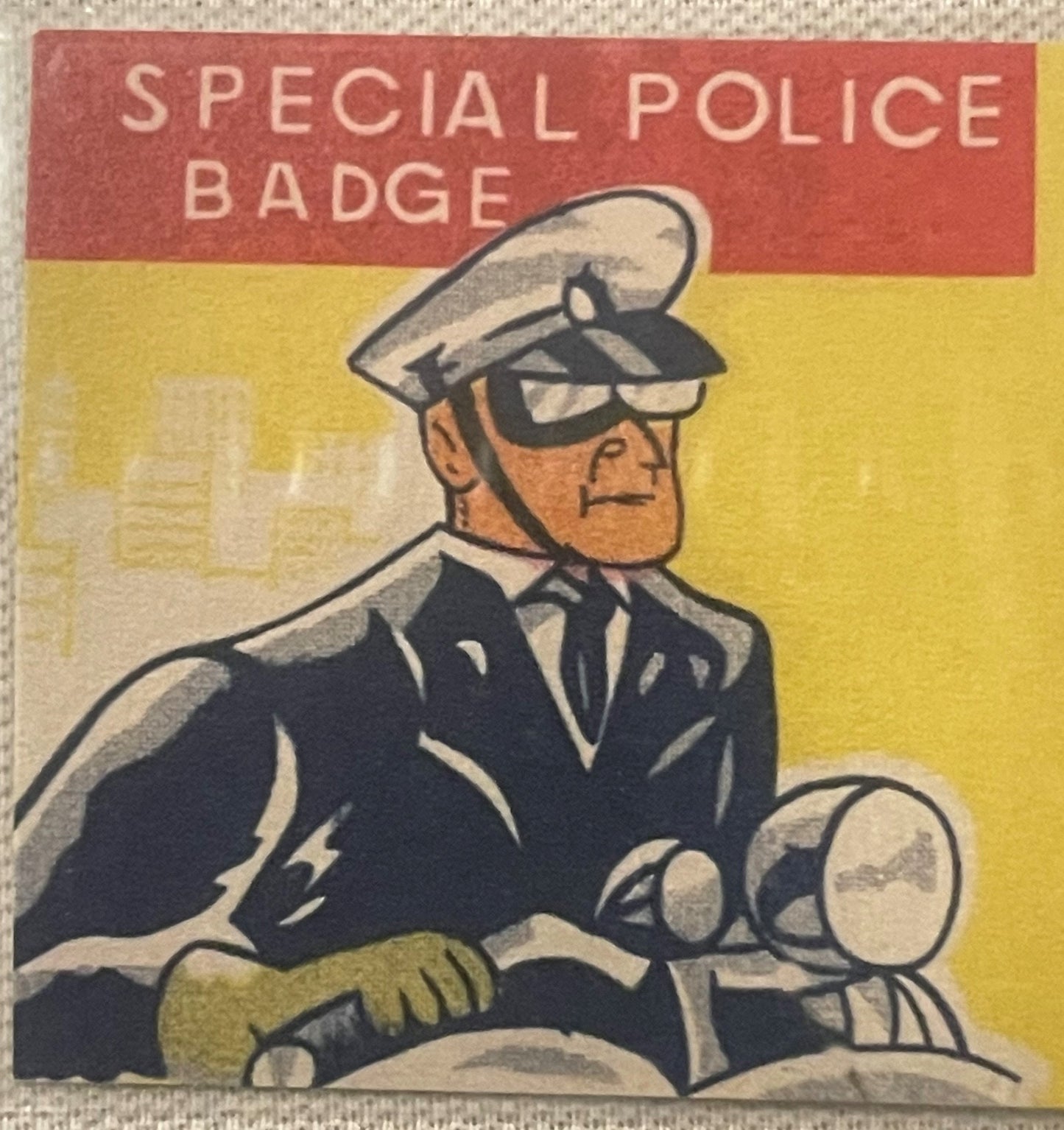
The badge rides on its original display card — a yellow card printed with a masked motorcycle officer leaning hard over his handlebars, his white cap pulled low, heavy dark goggles or a mask covering his eyes, every line of him radiating focused, forward-moving authority. Above him, in bold white lettering against a red banner: SPECIAL POLICE BADGE. The illustration style is that flat, graphic, slightly heroic comic-book register that American commercial artists had perfected by the mid-twentieth century — the same register you see in Golden Age comics, in World War II recruiting posters, in the dime-store toy packaging that defined an entire generation's visual vocabulary. In the lower right corner of the card, in small crisp letters: JAPAN. The whole package — badge, card, sleeve — is New Old Stock. It has been waiting, as NOS pieces do, for the person who recognizes what it actually is.

Badge diameter: approximately 1.5 inches. Card dimensions: approximately 4 x 2.25 inches.

---

🏭 The World That Made This Badge — Postwar Japanese Tin Litho and the American Dime Store

To understand this badge fully, you have to understand the world it came from — because that world no longer exists, and the objects it produced are now the primary record of what it felt like to live inside it.

In the years following World War II, Japan's manufacturing sector rebuilt itself with extraordinary speed, and a significant portion of that rebuilding was channeled into the production of small tin lithographed goods for the American consumer market. Tin was, as collectors have long noted, the plastic of the 1950s — inexpensive to form, easy to print on with vivid colors, light enough to ship by the gross, and durable enough to survive the handling of a child or the years in a storage drawer. Japanese factories turned out an astonishing range of tin-litho novelties: wind-up toys, noisemakers, spinning tops, pencil boxes, party favors — and badges. Thousands upon thousands of little carded badges, each one a complete small world of color and design and fantasy.

These badges were not manufactured to deceive anyone. They were novelties — play objects, costume accessories, dime-store treasures. A child who pinned one to his jacket on Halloween or to his shirt for a Saturday afternoon of backyard patrol was not impersonating a police officer in any legal sense; he was doing what children have always done, which is trying on the costume of authority and seeing how it fits. The badges were sized for that fantasy — big enough to notice, small enough to be clearly a toy — and their graphics were calibrated to the same end. Bold. Colorful. Heroic. The kind of design that makes a seven-year-old stand up a little straighter.

The "Made in Japan" mark is a useful dating tool for collectors. Under the postwar Allied occupation, goods exported from Japan were required to be marked "Made in Occupied Japan." When the occupation formally ended in 1952, that requirement was lifted, and manufacturers returned to the simpler "Japan" or "Made in Japan" designation. Pieces marked only "JAPAN" — as this badge is — therefore date to the post-1952 window, which aligns precisely with the mid-century design vocabulary on display here: the bold phoenix graphic, the motorcycle officer illustration, the red-and-yellow color palette of the card. Everything about the visual language of this piece speaks to a specific window of American commercial culture, and the manufacturing mark confirms it.

These carded novelty badges were distributed through the American dime-store network — the Woolworths, the Kresges, the Ben Franklins, the local variety stores that anchored every small town's main street. They sat on spinner racks near the front door, or lay flat in shallow counter bins, or hung in groups from pegboard displays. They were impulse purchases, a quarter or less, and they were everywhere. Which means that most of them were opened, pinned on, played with, lost. The ones that survived sealed on their original cards — the New Old Stock, the pieces that somehow never made it off the rack or out of the stockroom — are now the survivors. They are the ones that tell the full story: badge, card, sleeve, intact, together.

---

🦅 Herb Cooper Special Security Patrol — The Name, the Phoenix, and the Lore That Travels With It

The name printed on this badge — Herb Cooper Special Security Patrol — is the detail that lifts this piece out of the category of generic novelty and into something more specific, more personal, and more resonant for the collector who wants a story to go with the object.

Private security and patrol services were a genuine and growing feature of mid-century American commercial and residential life. As American cities expanded after the war, as suburban developments and industrial parks spread outward from city centers, and as businesses large and small looked for ways to protect property after hours, the private patrol industry flourished. These were not the large national firms of later decades; they were regional, often deeply local operations — a man with a car, a uniform, a badge, and a territory he knew block by block. Many of them were founded by former law enforcement officers or military veterans who brought their training and their institutional sense of order into a civilian context. They gave their companies names that projected authority: Security Patrol. Special Services. Protective Agency. And they ordered supplies — including badges — through the same commercial channels that supplied the toy and novelty trade, because in the mid-century dime-store economy, a small regional patrol service and a children's toy manufacturer were drawing from the same catalog of carded tin goods.

Lore passed down among collectors of mid-century security and law enforcement memorabilia holds that a number of these regional patrol badges were produced in small runs for specific operators — men who wanted their company name on a piece that could be given to a client, worn by a part-time guard, handed to a neighborhood kid as a token of the patrol's presence in the community. The phoenix design on this badge is worth pausing over in that light. The phoenix — rising, wings spread, tail feathers fanned — is one of the oldest symbols of renewal and protective watchfulness in Western iconography. It was a deliberate choice for a security operation. It says: we endure. We rise. We are here when others have gone home.

Local legend, as it circulates among the dealers and pickers who have moved pieces like this through the Midwest collector circuit over the years, holds that the "Herb Cooper" name represents exactly the kind of one-man or small-team operation that defined mid-century private security at the regional level — a proprietor who put his own name on his company the way a barber or a plumber did, because in that era, your name on the door was your bond and your reputation. Whether Herb Cooper himself ever wore one of these badges on a night patrol, or whether they were ordered as giveaways and promotional tokens for a client base that stretched across a specific community, is the kind of detail that the paper record does not always preserve. What the object itself preserves is the graphic evidence of a mid-century security operation that took its identity seriously enough to commission a badge with a phoenix at its center and its full name in red capital letters around the ring.

The motorcycle officer on the card adds another layer. He is not a generic figure — or rather, he is generic in form but specific in implication. The dark goggles, the white cap, the forward lean over the handlebars: this is the mid-century American ideal of mobile law enforcement authority, the officer-on-the-move who covers territory, who cannot be pinned down or anticipated, who is present everywhere and nowhere. Paired with a private security patrol badge, the illustration does something interesting: it blurs the line between official law enforcement and private patrol in exactly the way that mid-century American security culture often did. The private patrol man was not a police officer, but he occupied the same cultural space in the imagination of the communities he served. He was the night watchman, the trusted presence, the person you called when you saw something wrong. The motorcycle officer on this card honors that role.

---

🎨 The Craft of the Thing — Tin Litho at Mid-Century

It is worth slowing down for a moment to appreciate what tin lithography actually is, because the process that produced this badge is itself a piece of history that has largely passed out of everyday manufacturing.

Lithographic printing on tin — tin litho — involves transferring an inked image onto a thin sheet of tin or tinplate using an offset lithography process, then forming the printed sheet into the desired shape. The result is a surface where the image is integral to the material rather than applied on top of it: the colors are laid down in separate passes, each pass adding a new layer of ink and a new register of color, and the final piece has a depth and richness that later printing methods often cannot match. Look closely at the phoenix on this badge — at the way the gold of the feathers sits against the deep teal-green of the background, at the way the red lettering carries both body and outline, at the way the white of the outer ring gives the whole design room to breathe. That is the craft of the mid-century tin litho worker expressing itself in a piece that was, by commercial standards, a minor item — a novelty badge, a fraction of the production run, something to be sold for pennies. And yet the craft is there, fully present, because that was the standard of the era.

The printing on the card is equally accomplished in its own register. The motorcycle officer is rendered in a limited palette — navy, white, yellow, a touch of orange at the skin — but the draftsmanship is confident and the composition is immediate. You read it in one glance: authority, motion, protection. That is what good commercial illustration does, and this card does it well.

---

🖼️ Display Ideas

  • 🗂️ Shadow box framing: Mount the carded badge in a small shadow box alongside a period photograph of mid-century American street patrol or a dime-store interior — the contrast between the intimate scale of the badge and the sweep of the era it represents makes for a compelling display.
  • 🚔 Mid-century law enforcement grouping: Pair with other carded tin novelty badges from the same era — sheriff's stars, traffic officer pins, junior detective badges — to build a collection that maps the full range of mid-century American safety iconography.
  • 🦅 Phoenix and eagle themed display: Group with other mid-century pieces that use the phoenix or eagle as a central graphic — fraternal pins, civic organization buttons, military insignia — to show how pervasively that image ran through postwar American visual culture.
  • 📦 NOS dime-store display: Keep it carded and sealed and display it in a shallow tray or on a small easel alongside other NOS carded novelties from the era — the card and the sleeve are part of the artifact, and presenting them together tells the full story of how these pieces reached their buyers.
  • 🏛️ Private security history collection: Set within a grouping of mid-century private security and patrol ephemera — patches, letterhead, vehicle decals, promotional materials — where the Herb Cooper badge becomes a key piece of the visual record of a largely undocumented industry.
  • 🎨 Mid-century commercial art study: Frame alongside examples of mid-century graphic design — advertising art, toy packaging, catalog illustration — as a teaching example of how lithographic printing and flat commercial illustration worked together at the height of the form.
---

🎁 Who Collects These

The collector base for mid-century carded tin litho novelty badges is broader and more varied than you might expect, and it is genuinely passionate. At one end of the spectrum are the toy and novelty collectors — people who have spent decades tracking down NOS dime-store merchandise in its original packaging, for whom the combination of badge, card, and sleeve is the holy grail. For them, this piece represents one of the cleanest possible examples of a mid-century Japanese-manufactured American market novelty, complete and unissued.

At the other end are the law enforcement and security history collectors — men and women who collect badges, patches, uniforms, and ephemera from official and private protective services, and for whom the "Herb Cooper Special Security Patrol" identity on this piece makes it a specific artifact rather than a generic toy. The named identity of a small regional operation, rendered in tin litho on a mid-century novelty card, is exactly the kind of piece that fills a gap in the documentary record of an industry that rarely preserved its own materials.

In between are the Americana collectors broadly — people drawn to the visual vocabulary of mid-century American commercial culture, to the flat bold graphics of the carded display, to the motorcycle officer illustration, to the whole aesthetic world that this small object represents. And there are the phoenix and eagle symbol collectors, the tin litho specialists, the pinback button enthusiasts, and the people who simply grew up in the era and feel the pull of recognition when they see a piece like this. All of them are right to want it.

---

❓ Frequently Asked Questions

Is this a real security patrol badge or a toy?

It is a mid-century tin lithograph novelty badge — a carded play and costume item produced for the American dime-store market and manufactured in Japan. The "Herb Cooper Special Security Patrol" name is printed directly on the badge face as part of the lithographic design, giving it the specific identity of a named security operation rather than a purely generic design. Whether that identity was commissioned by an actual regional patrol service — as the lore surrounding these pieces suggests was common practice for small operators who ordered custom-run badges for promotional or uniform use — or whether it was applied as a design element by the card manufacturer or distributor, the badge carries that identity fully and permanently as part of its original manufacture. It is not a modern reproduction. It is not an officially issued law enforcement credential. It is exactly what it presents itself as: a mid-century carded novelty badge with a specific and evocative identity printed into the tin.

What does the "JAPAN" mark tell us about when this was made?

The "JAPAN" mark — as opposed to "Made in Occupied Japan" — places manufacture after the end of the Allied occupation, which concluded in 1952. Goods manufactured in Japan during the occupation period were required by Allied authorities to carry the "Occupied Japan" designation; once that requirement was lifted, manufacturers returned to the standard "Japan" or "Made in Japan" mark. The visual design vocabulary of this piece — the bold flat graphic style of the phoenix illustration, the red-and-yellow palette of the card, the motorcycle officer illustration — is fully consistent with mid-century American commercial aesthetics. The "JAPAN" mark combined with the design language places this confidently in the mid-century postwar window.

What is New Old Stock (NOS) and why does it matter?

New Old Stock refers to merchandise that was manufactured and stocked for retail sale but was never sold and never used — inventory that survived in storage, in a stockroom, in a warehouse, or in a collection without being opened, worn, or separated from its original packaging. NOS status matters enormously to collectors because it means the piece survives in its complete original form: badge, card, and sleeve together, exactly as they were assembled at the factory. Most carded novelty badges from this era were opened and the badge removed; the card was discarded; the badge itself was worn and played with and eventually lost. NOS examples preserve the full artifact — the commercial object as it was designed and presented to the buyer — rather than just the surviving component. For display, for study, and for the simple pleasure of encountering a piece of mid-century commercial culture intact, NOS status is the highest form of survival.

What is tin lithography and how is it different from other printing methods?

Tin lithography is a printing process in which an inked image is transferred onto a sheet of tinplate using an offset lithographic press, then the printed sheet is formed into the desired shape — in this case, a round pin-back button. The process prints directly onto the metal surface, so the image becomes integral to the material: it does not sit on top as a decal or label might. Multiple passes of the press build up the full color range in separate layers, which is why well-executed mid-century tin litho pieces have a depth and richness to their color that later printing methods often do not replicate. The craft required precision at every stage: the printing, the registration of colors, the forming of the metal. A well-printed tin litho badge of this era represents a genuine manufacturing accomplishment, even when — as with novelty goods — the commercial context positioned it as an inexpensive item. The phoenix design on this badge is a strong example of the form.

Who was Herb Cooper, and what was the Herb Cooper Special Security Patrol?

This is the question at the heart of what makes this badge interesting as a collectible, and the honest answer is that the paper trail is thin in ways that are themselves historically meaningful. Mid-century private security operations at the regional and local level were often small, proprietor-run businesses that left few formal records: no national directory listings, no trade press coverage, no corporate filings that have survived in searchable form. A man who put his name on a security patrol — as proprietors of that era routinely did — might have run a serious and well-regarded operation in his community for decades without generating the kind of documentary footprint that later research can easily find. Lore among mid-century security and law enforcement collectors holds that small operators frequently ordered custom-run novelty badges for promotional use, client relations, or part-time guard identification — and that the tin litho novelty trade was happy to accommodate those runs at the kind of price point that made sense for a small business. The phoenix at the center of this badge — a deliberate symbol of watchfulness and renewal — suggests a proprietor who thought about the image he wanted to project. The name printed there is the name he chose to stand behind. That is the record this object preserves.

Is the card part of the collectible, or just packaging?

The card is absolutely part of the collectible — and among serious collectors of carded tin novelty badges, it is often the harder piece to find. The badge itself is a survival; the card plus badge plus sleeve intact is a complete artifact. The illustrated card carries its own graphic and cultural content: the motorcycle officer illustration is a piece of mid-century commercial art in its own right, and the typography, color, and composition of the card tell you something important about how these badges were positioned and marketed to their buyers. The card anchors the badge in its commercial context — dime-store novelty, child's play item, fantasy of authority and protection — in a way that the badge alone, separated from its presentation, cannot fully convey. When you display this piece, display it carded. The whole is greater than the sum of its parts.

How does this badge fit into a broader collection of mid-century Americana or security memorabilia?

It fits beautifully in several directions at once, which is part of what makes it such a satisfying piece. As mid-century Americana, it represents the convergence of postwar Japanese manufacturing, American dime-store retail culture, and the graphic design vocabulary of a specific and well-defined era — the kind of object that a curator of mid-century commercial culture would immediately recognize and value. As security and law enforcement memorabilia, it occupies a specific niche: the named private patrol badge, a category that is genuinely underrepresented in most collections because so few pieces from small regional operations survived in identifiable form. As a tin litho piece, it demonstrates the craft at a scale — the small pin-back button — where the printing demands are especially exacting. And as a NOS carded novelty, it is the complete thing, not a fragment. Any one of those angles would make it worth having. Together, they make it the kind of piece you hold onto.

🚔 The Real Junior Programs Behind Badges Like This

Dime-store tin badges did not live in a vacuum. Across mid-century America, real law enforcement agencies ran junior deputy and junior police programs: sheriffs swore in wide-eyed honorary junior deputies at county fairs and school assemblies, police departments sponsored school safety patrols — a movement that began in the 1920s and put belts and badges on millions of schoolchildren — and an officer handing a kid a badge at a parade or classroom visit was a familiar piece of civic life. A Special Security Patrol badge in a child's hand belonged to that same world, the era when a badge from a trusted grown-up could make a kid stand a little straighter. That is the history a carded survivor like this carries beyond its tin and ink.

Shipping

🚚 Shipping & Handling

  • Shipping costs and timing are calculated at checkout.
  • Items curated and shipped directly by me include U.S. shipping at no additional cost, professionally packed to ensure safe arrival of your artifact.

Items from Vetted Pro Collectors
Shipping for items offered by vetted Pro Collectors is determined at checkout. All Pro Collector listings are reviewed to ensure fair, reasonable shipping practices.

For full details, please refer to our Shipping Policy.

Returns & Exchange

Product Page Return Policy

  • 60-Day Returns – Items must be in original condition.
  • Refunds – Issued after inspection (excluding shipping costs).
  • Return Shipping – Customer is responsible unless item is damaged or incorrect.
  • Damaged/Incorrect Items – Contact us within 48 hours for a replacement or refund.
  • Easy Returns – Email [email protected] or call 802-356-9872 to initiate a return.

For full details, visit our Refund Policy.

View full details