Skip to product information
1 of 6

Vintage and Antique Gifts

Vintage 1960s Mid-Century Globe Pencil Sharpener Unopened in Box No. 7204 Novelty Desk Toy Schoolroom Collectible 🧸

Vintage 1960s Mid-Century Globe Pencil Sharpener Unopened in Box No. 7204 Novelty Desk Toy Schoolroom Collectible 🧸

Regular price 17.00 USD
Regular price Sale price 17.00 USD
Sale Sold out
Shipping calculated at checkout.
Quantity

Spin the world, then sharpen your pencil in its base.

A 1960s globe pencil sharpener, No. 7204, unopened in its original box. It is a childhood desk toy with two stories printed on it. The little tin map still carries the USSR, a country that has not existed since 1991. The box end reads MADE IN HONG KONG, from the years when a British colony full of refugees and plastics workshops was becoming the toy maker of the world.

The Globe Sharpener Up Close

The tin globe is printed in flat, bright colour on a deep blue sea, with a fine seam around the equator where its two halves meet. North America is red with green to the north, South America yellow, Africa red-orange, Europe green, the Soviet Union red across northern Asia and China yellow beside it. The lettering is tiny and sharp: PACIFIC OCEAN, ATLANTIC, INDIAN OCEAN, CARIBBEAN SEA, ARABIAN SEA, NORTH AMERICA, UNITED STATES OF AMERICA, CHICAGO, SOUTH AMERICA, VENEZUELA, COLOMBIA, PERU, BOLIVIA, BRAZIL, AFRICA, EUROPE, ASIA, CHINA, and island names down to the Seychelles, Madagascar and Juan Fernandez off Chile.

It turns in a cream plastic half-meridian arc set on a red-orange domed plastic base. The sharpener is a dark blue insert built into the front of that base, with the pencil hole facing out, so the globe can sit on a desk and do its job without being moved.

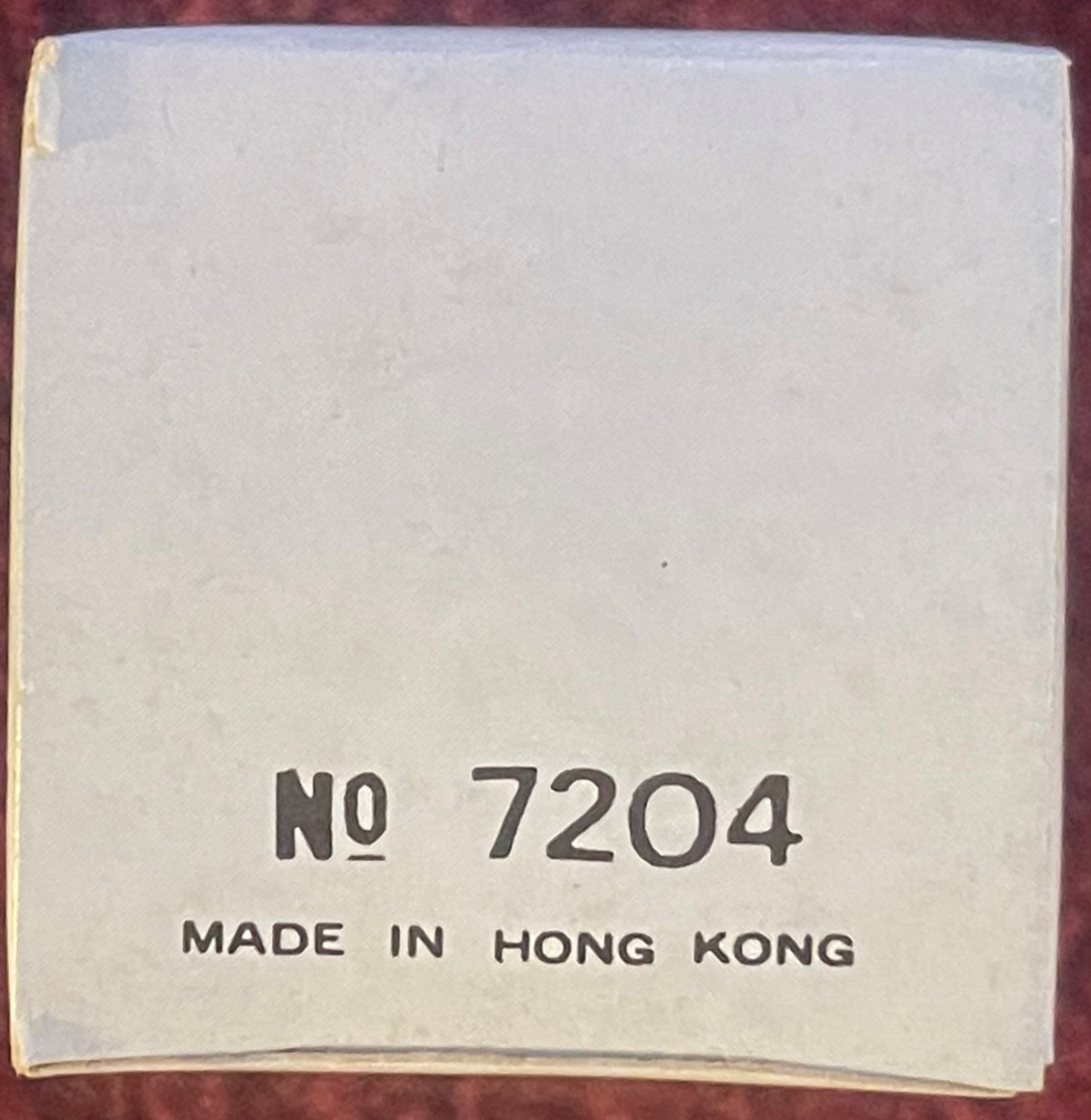
The box is part of the charm. On the front, PLASTIC is hand-lettered in black capitals beside "Pencil Sharpener" in swooping red script, over a painting of the globe on a yellow arc and green base above a red wave. The side panel shows a hand holding the sharpener while a magnifying glass reveals a blue pencil going into the red blade block inside, a small picture lesson in how it works. "No 7204" is printed on the side and again on the end flap, above MADE IN HONG KONG. The painted box shows a yellow arc and a green base; the sharpener photographed has a cream arc and a red-orange base.

  • Style number: No. 7204
  • Marked: MADE IN HONG KONG (box end flap)
  • Globe: lithographed tin on a plastic half-meridian arc
  • Base: domed plastic with a built-in pencil sharpener
  • Size: 3 inches by 1.75 inches (about 7.6 x 4.4 cm)
  • Condition: new old stock, unopened in its original box; the one photographed was taken out to show the globe and stand

A Map of a World That Is Gone

The map is a Cold War document you can close your hand around. It names the Union of Soviet Socialist Republics across the top of Asia, the state that dissolved on December 26, 1991, and broke into fifteen independent countries. China sits beside it, a solid block of yellow. On the far side, Chicago is marked inside the United States, and the tiny Chilean islands of San Ambrosio, San Felix and Juan Fernandez are named in the Pacific, detail enough for a child to hunt for with a fingertip before the pencil ever went in.

The CHICAGO on the map names a city with its own globe and sharpener history. Luther Replogle began Replogle Globes there in 1930, and by the mid-20th century it was the largest globe maker in the world. The Chicago-based Automatic Pencil Sharpener Company, APSCO, sold its sharpeners under names like Chicago, Giant and Dexter. This little sharpener was made in Hong Kong and carries neither name.

Made in Hong Kong: Refugees, Plastic and the World's Toy Box

Those three words on the box carry one of the great industrial stories of the twentieth century. Hong Kong's first plastics factory, the China Plastics Company, opened in 1947 on Tam Kung Road in To Kwa Wan. Its founder, Chieng Han-chow, is remembered as the father of the Hong Kong plastic industry. His first products were plastic plates in four colours, made on a 16-ounce injection moulding machine, the largest in the colony at the time. He co-founded the Hong Kong Plastic Manufacturers Association in 1957, and the trade exploded around him: 299 plastics factories employing 9,663 workers by 1959, and 977 factories with 30,421 workers by 1962. Many were small cottage workshops in tenement buildings and ground-floor shops.

American toy companies moved part of their manufacturing to Asia, where costs were lower, and hired Hong Kong's plastics factories to run second production lines for plastic toys. Toys became one of Hong Kong's four pillar industries, alongside electronics, textiles and plastics. In 1970 the colony counted about 1,100 toy factories employing some 40,000 workers, and in 1972 Hong Kong replaced Japan as the largest exporter of toys in the world. By 1980 there were more than 2,000 toy factories and 56,000 workers.

Plastic Flowers, Li Ka-shing and May 1967

A famous Hong Kong rags-to-riches legend grew out of the same plastic. The story goes that Li Ka-shing, who reached Hong Kong as a refugee boy in 1940, took a job at a plastics trading company and worked 16 hours a day. In 1950 he started his own business, Cheung Kong Industries, learned to mix colour into plastic so it looked like real petals, and became the largest supplier of plastic flowers in Asia. The flower money went into property, the business that built his fortune.

The flower trade also lit the fuse of the colony's worst unrest. On May 1, 1967, workers struck at the Hong Kong Artificial Flower Works in San Po Kong, where only 174 of the 679 workers belonged to a union. When management and pickets clashed on May 6, riot police were called in and 21 workers were arrested. The dispute grew into the 1967 riots: eight months of strikes, street battles and bombs that left 51 people dead, 832 injured and 4,979 arrested, until Premier Zhou Enlai ordered the leftist groups to stop the bombings that December. The turning point pushed the government toward reform, and Governor Murray MacLehose, in office from 1971, greatly expanded the changes that helped carry Hong Kong into the ranks of the Four Asian Tigers.

From Penknife to Pencil Sharpener

For most of the pencil's life it was sharpened with a knife; the pocket penknife takes its name from trimming quill pens. In Paris, Bernard Lassimone received the first patent for a pencil sharpener, French patent No. 2444, in 1828. Thierry des Estivaux gave the hand-held sharpener its recognisable modern form in 1847: a blade set so its edge just enters a cone, shaving wood and graphite as the pencil turns. Walter Kittredge Foster of Bangor, Maine, took the first American patent in 1855 and founded the first pencil sharpener company in the world.

Then came the idea this globe is built on. John Lee Love, an African American carpenter in Fall River, Massachusetts, filed for a portable sharpener on April 23, 1897, and received U.S. Patent No. 594,114 that November 23. His shavings dropped into a chamber that could be emptied, and he wrote into the patent that the device could also "serve as a paper-weight, desk ornament, and for other and similar purposes." A sharpener that is also a desk ornament is exactly what No. 7204 is.

Globes That Hide Something

A tin globe with a secret is an older trick than Hong Kong's factories. Between the world wars German makers turned out small lithographed tin globes as chocolate containers, as pencil sharpeners and as working parts of elaborate tin toys. One German globe sharpener offered by a specialist globe dealer as circa 1930 was hollow spun tin with a printed map on a heavy metal base, and its map still showed Persia, which means it was made no later than 1935, the year Persia asked the world to call it Iran. Collectors date these little globes the same way, by reading the countries, and this one's Soviet Union does that work for it.

What Changed

The toy outlived the world on its map. The Soviet Union is gone. Hong Kong, a British colony when this box was printed, returned to Chinese sovereignty on July 1, 1997. John Lee Love's notion that a sharpener could double as an ornament became a whole shelf of desk novelties, and a sharpener shaped like the planet was one of the best of them: a geography lesson, a toy and a school supply in one small box.

Good For

  • Collectors of vintage school supplies, desk toys and novelty pencil sharpeners
  • Globe and map collectors, and anyone drawn to Cold War maps
  • Made in Hong Kong toy collections
  • A gift for a retired teacher, a geography lover or someone who had one on a childhood desk
  • Shelf display, with the painted box beside the globe

Questions People Ask

How old is this globe pencil sharpener?
It is from the 1960s. The map still names the Soviet Union, which ended in December 1991, and the box is marked MADE IN HONG KONG.

Is it really unopened?
Yes. It is new old stock in its original box. The sharpener shown out of its box is there so you can see the globe, the arc and the base.

Who made No. 7204?
The box carries only the style number and MADE IN HONG KONG; no company name is printed on the box or the sharpener.

Is the globe metal or plastic?
The globe is tin, printed with the map. The arc, the base and the sharpener housing are plastic, which is why the box calls it a plastic pencil sharpener.

Does it match the picture on the box?
The shape does. The colours on the painted box differ from the pictured sharpener: yellow and green on the box art, cream and red-orange on the real thing.

Shipping

🚚 Shipping & Handling

  • Shipping costs and timing are calculated at checkout.
  • Items curated and shipped directly by me include U.S. shipping at no additional cost, professionally packed to ensure safe arrival of your artifact.

Items from Vetted Pro Collectors
Shipping for items offered by vetted Pro Collectors is determined at checkout. All Pro Collector listings are reviewed to ensure fair, reasonable shipping practices.

For full details, please refer to our Shipping Policy.

Returns & Exchange

Take your time — you've got a full six months. If a piece isn't right for you, send it back the way it reached you and we're good.

In the first 30 days your money goes straight back the way you paid. After that it's store credit, so you can put it toward something you'd rather have.

Return shipping we sort out between us, case by case. I don't make this difficult.

If something arrives damaged, or it isn't what I said it was, send me a photo within 48 hours and I'll make it right.

Email info@vintageantiquesgifts.com or call 802-356-9872 — that's me answering, not a call center.

The only things I can't take back are custom or special-order pieces and gift cards.

View full details
  • 5 stars: 5 (100%)
  • 4 stars: 0 (0%)
  • 3 stars: 0 (0%)
  • 2 stars: 0 (0%)
  • 1 star: 0 (0%)
K
Katherine

I loved the wonderful note from your family that came with the small pencil sharpener globe that I ordered. I will be happy to order items from you in the future and I give you my highest recommendation.

B
Bridget

Cute and unique sort of gift

Hello Bridget! We're ecstatic to see your 5-star review and it thrills us to know that you love the vintage globe pencil sharpener. Your happiness and satisfaction are what we strive for. We'll continue to bring more vibes from the past to light up your memories. Stick around for more charming finds! ✨

R
Ruurd van der Meulen

Aardbol gebruikt voor magneetlamp. Wel prijzig, maar dan heb je ook wat.

Hello Ruurd! Your 5-star rating on our Vintage Tin Globe Pencil Sharpener fills us with joy! We're over the moon that we could spark a trip down memory lane and make your day brighter. Stick with us for more heartwarming vintage treasures from the past!

A
Adrianna

This was such a great find, perfect for my 9 year old boy. Thank you so much for the speedy delivery too!

K
Karen

A perfect Etsy transaction! Love the globe!